Home Suzhou China Suzhou Hotels About
Home  ›  Asia  ›  China  ›  Suzhou  ›  Attractions
🇨🇳 Suzhou Attractions · 2026

What to see in Suzhou
Classical gardens, canal towns & a leaning pagoda

For a thousand years the Chinese have said it plainly: "In heaven there is paradise; on earth, Suzhou and Hangzhou." This is the capital of the classical Chinese garden — nine of them share one UNESCO inscription — a Jiangnan water city laced with Song-era canals, and home to a thousand-year-old pagoda that leans without falling. It's barely 25–30 minutes by high-speed rail west of Shanghai.

Why come here

A garden city built to slow you down

Suzhou rewards walking slowly more than almost anywhere in China. Picture an early morning in the Humble Administrator's Garden: thin mist over a lotus pond, the curved roof of a pavilion mirrored in still water, a willow brushing the surface, a few people in flowing hanfu photographing in silence. A classical Chinese garden was never built simply to be looked at — it was built so you could step inside the painting one frame at a time. Every window is a picture frame; every wall has its rhythm. That artistry is exactly why nine of Suzhou's gardens were inscribed together as a UNESCO World Heritage site.

But Suzhou is far more than its gardens. Step beyond the garden walls and you're in the Jiangnan water city — living Song-dynasty canals, the Pingjiang and Shantang lanes where old timber houses line the water and rowing boats slip beneath stone bridges. On the northwest edge stands Tiger Hill, crowned by a pagoda that has leaned for a thousand years; to the east, Jinji Lake reflects the modern Suzhou skyline at night. We picked the 10 sights that best capture this city — and each one links through to its own in-depth guide.

The sights

10 Suzhou attractions worth your time

Ordered from the old-town gardens out to the canals, the pagoda and the modern lake — tap any card for the full in-depth guide.
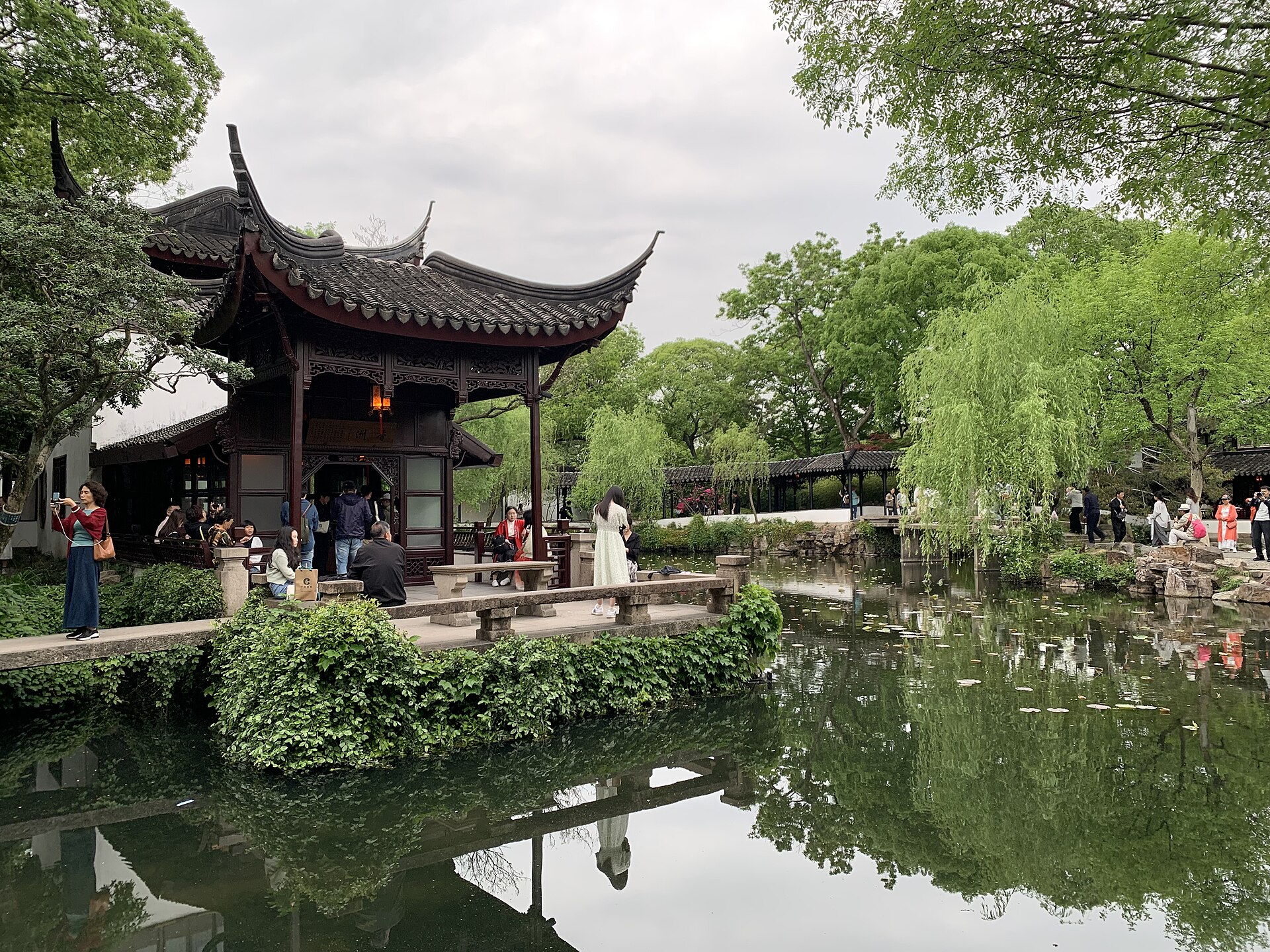
Humble Administrator's Garden, Suzhou — a dark curved-roof pavilion mirrored in a still lotus pond, willows along the water, visitors in hanfu 1
Humble Administrator's Garden (拙政园)
UNESCO World Heritage · Suzhou's largest, most famous garden

Picture this: you pass through a small doorway and the world inside opens onto a wide pond full of lotus, small pavilions ringing the water, every window framing a different view. The Humble Administrator's Garden — "the garden of the modest official" — was built in 1509 under the Ming dynasty and is the largest classical garden in Suzhou (around five hectares), considered the model water garden of China. Its most loved trick is "borrowed scenery": the Beisi Pagoda standing outside the wall is composed so it appears to belong inside the garden. It gets very busy by mid-morning, so arrive at opening for the best atmosphere.

Metro: Beisita (北寺塔, Line 4) or Lindun Road (Line 1), ~10-min walk
Ticket: ¥80 high / ¥70 low season (~฿400/350) · open 07:30–17:30
Tip: Go early · pair it with Lion Grove + Suzhou Museum next door
Read the full Humble Administrator's Garden guide →
🪨2
Lingering Garden (留园)
One of China's four great classical gardens · UNESCO

If the Humble Administrator's Garden is about water, the Lingering Garden is about space and architecture — it's counted among the four greatest classical gardens in China. What makes it special is the long winding covered corridor that leads you through view after view, squeezing and releasing the sense of space all the way through, and a giant Taihu rock named the Cloud-Capped Peak (冠云峰) — about 6.5 metres tall and regarded as the finest Taihu rock in Suzhou. It's quieter than the Humble Administrator's Garden, perfect if you want to take your time. It sits on the northwest edge of the old town, near Tiger Hill.

Location: Northwest edge of the old town · bus/taxi · near Tiger Hill
Ticket: ¥55 high / ¥45 low season (~฿275/225)
Tip: Pair with Tiger Hill in one day · quieter than the big garden
Read the full Lingering Garden guide →
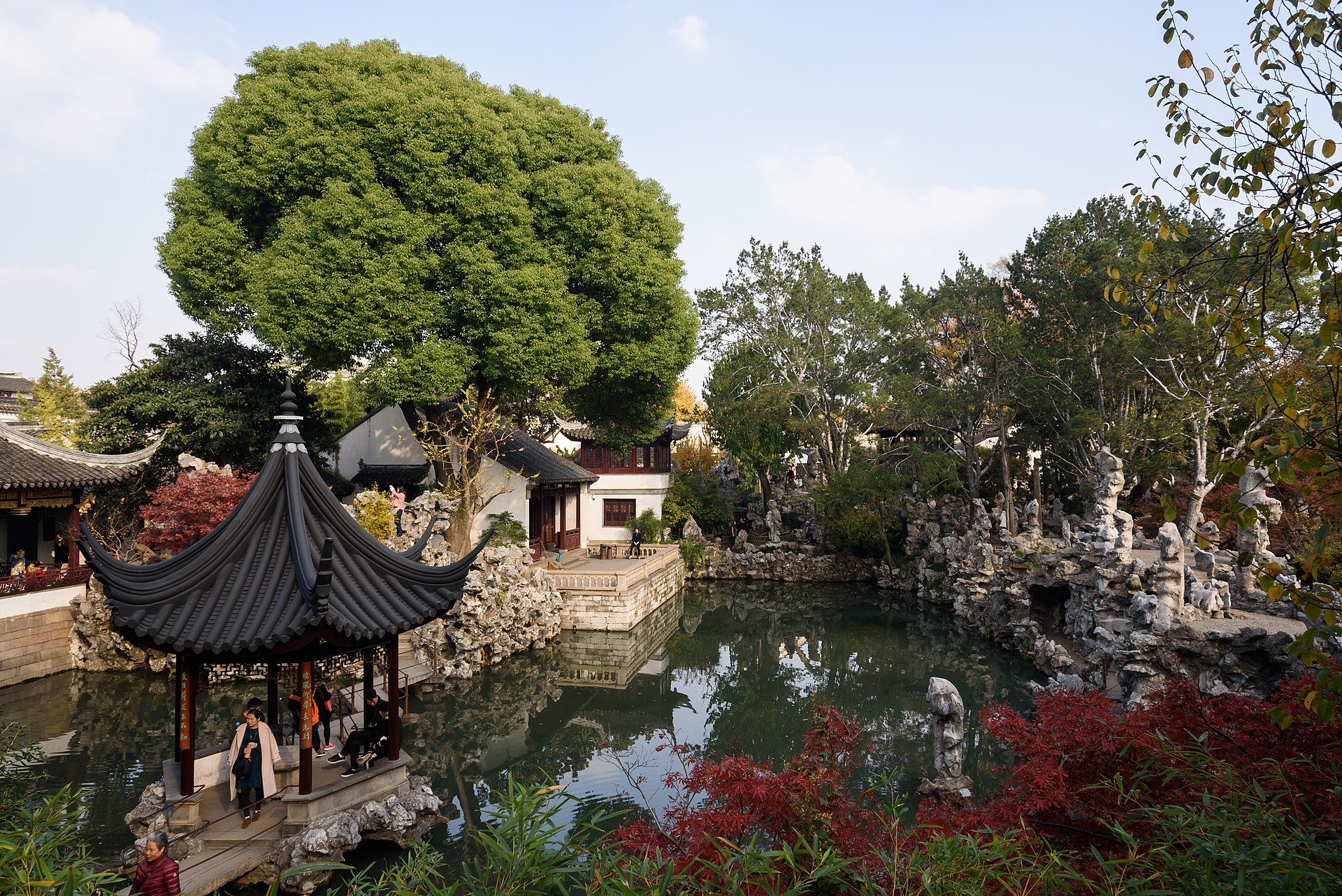
Lion Grove Garden, Suzhou — a black-roofed pavilion beside a pond, a large rounded tree, and a maze of stacked Taihu rockery on the right 3
Lion Grove Garden (狮子林)
Yuan-era (1342) · a labyrinth of Taihu rockery

Ever seen a garden where children disappear into the rocks? That's the Lion Grove. Built in 1342 under the Yuan dynasty, its highlight isn't the pond but an enormous bank of Taihu rockery stacked into a labyrinth — with caves, tunnels and gaps you can actually crawl through. Many of the stones resemble lions, which gives the garden its name. Kids love it because they can climb and burrow; adults enjoy finding their way out. It's right next to the Humble Administrator's Garden and an easy walk away, making the two a natural pairing for one morning.

Metro: Lindun Road (Line 1) or Beisita (Line 4) · beside the big garden
Ticket: ¥40 high / ¥30 low season (~฿200/150)
Tip: Great with kids · you really can climb and crawl the caves
Read the full Lion Grove Garden guide →
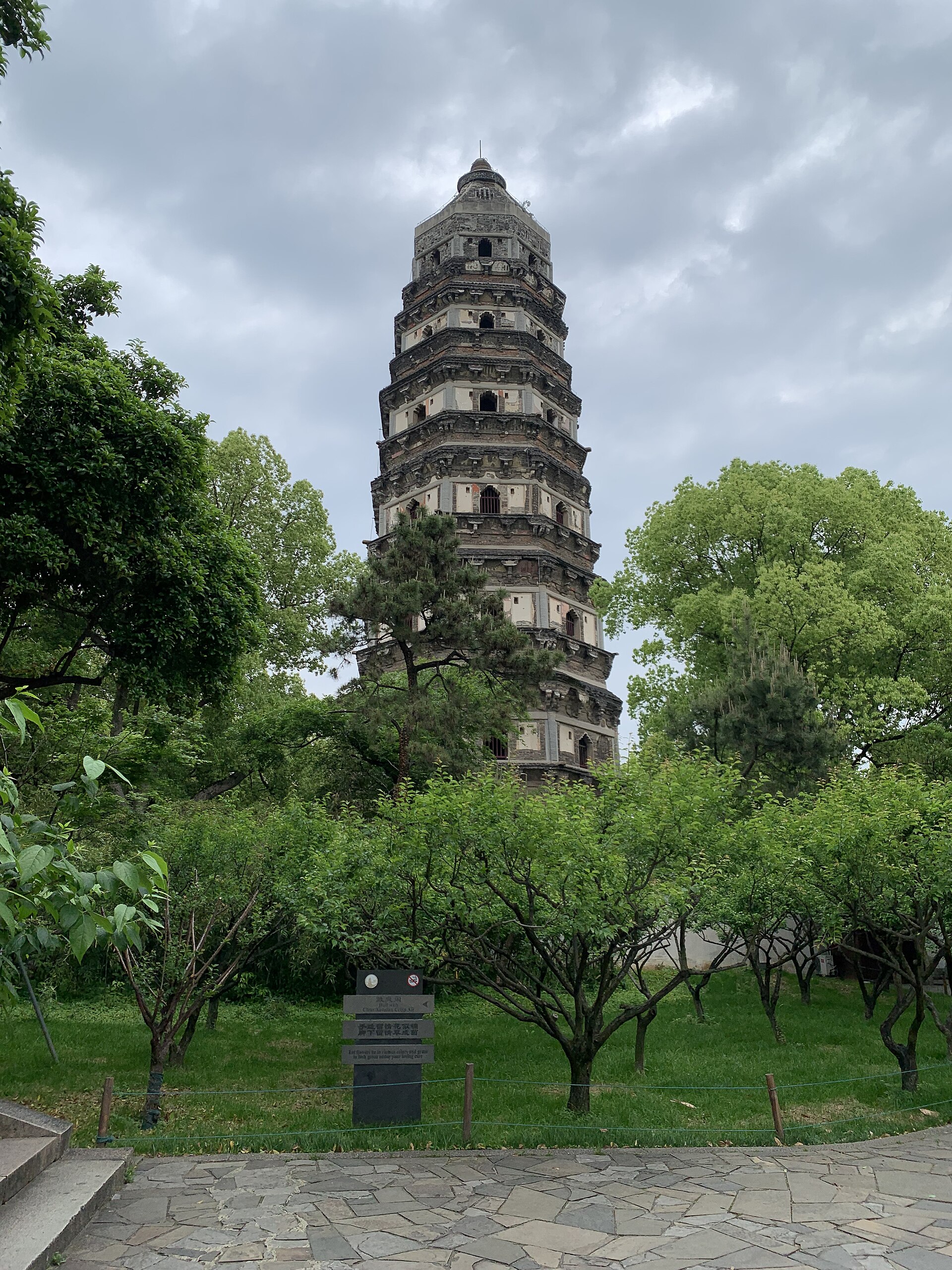
Tiger Hill, Suzhou — the old brick octagonal Yunyan Pagoda leaning slightly, standing on a green wooded hill under an overcast sky 4
Tiger Hill (虎丘)
A thousand-year leaning pagoda · "the first scenic spot in Wu"

The poet Su Shi wrote that "to visit Suzhou without seeing Tiger Hill is a great pity" — and the reason stands right on the summit. The Yunyan Pagoda (云岩寺塔), built around 961 AD in the Five Dynasties period, is an octagonal brick tower that has slowly tilted over a thousand years, earning it the nickname "the Leaning Tower of China" (it leans roughly 3 metres off its axis). Below it lie the tomb of King Helü of the state of Wu and the Sword Pool (剑池), where legend says swords are buried beneath the water. The walk up through rock gardens and old pavilions takes about 1.5–2 hours, and the spring flower fair makes it especially pretty.

Location: Northwest edge of the city · bus/taxi from the metro
Ticket: ¥80 (Apr–Oct) / ¥60 (Nov–Mar) (~฿400/300)
Tip: Go early · pair it with the nearby Lingering Garden
Read the full Tiger Hill guide →
🎭5
Master-of-Nets Garden (网师园)
Small, perfect · evening Kunqu opera

The Master-of-Nets Garden — "the garden of the fisherman" — is the lesson in "small but complete." It's the smallest of Suzhou's leading classical gardens, yet so tightly composed that it's treated as the textbook standard for Chinese garden design; every element — pond, pavilion, rock, path — is proportioned so precisely that designers come from around the world to study it. The real highlight is the evening (Apr–Oct), when the garden opens its Night Garden with Kunqu opera (昆曲), guqin music and Pingtan (Suzhou storytelling) performed in pavilions throughout — an atmosphere hard to find anywhere else. We cover how to pick and book in the Suzhou gardens guide.

Metro: Southern old town · near Line 4 · short walk/taxi
Ticket: Day ¥40/¥30 · Night Garden (with performances) ~¥100 (~฿500)
Night Garden: Apr–Oct, roughly 19:30–22:00 · book ahead
Pick the right Suzhou gardens →
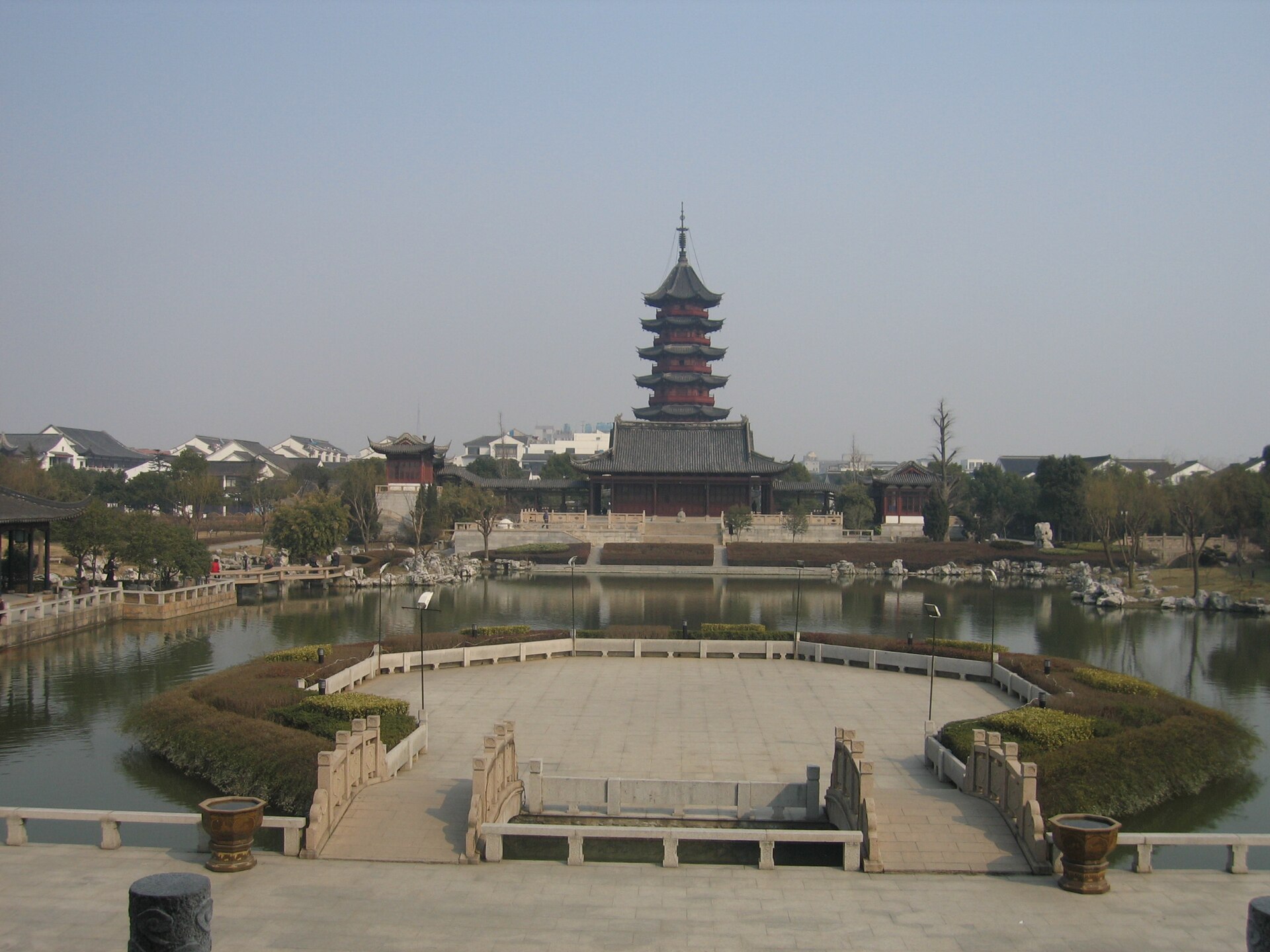
Panmen, Suzhou — the red-brick multi-tier Ruiguang Pagoda rising behind a pond, with a stone terrace and arched stone bridges around it 6
Panmen (盘门)
The only surviving land-and-water city gate · Ruiguang Pagoda

Few people realise Suzhou has been ringed by canals for some 2,500 years, and Panmen is the only combined land-and-water city gate still standing in China — boats entered the city by water, people on foot came in by land. You can walk the ancient walls, the gate fortifications and the moat. In the same scenic area stand the old red-brick Ruiguang Pagoda (瑞光塔) and the tall arched Wumen Bridge (吴门桥), which is beautiful for photos. The classic shot is the "three views of Panmen" in one frame — the water gate, the pagoda and the bridge together. This corner is noticeably calmer and less crowded than the famous gardens.

Location: Southwest corner of the old town · bus/taxi
Ticket: ~¥40 (~฿200) · evening garden lighting in some seasons
Tip: Quieter than the big gardens · the water-gate + pagoda + bridge shot
See the full Suzhou guide →
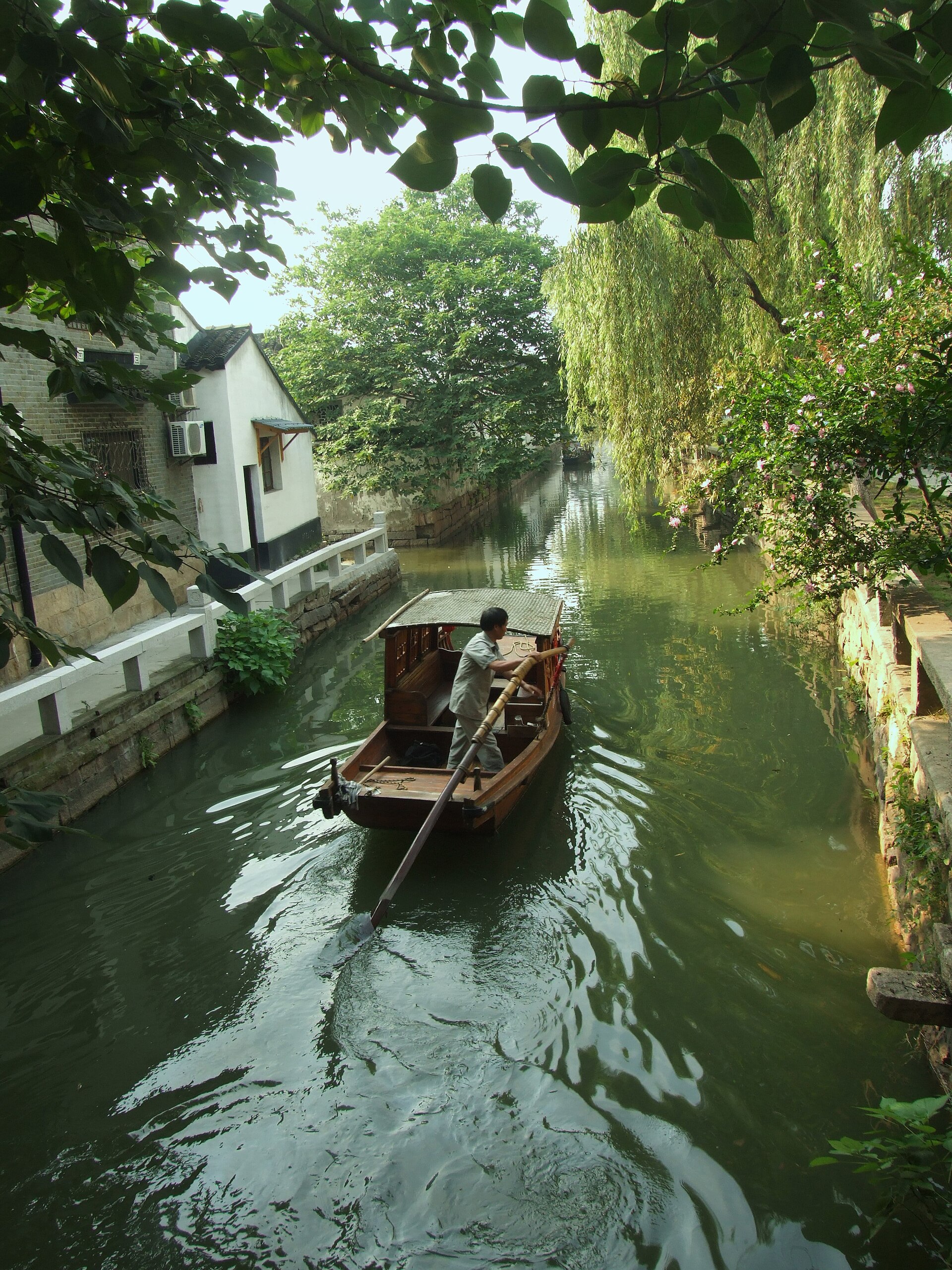
Pingjiang Road, Suzhou — a man poling a small wooden boat along a narrow shaded canal, white houses on the bank, willows leaning over the water 7
Pingjiang Road & Shantang Street (平江路 · 山塘街)
Old-town canal streets · timber houses, rowing boats, local food

Honestly, if you want to understand what a "Jiangnan water town" actually looks like, walk these two streets. Pingjiang Road (平江路) is the best-restored Song-era canal street in Suzhou — about 1.6 km of white timber houses lining the water, with cafés and craft shops hidden in the side lanes. Shantang Street (山塘街), to the northwest, is longer and older, red lanterns hanging along both banks of the canal, and especially lovely at night. Both are free to walk, you can take a rowing boat through the canal, and they're some of the best places in the city to eat local. We break the food down in our Pingjiang–Shantang street-food guide.

Metro: Pingjiang near Lindun Road (Line 1) · Shantang near Shantang Street (Line 2)
Open: Free all day · busiest and prettiest after dark
Boat: Canal boat ride ~¥80–120 (~฿400–600)
What to eat on Pingjiang & Shantang →
🔔8
Hanshan Temple (寒山寺)
The temple of a thousand-year poem · the New Year's bell

Hanshan Temple — "Cold Mountain Temple" — is a temple the Chinese know from a poem more than from the building itself. Zhang Ji's Tang-dynasty poem "Mooring at Night by Maple Bridge" (枫桥夜泊) describes the temple's bell carrying across the water late at night — a poem schoolchildren across China recite by heart. The temple sits on a canal just outside the old western wall, with a bell tower, the Maple Bridge (枫桥) of the poem, and the Puming Pagoda. Every New Year's Eve, a ceremony rings the bell 108 times to packed crowds. It's a small temple, around an hour, and easy to fold in on the way to the Lingering Garden or Tiger Hill.

Location: On a canal outside the western wall · bus/taxi
Ticket: ¥20 (Apr–Oct) / ¥15 (Nov–Mar) (~฿100/75)
Highlight: The 108-strike bell ceremony on New Year's Eve · ~1 hour
See the full Suzhou guide →
🏛️9
Suzhou Museum (苏州博物馆)
Designed by I.M. Pei · free entry (reservation required)

If the classical gardens are Suzhou's past, the Suzhou Museum is Suzhou looking forward — designed by I.M. Pei (Ieoh Ming Pei), the Chinese-American architect behind the Louvre glass pyramid, whose own family roots are right here in Suzhou. He set crisp white-and-grey modern geometry in conversation with the gabled roofs and white walls of Jiangnan, and pulled it off seamlessly. The rear rock garden, composed to read like a Chinese ink painting, is the most-photographed scene. Inside are antiquities, jade and Suzhou silk. The building sits right beside the Humble Administrator's Garden and Lion Grove, so it's an easy add-on. Free, but you must reserve a slot in advance.

Metro: Beside the big garden · Beisita (Line 4) / Lindun Road (Line 1)
Ticket: Free · reserve online 7 days ahead (slots fill fast)
Open: Tue–Sun 09:00–17:00 (last entry 16:00) · closed Monday
See the full Suzhou guide →
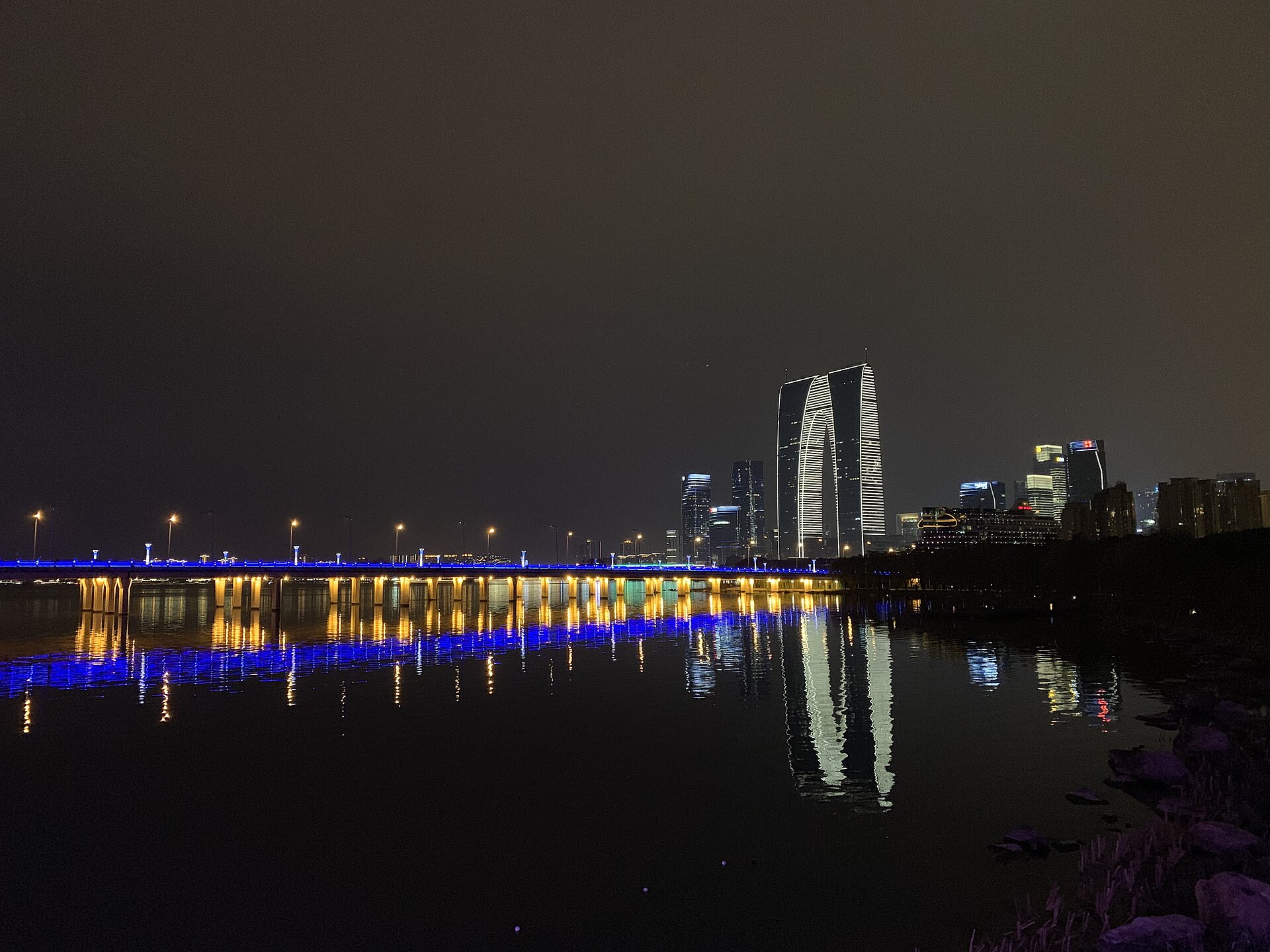
Jinji Lake, Suzhou at night — the glowing arch-shaped Gate of the Orient tower, skyscrapers and a blue-lit bridge reflected in the lake 10
Jinji Lake (金鸡湖)
Modern Suzhou · the SIP district · the Gate of the Orient

Cross from the old town heading east for just half an hour and the mood flips from ancient canals to glass skyscrapers around a lake. Jinji Lake is the heart of the Suzhou Industrial Park (SIP), developed jointly with Singapore. The landmark is the "Gate of the Orient" (东方之门), a 300-metre arched twin tower locals nickname "the big trousers" — at its best at night when the whole district lights up and reflects in the water. The lakeshore has a walking-and-cycling promenade, the Ferris Wheel Park, big malls and a cultural theatre. Come in the evening to stroll, eat and watch the lights — a different side of Suzhou from the old gardens.

Metro: Dongfangzhimen (东方之门, Line 1), right under the Gate of the Orient
Ticket: Lakeshore free · rides/boat trips charged separately
Best time: Dusk to night, once the whole district lights up
See the full Suzhou guide →
Tip: Suzhou is also the launchpad for the Jiangnan "water towns" — all doable as day trips. Zhouzhuang (周庄) is the most famous, Tongli (同里) is quieter with a lovely garden, and Mudu (木渎) is the closest to the city. We break down how to choose and get there in the Suzhou water towns guide →

Plan your visit

How to fit it all in

Most Suzhou sights cluster in the old town (Gusu), reachable on Lines 1 and 4; Jinji Lake sits across in the SIP district.

Old-town gardens (north)
Day 1 morning · Metro Lines 1/4

The Humble Administrator's Garden + Lion Grove + Suzhou Museum all sit together in the northeast corner of the old town, an easy walk apart — one morning does the lot. Get off at Beisita (Line 4) or Lindun Road (Line 1), and arrive at opening to beat the crowds. Don't forget to reserve the museum slot ahead of time.

Time needed: Half a day · Metro: Line 4 Beisita / Line 1 Lindun Rd
Old-town canals
Day 1 afternoon–evening · Metro Lines 1/2

Pingjiang Road is close to the northern gardens, so you can walk straight down in the afternoon — eat local, take a canal boat, then drift over to Shantang Street as its red lanterns come on at dusk. Panmen sits in the southwest corner; if you have time, break it off into another half-day.

Time needed: Half to full day · Metro: Line 1 Lindun Rd / Line 2 Shantang St
Northwest city edge
Day 2 morning · transfer to bus/taxi

Tiger Hill + Lingering Garden + Hanshan Temple lie along the northwest-to-west edge, reached by bus or taxi from the metro. Start at Tiger Hill in the morning (the walk up takes about 1.5–2 hours), then continue to the Lingering Garden and Hanshan Temple, which aren't far apart.

Time needed: Full day · Note: Transfer to bus/taxi from the metro
SIP + day trips
Jinji Lake · Jiangnan water towns

Jinji Lake is over east in the SIP district — take Line 1 to Dongfangzhimen, best in the evening for the lights. The surrounding water towns — Tongli, Zhouzhuang, Mudu — are all easy day-return trips. See how to choose in the Suzhou water towns guide →

Time needed: Half a day to one day · Tip: Day 2–3 if time allows
Frequently asked

FAQ · before you head out

How many days do you need in Suzhou?
Two days cover the main highlights. Day one: walk the old-town gardens — the Humble Administrator's Garden (拙政园) early before the crowds, then the Lion Grove (狮子林) right next door, then the I.M. Pei Suzhou Museum (free, immediately beside them); spend the afternoon and evening on Pingjiang Road by the canal. Day two: Tiger Hill (虎丘) and its leaning pagoda in the morning, then the Lingering Garden (留园) or Panmen (盘门) in the afternoon. With three days or more, add a water-town day trip → or catch the evening Kunqu opera at the Master-of-Nets Garden.
How many Suzhou gardens are enough, and which should you visit first?
Nine of Suzhou's classical gardens share a single UNESCO World Heritage inscription, but you don't need to walk all nine — garden fatigue is real. Two or three contrasting gardens give you the full picture. If you pick just one set: the Humble Administrator's Garden, the largest and most famous water garden, plus the Lion Grove, famed for its rockery maze (they're next door, walkable), plus the Lingering Garden, known for its winding corridors and Taihu rocks. The Master-of-Nets Garden is small but perfect and best at night for its Kunqu opera. See our Suzhou gardens guide → for how to pick.
How much are tickets for the Humble Administrator's Garden and the main gardens, and do you book ahead?
Suzhou garden tickets are priced by high/low season (high Apr–Oct, low Nov–Mar): Humble Administrator's Garden ¥80/¥70 (~฿400/350); Tiger Hill ¥80/¥60; Lingering Garden and Master-of-Nets Garden ¥55/¥45; Lion Grove ¥40/¥30; Panmen ¥40; Hanshan Temple ¥20/¥15. Popular gardens like the Humble Administrator's get extremely crowded over public holidays, so buy tickets ahead via Trip.com/Klook or the in-app mini-programs, and go early to beat the crowds. Prices can change — check again before you go.
Is the Suzhou Museum really free, and do you need to book?
The Suzhou Museum (苏州博物馆), designed by architect I.M. Pei, is free to enter — but you must reserve a slot online in advance. The booking system opens exactly seven days ahead (08:00 China Standard Time) and slots fill very quickly, especially on weekends. It's open Tuesday–Sunday, 09:00–17:00 (last entry 16:00), closed Monday except on national holidays. The building sits right beside the Humble Administrator's Garden and Lion Grove, so you can combine all three in half a day.
Which water towns near Suzhou are worth it, and how do you get there?
Several Jiangnan water towns around Suzhou make easy day trips: Zhouzhuang (周庄) is the most famous and the busiest; Tongli (同里) is quieter and has the Tuisi Garden; Mudu (木渎) is the closest to the city with free old streets; Luzhi (甪直) is small and compact. Most are reached by bus or metro plus taxi, and some charge entry of around ¥80–100 (~฿400–500). You can take a boat through the canals. See our Suzhou water towns guide → for directions and how to choose.
Is the metro convenient for getting around Suzhou?
Suzhou Rail Transit (Lines 1–5) covers the main sights well, at around ¥2–8 per ride. The old town (Gusu) runs mainly on Lines 1 and 4 — the Humble Administrator's Garden, Lion Grove and museum are near Lindun Road (Line 1) or Beisita (Line 4); Pingjiang Road is near Lindun Road. Jinji Lake in the SIP district is on Line 1 (Dongfangzhimen station). Tiger Hill and the Lingering Garden sit on the northwest edge, so you transfer to a bus or taxi from the metro. Use Alipay or WeChat Pay to scan straight through the gates — see our China payment guide →
Klook · Suzhou tours

Suzhou garden tickets & tours — book ahead and skip the gate queue

Tickets for the Humble Administrator's Garden and Tiger Hill, Pingjiang canal boat rides, and Tongli–Zhouzhuang water-town tours — book on Klook ahead of time, especially over the holidays when the big gardens get packed.

See Suzhou tours on Klook →
Wherebest is a Klook affiliate partner — we may earn a commission when you book through our links, at no extra cost to you.