Su Shi, the great Song-dynasty poet, wrote that "to visit Suzhou without seeing Tiger Hill is a great pity." On this low hill stands a brick pagoda that has been leaning for nearly a thousand years, above a sword-filled pool, a king's tomb, and the white-tiger legend that gave the whole hill its name.
Picture the walk: you climb a stone path from the foot of the hill, past an emerald pool said to hide an ancient king's swords, across a broad flat rock where legend says a monk once preached until the stones nodded in agreement. Then you look up, and there it is — a grey-brown brick pagoda on the summit, clearly tilting to one side. It has leaned like that for almost a thousand years and still has not fallen. This is Tiger Hill (虎丘 Huqiu), which the people of Suzhou proudly call "the first scenic spot in Wu (吴中第一名胜)".
The name comes from a legend. When King Helü (阖闾) of the ancient state of Wu died around 2,500 years ago, he was buried beneath this hill — and three days later, the story goes, a white tiger appeared to sit guard on the summit. People have called it Tiger Hill ever since. Beneath the hill lies the Sword Pool (剑池), believed to seal three thousand precious swords inside the king's tomb. No one has dared excavate it to this day, so the mystery still holds.
But what makes Tiger Hill known worldwide is the Yunyan Pagoda (云岩寺塔) on its summit — a seven-storey octagonal brick tower about 47.7 metres tall, completed in 961 AD at the turn from the Five Dynasties to the Song. Over the centuries, the ground settled unevenly beneath it, cracking two support columns and tilting the tower towards the north-east. The top now sits about 2.3 metres off the central axis — a lean of roughly 3 degrees, plainly visible to the naked eye. The Chinese call it "the Leaning Tower of China", and it was finished more than a century before the Leaning Tower of Pisa in Italy.
Climb slowly from the base to the summit — each stop carries its own legend.
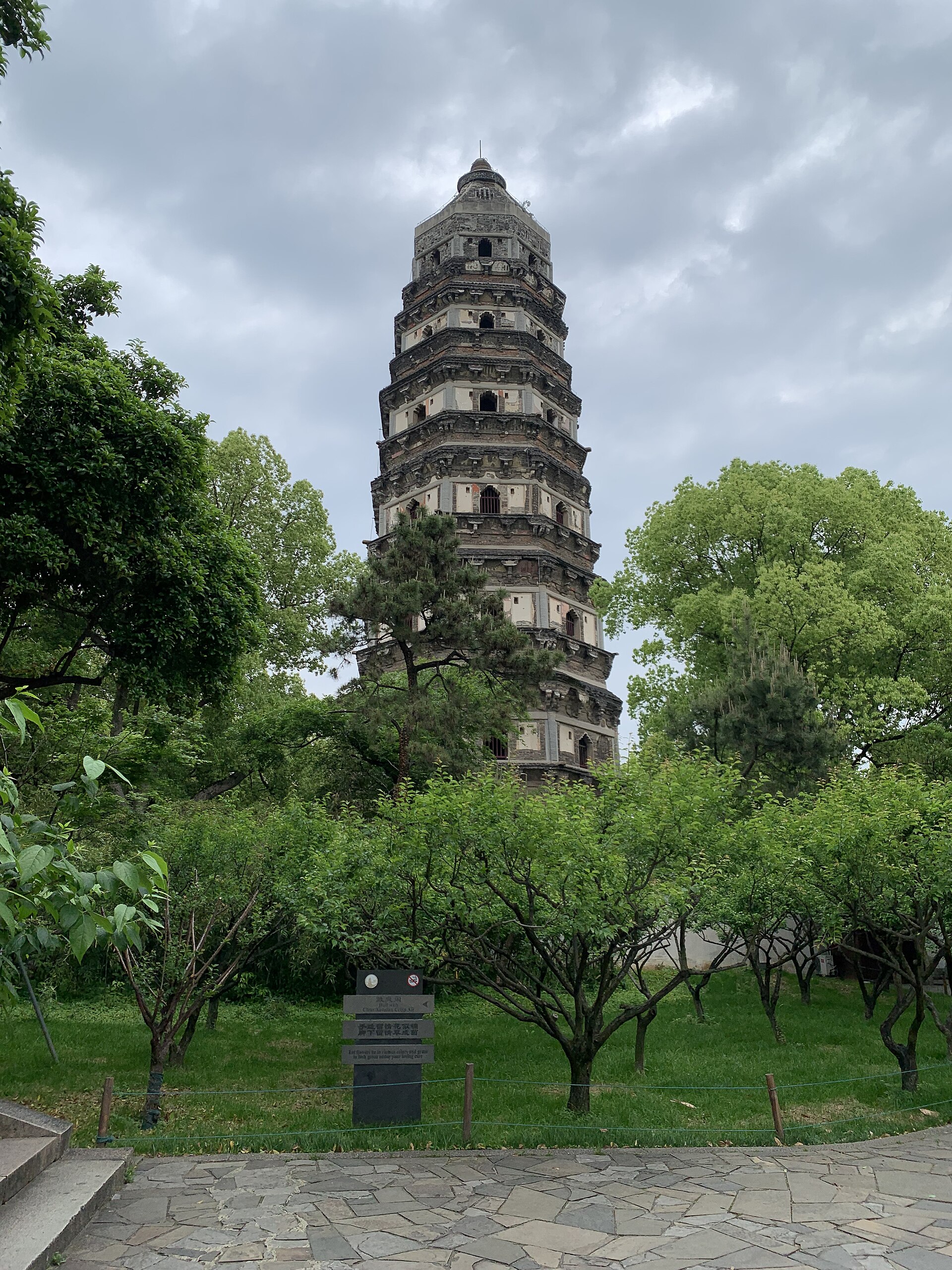
1
This octagonal brick tower stands about 47.7 metres tall and was completed in 961 AD, making it the oldest and largest surviving pagoda in the Jiangnan region. Centuries of uneven settling cracked two of its support columns and tilted it north-east, leaving the top about 2.3 metres off the central axis — enough that the lean is obvious from the ground. It is the hill's signature view. To protect the structure, only the exterior is open; you can no longer climb inside.
A short way up from the base, the rock splits into a narrow gorge, and below it lies a pool of still, deep-green water — calm enough to be unnerving. Legend says the entrance to King Helü's tomb lies beneath this pool, buried with three thousand precious swords. The rock walls on either side are carved with inscriptions by scholars across many dynasties, including calligraphy attributed to Wang Xizhi, the most revered brush-master in Chinese history. The pool was once partly drained during the Ming dynasty, then left alone — so it keeps its secret to this day.
Before you reach the Sword Pool, you cross a wide expanse of reddish, almost polished stone. Its name, "Thousand-Men Rock", comes from a legend that the monk Zhu Daosheng once preached here so persuasively that even the stones nodded in agreement, and a thousand people gathered to listen. A darker version of the tale says the reddish tint is the blood of a thousand craftsmen executed after they finished the king's tomb, to keep its location secret. Believe whichever you like — either way, this terrace is where people stop to take photos and rest before the final climb.
Helü was a king of the state of Wu during the Spring and Autumn period, the ruler who made Suzhou a powerful city-state. When he died, he was buried beneath this hill with his treasures and prized swords — and three days later, the legend goes, a white tiger came to sit on the summit, giving the hill its name. The tomb itself has never been opened. What you see is the hill, the gorge and the Sword Pool that act as a gateway to the legend, which is why every step here seems to carry a story underneath it.
Tiger Hill is more than a hill and a pagoda. Around the slopes spread Jiangnan-style gardens shaded by old pines, with lotus ponds and waterside pavilions. There is a bonsai garden displaying dwarf trees grown over decades, and every spring the hill hosts its Tiger Hill Flower Fair, when blooms of every kind are arranged across the grounds. Autumn brings its own colour as the leaves turn. Spend a little time in the lower gardens after you come down from the summit and you start to see why people in Suzhou come back here in every season.
Everything you actually need to know, in one place.
Tiger Hill sits on the north-western edge of the old town, a little beyond the historic centre. You can reach it by metro, by bus or by taxi:
The Suzhou metro has a Huqiu station near Tiger Hill. Get off, follow the signs for about 600 metres and you reach the entrance gate. This is the most convenient and budget-friendly approach if you are staying in the city.
Several bus routes pass Tiger Hill. Get off at the Huqiu stop or Huqiu Beimen (North Gate). Bus 32 and the Tiger Hill tourist line drop you close to the entrance — handy if your hotel is not near a metro station.
If you are travelling as a group or would rather not change vehicles, a taxi from the old town or the railway station takes about 10–15 minutes and is inexpensive. Booking through the DiDi app gives a similar price.
A full half-day comes together nicely: Tiger Hill first thing (7.30–10 am) while it is quiet → walk down to Shantang Street (山塘街), the historic canal street that runs to the foot of the hill, for snacks and lunch → finish at the Lingering Garden in the afternoon. Pagoda, canal and classical garden, all in one day.
Tiger Hill sits to the north-west, a little outside the historic centre. Staying in the old town puts the metro and a short taxi ride within easy reach. Here are the hotels we have reviewed across the city: