Home Suzhou China Suzhou Hotels About
Home  ›  China  ›  Suzhou  ›  Food Guide
Suzhou Food Guide · 2026

What to eat in Suzhou
11 dishes before you leave

The city of canals and classical gardens has the most delicate kitchen in all of Jiangnan. A mandarin fish scored, fried until it fans out like a squirrel's tail and sizzles under a sweet-sour glaze; tiny river shrimp tossed with Biluochun tea leaves; a noodle bowl that takes a hundred peeled shrimp; and the roe-rich Yangcheng Lake hairy crab in autumn. This kitchen isn't spicy — it's refined, gently sweet and ruled by the seasons.

Photo: Pingjiang Road (平江路), Suzhou's old canal street
Why eat here

The most delicate kitchen in all of Jiangnan

If the picture of Chinese food in your head is a slick of red Sichuan chilli oil, Suzhou will rearrange it entirely. Suzhou cooking — what locals call Su bang cai (苏帮菜), a pillar of the broader Jiangsu cuisine (苏菜), one of China's eight great culinary traditions — barely uses chilli at all. The heart of it is gently sweet flavour, light seasoning and seasonal freshness (时令): mandarin fish, tiny river shrimp, hairy crab, lotus root and the water vegetables of the Taihu region. The cooking leans on slow braising, steaming and quick high-heat stir-frying, and above all on knife work so precise it borders on art — a single squirrel fish is scored into thousands of fine squares before it ever hits the oil.

Suzhou is a canal city more than 2,500 years old, a place of classical gardens and high craft — and the taste and wealth of its old elite left behind a precise, elegant kitchen. Several of its legendary dishes carry stories tied to emperors and to restaurants that have run continuously for centuries. We picked 11 dishes and bites that tell the city's full story — from the classics in the famous houses on Guanqian Street to the noodle bowls locals eat every morning, the canal-side snacks, and the seasonal hairy crab the whole country waits for.

The essential dishes

11 things to eat before you leave Suzhou

Ranked by how unmistakably Suzhou they are — dishes you won't find done quite like this anywhere else.
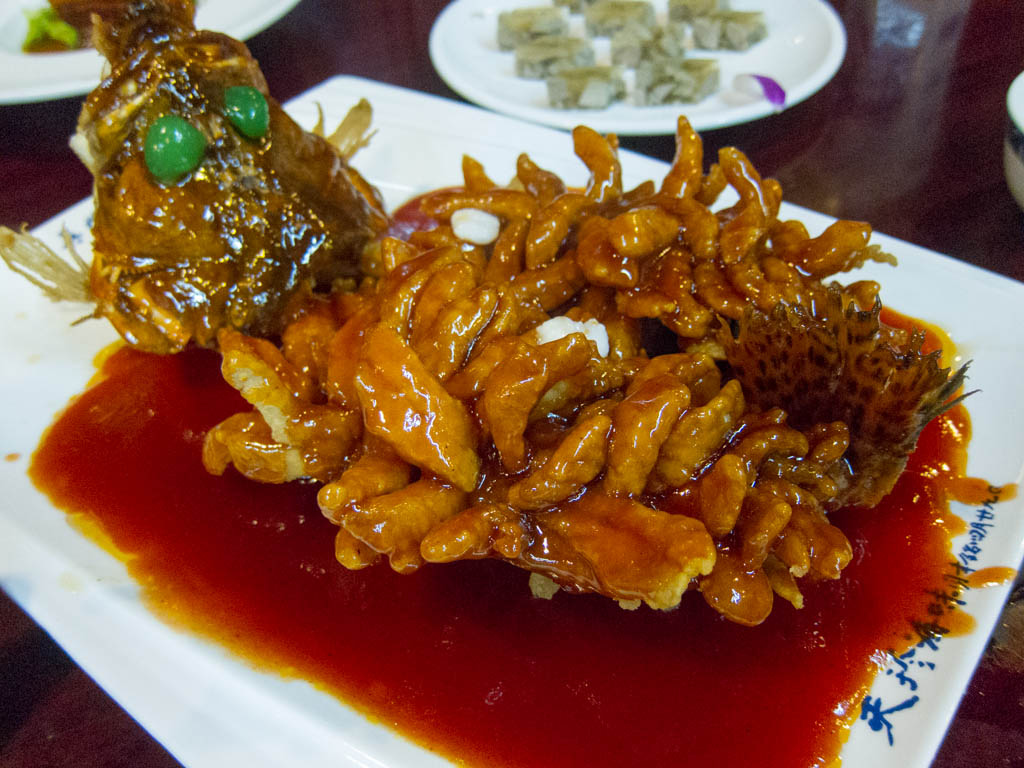
Suzhou squirrel mandarin fish — a whole fish scored into fans, deep-fried crisp and curling like a squirrel's tail under a glossy red sweet-sour glaze on a white plate 1
Squirrel Mandarin Fish (松鼠鳜鱼)
Crisp-fried mandarin fish in a sweet-sour glaze

Suzhou's signature dish, and a piece of knife work that stops you mid-conversation. A mandarin fish is deboned, scored into a tight crosshatch, then battered and fried so every fan of flesh curls open like a squirrel's bushy tail. It comes whole, head up and tail raised, drenched tableside in a bright-red sweet-sour tomato glaze poured on hot so the fish gives a faint squeak. The flesh inside stays tender while the surface crackles. The original house is Songhelou (松鹤楼), open since 1737, where a legend says the Qianlong Emperor tasted it and gave it its name.

Where: Songhelou (松鹤楼 · Guanqian area · the original) · Deyuelou (得月楼) · Wumen Renjia (吴门人家)
Price: ¥88–168 (฿440–840) / fish
Tip: Eat it while the glaze is still bubbling, to keep the surface crisp
Read the full squirrel-fish story →
🍲2
Sizzling Eel (响油鳝糊)
Stir-fried eel finished with hot oil tableside

Slivers of paddy eel are stir-fried with soy, sugar and rice wine into a thick, glossy dark-brown sauce, mounded on a plate with a well pressed in the middle and a scatter of minced garlic and white pepper. Then scorching-hot oil is poured into that well right at the table — it hits the garlic with a loud "shaa!" and a cloud of fragrance rises. The dish's name, xiang you (响油), literally means "the oil that speaks." It's deep and balanced, savoury-sweet, the eel soft and silky — a classic that is both fine cooking and a little tableside theatre.

Where: Wumen Renjia (吴门人家) · Deyuelou (得月楼) · classic Suzhou restaurants
Price: ¥58–98 (฿290–490) / plate
Tip: Order it hungry — it's best mopped up with hot white rice
🥩3
Cherry & Braised Pork (樱桃肉 / 酱方)
Pork belly braised to a glossy red

Suzhou loves braised pork as much as any city. Cherry pork (樱桃肉) is pork belly cut into cubes and braised in soy, sugar and red yeast rice until it turns a bright cherry red and melts as you chew. Jiangfang (酱方) is a big square block of belly braised whole until the skin turns to glossy jelly and the meat is tender enough to cut with chopsticks. Both are gently sweet and savoury in the Jiangnan style — eat them with a steamed bun or rice to catch the sauce and cut the richness. They're banquet dishes that turn up at the important meals.

Where: Songhelou (松鹤楼) · Wumen Renjia (吴门人家) · older Suzhou houses
Price: ¥58–128 (฿290–640) / plate
Tip: Order a stir-fried green alongside to balance the sweetness
🍯4
Honey-Glazed Ham (蜜汁火方)
Jinhua ham steamed sweet, eaten with buns

This dish turns something salty into something sweet, and does it beautifully. A square block of Jinhua ham (金华火腿) is scored into strips and steamed repeatedly with rock sugar, sweet wine and lotus seeds or longan until the meat softens. The fierce saltiness is drawn out and replaced by a fragrant sweetness; the ham ends up tender and springy, glossy and red with syrup. It's served with thin steamed pancakes so you can wrap a strip of ham like Peking duck. It's a dish that shows both the refinement and the playfulness of the Jiangnan kitchen.

Where: Songhelou (松鹤楼) · Deyuelou (得月楼) · upscale Suzhou restaurants
Price: ¥98–198 (฿490–990) / plate
Tip: Usually shared by a group · wrap it in the steamed pancakes
🦐5
Biluochun Tea Shrimp (碧螺虾仁)
River shrimp stir-fried with green tea leaves

The dish that weds two of Suzhou's signatures. Tiny river shrimp from Taihu Lake are coated in egg white and a whisper of starch, velveted in oil until plump and translucent, then stir-fried briefly with fresh Biluochun (碧螺春) green tea leaves and a splash of the freshly brewed tea. The result is clean and faintly sweet, the shrimp snappy, the green tea drifting up in a gentle perfume. It's a cousin of Hangzhou's Longjing shrimp, but made with Suzhou's own signature tea, and it's at its best in spring when the year's first leaves are picked.

Where: Deyuelou (得月楼) · Songhelou (松鹤楼) · good Suzhou restaurants
Price: ¥88–158 (฿440–790) / plate
Season: Best in spring (the new Biluochun harvest)
🍜6
Three-Shrimp Noodles (三虾面)
Summer's luxury bowl

Locals call this the "Hermès of noodles." The "three shrimp" are three parts of the river shrimp — the meat (虾仁), the roe (虾籽) and the rich tomalley from the head (虾脑) — each peeled out by hand, more than a hundred shrimp for a single bowl. The meat is springy, the roe briny-fragrant, the tomalley creamy and deep, all tossed with thin noodles in a light sauce. It's strictly a seasonal dish, available only in early summer (roughly May to July). It costs several times a normal bowl, purely for the labour — and Suzhou locals wait all year for it.

Where: Tongdexing (同得兴) · Zhu Hongxing (朱鸿兴) · old Suzhou noodle houses
Price: ¥80–160 (฿400–800) / bowl
Season: Early summer only (May–July)
Read the full Suzhou noodle story →
🥢7
Aozao Noodles (奥灶面)
Red-broth eel-and-duck noodles from Kunshan

If three-shrimp noodles is Suzhou in its formal clothes, aozao mian is the bowl people in Suzhou and Kunshan eat every morning. It comes from Kunshan (昆山), next door to Suzhou — a "red broth" (红汤) simmered from eel bones and duck until it's deep and richly sweet, ladled over thin springy noodles and topped with crisp-fried eel or braised duck leg. Locals are particular about kuan tang / jin tang (宽汤/紧汤) — more broth or less — and how hot the bowl is, all ordered to taste. It's a warm, simple, deeply satisfying way to start the day.

Where: Aozaoguan (奥灶馆 · Kunshan) · noodle houses across Suzhou
Price: ¥18–45 (฿90–230) / bowl
When: All day, but locals eat it for breakfast
Read about Suzhou noodle culture →
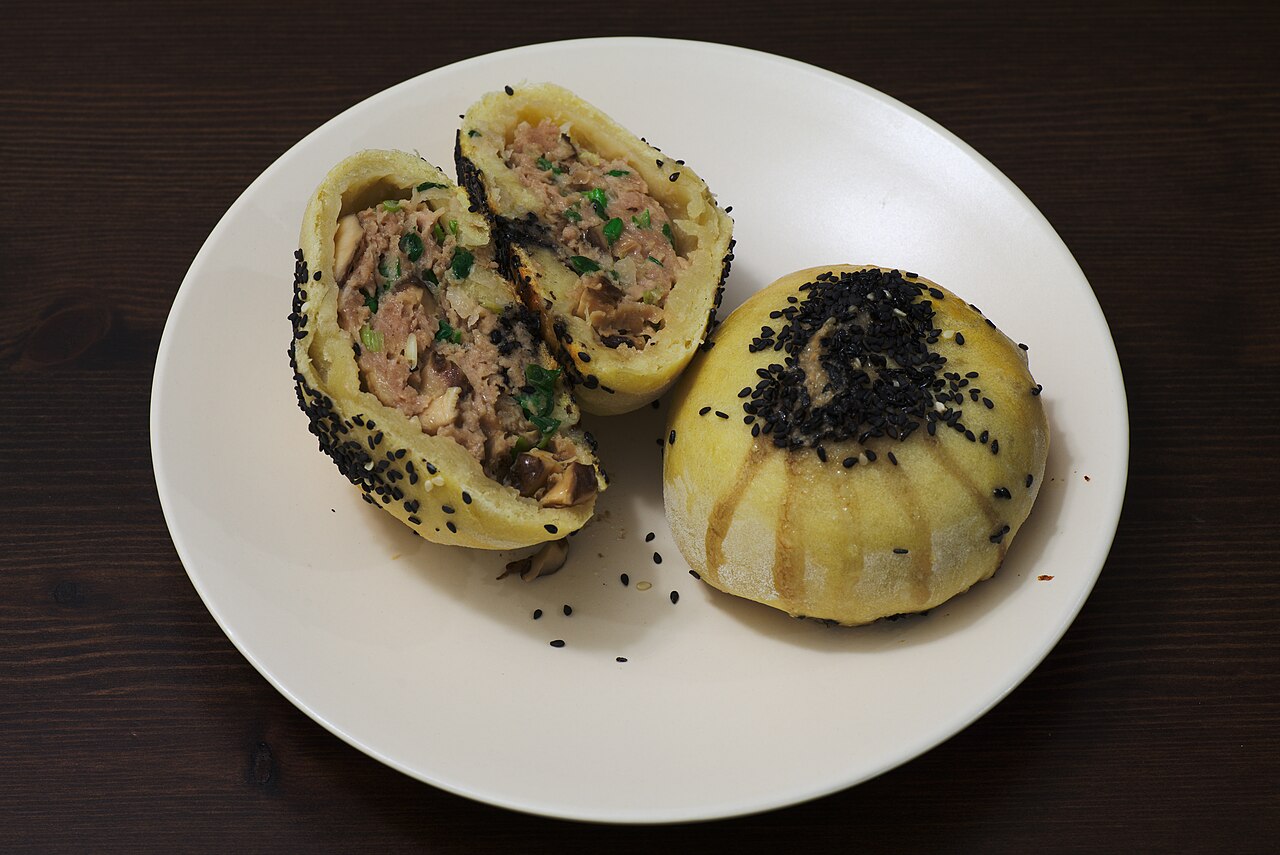
Su-style fresh-pork mooncake — a flaky golden layered pastry topped with black sesame, cut open to show the minced pork and mushroom filling on a white plate 8
Su-Style Mooncake (苏式月饼)
Flaky layered pastry with a fresh-pork filling

The Suzhou mooncake is nothing like the Cantonese kind. Its su pi (酥皮) pastry is built from lard rolled into thin sheets and layered until it bakes up crisp and shattering, like a French puff. The star is the savoury fresh-pork version (鲜肉月饼), packed with a juicy minced-pork filling and eaten hot — the pastry showers down with each bite and the pork is sweet and savoury at once. Locals queue for them fresh in autumn. There are sweet ones too, like rose and pine nut. The legendary pastry house is Daoxiangcun (稻香村), open since 1773; the sweet ones travel home well as gifts.

Where: Daoxiangcun (稻香村 · since 1773) · sweet shops along Guanqian Street
Price: ¥5–15 (฿25–75) / piece
Tip: Eat the pork ones hot · the sweet ones make good gifts
Read about Suzhou's pastries & gifts →
🌸9
Osmanthus Rice Cakes (桂花糕团)
Steamed sweets perfumed in season

Suzhou is a city of steamed rice cakes (糕团), and it treats them as an art. Glutinous and plain rice are steamed into pretty shapes — some with a sweet red-bean centre, some drizzled with syrup and scattered with amber osmanthus (桂花) blossoms that carry a soft, sweet floral scent. Among the favourites are dingsheng cake (定胜糕), a pink ingot-shaped sweet for good luck; meihua cake (梅花糕), shaped like a plum blossom with a filling; and osmanthus sticky-rice cake in autumn. The famous house is Huangtianyuan (黄天源), making Suzhou rice cakes for over a century. They're soft and chewy, lightly sweet, gently fragrant.

Where: Huangtianyuan (黄天源) · rice-cake shops along Guanqian Street · Pingjiang Road
Price: ¥8–25 (฿40–125) / piece or set
Season: Most fragrant during osmanthus bloom, Sept–Oct
Read about Suzhou rice cakes →
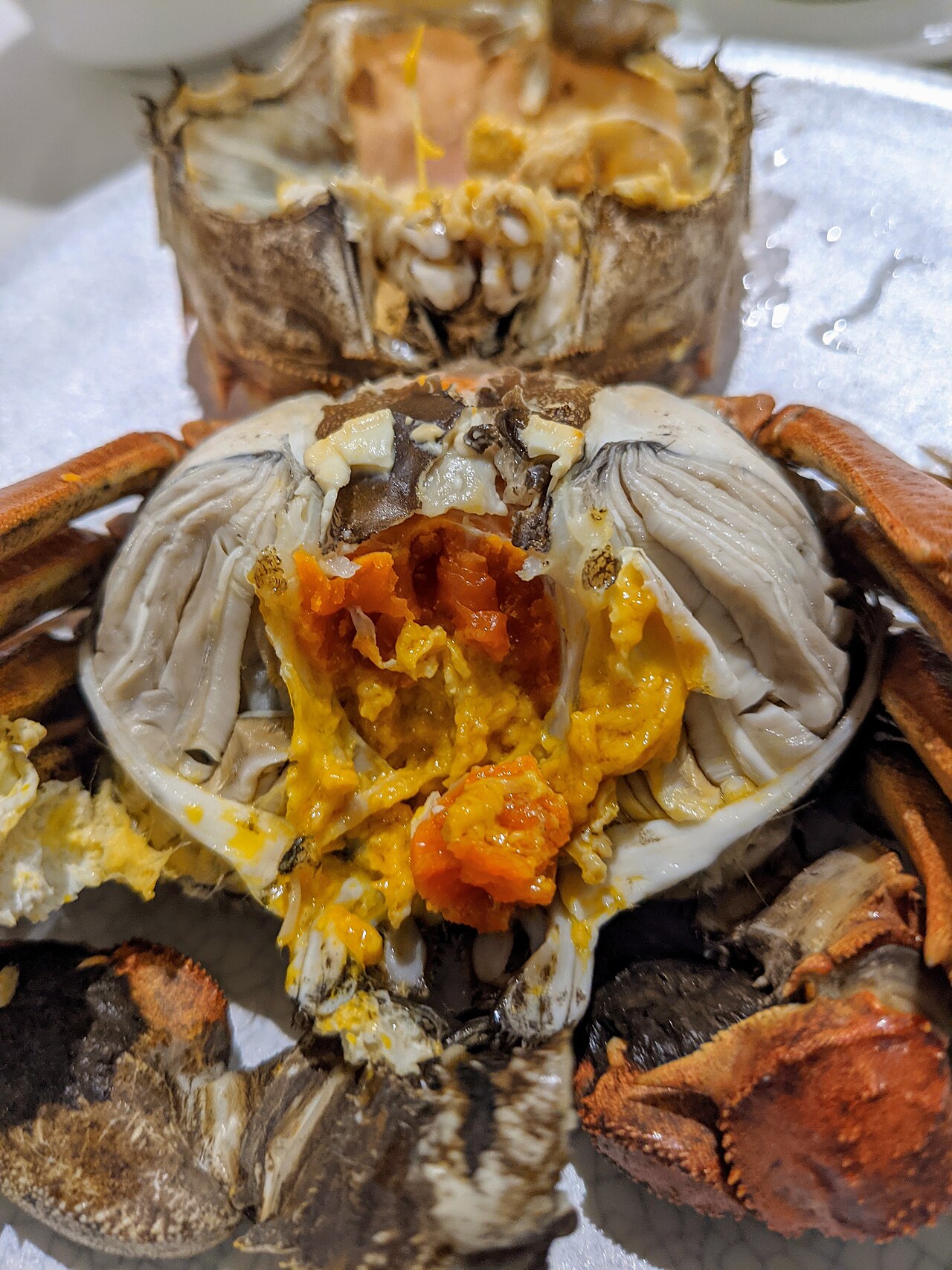
Steamed Yangcheng Lake hairy crab cracked open to reveal the prized bright-orange roe and white meat inside, served on a white plate 10
Yangcheng Lake Hairy Crab (阳澄湖大闸蟹)
The steamed, roe-rich autumn obsession

All of China's autumn craving converges on a small crab with brown fur on its claws — and the hairy crab from Yangcheng Lake (阳澄湖) near Suzhou is reckoned the richest of all. It's steamed whole to keep it at its freshest, dipped in black vinegar with shredded ginger and chased with warm yellow wine. The saying goes "九雌十雄" — in the 9th lunar month eat females for their roe, in the 10th eat males for their creamy fat. Because it's pricey and widely faked, real Yangcheng crab carries an anti-counterfeit ring tag with a code. For the surest thing, eat it at source in the crab villages of Bacheng (巴城). Honestly, it's strictly seasonal and not cheap.

Where: Bacheng crab villages (巴城 · Kunshan) · Suzhou restaurants in crab season
Price: ¥150–400+ (฿750–2,000+) / crab, by size
Season: Mid-Sept to Nov only (none out of season)
Read the full hairy-crab story →
🦆11
Suzhou Marinated Duck (卤鸭 / 母油船鸭)
Tender, aromatic braised duck

Suzhou loves duck as much as pork. Lu ya (卤鸭) is a marinated duck, sliced cold, its tender meat scented with five-spice and a hint of osmanthus — a snack or a side, easy to love. The banquet version is mu you chuan ya (母油船鸭), duck braised in soy and wine until the meat is falling-apart tender and soaked through with deep flavour. The name means "boat duck," because cooks once made it aboard the pleasure boats that plied the canals, serving it to wealthy guests. It's sweet-savoury and balanced in the Jiangnan way — a dish that tells the story of eating on the water in this canal city.

Where: Wumen Renjia (吴门人家) · Songhelou (松鹤楼) · classic Suzhou restaurants
Price: ¥48–98 (฿240–490) / plate
Tip: The cold marinated duck is a good opener for the meal
Eating neighbourhoods

Where to go for what

Suzhou has both legendary old-town houses and canal-side snacks. Know what each area does best before you set out.

Guanqian & Taijianlong
观前街 / 太监弄 · old-town centre · Metro Line 1/4, Lindun Rd

Suzhou's central eating district, where the lane called Taijianlong (太监弄) is known as the "eat street." The legendary houses Songhelou and Deyuelou are here, with the full run of classics — squirrel fish, honey ham, braised pork. Best for a special meal where you want the real thing in the place it was born. Prices are high and it's packed on weekends, so book.

Best for: Classics in the famous houses · Price: ¥120–250/person
Pingjiang Road
平江路 · the oldest canal street

An 800-year-old canal lane, the prettiest in Suzhou, lined with walking snacks — meihua cake, haitang cake, osmanthus lotus root, fresh rice cakes, most of it ¥5–15 a piece. Honestly, the main drag is fairly touristy and pricier than usual; the genuinely good and cheaper food tends to hide in the side lanes. Lovely for strolling and sipping tea in an old teahouse with a Pingtan (评弹) ballad performance.

Best for: Snacks · sweets · canal-side strolling · Hours: Afternoon–evening
Shantang Street
山塘街 · long Tang-dynasty canal lane · near Tiger Hill

A canal lane stretching seven li, laid out by the poet Bai Juyi in the Tang dynasty; at night the red lanterns glow on the water and it's beautiful. The food is similar to Pingjiang but livelier after dark — marinated duck, rice cakes, stinky tofu, sweet rice porridge. Like Pingjiang, the main street leans touristy; for cheaper, better bites duck into the side lanes or the far end of the street.

Best for: Evening walking food · atmosphere · Hours: Late afternoon–evening
Yangcheng Lake & Bacheng
阳澄湖 / 巴城 · Kunshan outskirts · crab season only

In autumn, Suzhou locals drive out to eat crab at the source. Bacheng (巴城), on the shore of Yangcheng Lake, has hundreds of crab restaurants steaming crab fresh from the holding nets, served with ginger-vinegar and warm yellow wine, the wide lake stretching out beyond. A good day trip in September–November only — out of season most places close or have no genuine crab.

Best for: Hairy crab at source · Season: Sept–Nov
Go deeper, dish by dish

Want to know each one more closely?

We've written full features on Suzhou's standout dishes and eating areas — the origins, the legends, how to eat them and where to go.

Frequently asked

FAQ · Before you go eating

What does Suzhou food taste like — is it spicy?
Suzhou cuisine (Su bang cai 苏帮菜, a pillar of the broader Jiangsu cuisine 苏菜) is not spicy at all. It's a refined Jiangnan kitchen — gently sweet, lightly seasoned, and built around seasonal freshness (时令) and lake-and-river produce: mandarin fish, river shrimp, hairy crab and lotus root. Fine knife work is at its heart. If you don't handle chilli well, Suzhou is one of the easiest cities in China to eat in.
How old is Songhelou, and is it worth it?
Songhelou (松鹤楼) has been open since 1737, in the Guanqian Street (观前街) area, and it's the original home of squirrel mandarin fish (松鼠鳜鱼) — the dish a legend says the Qianlong Emperor once ate and named. Expect roughly ¥120–250 (฿600–1,250) per person, more than a typical local restaurant, with big weekend crowds, so book ahead. For a special meal — eating a classic in the house where it was born — it's worth it. For the same dishes for less, try Deyuelou (得月楼) or Wumen Renjia (吴门人家).
How much does a meal cost in Suzhou?
Suzhou works at every budget. A bowl of soup noodles is about ¥15–35 (฿75–175). Most canal-street snacks are ¥5–15 (฿25–75) each. A local restaurant runs about ¥60–100 per person (฿300–500); a legendary house like Songhelou or Deyuelou ¥120–250 per person. Seasonal specials cost more — three-shrimp noodles ¥80–160 (฿400–800) a bowl, and a Yangcheng Lake hairy crab ¥150–400 or more apiece (฿750–2,000), by size and source.
Do Suzhou restaurants accept credit cards?
Street stalls and small shops along Pingjiang Road (平江路) or Shantang Street (山塘街) mostly accept WeChat Pay or Alipay only — some won't take cash or foreign cards at all. Download Alipay before you arrive and link a Visa or Mastercard via its international mode. Mid-range and upscale restaurants such as Songhelou and Deyuelou generally accept foreign credit cards. More in our China payments guide.
When should I eat Yangcheng Lake hairy crab, and how do I know it's real?
Yangcheng Lake hairy crab (阳澄湖大闸蟹) is at its best in autumn, roughly mid-September to November. There's a saying, "九雌十雄" — in the 9th lunar month eat females for their roe, in the 10th eat males for their creamy fat. Because it's pricey and widely faked (crab from other lakes passed off as Yangcheng), genuine crab carries an anti-counterfeit ring tag on a leg with a verification code. To be sure, eat it at source in the crab villages of Bacheng (巴城) in Kunshan. More in our full hairy-crab feature.
What Suzhou food makes a good gift to take home?
Suzhou's most famous edible souvenirs are the dry pastries from Daoxiangcun (稻香村), a pastry house dating to 1773 — flaky mooncakes, black-sesame and nut sweets, and assorted dry treats boxed handsomely for travel. Fresh rice cakes such as osmanthus cake and dingsheng cake come from Huangtianyuan (黄天源) and the sweet shops along Guanqian Street. Genuine Biluochun (碧螺春) green tea from the Dongting hills is a fine gift too — just beware of fakes. More in our Suzhou pastries feature.
Klook · Food Tours

Suzhou Food Tours — eat the right things with someone who knows

Guided food walks with local experts: the classics in the Guanqian houses, the snacks along Pingjiang Road, and Biluochun tea. No language barrier, no guessing which stall is worth the queue.

Browse Suzhou Food Tours on Klook →
Wherebest is an affiliate partner of Klook — we may earn a commission when you book through our links, at no extra cost to you.