Home Suzhou China Suzhou Hotels About
Home  ›  China  ›  Suzhou  ›  Attractions  ›  Humble Administrator's Garden
Suzhou Classical Gardens · UNESCO World Heritage

Humble Administrator's Garden (拙政园)
Suzhou's largest and finest water garden

A Ming-dynasty official began building it in 1509. Over half the ground is water — ponds rimmed by pavilions, crossed by zigzag bridges, filled with lotus in summer, and framed by the distant North Temple Pagoda. This is the masterpiece of the city of gardens.

Why it matters

The garden China treats as the textbook of what a garden is

You walk along a plain white wall in Suzhou's old town, step through a narrow gate, and the world opens. In front of you is a broad sheet of water reflecting a curved-roof pavilion, lotus pads spreading green across the surface, low stone bridges turning sharply from bank to bank. Far beyond the trees, an ancient pagoda rises into view — even though it stands well outside the garden, a kilometre away. That last touch is the trick at the heart of the Humble Administrator's Garden: it pulls a view from beyond its own walls and makes it part of the composition.

The Humble Administrator's Garden (拙政园, Zhuozheng Yuan) was begun around 1509 in the Ming dynasty by Wang Xianchen, a former official who had left the civil service to live simply. The name comes from a line of poetry suggesting that "watering the garden and growing vegetables is the governing of a humble man" — a piece of wry, deliberate self-deprecation. At roughly 5.2 hectares, it is the largest of Suzhou's classical gardens, and widely regarded as one of the most accomplished gardens in all of China.

It forms part of the UNESCO World Heritage inscription "Classical Gardens of Suzhou", which covers nine gardens in total. What sets this one apart is that it is genuinely a water garden — more than half of its area is ponds and channels, and almost every pavilion and walkway is positioned to look out over water. In summer the lotus comes into full bloom across the ponds, a sight Suzhou waits for all year.

What to look for

Five things that repay attention

The garden divides into three parts — east, central and west. The central section is the heart and the most beautiful; walk it slowly and you will catch everything.
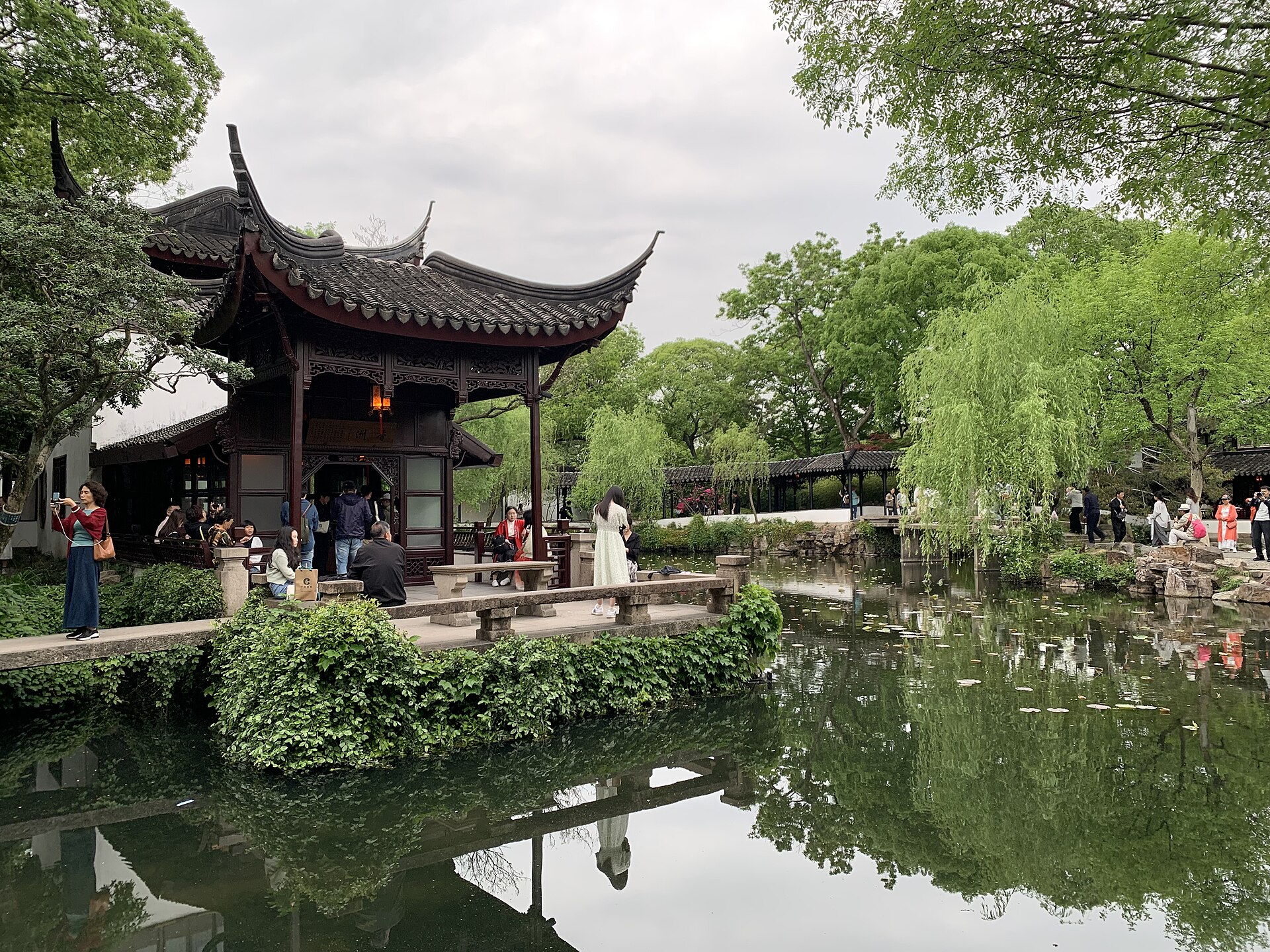
The Hall of Distant Fragrance and a waterside pavilion at the Humble Administrator's Garden, Suzhou — a curved-roof timber pavilion reflected in a pond with willows along the bank 1
Hall of Distant Fragrance (远香堂)
The main waterside hall · the heart of the central garden · named for lotus scent

This central hall is the point where every sightline converges. Built with glazed walls and open doors on all four sides, it lets you sit inside and look out in every direction. Its name, "Distant Fragrance", refers to the scent of lotus drifting in on the summer breeze — a nod to a classical Chinese line that the fragrance of lotus grows purer the further it travels. Stand here early in the morning, before the noise arrives, and you understand why scholars could sit over tea in this one spot for an entire day.

Location: Centre of the central garden, on the main pond
Best time: Early morning — fewer people, soft light reflecting off the water
🗼2
The Borrowed View of the Pagoda (借景)
A pagoda outside the garden, drawn in as backdrop · the advanced art of Chinese gardens

This is the feature that put the garden into design textbooks around the world. Look across the pond to the northwest and you see the North Temple Pagoda (北寺塔, Beisi Ta) rising above the treeline — even though the pagoda stands outside the garden walls, a kilometre away. The technique is called jiejing (借景), "borrowing scenery": the designers arranged trees, pavilions and sightlines so the distant pagoda becomes part of the picture inside the garden, making the enclosed space feel boundless.

Best angle: From the central pond, looking northwest across the water
Tip: On a clear day the pagoda is sharpest — frame pavilion, water and pagoda in one shot
🪷3
The Lotus Ponds & Zigzag Bridges
Water covers half the garden · lotus in full bloom June to August

What separates this garden from a rockery garden like the Lion Grove is water. The ponds connect into winding channels, crossed at intervals by stone and timber bridges, some set so low you seem to be walking on the surface itself. From around June to August the lotus blooms across the ponds — the most beautiful season of the year, and the source of the Hall of Distant Fragrance's name. In autumn the red maples reflected in the water are just as fine, so the garden essentially has two faces, both worth coming for.

Summer (Jun–Aug): Lotus in full bloom — the garden's classic image
Autumn (Nov): Red maples mirrored in the water — a different mood entirely
🪟4
Leak-Windows & Framed Views (漏窗)
How to read a Chinese garden · every window is a deliberately placed frame

The pleasure of a Chinese garden comes from learning to "read" it. Notice the latticed windows cut into the walls — each is called a louchuang (漏窗), a "leak-window", designed to reveal the far side in fragments, like a painting in a frame. Walkways, round "moon gates" and archways are all positioned so that the view changes as you shift position. Look through a moon gate to a pavilion on the other side and you grasp the idea: a Chinese garden is composed exactly like a painting.

How to look: Pause at every leak-window and moon gate and look through
Tip: Step slightly left or right — the framed view changes each time
📜5
The Name Plaques & Poetry
A scholar's garden · every building carries a poetic name describing its mood

The Humble Administrator's Garden is a true literati garden. Every pavilion and kiosk carries a poetic name on a wooden plaque — the "Listening to the Rain Pavilion", built to hear rain falling on lotus and banana leaves, or a kiosk positioned purely to watch the moon reflected in the water. These names are not decoration. They tell you what feeling each spot was built for and what you are meant to stop and do there. Once you read them, walking the garden becomes like turning the pages of a book of poems.
Look for: The Listening to the Rain Pavilion (by the lotus beds) · the moon-viewing kiosk
Tip: Pick up a garden map at the entrance so you know which pavilion is which
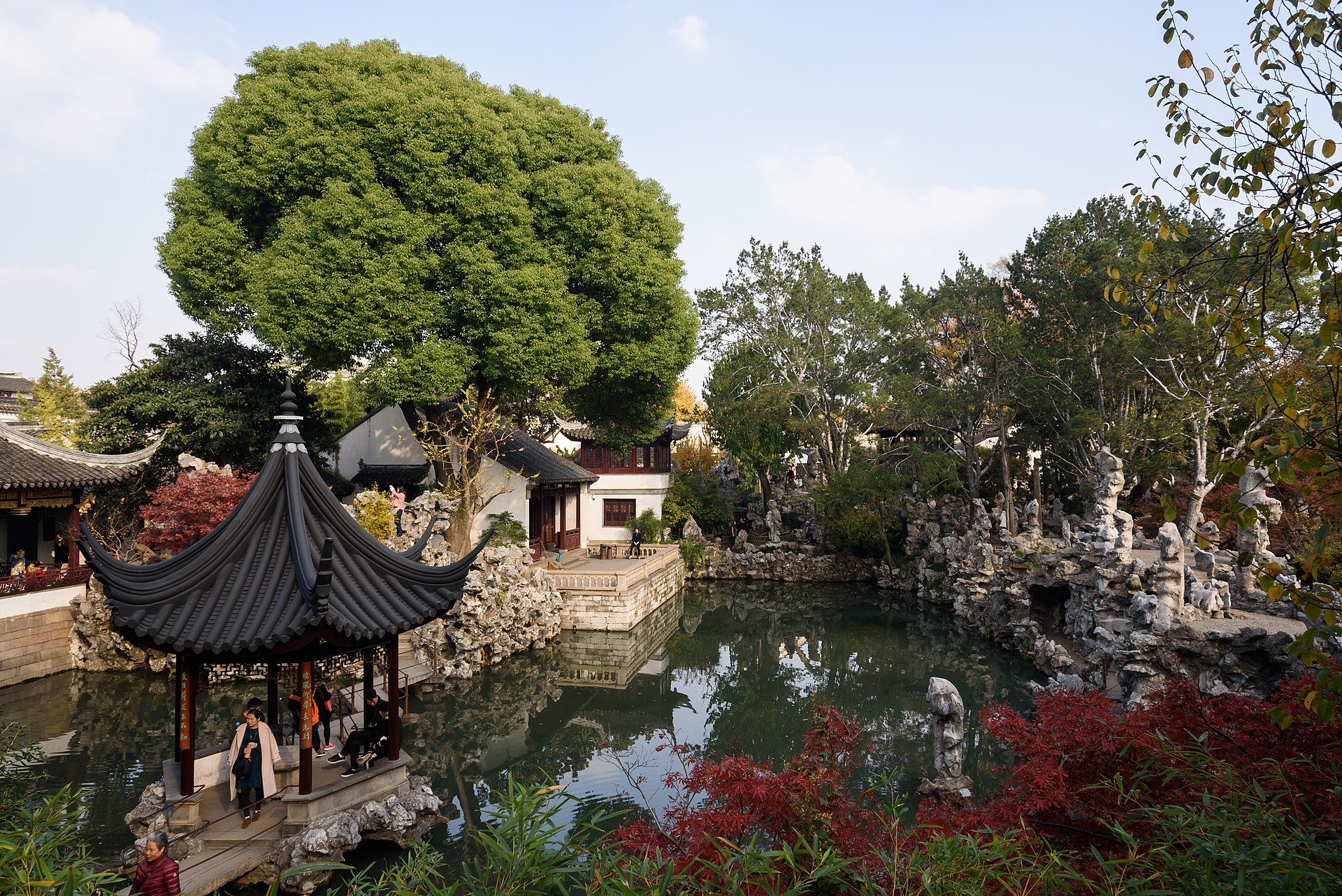
The Lion Grove Garden (狮子林) in Suzhou — a waterside pavilion and Taihu rockery beside a pond, a short walk from the Humble Administrator's Garden
A few minutes' walk from the Humble Administrator's Garden is the Lion Grove (狮子林) — the UNESCO rockery garden that pairs perfectly with it.
Before you go

Tickets, hours and how to get there

Everything you actually need to know, in one place.

Admission
¥70 / ¥50 (~฿350 / ฿250) adults
High season Apr–Oct ¥70 · low season Nov–Mar ¥50 · children and seniors discounted · book ahead on holidays to beat the daily quota
Opening hours
7.30 am–5.30 pm (Mar–Oct)
Nov–Feb closes earlier at 4.30 pm · last entry 30 minutes before closing · open every day with no weekly closing day
Metro
Line 4 — Beisita / Lindun Road station
Alight at 北寺塔 (Beisita) or 临顿路 (Lindun Rd), then walk 5–10 minutes to the garden entrance · in the old town
Time needed
1.5–2 hours
The largest garden in Suzhou at about 5.2 hectares — comfortable across all three sections in two hours. Add time if you walk slowly and read the plaques.
Best time to visit
7.30 am opening, or after 3.30 pm
Mid-morning to early afternoon on weekends is the most crowded, the paths are narrow and photos are hard. Go right at opening or late in the day for a garden you can breathe in.
When to avoid
Weekends · Golden Week
Golden Week (1–7 October) is so packed it is hard to move — the single week to avoid most if you can. Chinese New Year is busy too.
An honest note: The Humble Administrator's Garden is genuinely beautiful, but it is the most crowded garden in Suzhou. Some paths are narrow enough that you walk single file, and on a busy weekend afternoon it can feel more like queuing than strolling. The fix is simple — arrive right at opening and head straight into the central section before everyone else catches up.
Getting there & planning

How to reach it and what to pair it with

The garden sits in the old town (Gusu) in the northeast of the city, easy to reach by metro and naturally combined with the sights right beside it into a half-day:

From Suzhou Railway Station
Metro Line 4 · approx. 15 minutes

If you have come from Shanghai by high-speed rail (about 25–30 minutes), alight at Suzhou Railway Station and take Metro Line 4 to Beisita. A short walk brings you to the garden gate. This is the most convenient approach for a day trip in and out.

Metro fare: ¥2–5 · Total: approx. 20 minutes
Pair with the Lion Grove (狮子林)
5-minute walk · UNESCO rockery garden

The Lion Grove is right beside the Humble Administrator's Garden — almost across the road. It is a Taihu-rock garden children love, full of caves and stone passages you can climb through like a maze. Both are World Heritage gardens and pair perfectly into a single morning.

Walk: ~5 min · See the Lion Grove →
Stop at the Suzhou Museum
3-minute walk · designed by I.M. Pei · free

The Suzhou Museum, designed by the architect I.M. Pei, sits right next to the garden gate. It is a white-and-grey modern building that reinterprets the classical garden in contemporary form. Entry is free but you must reserve a time slot online in advance; it closes on Mondays.

Walk: ~3 min · Entry: free (advance reservation)
Half-day old-town plan
Garden + Lion Grove + museum + Pingjiang Road

Put it all together: the Humble Administrator's Garden (7.30–9.30 am), then the Lion Grove, then the Suzhou Museum, then stroll along Pingjiang Road (平江路) by the old canal for snacks and Biluochun tea — finishing with lunch over the local squirrel mandarin fish.

Total: 4–5 hours · See what to eat in Suzhou →
Where to stay nearby

Hotels close to the classical gardens

Staying in the old town (Gusu) puts you within walking distance of the Humble Administrator's Garden, the Lion Grove and Pingjiang Road. Here are the Suzhou hotels we have compared:

Frequently asked

FAQ · Before you visit

How much does the Humble Administrator's Garden cost?
Admission is seasonal: ¥70 (~฿350) in high season, April to October, and ¥50 (~฿250) in low season, November to March. Children and seniors receive discounts. You can buy at the gate or book online in advance — advance booking is recommended on holidays, when crowds are heavy and the daily ticket quota can sell out.
What are the opening hours?
The garden opens daily from 7.30 am to 5.30 pm from March to October (last entry 5 pm), and 7.30 am to 4.30 pm from November to February (last entry 4 pm). It is open every day with no weekly closing day — unlike Shanghai's Yu Garden, which closes on Mondays.
How do I get there by metro?
Take Suzhou Metro Line 4 to Beisita station (北寺塔) or Lindun Road station (临顿路). From either it is a 5 to 10 minute walk to the garden entrance. The garden is in the old town (Gusu), within easy walking distance of the Lion Grove Garden (狮子林) and the Suzhou Museum. Coming from Shanghai, take the high-speed train to Suzhou and change to Metro Line 4.
What is the best time to visit?
Arrive right at 7.30 am opening, or come after 3.30 pm in the late afternoon, when crowds are thinnest. This is the busiest of all Suzhou's gardens; mid-morning to early afternoon on weekends is heaving and the narrow paths back up. Golden Week (1–7 October) is a genuine crush — avoid it if you can.
How long does it take, and what should I see next?
Allow around 1.5 to 2 hours — it is the largest garden, about 5.2 hectares. The highlights are the central lotus pond, the Hall of Distant Fragrance (远香堂) and the borrowed view of the North Temple Pagoda. Pair it with the neighbouring Lion Grove Garden (狮子林), then the I.M. Pei-designed Suzhou Museum a few minutes away, and finish with a stroll and a meal on Pingjiang Road.
Wherebest · Visiting Suzhou

Plan your whole Suzhou trip in one place

The Humble Administrator's Garden is just the start. Suzhou has more classical gardens, Tiger Hill, old canal streets and a food scene worth the train ride — our full Suzhou city guide has the hotels, prices and transport all in one place.

Open the Suzhou guide →
Ticket prices and opening hours reflect 2026 information and may change with the season and the garden's own announcements — check before you travel.