Home Suzhou Must-Eat Dishes China About
Home  ›  China  ›  Suzhou  ›  Street Food
China · Suzhou Food Guide · 2026

Suzhou Street Food
The Canal Streets, the Lantern-Lit Lanes & the Food Street Locals Actually Eat On

Pingjiang Road and Shantang Street are Suzhou's loveliest canal lanes — white houses mirrored in still water, red lanterns overhead, a real joy to walk. But the main stretches are touristy and pricier. This guide points you to all of it: the two canal streets for snacks and photos, the quiet side lanes across the water, and Taijianlong food street, where Suzhou families sit down to eat.

Before You Go

Where to eat in Suzhou, honestly

Picture this — you've spent the afternoon wandering Suzhou's old town, over arched stone bridges, along narrow canals where wooden boats slip beneath the arches. The light is going soft and your stomach is rumbling. You don't want another air-conditioned restaurant. You want to walk the waterside, catch the smell of a begonia cake on the griddle, point at a glutinous-rice sweet you can't name and just try it. That's exactly what Suzhou's canal streets are for.

First, a bit of context. Suzhou food is Su cuisine (苏帮菜), a branch of Jiangsu cooking — light, faintly sweet, built on lake-and-river produce: freshwater fish, tiny river shrimp, lotus root, bamboo shoots, all by the season. It is not spicy. So the snacks here are gentler and more delicate, fragrant and softly sweet rather than fiery — and locals take more pride in finesse than in heat.

Second, the honest bit. The main stretches of Pingjiang Road (平江路) and Shantang Street (山塘街) are built for tourists — lots of souvenirs, snacks knocked out fast for passers-by, photo-friendly cafes, and prices roughly 1.5–2x higher than elsewhere. This guide walks you through every spot worth your time: Pingjiang Road (photos and a few standout snacks by the canal), Shantang Street (red lanterns in the evening and grab-and-go skewers), and Taijianlong food street (太监弄) near Guanqian Street, a lane of sit-down restaurants where locals have eaten since the 1980s. Want to know which dishes define Suzhou? Read our Suzhou must-eat dishes guide alongside this one.

3 Places to Eat

Walk and eat — one at a time

The two canal streets (Pingjiang Road + Shantang) sit at opposite corners of the old town, while Taijianlong is right in the centre — so split them across the day however suits you.
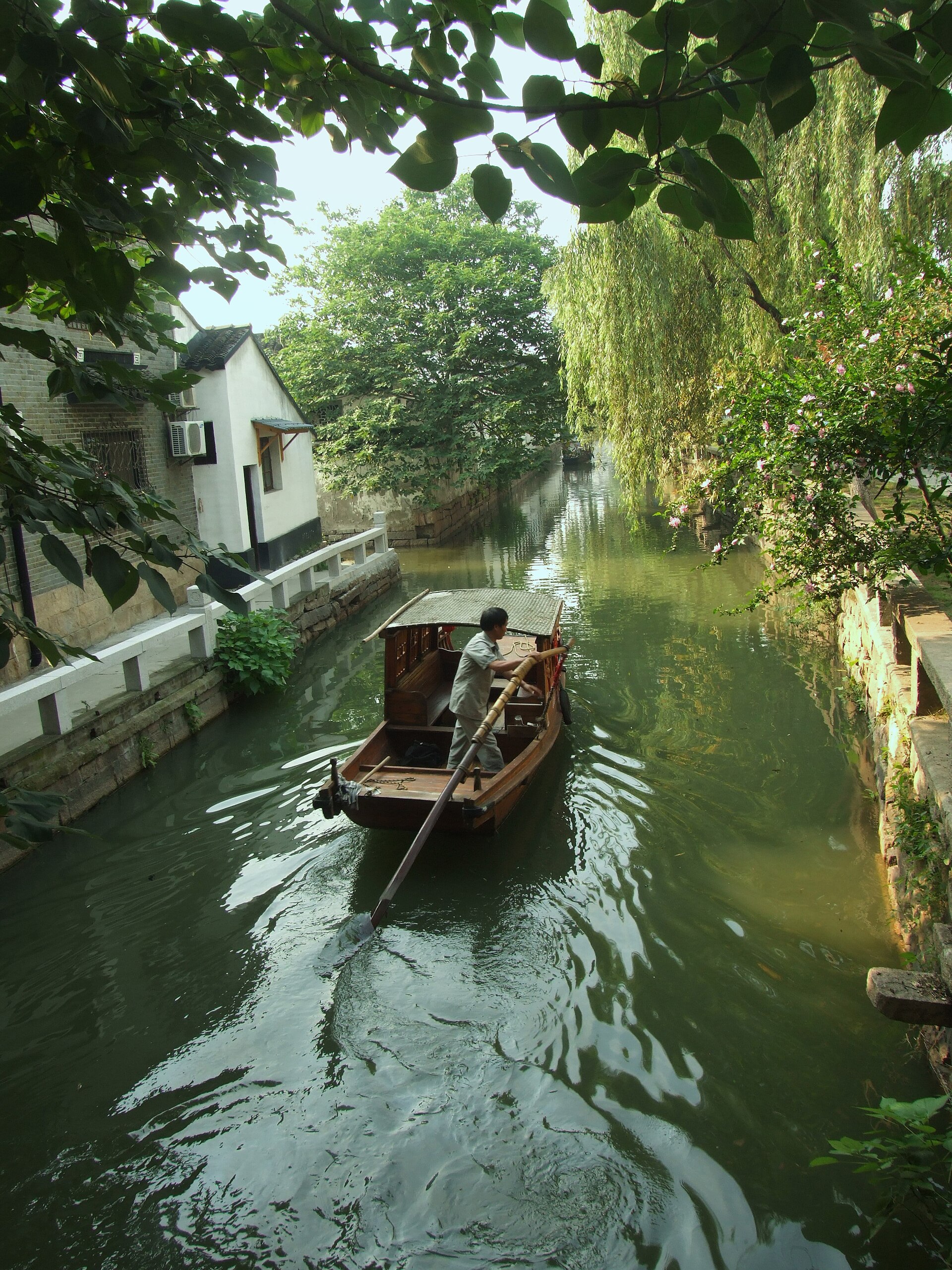
A Pingjiang Road-style old canal lane in Suzhou — a narrow still canal, a small wooden rowing boat, willows along the water, white houses with dark roofs on both sides, a quiet residential mood 1
Touristy — but unmissable
Pingjiang Road
平江路 · eastern old town, Gusu District · Metro Line 1 Xiangmen, then walk

Let's be straight: this is Suzhou's most celebrated canal street, running about 1.6 km along the 800-year-old Pingjiang Canal. One side is a stone street lined with shops; the other is a row of white waterside houses, with arched stone bridges crossing at intervals. It's beautiful to walk day or night — but the main street leans into cafes, souvenir shops and snacks made for visitors.

What's worth tasting along this canal (pick the stalls with a queue): 海棠糕 haitang gao — a batter cake griddled in a begonia-flower mould, filled with red bean and finished with a crisp caramel top · 梅花糕 meihua gao — a sweet, plum-blossom-shaped cake with red-bean or fruit filling, scattered with sugar and dried fruit · 糖粥 sugar porridge — silky glutinous-rice porridge with red bean and osmanthus sugar, an old city sweet sold from small carts by elderly vendors · plus little cups of Jiangnan-style desserts you can eat as you stroll the waterside.
Metro: Line 1 Xiangmen, ~10 min walk / lines through the centre
Price: ¥5–30 / item (฿25–150) · ¥50–100 to graze full
Best time: afternoon–evening 3–9 pm — lanterns lit after dark
Pay with: WeChat Pay / Alipay / cash
Honest warning: the main street is pricey and souvenir-heavy, and many snacks are turned out fast with shallow flavour. The move is to photograph and taste just 2–3 standout items here, then cross a bridge into the small lanes on the far side of the canal (such as Xuanqiao Lane 悬桥巷 or Daru Lane 大儒巷), still real homes and far quieter — or save your appetite for a proper meal on Taijianlong (see #3).
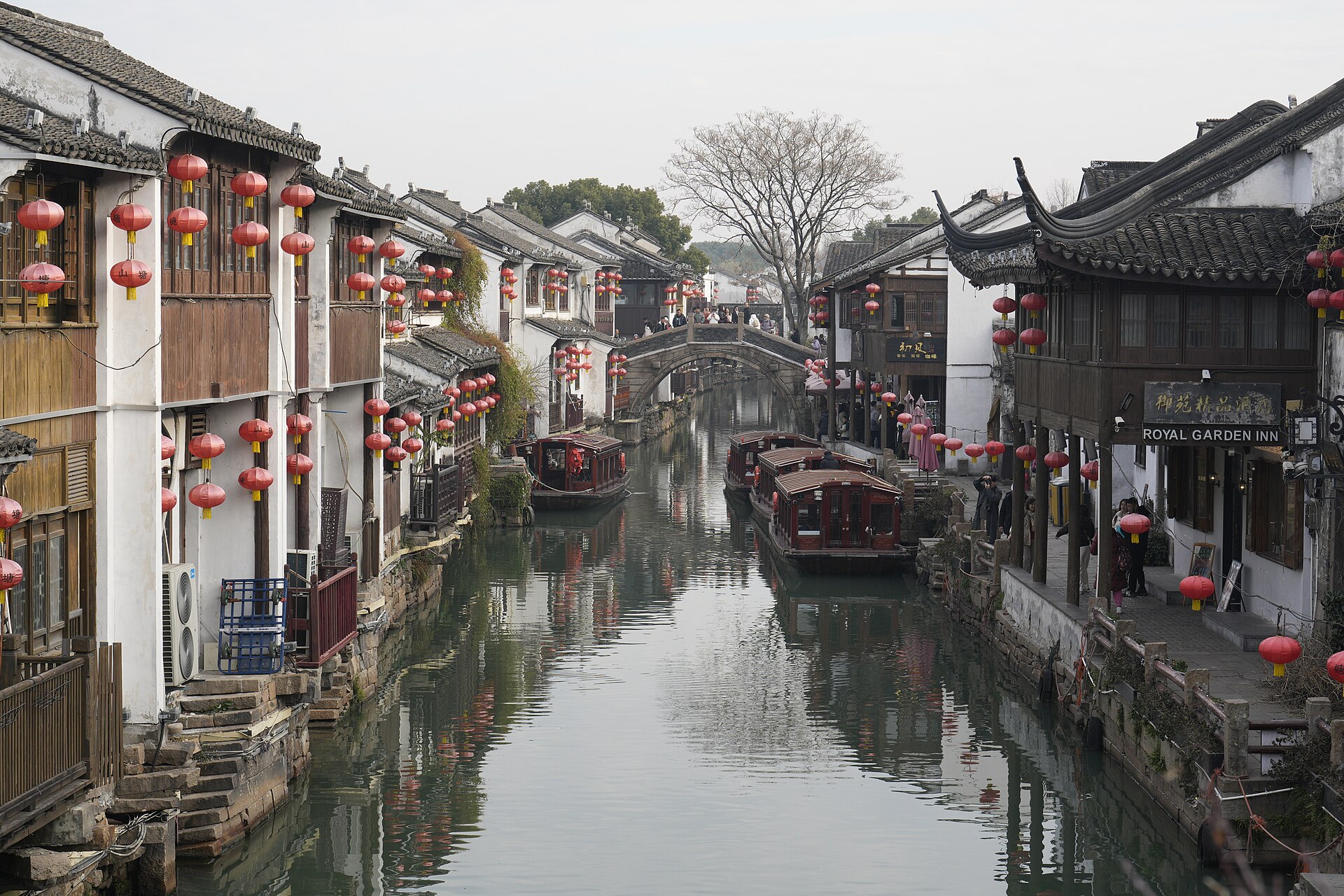
Shantang Street (山塘街) in Suzhou at dusk — a long canal, wooden boats, red lanterns strung along rows of white houses with dark roofs, an arched stone bridge, crowds grazing on both banks 2
Locals + visitors
Shantang Street
山塘街 "Seven-li Shantang" · near Changmen Gate · Metro Line 2 Shantangjie

Shantang is a 3.6 km canal street the locals call "Seven-li Shantang", first built in the Tang dynasty by the poet-governor Bai Juyi. The core old-town block — about 360 metres near Changmen Gate — is the busiest and prettiest stretch, where red lanterns light up at night and reflect the whole length of the canal. It's lovely enough to stop you in your tracks, with craft shops, souvenirs and clusters of food stalls.

What to hunt down: sheng jian bao (生煎包) — pan-fried pork-and-shrimp buns with crisp bottoms, a specialty of the century-old Xin Zhenyuan (新震源) · fried stinky tofu (臭豆腐), pungent but crisp outside and soft within · grilled skewers (烧烤) · jiuniang bing (酒酿饼), a fermented-rice cake fried golden (a springtime treat) · and plenty of roadside sweets along the way.

Metro: Line 2 Shantangjie, exit toward Shantang Street
Price: ¥8–35 / item (฿40–175) · ¥50–100 to graze
Best time: evening 5–9 pm — lanterns at their best
Pay with: WeChat Pay / Alipay / cash (handy at small stalls)
Know before you go: the core stretch of Shantang is beautiful but crowded, and prices climb on holidays — there's real food, but many vendors are tourist-facing brands. Come mainly for the lantern-lit canal at dusk and a few grab-and-go bites. Walk past the main block to the west and you'll reach a quieter section that's still real homes — Suzhou life without the staging.
🥢
3
Where locals eat · best value
Taijianlong Food Street
太监弄 · parallel to Guanqian Street 观前街, central old town · Metro Line 1/4 near Lindun Rd

Here's the card most guidebooks skip. Taijianlong is a short lane running parallel to the Guanqian Street shopping strip (观前街) in the heart of the old town. It was developed into Suzhou's "eat street" in the early 1980s and has been one ever since — a different world from the canal streets. There are almost no souvenir stalls here, just sit-down restaurants, several of them legendary city institutions, where Suzhou families come to eat.

The names and dishes to know: 松鹤楼 Songhelou (founded 1737, at No. 72) — the 250-year-old home of squirrel mandarin fish (松鼠鳜鱼) · 得月楼 Deyuelou, an old Su-cuisine house right beside it · 功德林 Gongdelin, a time-honoured vegetarian restaurant · and nearby on Guanqian are the legendary sweet shops 黄天源 Huangtianyuan (rice cakes, 糕团) and 稻香村 Daoxiangcun (fresh-pork mooncakes and marinated duck to take away). Order a squirrel mandarin fish, or a bowl of Suzhou's clear-broth soup noodles — the flavours that define the city.

Metro: Line 1/4 near Lindun Rd, then walk into Guanqian
Price: ¥40–90 / person (฿200–450) for a sit-down meal
Best time: lunch 11 am–1:30 pm · dinner 5:30–8 pm
Pay with: WeChat Pay / Alipay / cash
Why we steer you here: a ¥60 meal on Taijianlong buys you far better Suzhou cooking than a ¥25 snack on the canal streets — plus a seat, air-con, and home-style dishes you can't get from a tourist stall. The easy plan: photograph the Pingjiang / Shantang canals ↔ taste 2–3 standout snacks ↔ finish with a real meal on Taijianlong.
8 to Hunt Down

Point and eat — the snacks to find

A mix of grab-and-go bites along the Pingjiang / Shantang canals and sit-down dishes on Taijianlong — starting from just ¥5.

🌸
Begonia Cake
海棠糕 · flower-shaped, caramel top

Batter griddled in a begonia-flower mould, filled with red bean and topped with sugar caramelised crisp — fragrant and just sweet enough. A classic grab-and-go on Suzhou's canal streets.

¥5–12 (฿25–60)
🌼
Plum-Blossom Cake
梅花糕 · tapered blossom shape

A sweet cake shaped like a pointed plum blossom, oozing red-bean or sweet-bean filling, scattered with sugar, dried fruit and lotus seeds. Eat it hot off the griddle — it pairs with begonia cake as a sibling.

¥6–15 (฿30–75)
🥣
Sugar Porridge
糖粥 · an old vendor's sweet

Silky glutinous-rice porridge topped with mashed red bean and osmanthus sugar — mellow and gently sweet. Mr Pan Yulin's cart (潘玉麟) near the bird-and-flower market is the most famous; it opens early and sells out fast.

¥8–15 (฿40–75)
🥟
Sheng Jian Bao
生煎包 · pan-fried crisp-bottom buns

Yeasted buns pan-fried until the bottoms are crisp, filled with juicy pork and shrimp and finished with sesame and spring onion — bite carefully, they squirt. Century-old Xin Zhenyuan (新震源) on Shantang is known for them.

¥8–18 (฿40–90)
🪷
Sugar-Osmanthus Lotus Root
桂花糖藕 · local sweet

Lotus root stuffed with glutinous rice and simmered in sugar until chewy, sliced into rounds and drizzled with syrup and osmanthus blossom (桂花) — fragrant and mellow, a sweet tied to Suzhou's canals.

¥10–25 (฿50–125)
🤎
Stinky Tofu
臭豆腐 · crisp outside, soft within

You'll smell it before you see it, but fried until crisp and dipped in sweet chilli sauce, it's far more delicious than its reputation. A favourite all along Shantang and Pingjiang.

¥10–18 (฿50–90)
🫓
Jiuniang Bing
酒酿饼 · springtime fermented-rice cake

Dough leavened with sweet fermented rice (酒酿), filled with red bean, sesame or rose, then fried or griddled until softly sweet and fragrant. A Suzhou springtime treat — easiest to find early in the year.

¥5–12 (฿25–60)
🥧
Radish Cake
萝卜丝饼 · crisp fried, shredded radish

A round fried pastry stuffed with shredded white radish tossed with spring onion and dried shrimp — crisp outside, juicy within, with a whisper of white pepper. Fried fresh at the roadside, just right to eat as you walk.

¥5–10 (฿25–50)
Tips Before You Go

Know this and you won't get lost

📱
Set up WeChat Pay before you leave the hotel
Since 2023, foreign visitors can link a Visa/MC straight to WeChat Pay or Alipay. Do it before you head out — small canal-side stalls often take no cards at all.
🚖
Pingjiang and Shantang are at opposite ends
The two canal streets aren't within walking distance — about 4–5 km apart, a ~15-minute DiDi or taxi ride. Plan them separately: Pingjiang in the afternoon, Shantang in the evening when the lanterns come on.
💰
Save your appetite for Taijianlong
On the canal streets, taste just 2–3 standout snacks — don't fill up, since it's pricier and the flavour is shallow. Keep the hunger for a sit-down meal on Taijianlong, which is far better value.
🌅
Some old-school stalls open early and sell out
Mr Pan Yulin's sugar-porridge cart and a few other heritage snacks open around 5–6 am and sell out fast. If you want the real thing, go in the morning — don't wait for the evening.
🌃
Shantang is best after dark
Shantang's red lanterns reflecting in the canal look their best after 6 pm, while Pingjiang is lovely both afternoon and evening. Do Pingjiang by day and finish at Shantang at dusk — it works perfectly.
🕐
Weekdays beat weekends
Pingjiang and Shantang are packed on weekends and Chinese holidays. Go on a weekday early evening and you'll walk comfortably and get far better photos along the canal.
Frequently Asked

FAQ · what people ask before heading out to eat

How much does a street-food meal in Suzhou cost?
It depends where you eat. On the main stretches of Pingjiang Road and Shantang Street, small snacks run ¥5–30 each (about ฿25–150), or ¥50–100 per person (about ฿250–500) if you graze your way along the canal. Sit-down spots on Taijianlong food street and in the side lanes — where locals actually eat — run ¥40–90 per person (about ฿200–450), and the cooking is far better value than the snacks aimed at tourists on the main drag.
Are Pingjiang Road (平江路) and Shantang Street (山塘街) really touristy and pricey?
Yes. These are Suzhou's two most beautiful canal streets — white houses with dark roofs mirrored in the water, red lanterns strung overhead, lovely to walk and to photograph. But the main stretches lean into souvenirs, tourist-facing snacks and photo-friendly cafes, with prices roughly 1.5–2x higher than elsewhere. The trick is to photograph the main street, then cross a bridge into the small lanes on the far side of the canal (such as Xuanqiao Lane or Daru Lane), or eat properly on Taijianlong food street (太监弄) near Guanqian Street, where Suzhou families sit down to eat.
Do I need cash in Suzhou, or does WeChat Pay work?
Most vendors take WeChat Pay and Alipay first, especially in markets and on food streets. Since 2023, foreign visitors can link a Visa or Mastercard to WeChat Pay or Alipay — set it up and test it before you leave the hotel. Cash (RMB) still works everywhere, but you may need it at small stalls that have no QR terminal.
When is the best time to eat your way around Suzhou's canal streets?
Pingjiang Road and Shantang Street are lovely day and night, but busiest in the evening, roughly 5–9 pm, when the lanterns light up over the water. Some old-school snack stalls — like Mr Pan Yulin's sugar-porridge cart — open very early and sell out fast, so go in the morning for those. Sit-down places on Taijianlong suit both lunch and dinner. To dodge the crush, go on a weekday and avoid the big Chinese holidays (Lunar New Year, and the 1–7 October Golden Week), when the streets are packed.
How do I get to Pingjiang Road and Shantang Street, and are they close together?
Pingjiang Road is in the eastern old town, walkable from Metro Line 1 Xiangmen station or lines that cut through the centre. Shantang Street is in the northwest near Changmen Gate (阊门), with Metro Line 2 Shantangjie right at the door. The two are not within walking distance of each other — they sit at opposite corners of the old town, about 4–5 km apart, roughly a 15-minute taxi or DiDi ride. Plan them as separate sessions: Pingjiang in the afternoon, Shantang in the evening when the lanterns come on, or the other way round.
Is there vegetarian street food in Suzhou?
Yes, and it's easier to find than you'd think. Suzhou food is light and faintly sweet, with plenty of flour- and vegetable-based snacks. Safe bets include sugar porridge with red bean (糖粥); sugar-osmanthus lotus root (桂花糖藕) stuffed with glutinous rice; begonia and plum-blossom cakes (海棠糕 / 梅花糕) with red-bean filling; and osmanthus rice cake (桂花糕). The time-honoured vegetarian house Gongdelin (功德林) on Taijianlong carries several flour- and vegetable-based dishes too.
Klook

A Suzhou food walk with a local guide
the hidden canal-side corners the guidebooks miss

A food walking tour of the old town along Pingjiang Road and Shantang Street — taste local snacks with no English signs, try begonia cake and sheng jian bao straight from a heritage stall, and explore the small lanes across the canal with someone who knows. From ~¥200–350 per person (฿1,000–1,750).

See Suzhou food tours on Klook →
Wherebest is a Klook affiliate partner — we may earn a commission when you book through our links, at no extra cost to you.