Walk a 700-metre covered corridor whose carved leak-windows reframe the view at every step, ending at the 6.5-metre Cloud-Capped Peak — the finest scholar's rock in Suzhou. This is the garden for people who read gardens, and it stays far quieter than the Humble Administrator's.
Picture this: you are standing in a narrow timber walkway, looking through a flower-shaped opening cut into a whitewashed wall, with a pond and a pavilion framed in the distance. Two steps on, the next window frames a red maple and a single rock. A few steps more and the corridor opens onto a wide court with a great stone standing at its centre. None of it is accidental — every square metre is composed. This is what the Lingering Garden (留园 Liu Yuan) does better than any other garden in Suzhou.
The Lingering Garden is one of the Four Great Classical Gardens of China — alongside the Humble Administrator's Garden in Suzhou, the Summer Palace in Beijing and the Chengde Mountain Resort — and it forms part of the UNESCO World Heritage inscription of Suzhou's classical gardens. The site dates to the late Ming, but the form visitors see today comes from a major rebuilding in 1873, during the Qing dynasty, under the Sheng family. The name means roughly "the garden you want to stay in" — and that is exactly its effect.
If the Humble Administrator's Garden is about water and openness, the Lingering Garden is about architectural space. It plays with compression and release, with framing, and with the careful sequencing of revealed views — to the point that later garden designers treat it as one of the most complete textbooks in the form. And one more thing visitors agree on: because it sits outside the central cluster, the crowds here are noticeably thinner than at the Humble Administrator's.
Walk it slowly, in sequence, and you will understand why this garden is a design textbook.
1
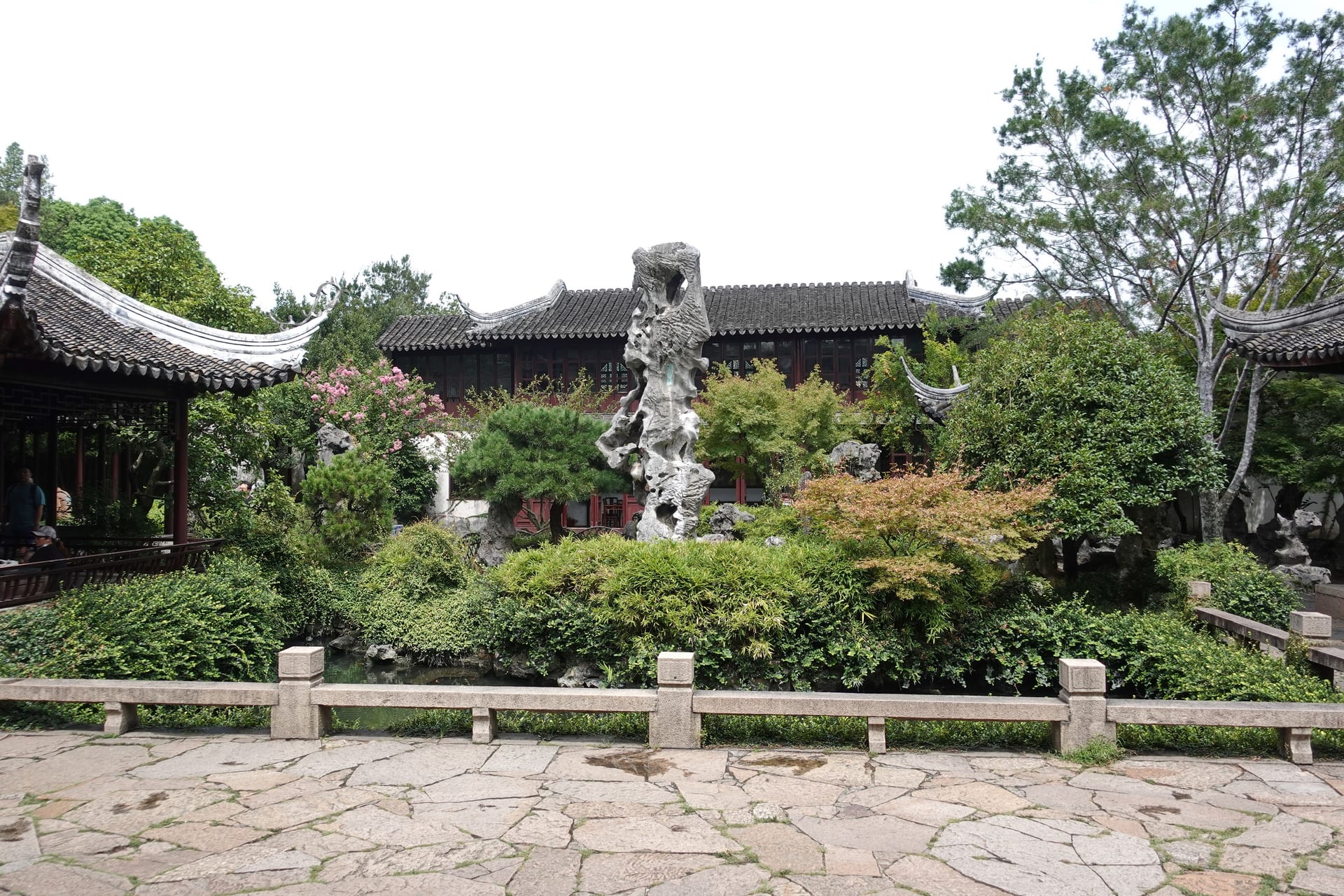
This is the highlight and the symbol of the garden. A single piece of Taihu limestone — from the great lake west of Suzhou — stands upright about 6.5 metres tall, alone in the northern courtyard. It is regarded as the most perfect scholar's rock in any Suzhou garden because it embodies all four prized qualities of top Taihu stone: slender (瘦), wrinkled (皱), translucent (透) and perforated (漏). The court is composed with two attendant rocks flanking it and a viewing hall set at exactly the right distance to take it in.
The design heart of the Lingering Garden is its winding roofed corridor — around 700 metres in total — that links every part of the garden, so you can walk the whole thing in rain or full sun. What makes it special is the hundreds of leak-windows (漏窗) cut into the walls along the way. No two patterns repeat, and each one frames a different view, so the picture in the opening changes every couple of steps. This is the technique of "borrowed" and "framed" views, and no other garden handles it with quite this finesse.
The garden's principal hall, the Five Peaks Celestial Hall (五峰仙馆), is known as the Nanmu Hall because its columns and main structure are built from nanmu — a fragrant, costly hardwood once reserved for imperial use. Inside sit classical Chinese furniture and marble-inlaid chairs whose natural stone veining reads like painted landscapes, with the rockery court visible through the openings. This was the room that announced its owner's standing and taste more clearly than anywhere else in the garden.
The central section is the original Ming-era core, laid out as a pond ringed by an artificial rockery, waterside pavilions and small stone bridges. In summer the pond fills with lotus; in autumn the maples and ginkgos around it turn colour. The design follows the principle of "a small pond made to feel vast", and the Hao Pu Pavilion (濠濮亭) juts out over the water — a favourite old resting spot for watching the fish.
Along one stretch of corridor wall, the garden has embedded over 300 stone steles (法帖) carved with the brushwork of celebrated Chinese calligraphers across several dynasties — a rare collection of brush calligraphy in stone. Even if you can't read the characters, the steles are absorbing, because each calligraphic style is an art in itself. Most visitors walk straight past, but if you stop and look you gain another dimension of the garden.
Suzhou's two most famous gardens are clearly different in character — pick the one that suits your taste.
Strong on the handling of space — a 700-metre covered corridor, leak-windows that frame the view, and the superb Cloud-Capped Peak. It rewards detail and reads as a design textbook. Fewer visitors, calmer atmosphere — the choice for anyone who wants to look at a garden closely.
The largest and most famous garden in Suzhou, built around water, broad ponds and open space, with a borrowed view of the Beisi Pagoda. It sits in the old town and is easy to reach by metro — but it draws far bigger crowds, especially on weekends and holidays.
Everything you need on one page.
The Lingering Garden is outside the old-town walls to the northwest, on Liuyuan Road, near Tiger Hill. It isn't right next to a metro station, so the easiest options are:
Tourist bus You 1 (游1) runs past Suzhou's main sights, including the Lingering Garden and Tiger Hill. Get off at the "留园" (Liuyuan) stop — the gate is a short walk away. Routes 85 and 317 also pass by.
The simplest option if you'd rather not change buses. Hail a taxi or order a DiDi from the old town (say, Pingjiang Road or Suzhou railway station) and reach the garden in about 15–20 minutes — good if you're in a group or short on time.
Suzhou Metro has no station right at the garden, so take the nearest line and finish by taxi or on foot. Useful if you're staying far out and want to avoid traffic, though a direct taxi is usually simpler for this particular spot.
Since both sit on the northwest side close together, start at the Lingering Garden early (07:30–09:30) while it's quiet, then take a bus or taxi to Tiger Hill for the leaning pagoda and Sword Pool, finishing around midday before heading back into the old town for lunch.
After the garden, Suzhou has plenty more to try — from signature dishes like Suzhou noodles and squirrel mandarin fish to its other classical gardens and canal streets. Read on here: