Most classical gardens ask you to look at a mountain from a distance. This one lets you walk inside it — a labyrinth of grottoes, tunnels and stacked Taihu stones, some shaped like crouching lions, that you wander into until you lose the way out. It's the most playful of all the Suzhou gardens.
Most Chinese classical gardens compose a miniature mountain for you to admire from a viewing pavilion. Lion Grove Garden does the opposite: it invites you to climb in. The grey, weather-pitted Taihu stones (太湖石) — limestone shaped over centuries by the waters of Lake Tai until they are full of holes and hollows — have been stacked here into a full-scale rockery maze. There are tunnels you duck through, short dark grottoes, narrow stone stairs that climb and drop, and dead-end turns that quietly route you back to where you started. After a few minutes you genuinely stop being sure where the exit is, and that uncertainty is exactly the point.
Lion Grove Garden (狮子林) was begun in 1342, in the late Yuan dynasty, by the Chan (Zen) Buddhist monk Tianru, who built it as a temple garden in memory of his teacher. The name has two roots: many of the stones resemble seated lions, and Tianru's master had lived on a mountain known as Lion Peak. The celebrated Yuan painter Ni Zan painted the garden, which made it known among scholars from the start. Today Lion Grove is one of nine Suzhou classical gardens jointly inscribed on the UNESCO World Heritage list.
What sets this garden apart is its later imperial fame. The Qing Qianlong Emperor visited several times and loved the rockery so much that he had imitations built at the Summer Palace in Beijing and at the imperial retreat in Chengde. A small temple garden ended up copied inside the palaces of the capital. Lion Grove sits in the Gusu old town immediately beside the Humble Administrator's Garden, the largest and most famous garden in Suzhou — they are only a 5-minute walk apart, which is why most visitors do the two together in one morning.
Each part of the garden has its own story and its own trick — walk it slowly and you'll find them all.
1
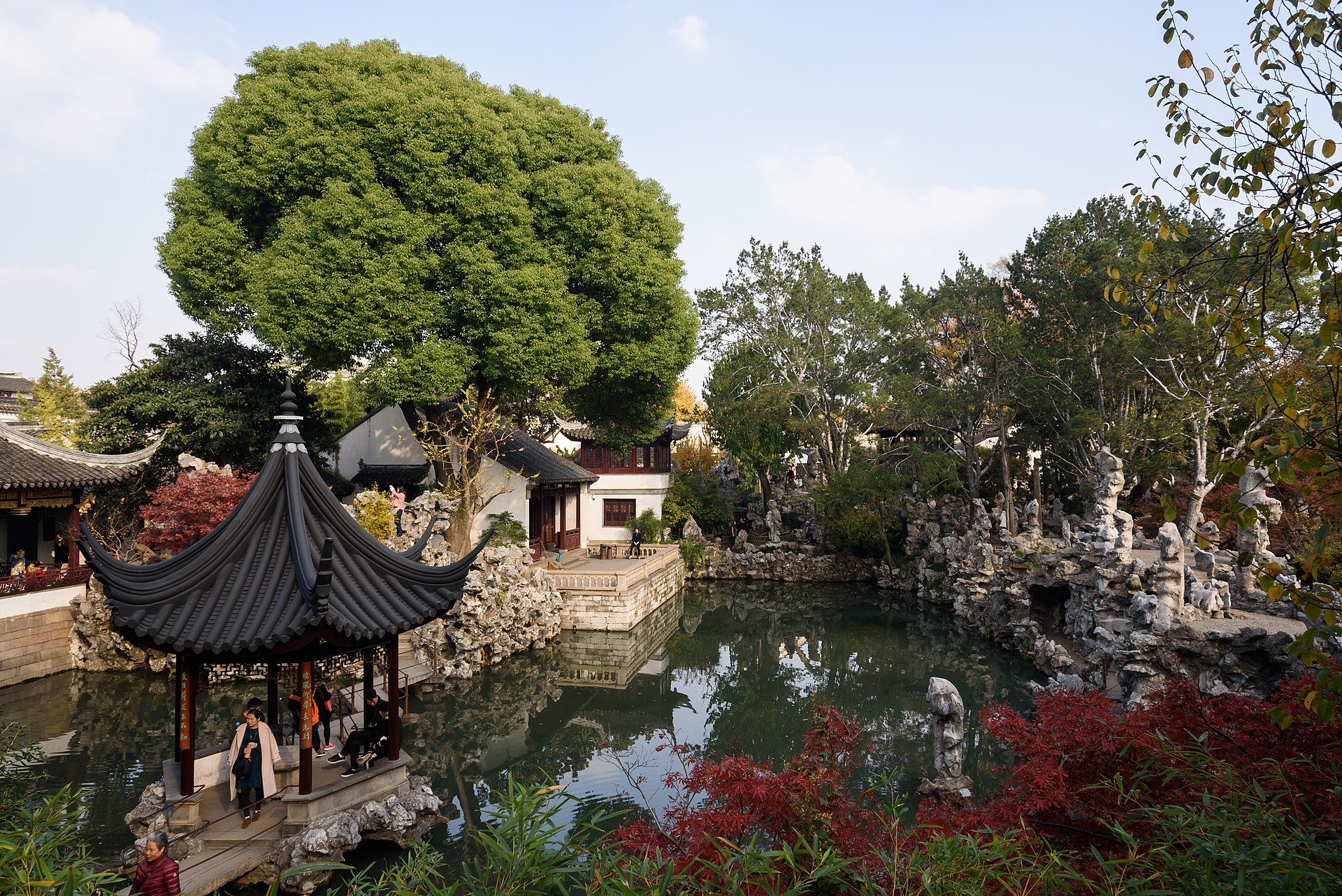
This is the reason people come. The artificial rockery in the south-eastern corner is built from hundreds of Taihu stones stacked into layers, threaded with more than nine winding routes that loop in and out, tunnels you crouch through, short dark grottoes and tight stone staircases up to the top. Step inside and getting lost is easy — most people lose the way on purpose. Look for the stones shaped like crouching lions as you go and the name starts to make sense.
When you finally come out of the stone, the garden opens onto a broad central pond ringed by wooden pavilions and covered walkways. This is the most photogenic spot in Lion Grove — the grey rockery reflected on the water's surface, with curved pavilion roofs and old trees behind it. A stone boat (石舫), built in imitation of a moored vessel, sits at the water's edge, and small stone bridges cross to the far bank. Sit in a pavilion for a moment and look back at the rockery; the whole composition reads far better from here than it did while you were inside it.
The western and northern sides of the garden hold a cluster of halls and reception rooms that once formed the home of the garden's later owners. Lion Grove passed through many hands; in the early 20th century it came into the Pei family — the same family as the world-renowned architect I.M. Pei, who designed the Suzhou Museum nearby. Walking through these halls you'll find timber furniture, Chinese calligraphy plaques and lattice windows that frame views of the garden like paintings. It's a good change of pace after working through the rockery.
The Qing Qianlong Emperor toured Suzhou several times and was especially taken with Lion Grove. He left calligraphy plaques in the garden, and admired the rockery so much that he ordered imitations built at the Summer Palace in Beijing and at the Chengde imperial retreat. Look for the plaques and stone inscriptions scattered around the garden, then picture how a modest temple garden ended up echoed inside the palaces of the capital.
5
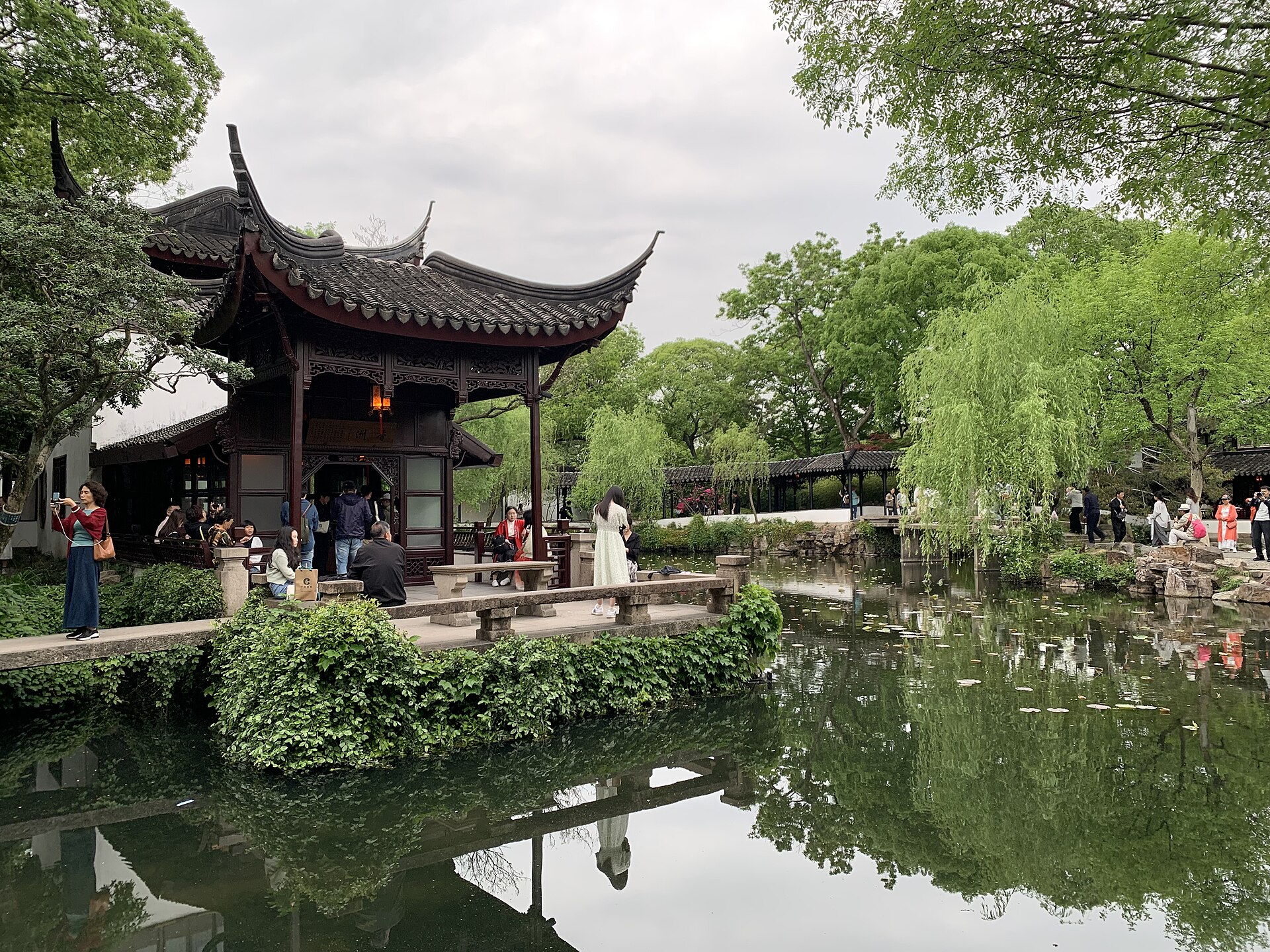
Lion Grove is small — about an hour on foot — which makes it ideal to pair with the Humble Administrator's Garden, only a 5-minute walk north. The two are near-opposites: Lion Grove is all rockery you climb through, while the Humble Administrator's is a sprawling water garden of broad ponds, pavilions and a borrowed view of a distant pagoda. The free Suzhou Museum, designed by I.M. Pei, is right there too. Plan one morning and you can do all three.
Everything you actually need to know, in one place.
Lion Grove Garden sits in the Gusu (姑苏) old town in central Suzhou, close to the main cluster of classical gardens. It's easy to reach on the metro:
Take Line 4 from the railway station to North Temple Pagoda station (北寺塔), then walk east for about 10–15 minutes. This is the most convenient route if you have arrived by high-speed train from Shanghai (around 30 minutes away).
Pingjiang Road is Suzhou's prettiest old canal street, an easy 10–15 minute walk from Lion Grove. Stroll the canal in the morning, then continue to Lion Grove and the Humble Administrator's Garden in a single line through the old town.
The Humble Administrator's Garden is only a 5-minute walk north — the most popular pairing in Suzhou. Most people start at the Humble Administrator's in the morning (it's bigger and takes longer), then walk down to Lion Grove. The free Suzhou Museum is right here too.
With a full morning free: Humble Administrator's Garden (7.30–9.30 am, first because it's largest), then Lion Grove (9.30–10.30 am), then the I.M. Pei Suzhou Museum (free). You'll finish around noon, just in time for a bowl of Suzhou noodles for lunch near Pingjiang Road.
The Gusu old town and Pingjiang Road put you within easy walking distance of the main cluster of classical gardens — perfect if you want to be at the gate early, before the tour groups arrive. Here are the hotels we have reviewed in the area: