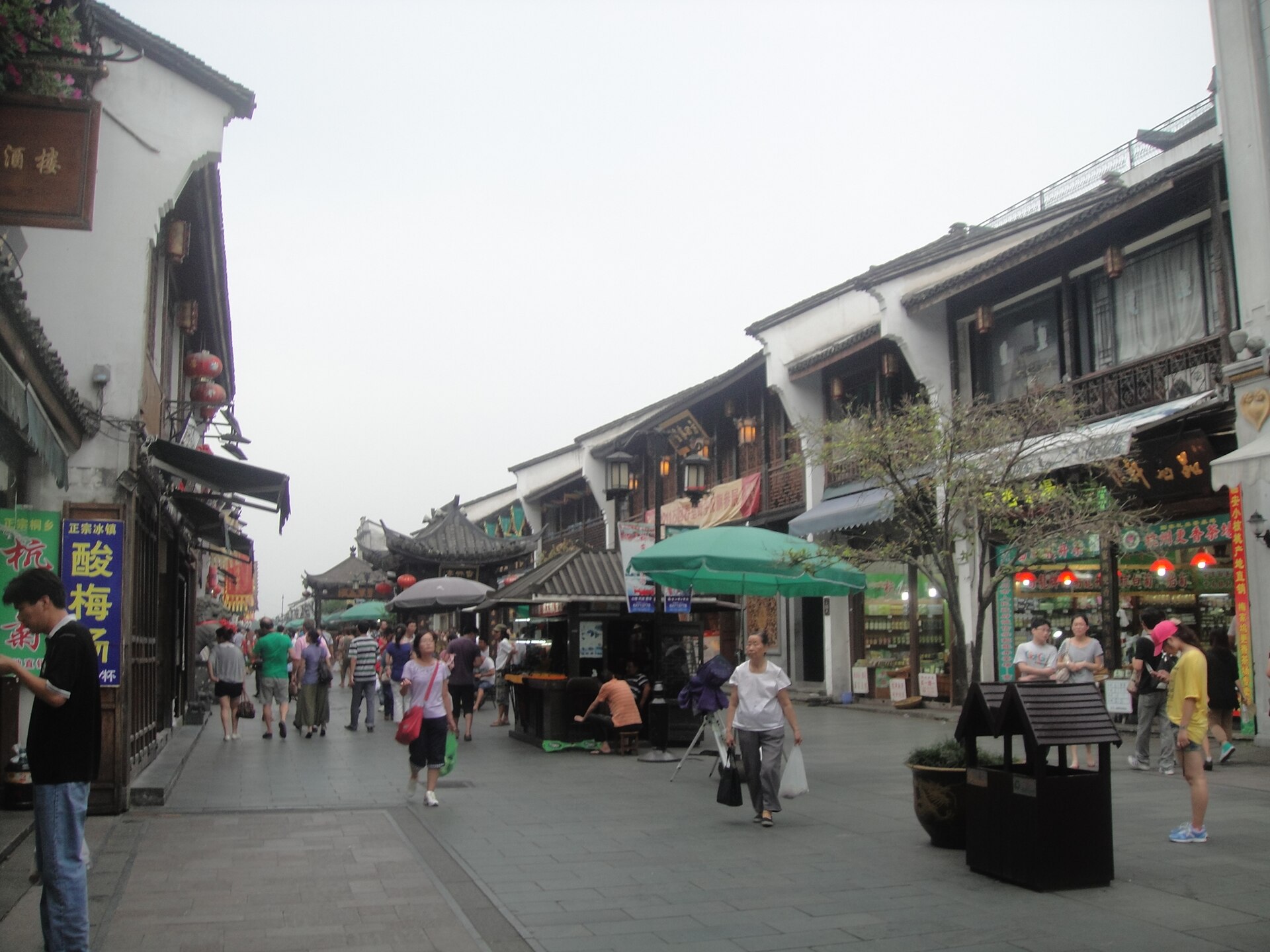
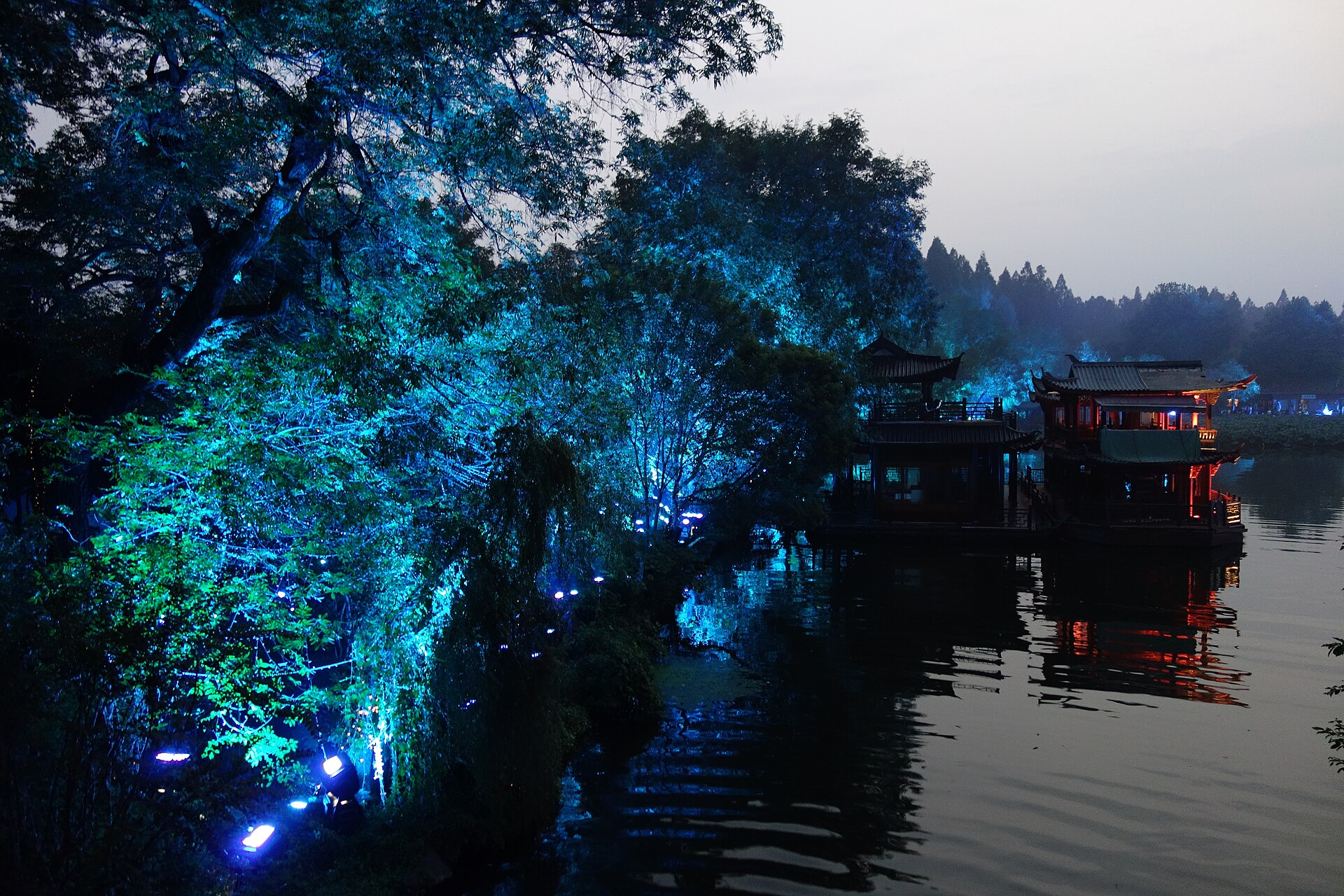
Below Wushan Hill, just south of West Lake, runs Hefang Street — a Qing-dynasty old quarter that still works as a real trading street. Heritage medicine halls, silk and fan shops, snack stalls the length of the road, then a ten-minute climb to a pavilion that frames the entire lake.
Picture a pedestrian street running almost two kilometres along the foot of a low hill, both sides lined with timber buildings under curved Qing-dynasty eaves, gilt-carved shop signs overhead, and the smell of herbal medicine from an old pharmacy mingling with steam off a tray of warm rice cakes. That is Hefang Street (河坊街), which locals more often call Qinghefang (清河坊): the old quarter south of West Lake, and a trading street that has been continuously in business since Hangzhou was the Southern Song capital.
The street is roughly 1,800 metres long, running from Jiangcheng Road in the east to Nanshan Road in the west, near the lakeshore. There is something to stop for every ten paces — the centuries-old Chinese medicine hall Huqingyutang (胡庆余堂), which still sells real medicine and doubles as a museum; the heritage scissor and knife brand Zhang Xiaoquan (张小泉), a source of genuine Hangzhou pride; silk shops, fan shops, Longjing tea sellers, and a long run of snack stalls. The western end opens onto the path up Wushan Hill (吴山), the one West Lake hill that pushes right into the city, with a pavilion at the top that frames the whole lake.
Here is the honest version: plenty of "old streets" across China have been restored into pure photo backdrops, selling the same souvenirs you see everywhere. Hefang has a little of that too. But it also keeps genuinely old shops, real Hangzhou residents, and the actual hillside of Wushan to climb away from the crowds. If you come to Hangzhou and only see West Lake, you have seen half the city.
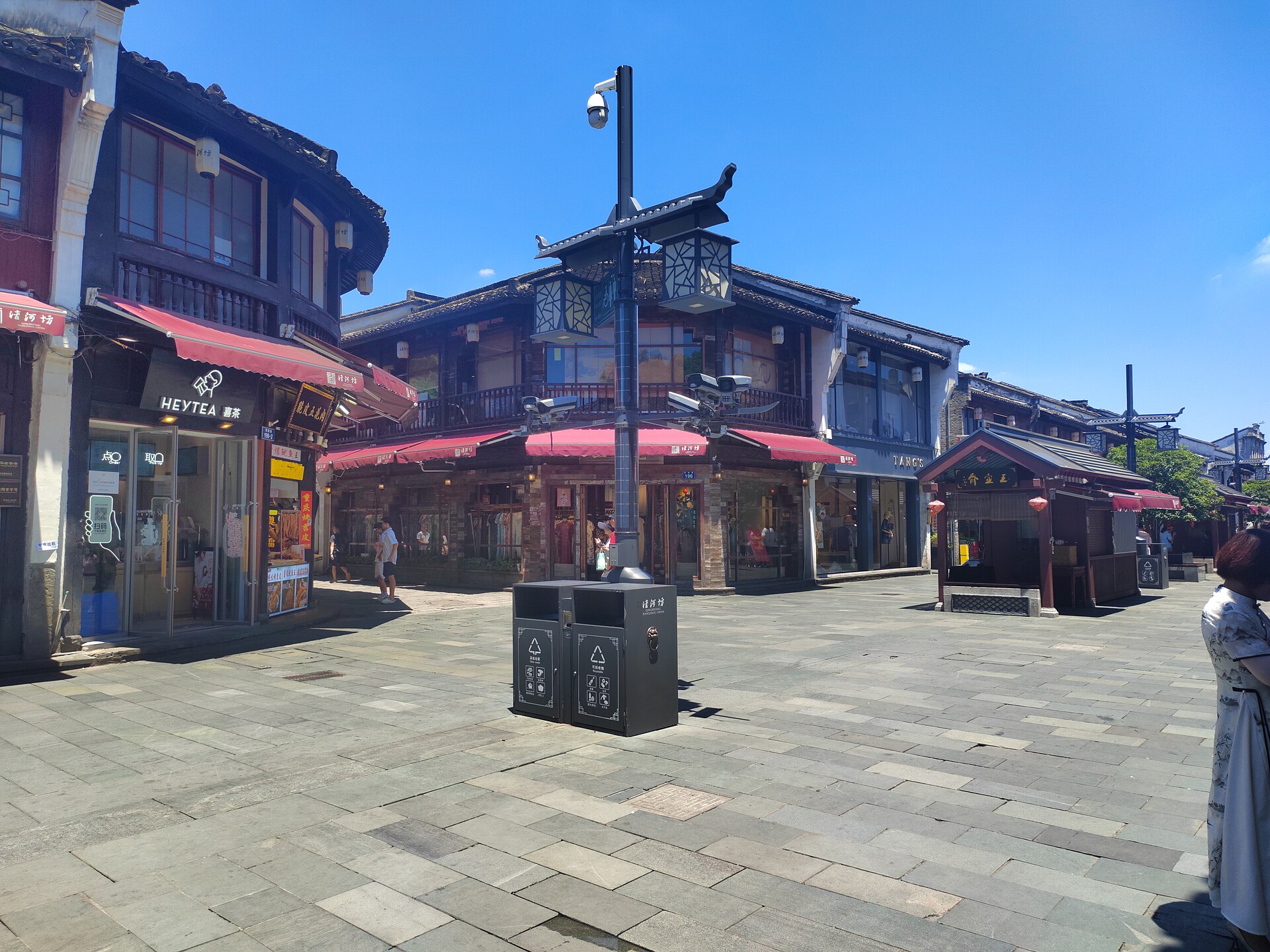
Hefang is not a quiet place. It is busy, crowded and loud with vendors — but the end of the street has Wushan Hill, where you can always escape uphill into the calm.
What gives Hefang its appeal is that it still functions as a real trading street, not an open-air museum. A few steps take you from a pharmacy where people actually buy medicine, to a fan shop where the painter still works at the front, to a spun-sugar stall with children gathered round. In the evening, once the shops are fully lit, the whole length of the street turns into the liveliest night market in the old city.
This is the main reason Hangzhou locals bring out-of-town friends to Hefang. The snacks run from dingshenggao (the pink steamed rice cake said to bring luck) to fish balls, roast duck, fresh black-sesame sweets, animal-shaped spun sugar, and Longjing green-tea ice cream and milk tea. You can walk and eat the whole length of the street. Typical snacks cost ¥10–40 (~฿50–200). Evening into night is busiest and best.
Hefang gathers Hangzhou's heritage brands — the centuries-old scissor and knife maker Zhang Xiaoquan (张小泉), silk shops selling scarves and clothing, hand-painted folding fans, and Longjing tea sellers who let you taste before buying. These make better souvenirs, with a real story behind them, than the generic gift-shop stuff. Just compare prices a little — tourist shops and traditional shops price quite differently.
The Huqingyutang pharmacy (胡庆余堂), founded in the 19th century, is both a working Chinese-medicine dispensary and a museum of traditional Chinese medicine. The original carved-timber building is the draw on its own. Museum admission is around ¥10 (~฿50), open 09:00–17:00 — the most accessible place in the city to see what an old apothecary actually looked like.
The western end of Hefang is the trailhead for Wushan Hill. A climb of under fifteen minutes leaves the bustle behind and brings you onto shaded woodland paths dotted with small shrines and temples, up to the multi-storey Chenghuang Pavilion (City God Pavilion), whose upper floors take in the whole of West Lake. It is the natural break in a day of walking the street below.
The heart of the quarter — a Qing-era pedestrian street about 1,800 metres long, free to enter and walkable all day. Most shops open around 09:00–22:00, but if you have to pick one window, the evening is when the lanterns come on and the street becomes a night market: easy strolling, street food, old shops to browse. Allow about 1.5–2 hours. Full detail in the complete Hefang Street guide.
A Chinese-medicine pharmacy founded in the late 19th century by the merchant Hu Xueyan, now both a working dispensary and a museum of traditional Chinese medicine. The carved-timber building is beautifully preserved; inside are displays of medicine-making tools, antique apothecary cabinets, and the story of Chinese pharmacology. Admission around ¥10 (~฿50), open 09:00–17:00. It is just off Hefang Street, a short walk into Dajing Alley.
Wushan is the only West Lake hill that extends into the city centre. The path up starts at the end of Hefang Street, and the summit is a 10–15 minute climb, with small temples and shrines along the way. At the top is the multi-storey Chenghuang Pavilion (城隍阁), the City God Pavilion; from its upper floors you see the whole of West Lake — the full two-causeway, three-islet layout — and the Qiantang River beyond. Pavilion admission is around ¥30 (~฿150) (walking the hill itself is free). Sunset is the best time to be up there.
Hangzhou has several heritage brands it is proud of, the best known being Zhang Xiaoquan (张小泉), the long-established scissor and knife maker. Alongside it you will find Hangzhou silk merchants, hand-painted folding-fan shops, Longjing tea sellers, and Chinese calligraphy-brush stationers. If you want souvenirs with a real story and genuine quality, this is a good place — but compare prices, since tourist shops and traditional shops set them quite differently.
Running parallel to Hefang is Gaoyin Street (高银街), which leans more toward restaurants and food, plus a zone of antique and collectible stalls that vintage hunters enjoy. It is just as lively as Hefang but a touch less crowded, and the two link up on foot. If you have time after the main street, the side lanes like this one are where you find the corners most visitors never reach.
Hefang is a paradise for snackers — but if you want a proper sit-down meal, there are Shanghainese-Hangzhou restaurants scattered through it and along Gaoyin Street next door.
The signature snack of Hefang Street is dingshenggao (定胜糕), a pink steamed rice cake people once ate for luck before exams or going to war — gently sweet, soft and chewy. Beyond it there is freshly ground black-sesame sweets, fish balls, roast duck, animal-shaped spun sugar, sugar-stewed beans, and ice cream and milk tea made with Longjing green tea, Hangzhou's own. Typical snacks run ¥10–40 (~฿50–200) each. More in the Hangzhou street food guide.
Once you have grazed your fill and want a real meal, the quarter has traditional Hangzhou restaurants serving the city's signature dishes — Dongpo pork (东坡肉), West Lake sweet-and-sour fish (西湖醋鱼) and Longjing tea-fried shrimp (龙井虾仁). Walk over to the parallel Gaoyin Street and there is plenty of choice. See all the signature dishes in the Hangzhou food guide, or for a place to sit with a coffee and rest your feet, the Hangzhou café guide.
Hefang sits south of West Lake, so basing yourself along the eastern lakeshore (Hubin) or near the old town puts the easiest sightseeing on foot.
The advantage of staying around the eastern shore of West Lake (Hubin 湖滨) or near the old town is that both the lake and Hefang Street are walkable. Stroll the lakeshore early before the crowds, spend the day around the water, then drop down to Hefang in the evening for the night market — a whole day without touching a car. Wushan Square on Metro Line 7 also connects you onward to the railway stations and the airport when you need it.
If you want a resort feel against the hills and water instead, the wooded western side of West Lake has several upscale properties — though they are a little further out from Hefang. The choice comes down to whether you weight convenience for the old town or quiet by the hills more heavily.
The easiest option is Metro Line 7 to Wushan Square. From West Lake it is also a comfortable few minutes on foot.
15:30 — Metro Line 7 to Wushan Square, Exit D. Start Hefang Street from the western end.
16:00 — Stop at the Huqingyutang pharmacy (¥10) to see the timber building and the medicine museum.
16:45 — Climb Wushan Hill to the Chenghuang Pavilion for the West Lake panorama in the softening light (¥30).
17:45 — Back down to walk Hefang as the lanterns come on; eat your way along the stalls for dinner.
18:30 — Browse the silk, fan and Zhang Xiaoquan shops, pick up souvenirs, and finish with a Longjing green-tea milk tea.
The common approach is to spend the day at West Lake — walking the causeways, a boat trip, a stop at Leifeng Pagoda on the southern lakeshore close to Hefang — then move into the old town in the late afternoon for Hefang Street. Close the day with the night market and dinner from the stalls. The two are so close together you barely need transport.
To see more of Hangzhou, browse all Hangzhou attractions · Lingyin Temple · day trips from Hangzhou.