Home Hangzhou China Hangzhou Hotels About
Home  ›  China  ›  Hangzhou  ›  Attractions  ›  Lingyin Temple
Hangzhou Attractions · Chan Temple

Lingyin Temple (灵隐寺)
A 1,700-year-old Zen monastery behind the Peak That Flew Here

Climb the stone steps through a forest of old camphor trees, incense drifting over the sound of chanting, and you reach a triple-eaved wooden hall holding a gilded camphor-wood Buddha as tall as an eight-storey building — one of the oldest and most important Buddhist temples in all of China.

Why it matters

A monastery that began with an Indian monk in 328 AD

Roughly 1,700 years ago, an Indian monk named Huili arrived in the wooded hills northwest of Hangzhou. He looked at a strangely shaped limestone peak rising from the forest and decided it must have "flown here from afar." In 328 AD, during the Eastern Jin dynasty, he founded a temple at its foot and named it Lingyin (灵隐) — the "soul's retreat," which English speakers know as the Temple of the Soul's Retreat.

Lingyin Temple is a temple of the Chan (Zen) school of Buddhism and counts among the ten most important Chan monasteries in China. At its height under the Wuyue Kingdom (907–978) it held 18 pavilions, 72 halls, more than 1,300 monks' rooms and a community of over 3,000 monks. It has burned, been destroyed in war and been rebuilt more times than anyone can comfortably count — and yet it remains a working monastery where monks live and worship today, not a museum piece kept behind ropes.

The reason people travel here is the Mahavira Hall (大雄宝殿 Daxiong Baodian), the main hall, which enshrines a seated Sakyamuni Buddha carved from gilded camphor wood and rising about 24 metres — one of the tallest wooden seated Buddhas in China. Immediately beside the temple is Feilai Feng (飞来峰), the "Peak That Flew Here," its cliffs and caves carved with more than 340 Buddhist figures dating from the Five Dynasties to the Yuan. The good news for 2026: since late 2025 the Feilai Feng area is free, leaving only the ¥30 temple ticket.

What to look for

Five things worth your time

Walk up from the foot of the hill, hall by hall — go slowly and you start to understand why this place matters so much to Chinese visitors.
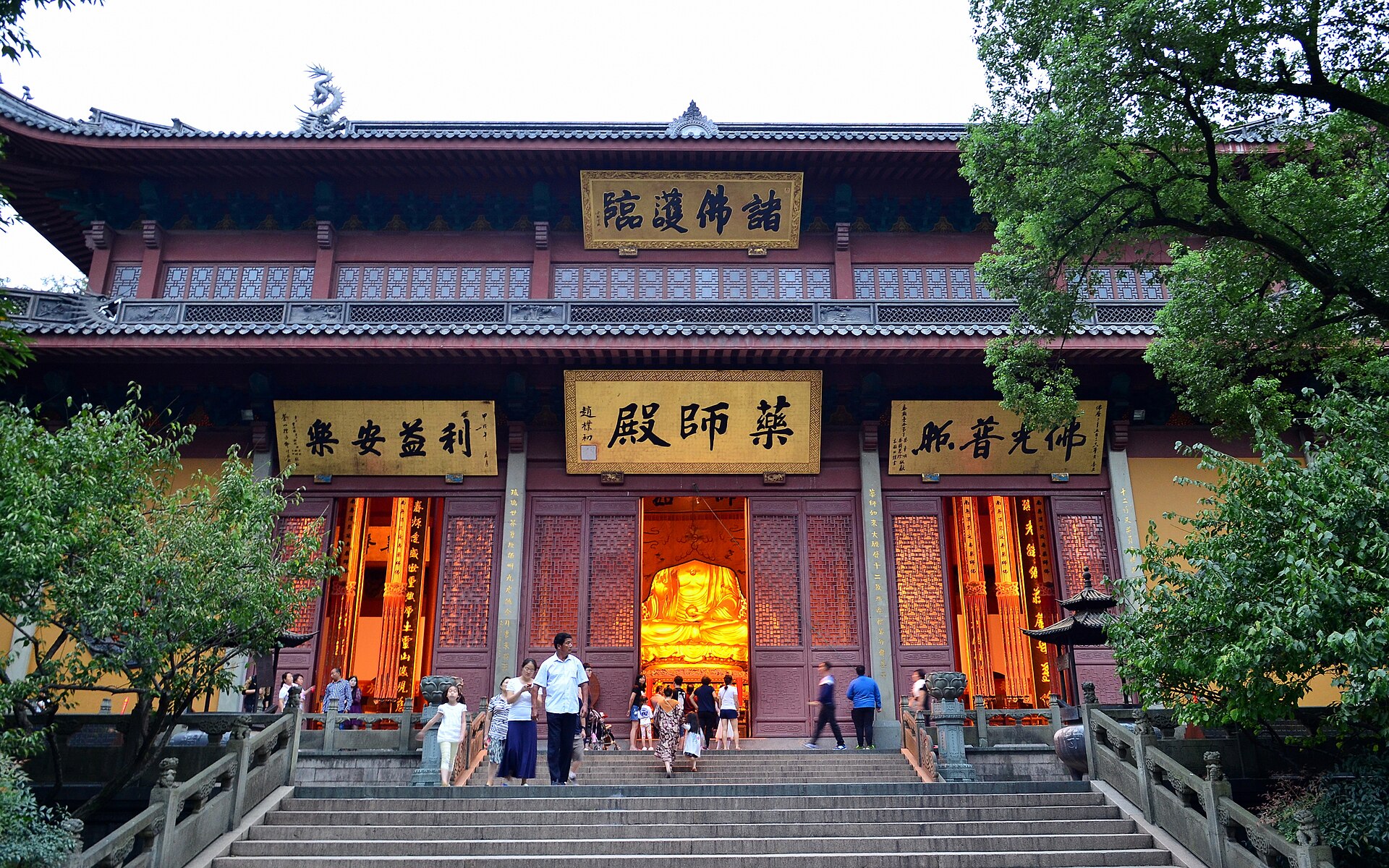
A hall at Lingyin Temple, Hangzhou — a tiered wooden Chinese temple building with gilded calligraphy plaques and a golden Buddha glowing inside, visitors climbing the stone steps 1
Mahavira Hall & the Camphor-Wood Buddha
大雄宝殿 Mahavira Hall · 24-metre gilded camphor-wood Sakyamuni

The heart of the temple is this hall. A great seated Sakyamuni sits in calm at its centre, carved from 24 sections of camphor wood and gilded all over, rising about 24 metres — built in its current form in 1956 after a Tang-dynasty model. To see the top of his head you have to tip your own head all the way back. Around the walls stand hundreds of carved arhats and celestial figures, and when the outside light catches the gold the whole space seems to glow. Most people fall quiet on the way in without being told to.
Location: The second hall up from the gate, behind the Hall of the Heavenly Kings
Etiquette: Remove hats, keep your voice low, and watch for signs — photography of the main image is restricted at times
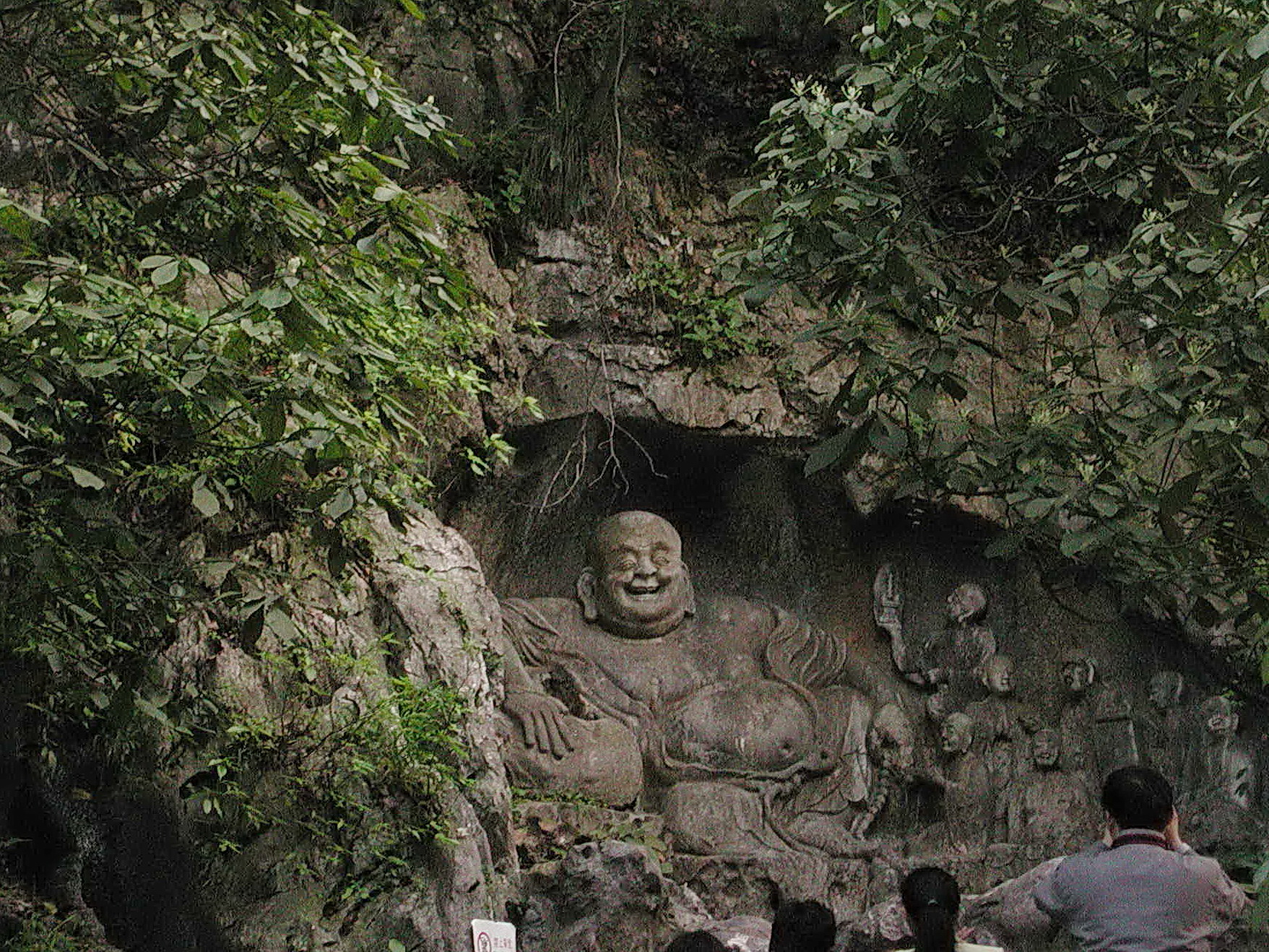
The Laughing Buddha (Maitreya) stone carving on the Feilai Feng cliff face beside Lingyin Temple, Hangzhou, with worshippers kneeling in front 2
The Laughing Buddha of Feilai Feng
A cliff carving, not a temple statue · the most famous figure on the peak

To be clear, the figure in this photo is a carving on the Feilai Feng cliff, not a statue inside a hall — it is the rotund, broadly smiling Maitreya (the "Laughing Buddha") cut into the rock in the 13th century, and the single most photographed carving on the peak. Across the whole hill, more than 340 stone Buddhas and bodhisattvas are scattered along the cliffs and inside the caves, ranging in date from the Five Dynasties to the Yuan. You walk past them along a stream before you reach the temple gate — and since late 2025 this whole stretch is free to enter.

Location: Along the cliffs opposite the temple, before the temple ticket gate
Tip: Step into the caves too — many of the finest carvings are tucked inside and easy to walk straight past
🛕3
Hall of the Heavenly Kings (天王殿)
The first hall that greets every visitor

The first hall you meet after the gate. A broadly smiling Maitreya sits at the front, flanked by the four towering Heavenly Kings holding their directional emblems; behind Maitreya stand Guanyin and the bodhisattva Skanda. Above the entrance hangs a plaque reading "云林禅寺" (Yunlin Chan Temple) — the name granted by the Kangxi Emperor when he visited. You pass through here before climbing the steps up to the Mahavira Hall above.

Location: The very first hall past the ticket gate
Detail: That "Yunlin" plaque is in the calligraphy of the Qing-dynasty Kangxi Emperor
🌲4
The Camphor Forest & Stream Path
The shaded walk along the hill · what sets this apart from a city temple

A lot of people leave Lingyin remembering not just the halls but the walk to them. The path runs under old camphor trees and centuries-old hardwoods that shade it the whole way, with a stream running quietly alongside. The air is cool and damp and far quieter than the city, especially at dawn when the mist still hangs and light comes through the leaves in shafts. Walk it slowly from the foot of the hill — it takes only a few minutes but it genuinely shifts you from tourist to pilgrim.

Location: The full approach from the car park up to the temple gate
Best time: Early morning, 7.30–9 am, for light mist and thin crowds
⛰️5
The Upper Halls & Neighbouring Temples
Hall of the Medicine Buddha · sutra library · Yongfu and Taoguang temples

If your legs are willing, the complex keeps climbing past the Mahavira Hall: a Hall of the Medicine Buddha, a Hall of Five Hundred Arhats, and a tiered sutra library stepping up the hillside. The higher you go, the thinner the crowds and the quieter it gets. And if that still is not enough, two smaller temples hide in the forest nearby — Yongfu Temple (永福寺) and Taoguang Temple (韬光寺) — both serene, tea-Zen in mood, and far less visited than Lingyin itself. They are the move if you want to escape the crowds.

Location: Climbing up the hillside behind the Mahavira Hall
Tip: The walk up to Taoguang Temple opens up a distant view over the city of Hangzhou
Before you go

Tickets, hours and how to get there

Everything you actually need to know, in one place — and worth re-checking before you travel, as the ticket policy is recent.

Admission
Temple ¥30 (~฿150) · Feilai Feng free
Since 1 Dec 2025 the Feilai Feng scenic area is free; only the temple itself charges ¥30 (it was ¥75 combined before). Children and seniors get discounts.
Opening hours
7.30 am–5.30 pm (last entry 5 pm)
Open daily · On Buddhist observance days and the first of the lunar month, worshippers pack in and the incense is heavy
Reservation
Real-name booking required in advance
Reserve at least 1 day ahead via the "Hangzhou Lingyin–Feilai Peak" mini-program on Alipay or WeChat · daily visitor cap applies
Getting there
Bus Y2 or taxi from West Lake
Tourist bus Y2 to the Lingyin (灵隐) terminus · taxi or DiDi from the West Lake shore, ~15–20 min, ¥20–30
Time needed
2.5–3.5 hours (Feilai Feng + temple)
About 1 hour for the Feilai Feng carvings plus ~1.5 hours through the temple halls. Add time for the upper halls or neighbouring temples.
Best time to visit
Early morning, 7.30–9 am
Thin crowds, lovely light, lighter incense. Avoid Golden Week (1–7 October) and major Chinese holidays, the busiest dates of the year.
Worth knowing: The ticket policy changed in late 2025 (Feilai Feng now free, temple ¥30) and entry requires a real-name reservation in advance. Check the latest details and browse half-day temple tours on Klook — Lingyin Temple Hangzhou →
Getting there

From West Lake to Lingyin Temple

Lingyin Temple sits in a valley northwest of Hangzhou, about 5–7 km west of West Lake. There are several easy ways in:

Tourist bus Y2
From the lakeside · ~20–30 minutes

The Y2 is a tourist route that runs along West Lake and ends at the Lingyin (灵隐) stop, right at the entrance area. Board it from a lakeside stop and pay by scanning Alipay/WeChat QR or with cash. It is the cheapest and simplest option.

Bus fare: ¥2–5 · Total time: ~20–30 minutes
Taxi / DiDi
~15–20 minutes from the lake

If you are in a group or just want comfort, a taxi or DiDi from the West Lake shore is the easier choice — about 15–20 minutes. You are dropped at a car park near the entrance, then walk in through the camphor forest from there.

Fare: ¥20–30 · DiDi: book in the app (English interface available)
From downtown / the train station
Metro plus a bus, or a direct taxi

From Hangzhou East Railway Station, take the metro toward West Lake and change to a bus or taxi, or take a direct taxi (about 30–40 minutes). Making Lingyin your first stop of the day and circling back to West Lake in the afternoon works neatly.

Total time: ~30–45 minutes · Taxi: ¥40–60
Half-day plan: Lingyin + Feilai Feng
Carvings + halls + hillside temples

Arrive at the 7.30 am opening → walk the Feilai Feng carvings along the stream → enter the temple through the Hall of the Heavenly Kings → the Mahavira Hall and its camphor Buddha → the upper halls. You are done around 11 am; with energy to spare, add Yongfu Temple on the hill, then take the Y2 back for lunch by West Lake.

Total time: 3–4 hours · Budget: ¥30–50 per person (ticket + transport)
What to pair it with

Combine Lingyin with what's nearby

Lingyin sits on the western side of West Lake, so it slots easily into a single day — start here and loop back to the lakeside in the afternoon:

Where to stay

Hotels close to West Lake

Most visitors base themselves by West Lake or in the city centre and take a bus or taxi out to Lingyin in the morning. Here are the hotels we have reviewed:

Frequently asked

FAQ · Before you visit Lingyin Temple

How much does Lingyin Temple cost, and is Feilai Feng still ticketed?
Since 1 December 2025 the Feilai Feng scenic area, including all of its stone carvings, is free to enter. Only the temple itself now charges admission: ¥30 (~฿150) per adult. Previously visitors paid ¥45 for Feilai Feng plus ¥30 for the temple, ¥75 in total. As the policy is recent, it is worth double-checking before you travel.
Do I need to book Lingyin Temple tickets in advance?
Yes. Since late 2025 the Lingyin–Feilai Peak area uses a real-name online reservation system with a daily visitor cap. Reserve at least one day ahead through the "Hangzhou Lingyin–Feilai Peak" mini-program on Alipay or WeChat, linking your passport or ID. On Chinese public holidays the daily slots sell out fast, so book as soon as you know your date.
How do I get to Lingyin Temple from West Lake?
Lingyin Temple sits about 5–7 km west of West Lake. Take tourist bus Y2 from the lakeside to its terminus at the Lingyin (灵隐) stop, or take a taxi or DiDi for roughly 15–20 minutes at ¥20–30. Most visitors pair an early-morning Lingyin visit with West Lake in the afternoon, or the other way around.
What is the best time to visit Lingyin Temple?
Arrive right at the 7.30 am opening. Crowds are thin, morning light filters through the old camphor trees, and the incense smoke has not yet built up as it does later in the day. On Buddhist observance days and the first of the lunar month, local worshippers arrive in large numbers and the incense is heavy — avoid those dates if smoke bothers you, and avoid Golden Week (1–7 October) entirely if you can.
Where is the giant camphor-wood Buddha inside Lingyin Temple?
It stands in the Mahavira Hall (大雄宝殿 Daxiong Baodian), the temple's main hall at the centre of the complex. This seated Sakyamuni is carved from gilded camphor wood and rises about 24 metres, making it one of the tallest wooden seated Buddha statues in China. You reach it by walking in from the gate through the Hall of the Heavenly Kings first.
Klook · Lingyin Temple Tickets & Tours

Check Lingyin Temple tickets and half-day tours in advance

The ticket policy changed in late 2025 (Feilai Feng now free, temple ¥30) and entry needs a real-name reservation. If you would rather not wrestle with a Chinese mini-program, a half-day tour with a guide and transfers on Klook takes the friction out. Compare options and current prices first.

See tickets & tours on Klook →
Wherebest is an affiliate partner of Klook — we may earn a commission when you book through our links, at no extra cost to you.