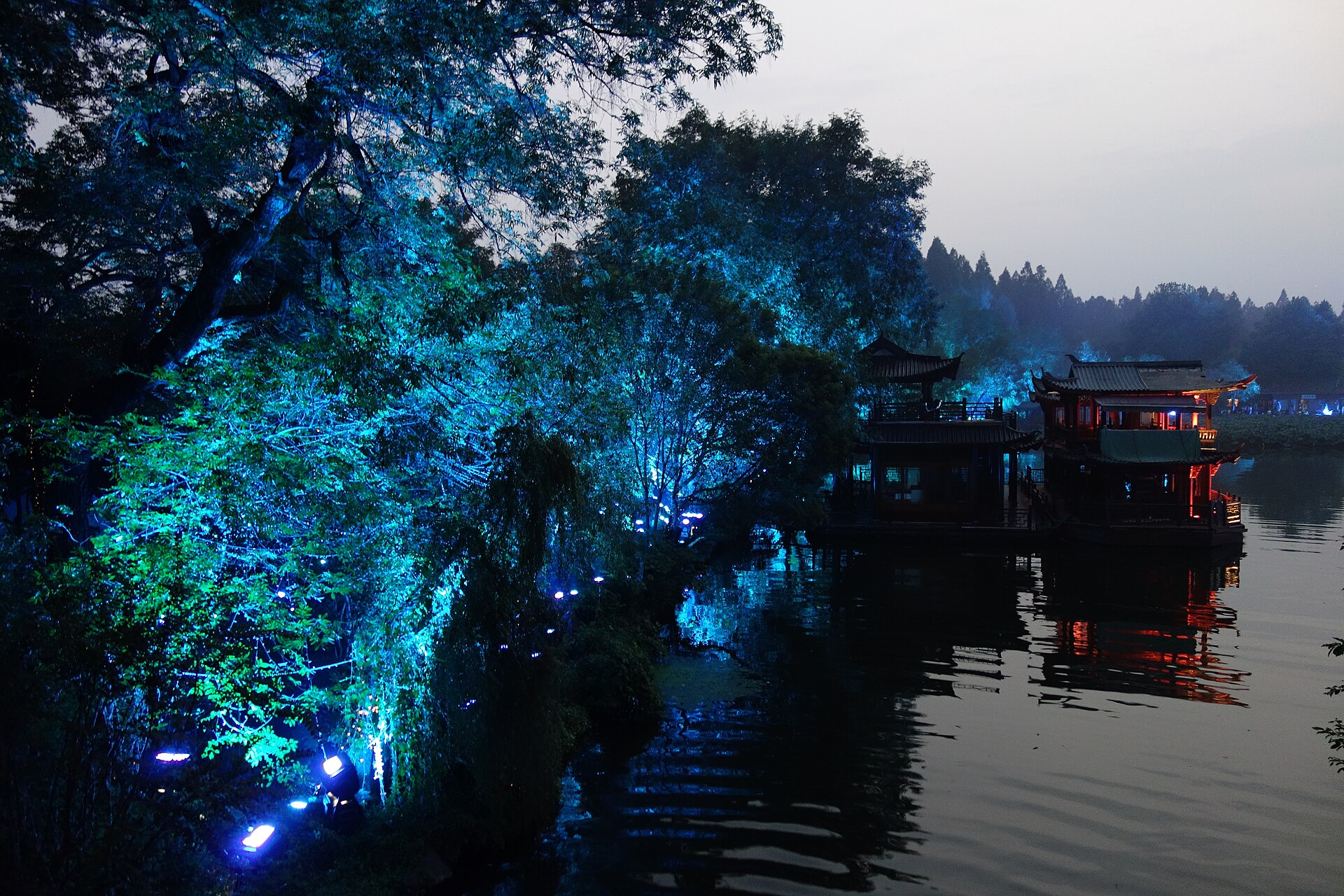
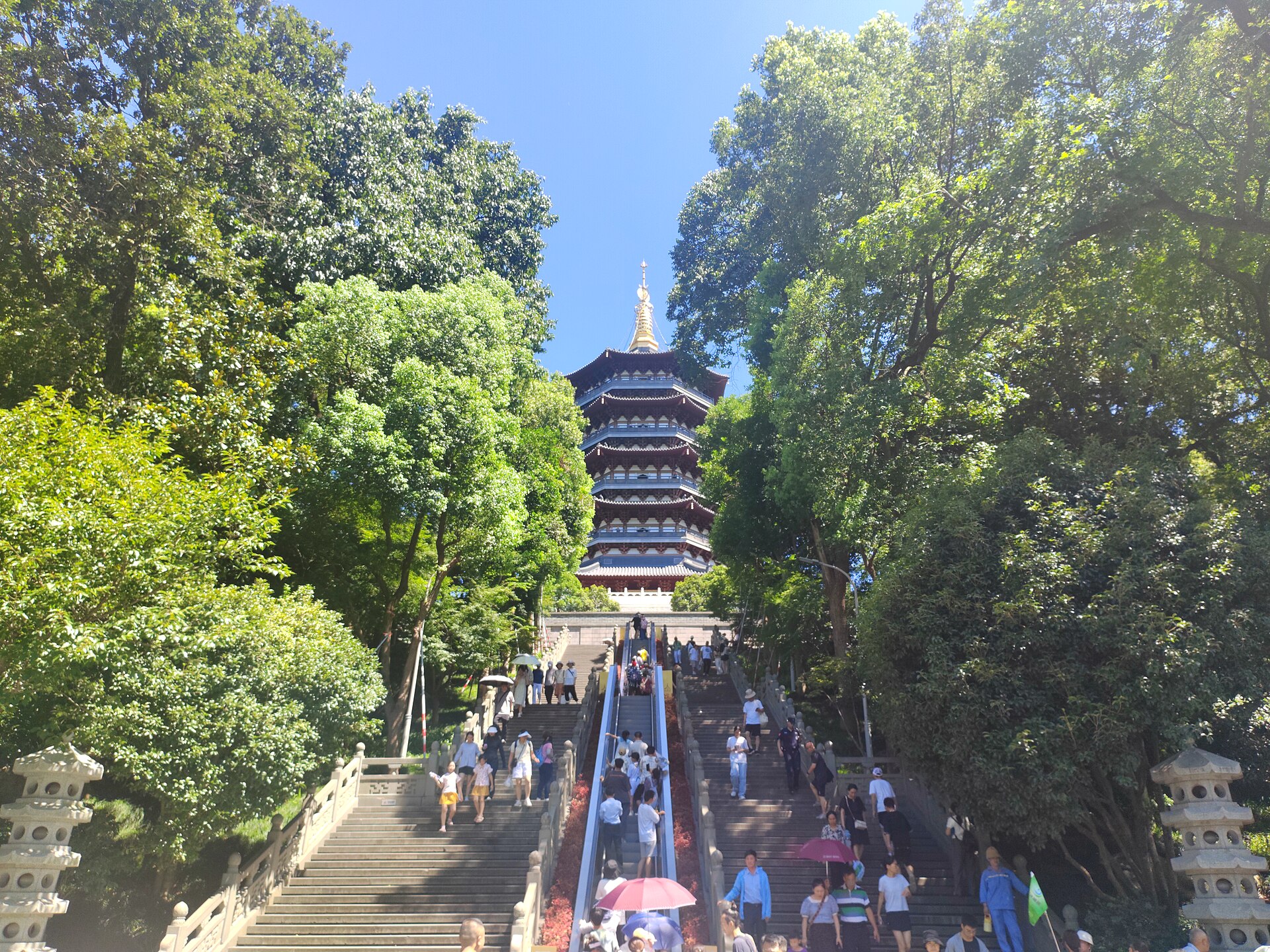
The south-shore pagoda where Madam White Snake was said to be imprisoned beneath the tower — the original collapsed in 1924, the 2002 rebuild sits over the relic crypt, and escalators and a lift carry you up to the best sunset view of West Lake.
Most pagodas in China are quiet relics. Leifeng is not. Picture this: you are standing on the south shore of West Lake in late afternoon, looking up at a small hill called Sunset Hill, where a five-storey tower in warm brown and gold catches the last light while the lake below turns the colour of honey. Every Chinese visitor around you knows this hill from childhood — because beneath this pagoda is where Madam White Snake was imprisoned.
Leifeng Pagoda was first built in 975 AD by King Qian Chu of the Wuyue Kingdom, in honour of his favourite consort, Consort Huang — which earned it the alternative name "Huangfei Pagoda". It watched over West Lake for nearly a thousand years until, on 25 September 1924, the whole structure collapsed. The cause is half-sad, half-absurd: locals believed bricks taken from the tower could ward off illness and prevent miscarriage, so they quietly removed them one by one until the base gave way.
The tower you see today reopened on 25 October 2002 and stands about 71 metres tall. What makes it special is what the architects chose not to do — they did not clear the old ruins. The new pagoda was built directly over the original 975 AD brick base, with a glass floor so you can walk above it, plus an underground palace (the relic crypt) where Buddhist relics and ancient treasures were excavated. The result is a viewpoint, a museum and the stage of a legend all in one.
The legend, the history and what is hidden inside, before you step onto the escalator.
Bai Suzhen, a white snake spirit who cultivated for a thousand years until she could take the form of a beautiful woman, fell in love with and married a young man named Xu Xian. The monk Fahai saw her as a demon, subdued her, and imprisoned her beneath Leifeng Pagoda. This story of love across lifetimes has been retold for centuries — and when the old tower collapsed in 1924, plenty of people joked that the White Snake had finally been set free.
Step into the new tower and the first thing you meet is the original brick base, standing since 975 AD, enclosed under glass so you can walk all the way around it. It is a genuinely affecting moment — you are standing above a thousand years of history that collapsed only a century ago. This is how the rebuild chose to honour the original, rather than clearing it away and starting fresh.
Before the new tower went up, archaeologists excavated the underground palace beneath the old base and found dozens of groups of artefacts — gilded bronze Buddha statues, bronze mirrors, ancient coins, and a gilded silver stupa holding Buddhist relics. Some are displayed inside the pagoda. It means this is not just a photo stop; it is a real Buddhist archaeological site.
This scenic name dates back to the Song dynasty: the image of Leifeng Pagoda catching the setting sun beside West Lake, its reflection turning the water gold. Look across the lake to the north and you will see Baochu Pagoda standing opposite — two pagodas guarding West Lake from its north and south shores. As the old saying goes, "Baochu is like a graceful maiden, Leifeng like a sturdy monk."
The pagoda sits on a hillside, so a set of outdoor escalators carries you from the foot of the hill up to the pagoda's terrace — no hill-climbing required. Inside, sightseeing lifts take you up to the higher floors. That makes it genuinely comfortable for older travellers, families with young children, or anyone short on energy. If you would rather take it slowly, the stairs let you view each floor on foot, with displays and carvings telling the White Snake story the whole way up.
Allow about 1 to 1.5 hours here — see the ruins on the lowest level, ride up for the view, then come down and continue along the lakeshore.
The reason to come is the view from the upper floors. Because the pagoda stands on a lakeside hill on the south shore, you look out over the full sweep of West Lake, with the green line of the Su Causeway crossing the water, the lake islands, and — far across to the north — Baochu Pagoda on its own hill. Late afternoon into sunset is the golden window, when the low light turns everything amber and orange. It earns the name "Leifeng Pagoda in Evening Glow" honestly.
Leifeng's location is its other advantage — it sits at the southern end of the Su Causeway, about a 10-minute walk south. Just across the road at the foot of the hill is Jingci Temple, whose evening bell is itself one of the Ten Scenes of West Lake ("Evening Bell at Nanping Hill", 南屏晚钟). A neat plan: walk the Su Causeway in the afternoon, reach Leifeng for sunset, then head back into the city — a half-day that covers the walk, the view and the legend.
The pagoda is on the south shore of West Lake. No metro station sits right at its door, but there are several easy ways in.
All three sit around West Lake and connect easily on foot or by a short ride.