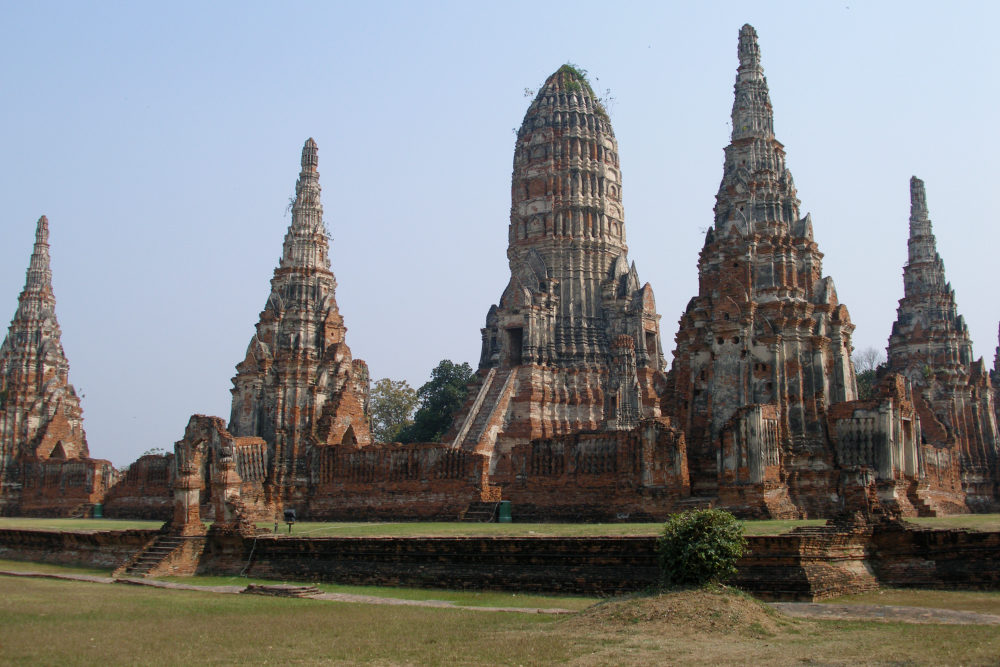
Take the cheap classic northern-line train out of Bangkok and ferry across to the island. Morning at the Buddha head in the tree roots at Wat Mahathat and the three royal chedis of Wat Phra Si Sanphet. Grilled river prawns for lunch. Wat Yai Chai Mongkhon in the afternoon, then a sunset at Wat Chaiwatthanaram. One day, the old capital's best.
The good news is that Ayutthaya makes an easy day trip from Bangkok — it sits only ~70–80 km away, about ninety minutes by train or minivan, and you can see the headline temples and be back the same evening with no overnight stay. That is exactly why it has long been Bangkok's most popular day trip.
The trick is to order the temples by where they sit on the map, because the Ayutthaya Historical Park covers a flat, compact island — rent a bicycle or hire a tuk-tuk by the hour and you can circle the lot. This plan puts the central-island cluster (Wat Mahathat → Wat Phra Si Sanphet → Wihan Mongkhon Bophit) in the morning before the heat builds, takes a riverside lunch out of the midday sun, crosses to Wat Yai Chai Mongkhon to the south in the afternoon, then closes the evening with a sunset at Wat Chaiwatthanaram on the river — the best photo spot of the day.
What is worth being honest about: the ruins have almost no shade. In the hot season (Mar–May) the sun is fierce, and from late March into April it can hit 40–45°C, so start early, carry water, a hat and sunscreen, and keep the open-air temples to the morning and evening. What is deliberately excluded is Bang Pa-In Palace and the floating market — if you want those too, the 2-day plan picks them up at a slower pace.
One day leaves little spare time — get these three things ready the night before and the whole day runs smoothly.
The northern-line train leaves from Krung Thep Aphiwat Central Terminal (Bang Sue) with many services a day; pick one departing around 06:00–07:30 and you reach Ayutthaya before 9:00. At the station, walk to the river ferry across to the island (a few baht), then take a tuk-tuk or rent a bicycle. See every way to get there in the getting-to-Ayutthaya guide.
If you go in the hot season (Mar–May) the sun is strong and there is no shade — leave as early as you can, finish the open-air temples before noon, then take a break in the early afternoon. Carry water, a hat and sunscreen. The most comfortable months are Nov–Feb, cool and good for cycling. Check the months in the best time to visit guide.
It is a lot of walking across several temples, so dress modestly with shoulders and knees covered — especially at working temples like Wat Yai Chai Mongkhon and Wihan Mongkhon Bophit. Wear shoes that slip off easily, since you remove them to enter the halls. Carry small notes and cash for temple entries and the bicycle or tuk-tuk — cash is still easier in a small town.
Ayutthaya is only ninety minutes from Bangkok, so choose by budget and how flexible you want to be.
The northern line runs from Krung Thep Aphiwat Central Terminal (Bang Sue) to Ayutthaya station in ~1.5–2 hours, with many services a day. Fares start at just ฿15–50 for an ordinary 3rd-class seat — the budget traveller's classic — up to around ฿183 for a 2nd-class air-conditioned one. From the station you ferry across the river onto the island. It is the most scenic and the cheapest way to go.
Minivans from Bangkok cost ~฿80–150 per person and take about 1.5 hours, dropping you in town. Buses run from Mo Chit roughly every 30 minutes for ฿50–100. Both are quick and skip the ferry the train involves — handy if you want to arrive fast and right in the centre.
Driving yourself or chartering a car takes about 1.5 hours and is the most flexible, letting you stop at several temples as you like — good for groups or families. Grab for a trip this long costs more and is hard to hail within Ayutthaya itself, so a chartered return car or your own vehicle works out better.
Compare the cost, time and comfort of every option in detail in the getting-to-Ayutthaya guide. For getting around once you arrive (bicycles, tuk-tuk by the hour, the river ferry), see getting around Ayutthaya.
This plan assumes you reach the island around 9:00 — shift the times to match the train or minivan you take.
Start the day at Wat Mahathat early — a major temple in the centre of the island, dating to around the 14th century. The image everyone comes for is the stone Buddha head cradled in the roots of a bodhi tree, Ayutthaya's defining picture, sent on postcards the world over. Around it stand the toppled central prang and rows of red-brick laterite ruins. The morning light is soft and the crowds thinner — the best window for photos before the sun gets harsh later on.
One piece of etiquette to know: when you photograph yourself with the Buddha head, crouch or sit so your own head is lower than its level, as a mark of respect. Do not stand over it or point at it, and dress modestly with shoulders and knees covered.
Move on to Wat Phra Si Sanphet — the temple within the old royal-palace grounds. It was the court temple, with no resident monks, and its highlight is the row of three bell-shaped chedis that has become a symbol of Ayutthaya, holding the ashes of three kings. Walking the old palace grounds you pass the bases of throne halls and the ruins of what was once the heart of the royal court.
A short walk on is Wihan Mongkhon Bophit, which houses a huge seated bronze Buddha — one of the largest bronze Buddha images in Thailand — inside a restored hall. This is a working temple, so remove your shoes and dress modestly before entering. The two sit side by side, so you take them in on a single stop.
Midday is the time to get out of the sun — and Ayutthaya is known for two dishes you should not miss. The first is boat noodles, small intense bowls that people order several of and stack up by tradition. The second, for a slightly bigger budget, is grilled giant river prawns, fat and rich, at a riverside spot looking out over the ruins — a lunch that gives you both the food and the setting.
If you plan a big river-prawn lunch at midday, keep the evening light or pick up roti sai mai (the spun palm-sugar "silk floss" sweet) to take home instead. Choose a place on the Pa Sak or Chao Phraya river around the island for the best view. See all the standout spots in the Ayutthaya food guide.
In the afternoon, cross to the southeast of the island to Wat Yai Chai Mongkhon — a working temple with resident monks. The highlight is the great central chedi you can climb for a view, with long rows of saffron-wrapped seated Buddhas ringing the base, and there is a large reclining Buddha draped in saffron robes in the same grounds. The gardens here are leafier than the central cluster, so the afternoon sun is still bearable for walking.
Close the day at Wat Chaiwatthanaram — the loveliest temple for the evening, set on the west bank of the Chao Phraya just off the island. Its Khmer-style central prang ringed by eight smaller chedis catches the low golden light beautifully, and it is the sunset photo spot people talk about most in Ayutthaya. During some festivals the temple is even lit up after dark.
This is also a popular place to rent traditional Thai costume for photos, with rental shops nearby — fun if you want a period-style picture. Make it your last stop, then head back into town for the train, minivan or car back to Bangkok.
The island is flat and compact, so renting a bicycle (~฿50/day) is the local favourite and the easiest way to ride the temple circuit. Or hire a tuk-tuk by the hour (~฿200–300/hr) — agree the price before you get in, every time, and do not be shy about it. From the train station a river ferry crosses onto the island for a few baht. ⚠️ Ayutthaya has no BTS or MRT — it is a small town — but the northern-line train serves it from Bangkok. Full detail in getting around Ayutthaya.
Plenty of people do Ayutthaya as a day trip from Bangkok — and honestly, it works and it is good value. If you would rather stay over to catch the temples at dawn and sunset unhurried, there are guesthouses on the island and riverside stays. Compare areas in the where-to-stay guide, or browse the top 10 Ayutthaya hotels.
Most temples charge ~฿20–50 each; if you do several in the central cluster, the combined ticket at ฿220 is better value. Dress modestly with shoulders and knees covered at every temple, remove your shoes for the halls, and keep your head lower than the Buddha head when photographing it. Carry small notes and cash for entries and the bicycle or tuk-tuk.
| Category | Budget | Mid-range | Comfortable |
|---|---|---|---|
| Return transport from Bangkok | ฿30–100 (3rd-class train return) |
฿160–300 (minivan / AC train return) |
฿1,200–2,500 (guided tour / chartered car) |
| Temple entries | ฿120–200 (headline temples only) |
฿220 (combined ticket) |
| Getting around town | ฿50 (bicycle all day) |
฿300–600 (tuk-tuk by the hour, 2–3 hr) |
฿0 (included in tour / car) |
| Food (lunch + snacks) | ฿100–200 (boat noodles / local shops) |
฿300–600 (incl. grilled river prawns) |
฿600–900 (big riverside meal) |
| Total for the day (est.) | ฿500–800 (~$14–22 USD) |
฿1,000–1,800 (~$28–50 USD) |
฿2,500–4,000 (~$69–111 USD) |
Exchange rate used: ฿1 ≈ $0.028 USD · Prices are estimates and vary by season and how many temples you do · check before you go · Hotel not included (a day trip needs none) · For a full breakdown see the Ayutthaya trip budget.