A working temple just southeast of Ayutthaya island, built around a tall central chedi you can actually walk up — with long rows of saffron-wrapped seated Buddhas around the cloister and a large reclining Buddha in the grounds. History you can still feel, in a temple that is very much alive.
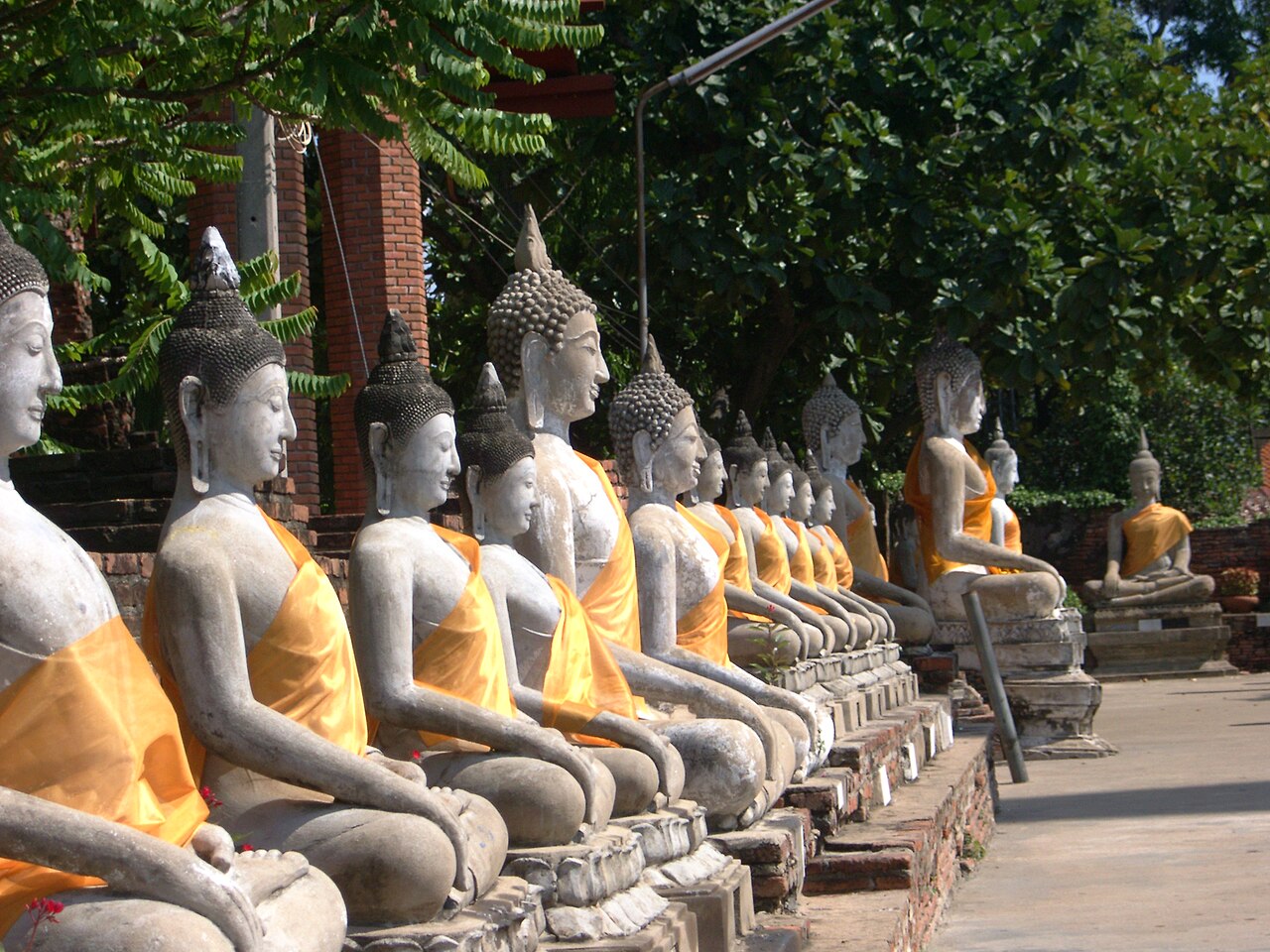
Cycle out from the centre of the island, cross to the southeast, and you arrive at a tall bell-shaped chedi standing alone in a wide courtyard. Ringing its base is a long line of seated stone Buddhas, each one wrapped in a bright saffron robe that cuts vividly against the old orange-red brick. This is the picture people keep taking, and it is a large part of why Wat Yai Chai Mongkhon ends up on so many "favourite temple in Ayutthaya" lists.
Wat Yai Chai Mongkhon dates to the early Ayutthaya period and is still a fully active monastery today — monks live and worship here, and locals come to make merit. The tall central chedi that you see from a distance is the temple's defining feature; it is commonly linked to King Naresuan's victory in the elephant duel against the Burmese crown prince in 1593. It is one of the tallest chedis in Ayutthaya, and unusually for the city's monuments, it has a staircase you can actually climb to a terrace near the top, looking down over the courtyard, the rows of saffron Buddhas and the flat fields beyond.
What sets it apart from the ruined temples on the central island is that it is a living temple, not just brickwork to photograph. There is a shaded garden, people lighting incense and applying gold leaf, and a working prayer hall. You get the history and the religion in the same place — and because it is in use, dressing respectfully and moving quietly matter from the moment you walk in.
The temple is not large, but each part has a story and an image worth slowing down for — you can see it all in under an hour.
The large bell-shaped chedi visible from afar is one of the tallest in Ayutthaya. The part that excites most visitors is that a staircase runs up to a terrace near the top, with a wide view down over the whole courtyard, the rows of saffron-robed Buddhas and the open fields around. The steps are steep and narrow, so hold the handrail and take care in strong sun — the stone heats up fast. There is limited room up top, so on busy days you take turns going up and coming down.
A rectangular cloister surrounds the base of the chedi, lined with seated Buddha images set in a long, even row. Each one wears a bright saffron sash that stands out beautifully against the weathered orange-red brick. Walk along the row and the angles are endless — a deep line of figures shot from one end, or a single close-up. The low morning light brings out the texture of the robes and the brick especially well.
Another spot most people make sure to see is the large reclining Buddha in the temple grounds, draped in a long saffron robe. It is a place where visitors pay their respects and apply gold leaf to the figure. This corner is quieter than the chedi area and feels more contemplative, a good place to pause. Walk softly here, and do not climb on or sit against the image for photographs.
Beyond the monuments, Wat Yai Chai Mongkhon has a leafy garden, a prayer hall and pavilions that are genuinely used for worship. Strolling through the garden gives you a break from the sun and a glimpse of people coming to make merit — and this is exactly what separates the temple from the ruined sites on the island. It is a place of worship in daily use, not simply a stack of bricks to photograph.
Two images circulate most. The first is the tall central chedi against the sky, with a saffron-robed Buddha at its base as a foreground — easy to frame from the courtyard in front. The second is the row of saffron-robed seated Buddhas in the cloister, shot from one end so the figures recede into a long line. Neither needs any special equipment; the temple does the work for you.
The best light is the early morning, around 08:00–09:30, when the sun is still low and not yet harsh, and the shadows on the saffron robes and old brick come out well — and before the tour buses fill the courtyard. Come mid-morning or midday and the Ayutthaya sun is fierce with almost no shade, so always carry a hat, water and sunscreen.
Wat Yai Chai Mongkhon is not a ruin you only photograph. In the mornings you will find people making merit, applying gold leaf to the reclining Buddha and praying at the various shrines. That atmosphere is what sets it apart from the bare archaeological sites: you are seeing history and a living religion in the same place. Walking slowly and watching how people pay their respects is part of the experience.
On major Buddhist holy days — Makha Bucha, Visakha Bucha — or during Songkran and Loy Krathong, far more people come to make merit and the temple feels busy and full of energy. It is worth being there, but be ready for slower going in and out than on a normal day, and for the car park to fill quickly.
Ayutthaya sits on the central plain, hot for most of the year, and the temple courtyard has almost no shade. The most comfortable window is November to February — cool and dry, the best time to cycle the ruins. March to May runs very hot, with some days hitting 40–45°C, so come at dawn or late afternoon and keep water and a hat on you. The upside of the hot season is thinner crowds and cheaper rooms.
June to October is the rainy season, usually heavy afternoon downpours that clear later; September to October is the most flood-prone period in Ayutthaya, and low-lying riverside temples can be affected in a bad year. Wat Yai Chai Mongkhon sits on higher ground than the riverside temples, but it is still worth checking the weather and flood situation before you travel in those months. For the full picture, see the best time to visit Ayutthaya and the countrywide best time to visit Thailand.
Wat Yai Chai Mongkhon sits a few kilometres southeast of the island, just off the central ruins, and most people fold it into a temple circuit. Ayutthaya is a small historic town with no BTS, MRT or skytrain — but it is reached from Bangkok on the Northern Line train, and once you are in town there are several easy ways to get around.
Wat Yai Chai Mongkhon is genuinely in use, with resident monks and locals making merit, so dress respectfully — cover your shoulders and knees, and avoid sleeveless tops and very short shorts or skirts. If you are in summer clothes, a light scarf or shawl in your bag is enough to cover up. Some areas, such as inside the prayer hall or by the reclining Buddha, may require you to remove your shoes — watch for the signs and follow them.
Walk quietly where people are praying and keep your voice down. Do not climb on or sit against any Buddha image — whether the seated Buddhas at the base of the chedi or the reclining Buddha — to take photos. Standing beside them is fine, but carry yourself appropriately for the place, and when posing near an image, do not turn your back on it or point your feet toward it.
On the chedi staircase, hold the handrail and watch for people coming the other way on the narrow steps — there is no need to rush. Applying gold leaf or making an offering where the temple provides for it directly supports the monastery, and is part of what Thai visitors come here to do.
Wat Yai Chai Mongkhon is a quick visit, which leaves plenty of time for the other temples around the city in the same day.