A flat island ringed by three rivers, holding the prangs and chedis of a 417-year-old capital all within cycling distance — here is how to actually do it: tickets, routes, and the heat you need to plan around.
There is a moment, usually early on a rented bicycle, when you turn off a small road lined with red-brick walls into Wat Mahathat and see it: a sandstone Buddha head held inside the roots of a bodhi tree, slowly grown around for over a century. Around you, prangs with their tops sheared off and laterite ruins under low morning light, the crowds still thin. This is Ayutthaya at its best — and it is the reason to start at dawn.
Ayutthaya Historical Park is the heart of Phra Nakhon Si Ayutthaya, the capital of Siam for 417 years (1351–1767) before it was sacked and burned. Today its ruined prangs, chedis and Buddha images are scattered across an island formed by the Chao Phraya, Pa Sak and Lopburi rivers — a site inscribed as a UNESCO World Heritage Site in 1991.
What makes it easier to visit than most ancient cities is simple: the island is flat and compact. The major temples sit within a few kilometres of each other, so you can loop the central cluster comfortably by bicycle in a day, and it is only about 1.5 hours from Bangkok — close enough for a day trip. The honest catch is the heat: the ruins are open to the sky with almost no shade, so the middle of the day is to be avoided.
All in the middle of the island, only a few minutes' cycling apart — this is the loop to start with if you have half a day.
The image that defines the whole city — a sandstone Buddha head gradually embraced by bodhi-tree roots until the two are one. Around it stand the collapsed central prang and rows of laterite ruins. Entry around ฿50. One important rule: when photographing the head, sit or crouch so your own head stays lower than the Buddha's → read the full Wat Mahathat guide
Right across the road from Wat Mahathat — a quick pedal away. Its draw is the main prang, intact enough that you can climb a narrow staircase down into the crypt beneath it. A hoard of gold artefacts and votive tablets was excavated from this temple. Entry around ฿50.
Set beside Bueng Phra Ram, a pond ringed by large trees that actually offer shade — rare in Ayutthaya. The tall central prang reflects in the water nicely in the late afternoon, and it makes a good rest stop on the ride between Wat Mahathat and Wat Phra Si Sanphet. Entry around ฿50.
The heart of the old royal court — three bell-shaped chedis in a row that hold the ashes of Ayutthaya's kings. This is the image on countless Thailand guidebook covers. Entry around ฿50 → read the full Wat Phra Si Sanphet guide
Adjoins Wat Phra Si Sanphet — you can walk straight between them. Inside the restored hall sits Phra Mongkhon Bophit, one of the largest bronze Buddha images in Thailand. The hall itself is free to enter. It is the busiest stop on this loop, so keep a shawl handy for the dress code.
The major fenced temples charge separately, around ฿50 each (for example Wat Mahathat, Wat Ratchaburana, Wat Phra Si Sanphet and Wat Chaiwatthanaram), while Wihan Phra Mongkhon Bophit and walking the open park grounds are free.
If you plan to enter several, there is a combined pass at about ฿220 covering six main temples (Wat Phra Si Sanphet · Wat Phra Ram · Wat Ratchaburana · Wat Chaiwatthanaram · Wat Mahathat · Wat Maheyong), valid for 30 days from purchase — it pays off the moment you visit four or more, since entering all six individually adds up to ฿300. Prices can change, so check at the ticket booth of each temple.
The option locals and budget travellers choose most is renting a bicycle for around ฿50 a day from shops near the morning market or the train station. The island is flat and compact, so you can loop the central temples at your own pace, park anywhere and wait for no one.
If you would rather not pedal — especially in the hot season — hire a tuk-tuk by the hour at roughly ฿200–300 per hour for a temple circuit. Many drivers know the route and can run you out to outlying temples like Wat Chaiwatthanaram or Wat Yai Chai Mongkhon — but agree the price and the number of temples before you get in, as there is no meter and the rate comes down to negotiation. Walking the whole site is genuinely tiring because the temples are spread out and the sun is strong, and Grab is limited in Ayutthaya, harder to hail than in Bangkok.
If you have time and want to understand what you are looking at, stop by the Chao Sam Phraya National Museum, which holds the gold artefacts and antiquities excavated from the crypts of Wat Ratchaburana and Wat Mahathat — the real objects that make the prangs you just cycled past come alive. The other option is the Ayutthaya Historical Study Centre, with scale models of the city plan and life at its height that help you picture how vast this capital once was. Both charge separate admission and keep office hours (often closed Monday–Tuesday — check before you go).
Etiquette: many ruins are still sacred ground — dress respectfully with shoulders and knees covered (carry a shawl), and do not climb on the chedis, prangs or walls, which are fragile ancient monuments. Wat Mahathat has its own rule: when photographing the Buddha head in the roots, you must sit or crouch so your head stays lower than the Buddha's — never standing over it or pointing.
Heat and shade: the ruins are open to the sky with barely any shade. In the hot season (March–May) the sun makes a midday walk hard going. The trick is to start at opening time (~8 am) or come in the late afternoon, avoiding roughly 11 am to 3 pm. Bring water, a wide-brim hat, sunscreen, and shoes you can slip off easily (a few spots require removing them).
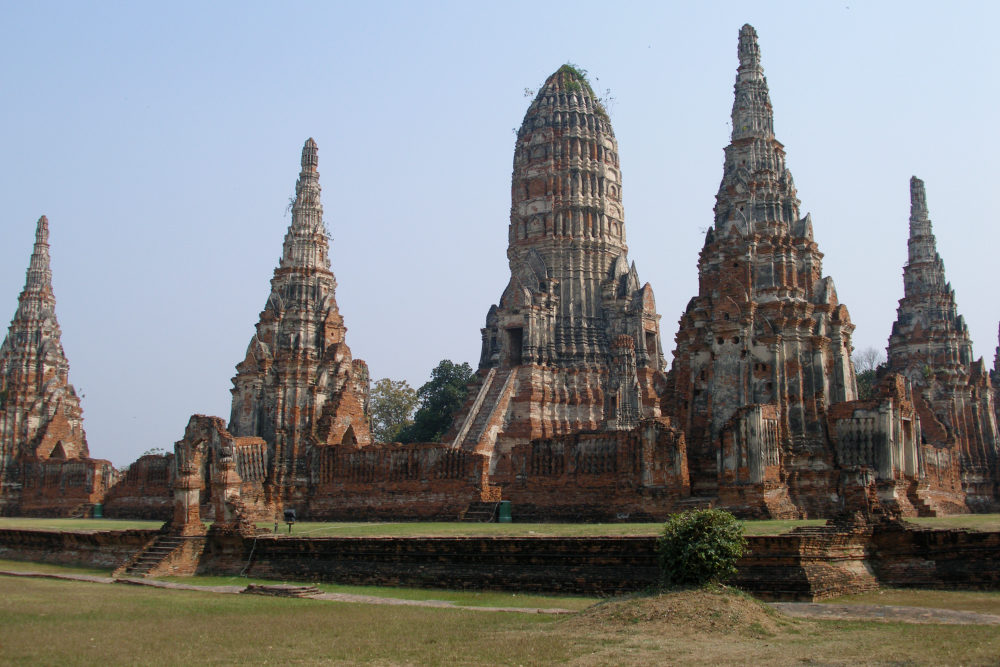
After sunset, several major temples on the island — including Wat Mahathat, Wat Ratchaburana and Wat Phra Si Sanphet — are floodlit, so you can walk the perimeter at night for an atmosphere completely unlike the daytime: cooler air, far fewer people, and the old brick glowing warm under the lights. Out by the river, Wat Chaiwatthanaram is the finest evening-to-night photography spot, especially with the sun setting behind the central prang → read the full Wat Chaiwatthanaram guide
These two sit off the central loop, but they are worth cycling or hiring a tuk-tuk to reach.
Stay on the island to wake up and cycle into the ruins before the heat — or do it as a day trip from Bangkok.