12 sights worth your time
Ordered outward from the heart of the island — not just photo stops, but places that genuinely tell Ayutthaya's story.
 1
1
Picture it: you walk into an old temple court whose central prang collapsed back when the Burmese sacked the city, and your eye catches the foot of a bodhi tree in one corner — a sandstone Buddha head slowly being cradled by the roots, the most photographed sight in Ayutthaya. Wat Mahathat was built around 1374 and was once the religious and political centre of the Ayutthaya kingdom. Around it stand more prangs, chedis and armless Buddhas, the wreckage of a once-great city. It sits right in the middle of the island, so you can pair it with Wat Ratchaburana directly across the road in one stop.
 2
2
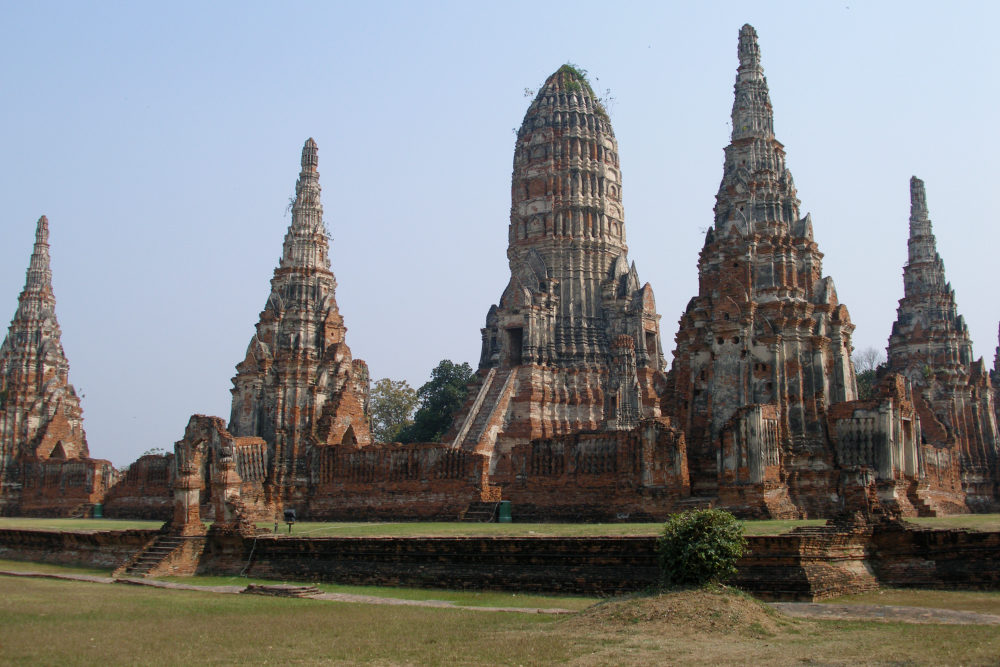
If you only pick one temple for the evening, make it this one. Wat Chaiwatthanaram was built in 1630 under King Prasat Thong, a Khmer-style temple with a tall central prang ringed by smaller towers and crematorium chapels. It stands on the west bank of the Chao Phraya River, just off the island, and at dusk the low gold light on the red brick makes it the city's most popular photo stop. Many people rent a traditional Thai costume to be photographed here, and in special seasons around the end of the year the temple is lit at night, the prangs reflected in the water. One thing to know: it sits low by the river, so in a heavy wet-season year flooding can close it temporarily — check the news first.
 3
3
The three aligned bell-shaped chedis against a clear sky are another of Ayutthaya's signature images. Wat Phra Si Sanphet was the temple inside the royal palace grounds — the equivalent of the Temple of the Emerald Buddha in Bangkok — used for royal ceremonies and with no resident monks. The three chedis hold the ashes of three kings. A short walk away is Wihan Phra Mongkhon Bophit, where a great seated bronze Buddha sits in a restored hall — so you can pair these two with Wat Mahathat in one cluster, because this was the royal-court heart of old Ayutthaya.
Right beside Wat Phra Si Sanphet stands a dark-roofed hall housing Phra Mongkhon Bophit, one of Thailand's largest bronze Buddha images, cast in the Ayutthaya era and through fire and several restorations. The present hall was rebuilt to give it a dignified setting, and this is a temple Thais come to pray at in earnest — it has a living feel that the surrounding ruins don't, with people lighting incense and pressing on gold leaf, and a small market of snacks and souvenirs out front. Stop here for roti sai mai and local sweets.
 5
5
Wat Yai Chai Mongkhon is a working temple southeast of the island. Its centrepiece is a tall central chedi you can climb, the steps leading to a platform with a view; around the base, long rows of seated Buddhas draped in saffron cloth make a striking sight. The chedi is said to commemorate a victory in the reign of King Naresuan. In another corner sits a large reclining Buddha wrapped in yellow cloth, facing east toward the sunrise. It feels different from the ruins — there are people making merit and the gardens are greener and shadier, so it's a good morning or late-afternoon stop.
Where other temples are about prangs and chedis, this one is about its open-air reclining Buddha, the largest in Ayutthaya at over 40 metres, built of brick and once lacquered and gilded. Today a pale, smooth figure reclines in the open under sun and rain, draped in a great yellow cloth that locals bring as an offering — simple and striking against the sky. It's quieter than the central-island temples, set on the west side of the island near the old royal palace, and you can stop in on the way to Wat Chaiwatthanaram. It's a short, easy visit, and free.
Wat Ratchaburana sits directly across the road from Wat Mahathat, so you can walk straight over. Its highlight is the central prang, still standing tall, and what sets it apart is that you can climb down a stairway into the crypt beneath it, where traces of old wall paintings remain. This crypt famously yielded a huge hoard of gold and Buddha images when it was excavated in 1957 — most of those treasures are now displayed at the Chao Sam Phraya National Museum. The temple was built in the reign of King Borommaracha II (Chao Sam Phraya), so it ties neatly to the museum: see the crypt itself, then go see the treasures.
 8
8
About 18 kilometres south of the island is Bang Pa-In, the royal summer palace used as a country retreat by the kings. What makes it special is the mix of architectural styles on the grounds — the Aisawan Thiphya-Art, a Thai-style pavilion in the middle of a pond that everyone photographs; the Wehart Chamrun, a red-and-gold Chinese-style building; and Italian-style European buildings. Inside are wide, shady gardens you can stroll, or loop on a rented golf cart or bicycle. There's a strict dress code (no sleeveless tops, no skirts above the knee, no leggings, no strapless sandals); sarongs are available to borrow at the entrance.
To understand why these ruins were once so grand, stop at the Chao Sam Phraya National Museum, which holds the gold work, Buddha images and treasures excavated from the crypts of Wat Ratchaburana and Wat Mahathat — the real objects, behind glass, showing the craftsmanship of the Ayutthaya court. Nearby, the Ayutthaya Historical Study Centre uses models and exhibits to recreate the city in its heyday. Both are air-conditioned, which makes them a good place to escape the midday heat and add some context before or after you tour the temples.
The Ayothaya Floating Market is a retro-themed market built for tourism — not a centuries-old waterway market, but fun if you want to wander and eat local snacks, try Thai sweets, catch a cultural show and shop for souvenirs in a wooden-house, by-the-water setting. Stalls of food, old-style Thai desserts and keepsakes line the boardwalks. Some people enjoy it, some find it a little staged — honestly, you come for the atmosphere and the food more than for a "real" floating market. It's off the island to the east, near Wat Yai Chai Mongkhon, so you can pair the two.
When you've finished the temples, the heat has eased and you want genuine local food, head to Bang Ian Night Market, an evening market on the island where Ayutthaya locals actually come to eat — not a staged tourist set-up. You'll find boat noodles, grilled and fried snacks, Thai sweets and cheap single-plate meals: the feel of an everyday local dinner at friendly prices. Another spot people recommend is Hua Ro Market by the river nearby. Either makes a good way to end the day with a cheap, tasty dinner before heading back to your room or catching the train back to Bangkok.
Once you've done the island temples and still have time, see the other side of Ayutthaya — the Japanese, Portuguese and Dutch settlement villages along the river, which tell the story of Ayutthaya as an international trading port. On elephants, if you're interested, we'd point you to places that observe and feed elephants in ethically run sanctuaries rather than offer rides (animal welfare matters — skip anywhere offering rides or shows). And nearby towns like Lopburi, the monkey town to the north, and Ang Thong with its giant Buddha, are doable on the same day.