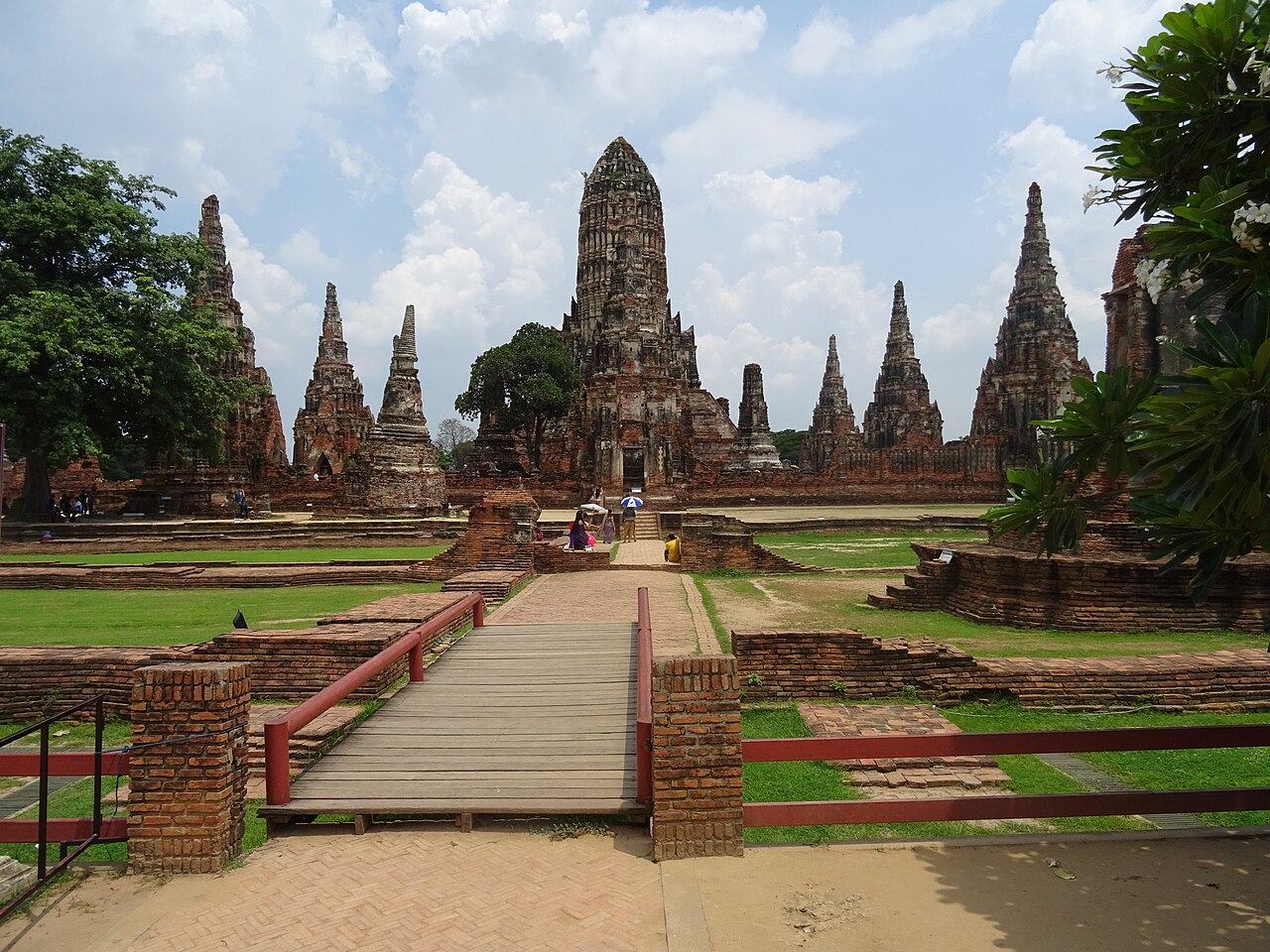
Built in 1630 by King Prasat Thong on the west bank of the Chao Phraya, its tall central prang is ringed by eight chedi-shaped chapels. When the late sun hits the brick, the whole complex turns orange-gold — the photograph that draws everyone here at dusk.
Picture this: you are standing on the riverbank at six in the evening, looking across a lawn at a tall brick prang ringed by smaller prangs and chedi-shaped chapels. The last sun of the day rakes in low and the red brick of the whole complex turns orange-gold; the sky behind shifts colour by the minute. This is the scene that makes travellers in Ayutthaya save Wat Chaiwatthanaram for the late afternoon, every time.
Wat Chaiwatthanaram was built in 1630 during the reign of King Prasat Thong, as an act of merit and, by tradition, a memorial to his mother. What sets it apart is its Khmer-style layout, drawing on the model of Angkor: a large central prang stands on a square platform, surrounded by corner prangs and a ring of eight chedi-shaped chapels (the so-called meru), connected by a cloister. That plan is uncommon among Ayutthaya's other temples, which is exactly why this one is instantly recognisable.
The other thing that distinguishes it is the riverside setting on the west bank. Most of Ayutthaya's temples sit on the island; Wat Chaiwatthanaram is across the Chao Phraya, facing the water. That gives you low evening light off the river and, when the level is right, reflections in the water — and it is the reason the temple has become the single most popular place in town for travellers to photograph themselves in traditional Thai costume.
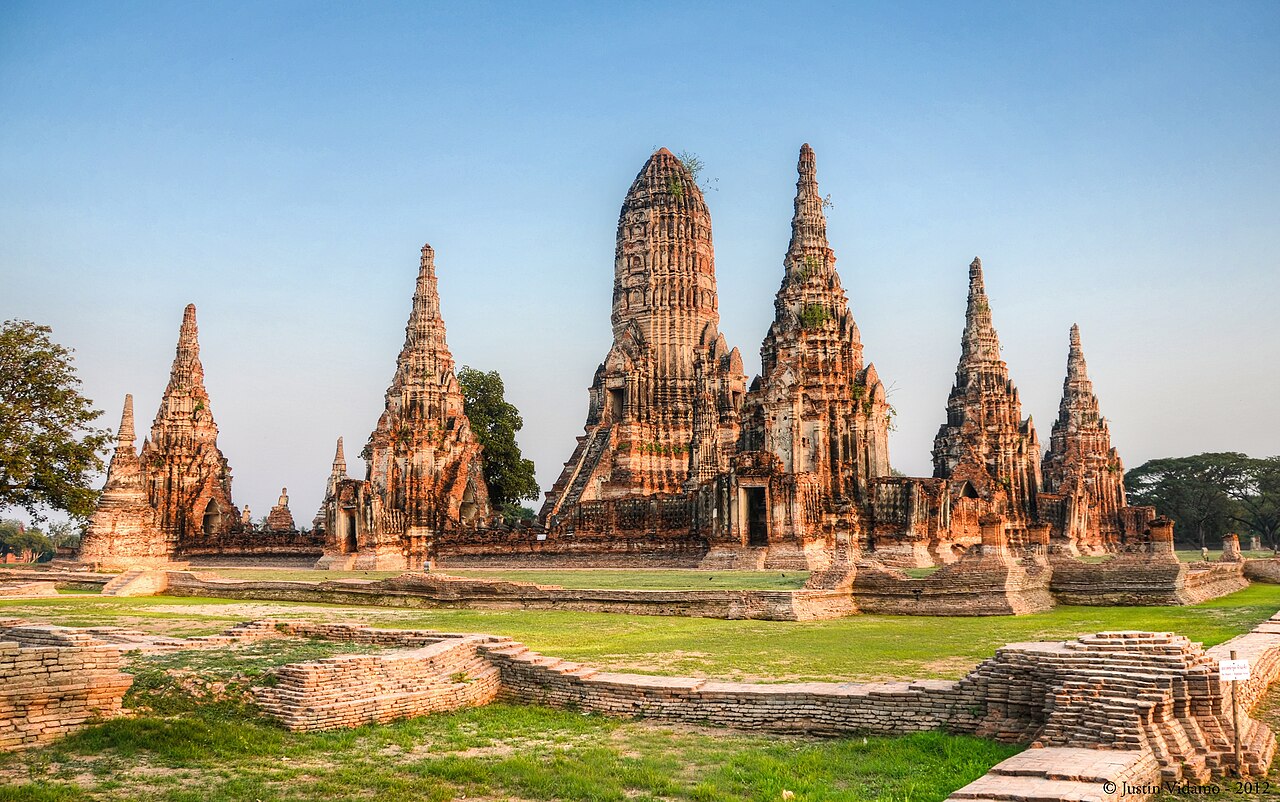
The grounds are not large, but the Khmer plan gives every angle its own composition and story.
The tall central prang rises from a square platform and pulls every eye the moment you walk in. The prang form is borrowed from Khmer art, unlike the bell-shaped chedis you see at most other Ayutthaya temples. Four smaller corner prangs flank the main tower, which makes the central group read as balanced and stately — a strong frame in daylight and even better when the late sun gilds the brick.
Eight chedi-shaped chapels (the meru) stand in a ring around the central prang, linked by a cloister. Inside some of them you can still make out traces of seated Buddha images and old mural fragments. Walking the cloister around the complex lets you see the central tower from many angles, and it is where people like to line up several of the smaller prangs in a row against the sky for a photo.
The front of the temple faces the Chao Phraya River. In the evening the sun drops in from the river side, so the brick prangs glow orange-gold and, when the water level cooperates, cast reflections. This is why Wat Chaiwatthanaram is reckoned the best sunset spot in Ayutthaya. Arrive about half an hour before sundown to find your angle and wait for the light to peak.
During major festivals — especially the December Ayutthaya World Heritage Fair and Loy Krathong — the park often floodlights Wat Chaiwatthanaram after dark. Up-lit from below, the brick prangs look completely different from how they appear by day, and it is a time when costume photography is especially popular. Check each year's night-lighting schedule before planning around it, as the dates and the lit hours vary.
The image that circulates most is the group of brick prangs in the evening light. You can take it from the lawn in front, facing the central prang as the sun drops low and the brick warms to orange-gold. For the version with the smaller prangs lined up in a row, walk along the cloister to one side and shoot at an angle, so several towers stack in a single frame.
The best light is the evening, around 17:00–18:00, just before closing. If you prefer soft light and thinner crowds, the first hour after opening — roughly 08:00–09:00 — is the other good window, with cooler air and no tour groups yet. Midday is harsh and the grounds have almost no shade, so skip it for serious photos.
Shops around Wat Chaiwatthanaram rent traditional Thai costumes, often with hair and make-up included. Photographing yourself in costume against the brick prangs — especially in the evening — is hugely popular here, and it is part of what sets this temple apart from the others in Ayutthaya: the grounds are lively with people in Thai dress posing for photos. Rental prices and services vary by shop, so ask and agree on the cost first.
Remember that Wat Chaiwatthanaram is both an ancient monument and a religious site. You can photograph freely, but do not climb on the prangs or old walls for a shot, and dress respectfully — cover your shoulders and knees as you would at any temple. Treating the place with care is what keeps it in good condition for everyone who comes after you.
Because Wat Chaiwatthanaram sits right on the river on low ground, it is genuinely flood-prone late in the wet season, especially September–October in a high-water year. In bad years the Chao Phraya rises over the temple base and the site closes temporarily to protect both visitors and the monument. If you are travelling in that window, always check flood news before you go.
The most comfortable and reliable time is the cool season, November–February, with pleasant 22–30°C weather for walking. The hot season, March–May, brings fierce sun, and late March to April can reach 40–45°C with almost no shade at the temple — come early or late, and carry water, a hat and sunscreen.
Wat Chaiwatthanaram is on the west bank of the Chao Phraya, directly across from the Ayutthaya island and only a few kilometres from the central temple cluster. There are several easy ways to get there — Ayutthaya is a small historical town with no BTS/MRT or skytrain, but it is simple to get around by bicycle and tuk-tuk.
Wat Chaiwatthanaram is both a historic monument and a religious site, so dress as you would for any Thai temple: cover your shoulders and knees. Avoid sleeveless tops and very short shorts or skirts. Visitors who rent Thai costume tend to fit the setting nicely, but it is still best to choose something modest.
Do not climb on the prangs, chapels or old walls for photos — the brick is centuries old and fragile. Do not touch or lean on the Buddha images and original fabric. Keep to the marked paths, take your litter with you, and lower your voice where people are praying. Photography is free, but be considerate of worshippers and try not to block others who are lining up a shot.
If you are planning serious costume photography during a busy festival, allow extra time and be patient: popular spots such as the front of the central prang often have a queue of people waiting to photograph there.
Wat Chaiwatthanaram is one highlight — but there is plenty more to see and eat. Build a full day around it.