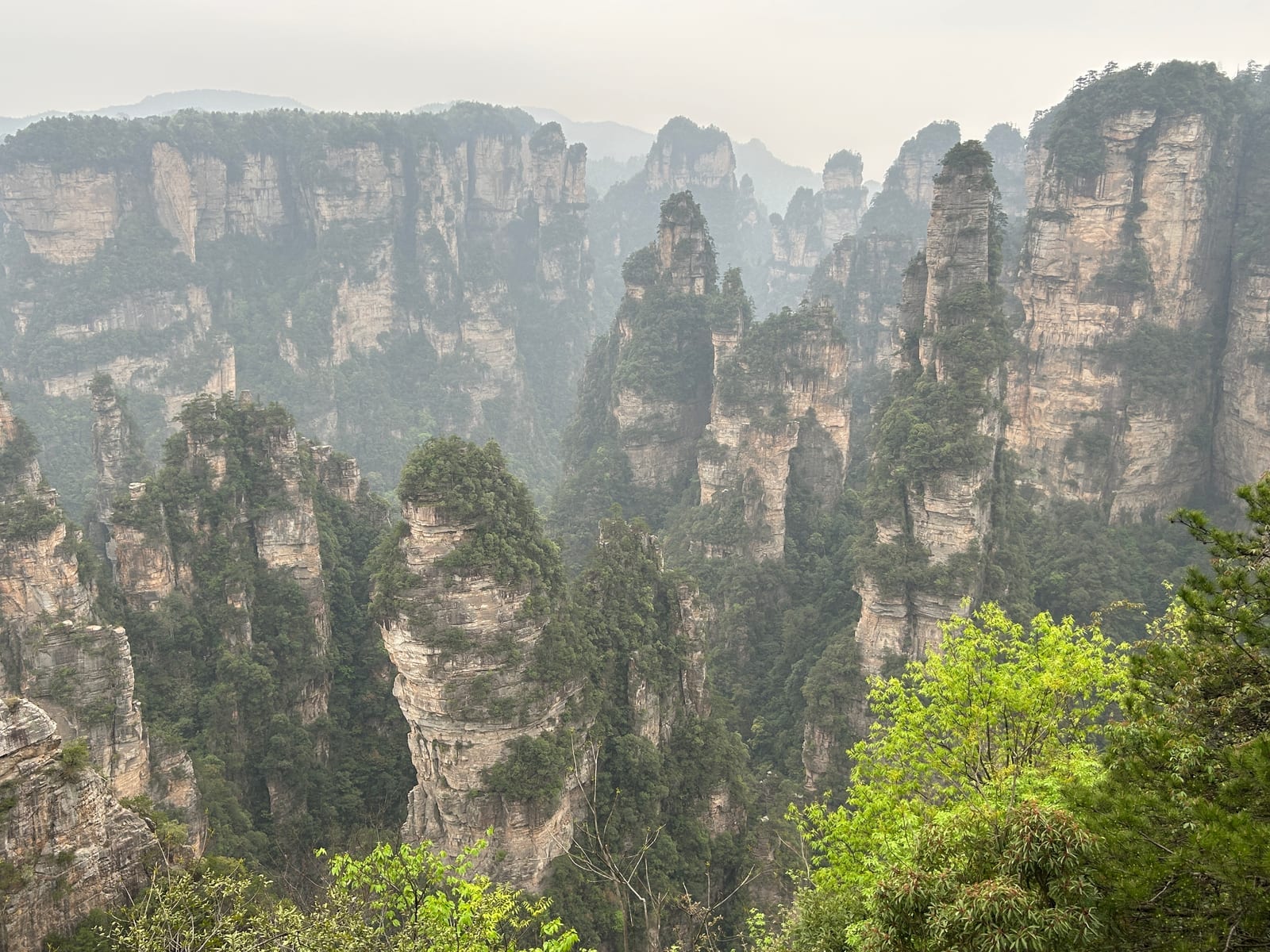
Thousands of quartz-sandstone pillars rise straight up from the valley floor, draped in green and wrapped in drifting mist until the peaks look like they are floating in mid-air. These are the real mountains that inspired the floating peaks of Pandora in Avatar — and the reason everyone comes to Zhangjiajie.
Picture it: you are standing at a railing on the Yuanjiajie clifftop. In front of you, countless pale-brown sandstone pillars rise a hundred metres or more, each crowned with pines and shrubs clinging to the rock. Thin mist slides between them, so a few pillars seem to hover with no base touching the ground — and then it clicks that this exact scene became the floating mountains of Pandora in Avatar.
That is Zhangjiajie National Forest Park (张家界国家森林公园) — the heart of the Wulingyuan Scenic Area (武陵源), a UNESCO natural World Heritage Site, in the Wulingyuan zone about 33 kilometres northeast of Zhangjiajie city. Inside are more than 3,000 quartz-sandstone pillars, shaped over millions of years by water and wind. The most famous spot is Yuanjiajie (袁家界), home to the Southern Sky Column that became the Hallelujah Mountain, and the First Bridge Under Heaven (天下第一桥), a natural stone arch linking two summits across a chasm about 357 metres deep.
What makes the place special is that it changes with the weather every single day. On a clear day every pillar stands out sharply; just after rain, the mist rises out of the valley until the peaks seem to float on cloud. Honestly, no photograph ever quite captures it the way standing there does — and whatever the season, everyone who comes to Zhangjiajie ends up here, because this is the centre of the whole trip.
From the valley floor up to the summits — each is a spot where everyone stops and raises a camera at once.
The clifftop terrace looking out over a valley full of sandstone pillars. This is where the Southern Sky Column (南天一柱) stands — the slender pillar the Avatar team photographed as a reference for Pandora's peaks. After the film's success in 2010 the authorities gave it the Hallelujah Mountain nickname. Come early after rain and the mist round the pillars looks just like the film.
A natural slab of rock that links two summits, eroded over time into a stone bridge roughly 357 metres above the valley floor. Walk out onto it and look down at pillar tops poking above the trees — one of the most thrilling spots on the whole of Yuanjiajie. Visitors like to fasten "love locks" along the railings.
Many people rate this the best panorama on Yuanjiajie. Stand here and the pillars stretch across the valley as far as you can see. The name means roughly "soul-losing platform" — the view is so absorbing you lose track of where you are. It is the favourite spot for photographing the morning sea of clouds.
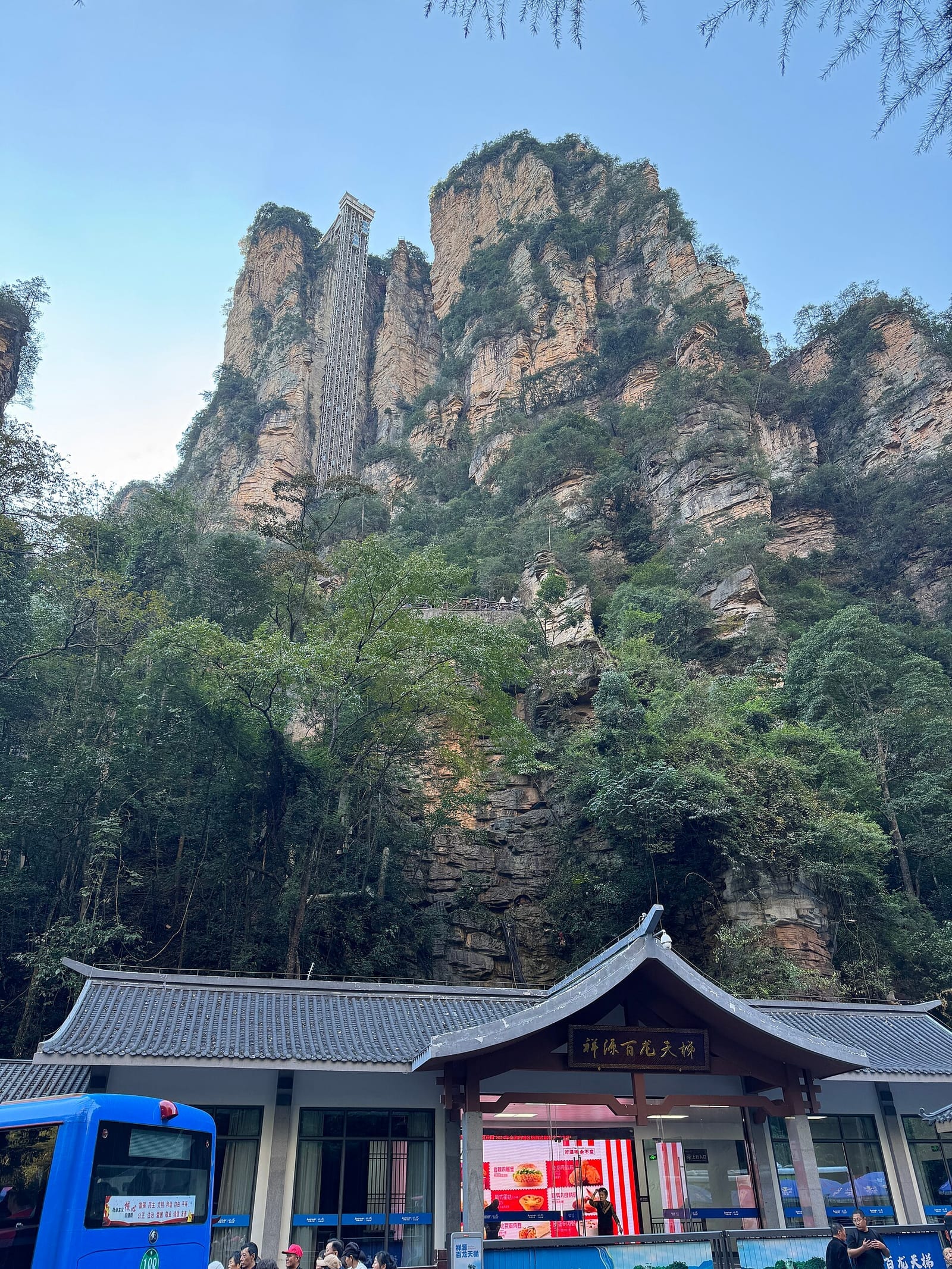
A glass elevator bolted to a sheer rock face that lifts you from the valley floor to the Yuanjiajie level in about 2 minutes — a record-holder as the world's tallest outdoor passenger lift. On the way up the pillar forest spreads out through the glass. It costs around ¥65 one way; allow time to queue in peak season. More in the Bailong Elevator guide.
A flat trail about 5.7 kilometres long that follows a clear stream at the foot of the pillars. Unlike the clifftop viewpoints, here you look up at the pillars from below in the shade. Wild macaques appear along the way, and there is the Golden Whip Rock. Everyone loves it for being easy and cool, about 2 to 3 hours. Read the Golden Whip Stream guide.
The entrance ticket is about ¥225 per person (~฿1,125) from March to November, and the part many people don't realise is that it is valid for 4 consecutive days. It covers the whole Wulingyuan area — Yuanjiajie, Tianzi Mountain, Yangjiajie and Huangshizhai — and includes unlimited rides on the park shuttle buses. The green buses loop between the scenic points all day and are free once you hold a ticket; there is nothing extra to pay.
What the ticket does not include is the Bailong Elevator (~¥65 one way) and the cable cars up Tianzi Mountain and Huangshizhai, which you pay for as you use them. Since June 2025 the park requires you to reserve or register in advance for every visit because it caps daily numbers. Book before you go and carry your passport, since the ticket is tied to your identity at the gate.
Yuanjiajie sits up on the ridge, so you have to climb from the valley floor — three ways. The Bailong Elevator is fastest, up in about 2 minutes with a great view on the way, but in busy periods the queue can run to an hour. Hiking the stair path is free with no queue but tiring, around 1.5 to 2 hours. Or take the cable car up Tianzi Mountain and do the ridge walk over to Yuanjiajie — good if you want the Tianzi sea of clouds in the same loop.
The popular plan many people use is to walk the Golden Whip Stream in the morning, when it is cool and quiet, then take the Bailong Elevator up later to explore Yuanjiajie — you get both the view from below and the view from the top in one day. With two days, you can pick up Tianzi Mountain and Huangshizhai the next day without rushing.
No season is "wrong" for Zhangjiajie; each gives a different mood. What is certain is that a morning just after rain stops tends to bring the most beautiful sea of clouds, making the pillars look like they are floating, just as in Avatar.
Stay in the Wulingyuan area to enter the park at dawn, or base in Zhangjiajie city — pick to suit the rhythm of your trip.