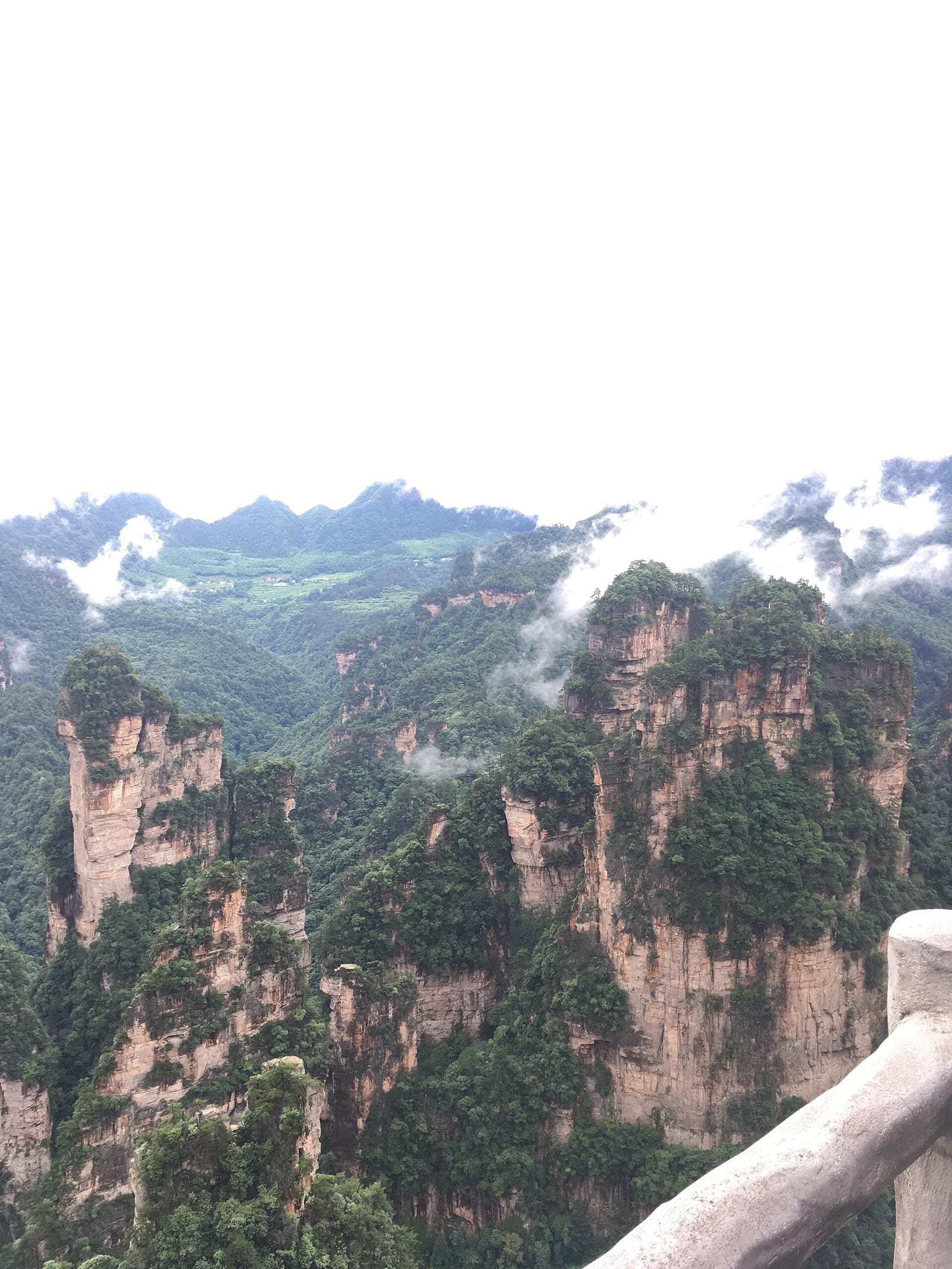
The viewpoint in the far north of Zhangjiajie National Forest Park, where rain leaves the valleys steaming the next morning and the cloud wraps thousands of sandstone pillars until only their tops break the surface, like islands in a white sea — the sight that gets people up before dawn to wait at Helong Park.
Picture this: you are up at five, on a park shuttle bus while the sky is still grey, reaching a clifftop railing while the air is still cold. In front of you is a white sea of cloud filling the valley, and one by one, two by two, sandstone pillars over a hundred metres tall break through it like floating islands. As the first light touches the peaks, the mist begins to drift — this is not a sight you see every day, but it is the one travellers come to Zhangjiajie chasing.
This is Tianzi Mountain (天子山, "Son of Heaven Mountain"), in the northern zone of Zhangjiajie National Forest Park, within the Wulingyuan (武陵源) World Heritage area. The name comes from Xiang Dakun, a leader of the local Tujia people, who once led an uprising here and declared himself "Tianzi", the Son of Heaven; later generations named the mountain after him. So the story is not only scenery — there is a local legend underneath it.
What sets Tianzi Mountain apart from the park's other lookouts is its "looking-down" perspective over the pillar forest. The standout viewpoints — Helong Park (贺龙公园), the Imperial Brush Peaks (御笔峰) and Fairy Presenting Flowers (仙女散花) — sit along the ridge, looking out over thousands of quartz-sandstone pillars marching to the horizon. Add a layer of mist, and the whole thing turns into a classical Chinese ink painting that happens to be moving.
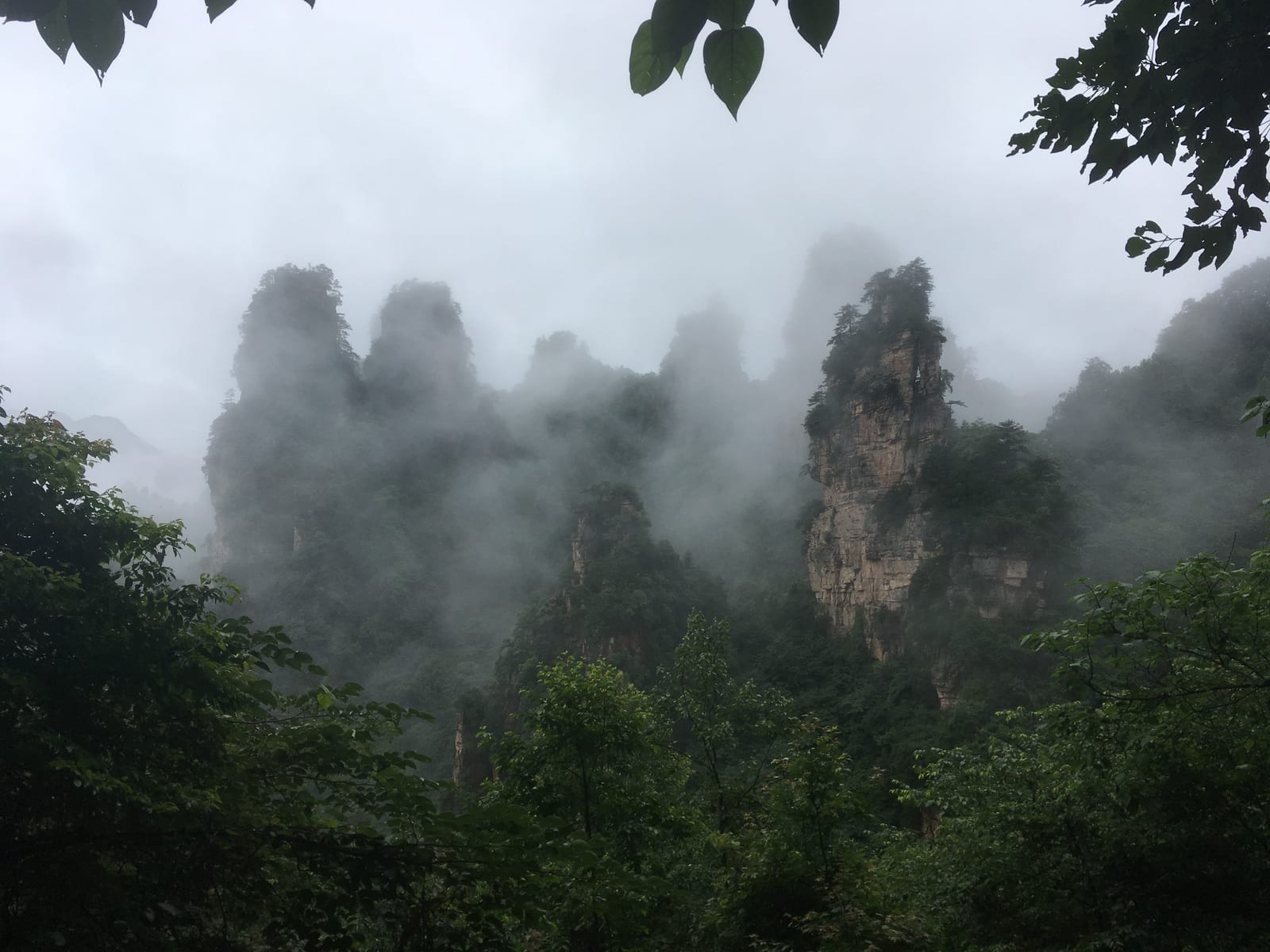
Once you are up top, a path along the ridge links the lookouts one after another, each one facing the pillar forest from a different angle — easy walking, no climbing.
The hub of Tianzi Mountain, a memorial garden built around a large bronze statue of General He Long, a local Tujia hero. From the terraces around it, you look out over the pillar forest as far as the eye can see, and this is where most people gather to wait for the morning sea of clouds. On a clear morning after rain, this is the spot where the photos come out best.
One of the most photographed views in all of Zhangjiajie: several pointed sandstone pillars standing in a row like Chinese writing brushes set in a holder, with a rounder rock beside them that people read as the emperor's seal. Legend says they are the brushes "Tianzi" threw away after losing his battle. The viewpoint is part of the West Sea Stone Forest (西海石林), a short walk from Helong Park.
A cluster of pillars that, from the right angle, looks like a young woman holding a flower basket, scattering petals into the valley — a view tied to a gentle folk tale. When thin mist drifts past, the rock really does seem to move. Many people find this the calmest, most still corner of the ridge.
Tianzi Pavilion (天子阁) is a multi-storey Chinese-style viewing tower; from its top floor you get a 360-degree view of the pillar forest. The West Sea Stone Forest (西海石林), meanwhile, is a field of pillars so dense it has been called an "enlarged bonsai" — thousands of them packed together, like a frozen sea of waves. It is the grandest scene on Tianzi Mountain.
It comes down to one word — "after rain". When rain falls overnight and the sky starts to clear at first light, the moisture in the valleys evaporates into white cloud that wraps the pillars, leaving the taller peaks poking through like islands. The golden window is early morning, around 6 to 9 am, because once the sun strengthens, the mist gradually burns off. The more humid, rainier months of March to October give you better odds than winter.
Honestly, the sea of clouds is a matter of luck and weather — no one can promise it on a given day. The trick that improves your chances is to stay overnight in or near the park and head up early, and to leave a few days' slack in your plan. The morning after an evening of rain is the one to watch.
The most pleasant weather, and the greenest scenery, runs from April to October, spring through early autumn, with enough rain to give you a shot at the mist. Winter (December to February) is bitterly cold, and in some years snow or ice on the pillars makes for a different kind of beauty — but on some days the cable car or sections of the trail close because of ice.
On crowds — Tianzi Mountain is on every tour's list. The times to avoid are the Chinese public holidays, especially Golden Week in early October, National Day on 1 October, Labour Day on 1 May, and the week of Chinese New Year, when the cable car and shuttle queues are very long. If you can, come on a weekday and head up early.
Tianzi Mountain shares the same park as Yuanjiajie (the "Avatar Hallelujah Mountain") and the Golden Whip Stream. Many people plan two days inside the park: on day one walk the Golden Whip Stream at the bottom and ride the Bailong Elevator up to Yuanjiajie; on day two take the park shuttle (about 40 minutes) over to the Tianzi Mountain side for the morning clouds. It all sits on a single ticket — nothing to buy separately.
If time is tight, order your days by the weather — on a morning with plenty of cloud after rain, commit to Tianzi Mountain that very morning, because the sea of clouds will not wait.
Tianzi Mountain is inside Zhangjiajie National Forest Park / Wulingyuan, about 33 kilometres northeast of the city. Zhangjiajie has no metro, so you take a vehicle from the city or the airport to the park first (around 40 minutes to an hour), and inside the park you use free shuttle buses and cable cars to get around — no driving yourself.
If you want to chase the morning clouds, stay in Wulingyuan near a park gate so you can be up at first light — or stay in Zhangjiajie city if you are also visiting Tianmen Mountain.