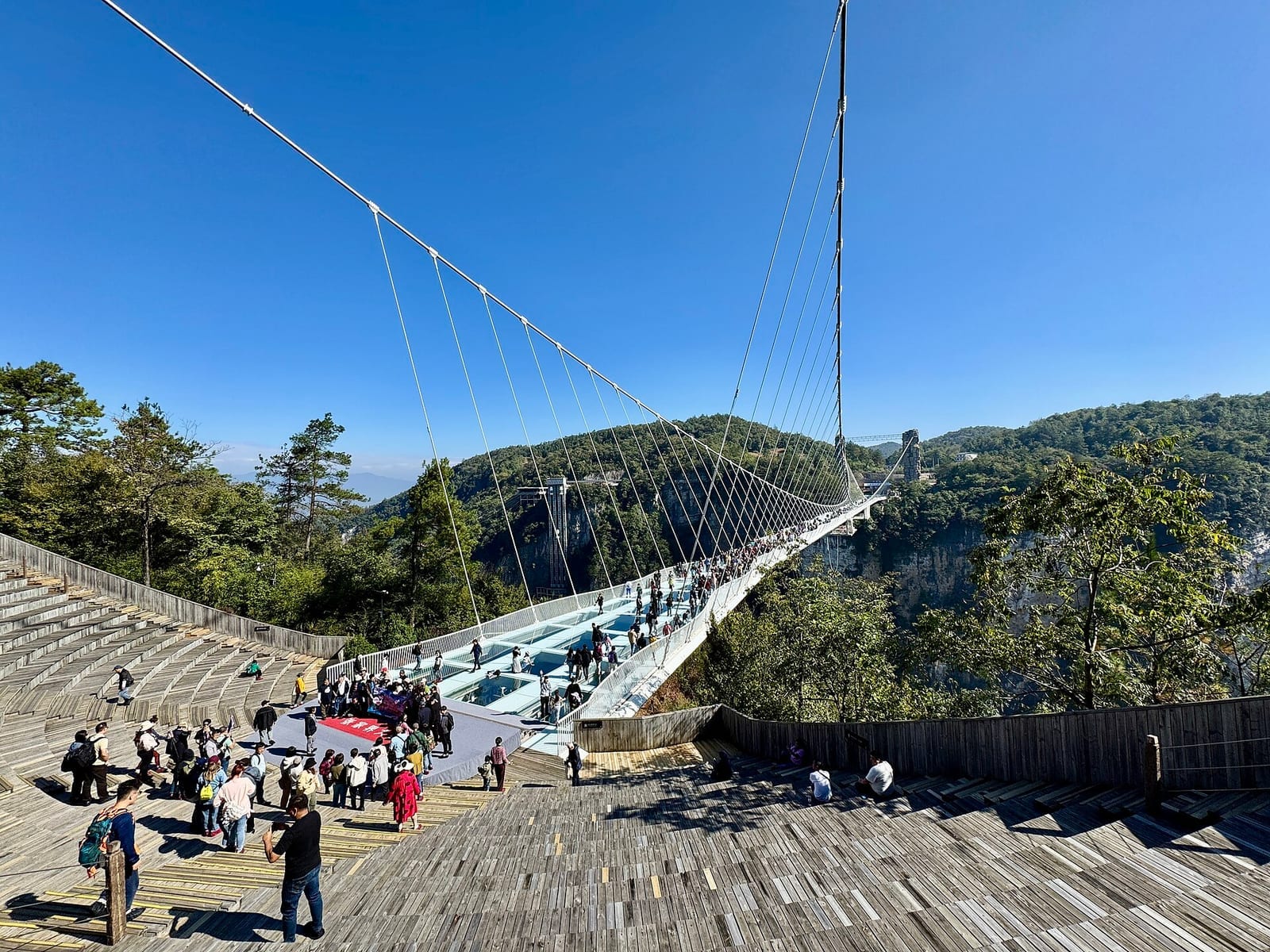
A glass-decked suspension bridge about 430 metres long, spanning the Zhangjiajie Grand Canyon roughly 300 metres up — one of the world's longest and highest glass bridges. That first step onto a clear floor, looking straight down through it at the treetops and the canyon below, is a feeling that argues with your own brain the whole way across.
Picture this: you stand at the end of a bridge stretched right across a wide canyon, sheer rock walls on both sides cloaked in green forest, the wind moving through the cables that hold it up. Then you step down onto the deck — which is not timber or concrete but clear glass — and look straight through it to the small treetops and the canyon floor some 300 metres below. Your brain knows it's safe, but your legs hesitate at every step. That tension is exactly the thrill that made this bridge famous worldwide.
This is the Zhangjiajie Grand Canyon Glass Bridge (张家界大峡谷玻璃桥), a glass-decked suspension bridge about 430 metres long and roughly 300 metres above the canyon floor. It opened to walkers in 2016, and when it did, it held records as both the longest and the highest glass bridge in the world at once. The deck you walk on is triple-layer tempered glass, engineered to carry a large number of people at the same time.
The key thing to understand before you go is that the glass bridge sits in the Grand Canyon, which is a separate place from Tianmen Mountain with its cliff-edge glass walkways, and separate again from the Avatar pillar park at Wulingyuan, the main draw of Zhangjiajie. The canyon is about 30 to 40 kilometres from Wulingyuan, so most people treat the glass bridge as its own half-day trip rather than a stop you slot in while hiking the pillars.
The glass bridge isn't only about "walking across" — up top there's the glass deck and a few daredevil add-ons, and below it lies an entire canyon you can hike down into.
The heart of it is walking on the clear glass deck, looking straight through to the canyon floor under your feet. Before stepping on, everyone puts on the felt shoe covers handed out at the entrance, which protect the glass and stop you slipping. The middle of the bridge is where your heart pounds hardest, since it's both the highest point and the furthest from either bank — plenty of people hug the railing, and a few sit right down on the glass for a photo.
In the middle of the bridge there's a bungee jump that has been billed as one of the highest bridge bungees in the world, plus a swing that throws you out over the canyon for anyone feeling brave. These cost extra on top of the entry ticket and usually need to be booked into a queue. If you're not jumping, you can stand and watch your friends scream their way down instead.
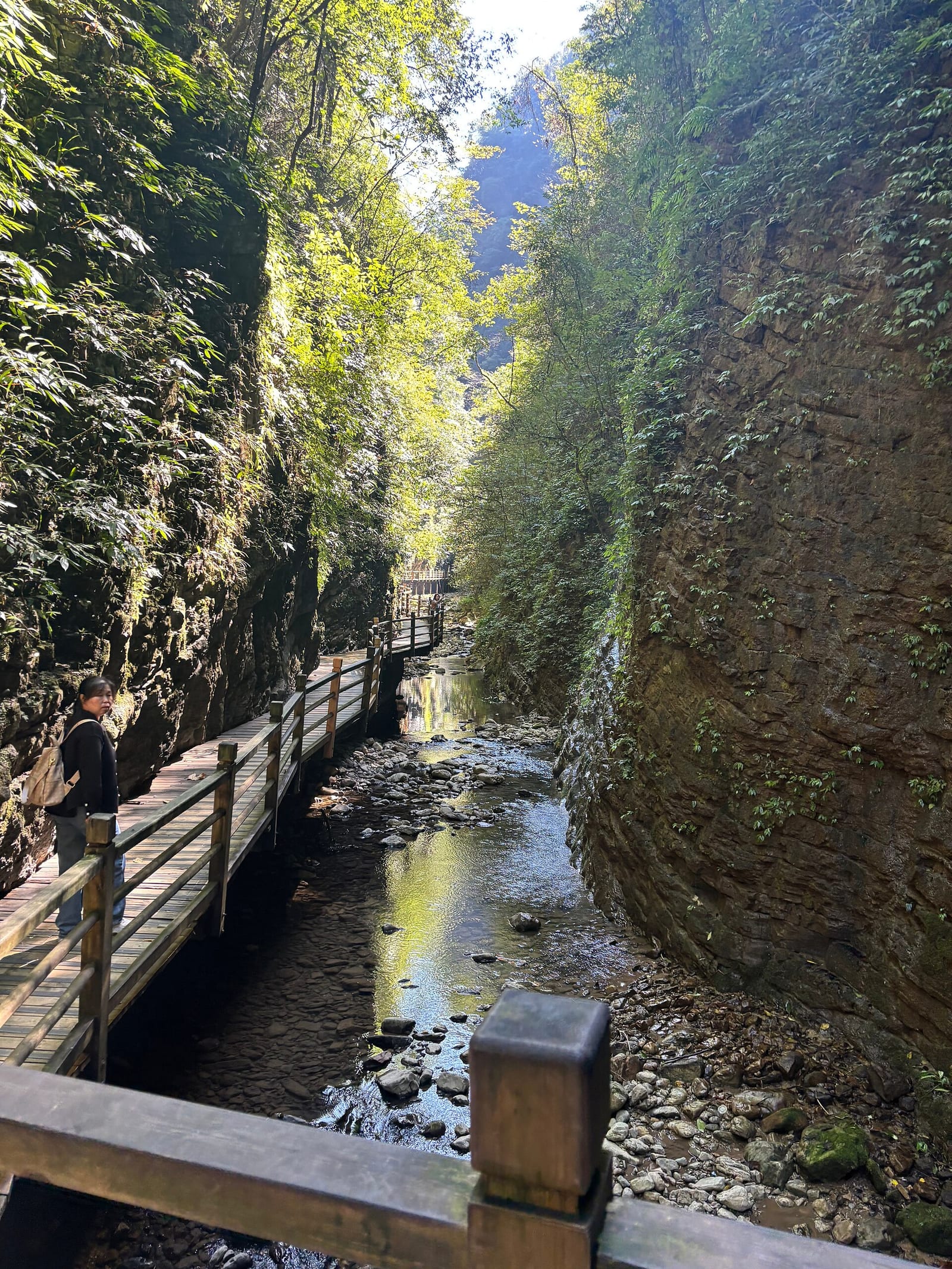
Below the bridge is the canyon walk, a route of wooden boardwalks and steps that hugs the cliff down to the canyon floor, past a clear cool stream, small waterfalls and tall rock walls that close in to narrow slots. It takes roughly two to four hours depending on the path, and the mood is the opposite of the bridge — shaded, quiet and a good deal cooler.
Most of the canyon walk ends at a small lake on the canyon floor, where there's usually a short boat ride to carry you back out. It's a welcome rest for the legs after all those steps down, and a different view of the canyon from water level. With a combined activities ticket, the boat is normally included in the package.
The one thing you can't get wrong here is that tickets are timed and capped per day. Over long weekends and in high season (July to August, Chinese public holidays) they often sell out by mid-morning, and turning up to buy on the day means a real risk of missing out. The advice is to book online in advance — at least 1 to 2 days ahead in the normal season, and 3 to 5 days ahead at peak times. Once booked, you're given a time slot, and you need to arrive for it.
The other thing is to pick the right ticket type: a canyon-only ticket does not include the glass bridge. You need one that specifically covers the glass bridge (玻璃桥). If you've come mainly to walk on the glass, don't accidentally buy the cheaper canyon-only ticket.
The canyon looks its best from spring to early autumn (April to October), when the forest is deep green and the stream runs clear. After rain the canyon can fill with delicate mist, which is lovely — though watch for a slippery glass deck and hazier views. In winter the air is bitterly cold, and on some days the bridge closes for strong wind or ice on the glass, so if you're going in winter, check whether it's open that day before you set out.
On crowds — this is a hugely popular photo spot, and early mornings and weekdays are far quieter and easier for taking pictures. The busiest stretches are the Chinese public holidays, especially Golden Week in early October and the week of Chinese New Year, when you can barely see the glass for the people standing on it.
Honestly, a glass floor looking down a 300-metre canyon really does play on the mind. Anyone with a serious fear of heights, or who gets dizzy easily, may feel uneasy from the very first step. The tricks that help: walk close to the railing, look straight ahead or out at the view rather than down at the floor, and keep moving rather than stopping in the middle. If you're with small children or older relatives, hold hands and avoid the most crowded slots.
The deck is strong and there are always people on it, but if you genuinely know you won't be comfortable, there's no need to force it — you can still explore the canyon down below, which is every bit as beautiful, without ever setting foot on the bridge.
The glass bridge is in the Grand Canyon, about 30 to 40 kilometres from the Wulingyuan area (where most people stay to visit the pillar park) and about 55 kilometres from Zhangjiajie city centre. Zhangjiajie has no metro, so getting there means a tour coach, a public bus, a taxi or a DiDi.
Most people stay in the Wulingyuan area for easy access to the pillar park, then take the glass bridge as a separate half-day trip; if you're focused on Tianmen Mountain, staying in the city centre works well too.