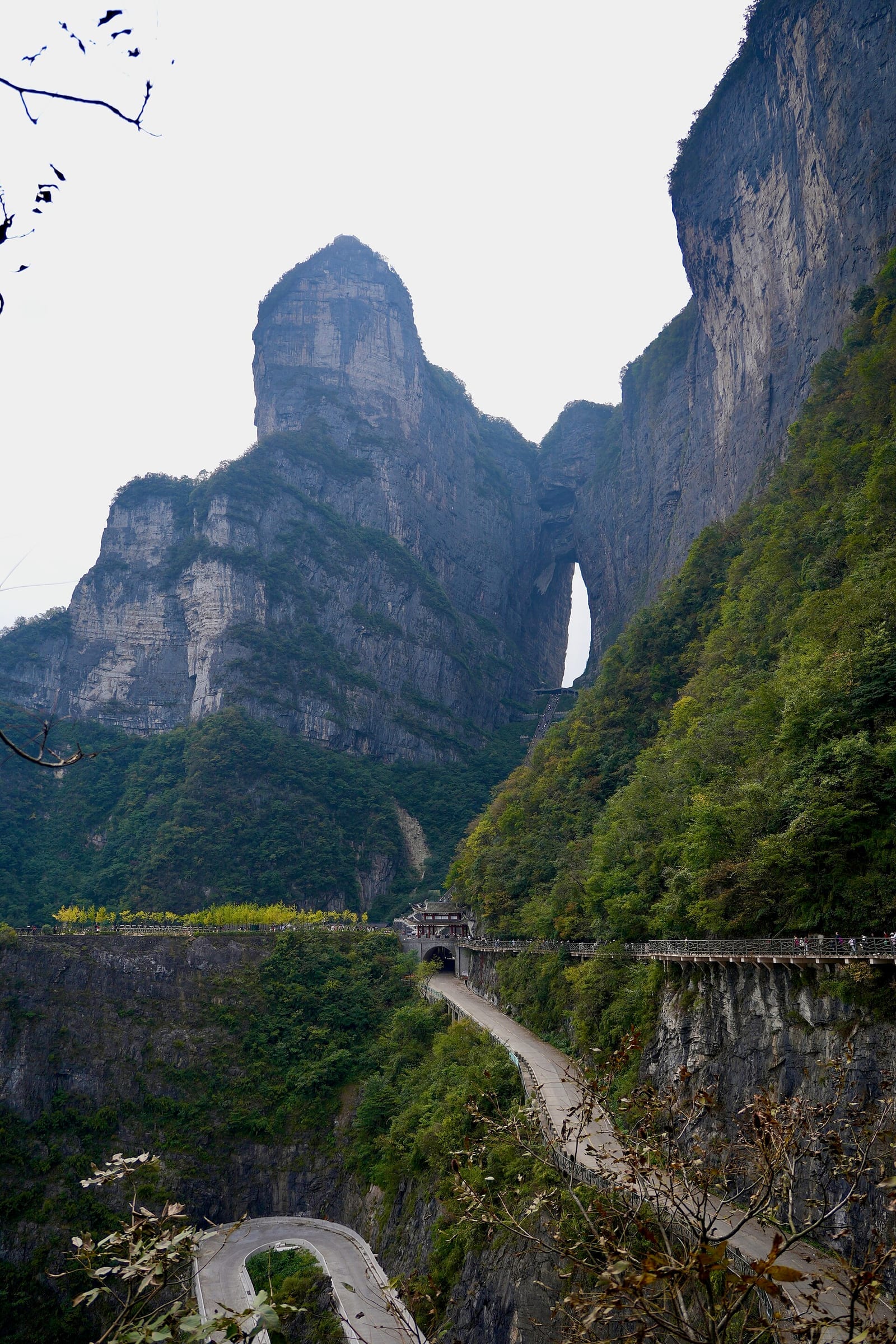
Ride a cable car nearly 7.5 km long straight up from the centre of Zhangjiajie, floating over rooftops and the 99-bend road to the summit — then walk a glass skywalk along the cliff at around 1,400 metres to stand before Heaven's Gate, a giant arch punched clean through the mountain into the sky.
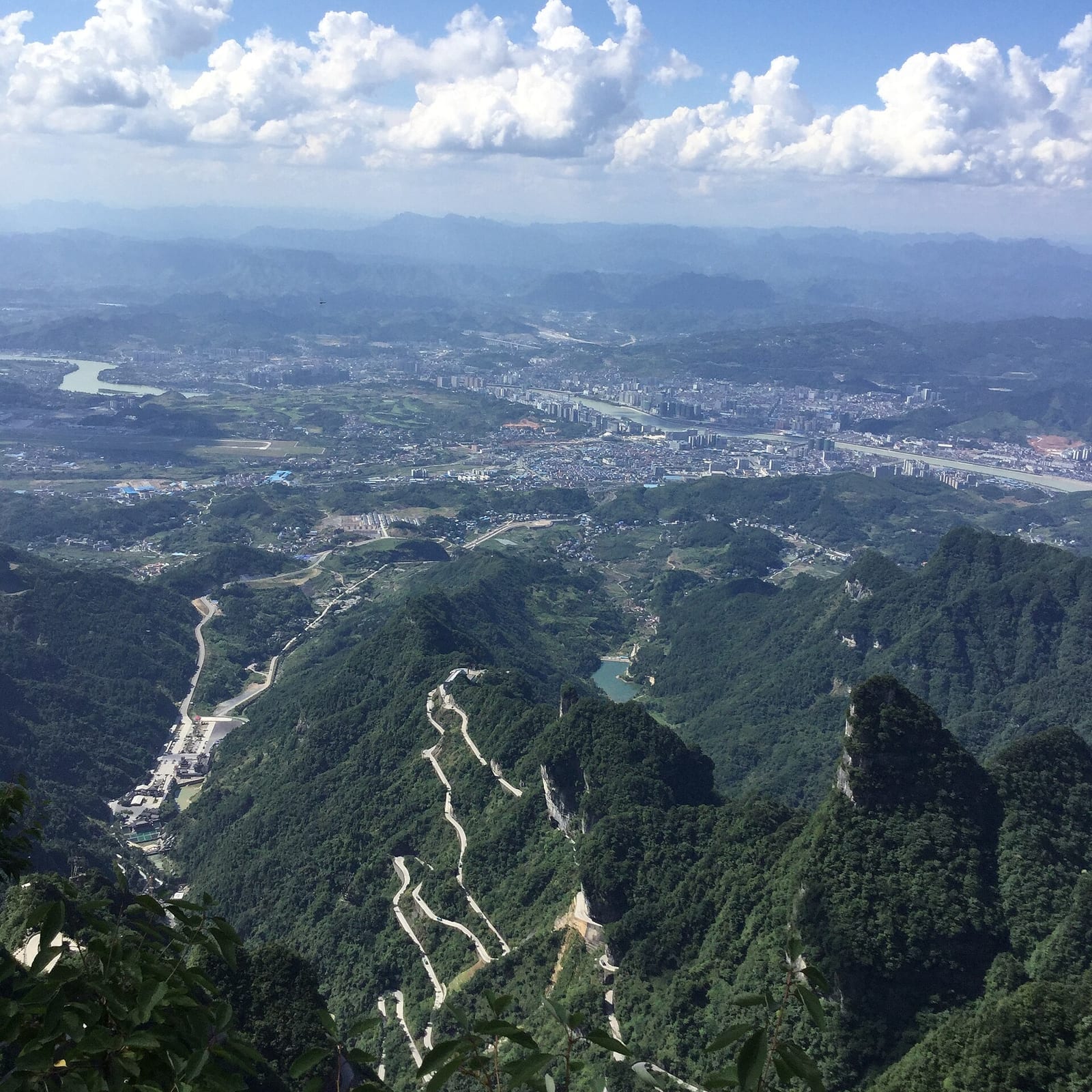
Picture this: you are in a small cable-car cabin slowly climbing out of central Zhangjiajie. Beneath your feet rooftops give way to fields, fields give way to green forest, and then the cable swings out over a road that coils like a snake through 99 hairpin bends far below, climbing higher until the clouds are at eye level. This cabin is riding the longest passenger cable car in the world, about 7,455 metres long (nearly 7.5 km), and it carries you from the city up to the roof of Zhangjiajie in one go.
Tianmen Mountain (天门山, "Heaven's Gate Mountain") is a flat-topped, table-shaped mountain about 1,500 metres high that rises right beside Zhangjiajie city, in Yongding District. What made it famous worldwide is the Heaven's Gate cave (天门洞) — a giant natural arch about 131 metres high cut clean through the cliff, which from a distance looks like a doorway opening through the mountain into the sky. Add a cliff-edge glass skywalk, the 99-bend road and a sea of clouds, and you have one of the two hearts of any trip to Zhangjiajie.
One thing to get straight first: Tianmen Mountain is "in the city". The strange sandstone pillars from the film Avatar, which is what many people picture when they hear Zhangjiajie, are at Zhangjiajie National Forest Park / Wulingyuan — a different place, about 30 km away, roughly an hour by road. The two are entirely separate and take a day each. We explain how to plan a split stay below, so you do not get confused when booking hotels.
From the world's longest cable car to Heaven's Gate, the glass skywalk and the 99-bend road — knowing them first makes the visit far better.
For many people this is the whole reason to come. The cableway runs about 7,455 metres (nearly 7.5 km) and climbs around 1,279 metres from the lower station in the city centre up to the summit, normally taking about 28 minutes. On the way you watch the city shrink, pass over the coiling 99-bend road below, and float in straight towards the Tianmen cliffs — a stretch where the camera barely gets a rest.
This is the signature image of Tianmen Mountain: a giant natural arch about 131 metres high and 57 metres wide, cut clean through the middle of the cliff — the source of the "Heaven's Gate" name, because from afar it looks like a doorway opening through the mountain into the sky. Below it climbs a steep stone stairway, the 999-step "Stairway to Heaven" (about 300 metres long). The number 9 stands for eternity in Chinese culture. If you are not up for all 999 steps, escalators inside the mountain take you up instead (for a separate fee).
Along the summit run several walkways pinned to the cliff face, some with clear glass floors jutting out over the drop at around 1,400 metres above sea level — look through the floor and the gorge falls away beneath your feet. The longest and most talked-about cliff path is the Guigu (Coiling Dragon Cliff) walkway, around 1.6 km, looping the rock face for wide-open views from a different angle. The glass sections charge a small extra fee of about ¥5 each for shoe covers, and if you are afraid of heights you can take the ordinary cliff path instead — it is not compulsory.
The Tongtian Avenue (通天大道, "the road to heaven") climbs from around 200 metres at the foot to about 1,300 metres in just 10.77 km, but packs in 99 hairpin turns along the way — the famous snaking-road shot. You see it from above out of the cable car, and on some routes you actually ride a park bus up the road, around 20 minutes of turn after turn that leaves more than a few people dizzy. Bring motion-sickness tablets if you know you are prone to it.
Once you are at the top, beyond Heaven's Gate and the glass paths there are viewpoints and easy forest trails along the summit ridge to wander. On mornings just after rain, a sea of clouds often hangs at cliff level, making the mountain look as if it is floating above them — a view many people come chasing. Up top there is also the old Tianmen Mountain Temple to visit, a calm contrast to the thrill of the cliff edge.
This needs saying plainly before you plan: since 6 November 2025 the upper section of the cableway (from the middle station up to the summit) has been closed for a major overhaul, expected to take about one to two years, and it is still under repair as of mid-2026. During this time the cable car only runs from the lower station to the middle station (about 10 minutes, down from 28), after which you continue by shuttle bus up the 99-bend road plus the in-mountain escalators.
The upshot is that Routes A and B now include an extra bus segment, while Route C is unchanged. You can still see everything — Heaven's Gate, the glass paths, the summit views — only the up-and-down sequence differs from the older guides you may have read. Before you go, check the latest cable-car status with your ticket seller or the official channels, since no firm reopening date for the upper section has been announced.
The Tianmen ticket lets you choose your up-and-down combination, normally split into three options that differ in whether you go up by cable car first or by bus-plus-escalator first — the idea being to keep crowds from bunching on one side. Route A is the most popular: cable car up first (the views while you are fresh), then down via the 99-bend road. Route B reverses it: up the 99-bend road first, down on the long cable car. Route C leans on the express cable car both up and down.
Honestly: if you want the full longest-cable-car-in-the-world experience and don't mind the queue, Route A is the favourite. But while the upper section is under repair (in 2026), every route has a bus segment slotted in, so ask your ticket seller which route gives you the most cable-car time right now, then decide.
Tianmen Mountain is high up, so it runs several degrees colder than the city and the wind can be strong — even when it is pleasant in town, bring a windbreaker or jacket for the summit. Wear comfortable, grippy shoes, because there is plenty of cliff-path walking and stair-climbing. Mornings after rain give you the best shot at a sea of clouds, but if the sky closes in or thick fog sets in, the view can vanish into cloud entirely — a mountain risk you cannot control.
On timing: because entry is by pre-booked slot and the ticket expires the same day, allow half a day to a full day and don't try to cram another sight into the same day. During the long Chinese holidays (Chinese New Year, National Day on 1–7 October, Labour Day) it gets very busy and the cable-car queues are long — avoid those windows if you can.
The best thing about Tianmen Mountain is that the lower cable-car station is right in the city centre, only about 1 km from Zhangjiajie Railway Station. Zhangjiajie has no metro or subway, so you get around the city by taxi, the DiDi ride-hailing app, or public bus — all of them easy and cheap.
After you come down from Heaven's Gate, the Avatar pillar-forest and the glass bridge are waiting.