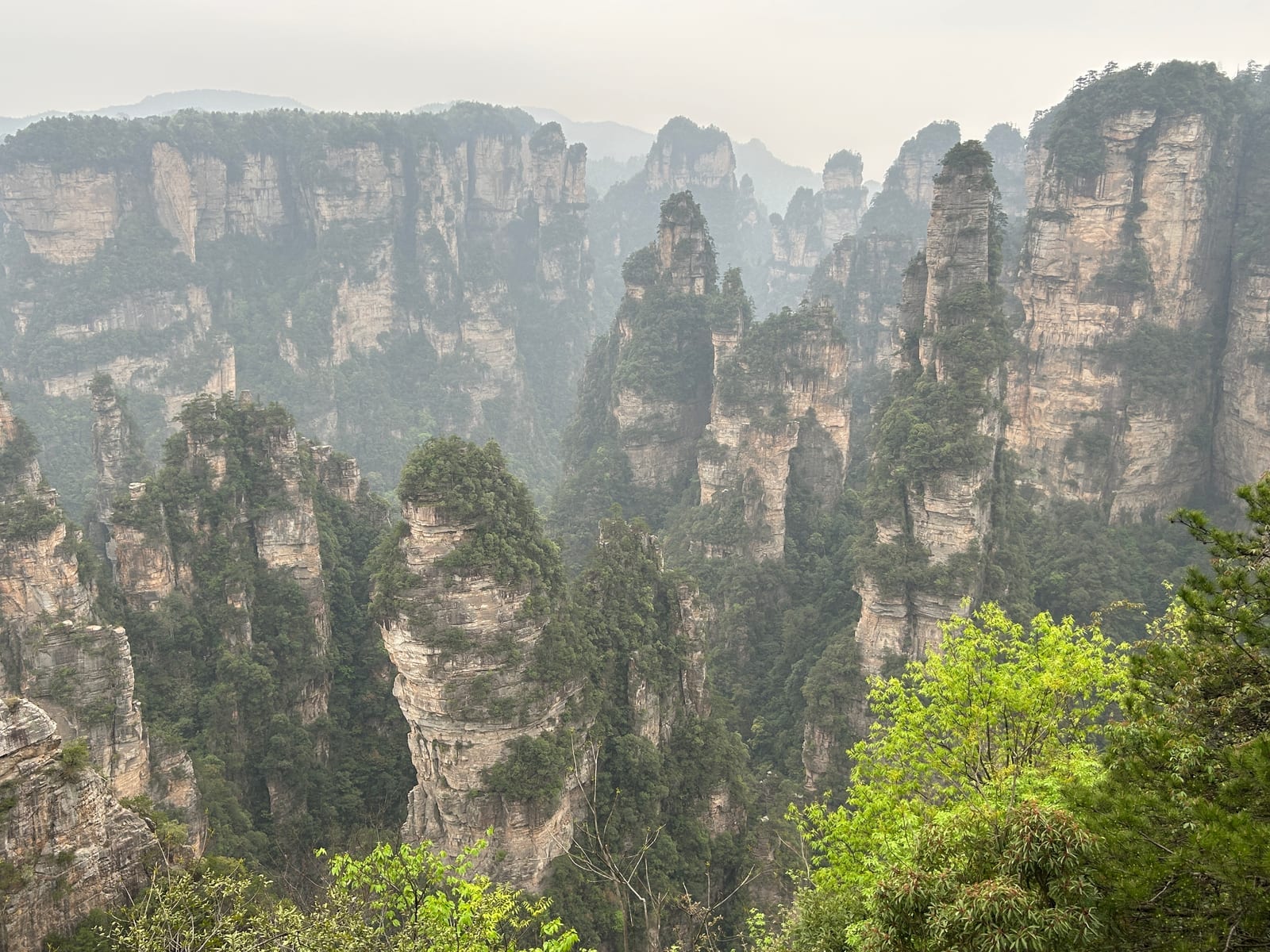
A glass elevator about 326 metres tall, bolted to a sheer cliff in the middle of Zhangjiajie's pillar forest. It carries you from the valley floor near the Golden Whip Stream up to the Yuanjiajie clifftop in about one to two minutes, sparing a steep climb that otherwise takes roughly three hours — then the glass doors open right where the Hallelujah peaks float in the mist.
Picture this: you have spent the morning walking beside a clear stream, you tip your head back at a cliff wall rising hundreds of metres straight up, and then you spot a clear glass column running up and down, pressed flat against that cliff — the Bailong Elevator. You step in, the doors close, and in barely one to two minutes you are lifted from the forest floor and let out on a clifftop that looks down over an entire forest of stone pillars. It is the shortcut that lets an ordinary walker stand on the very same ledge as someone who just spent three hours climbing stairs.
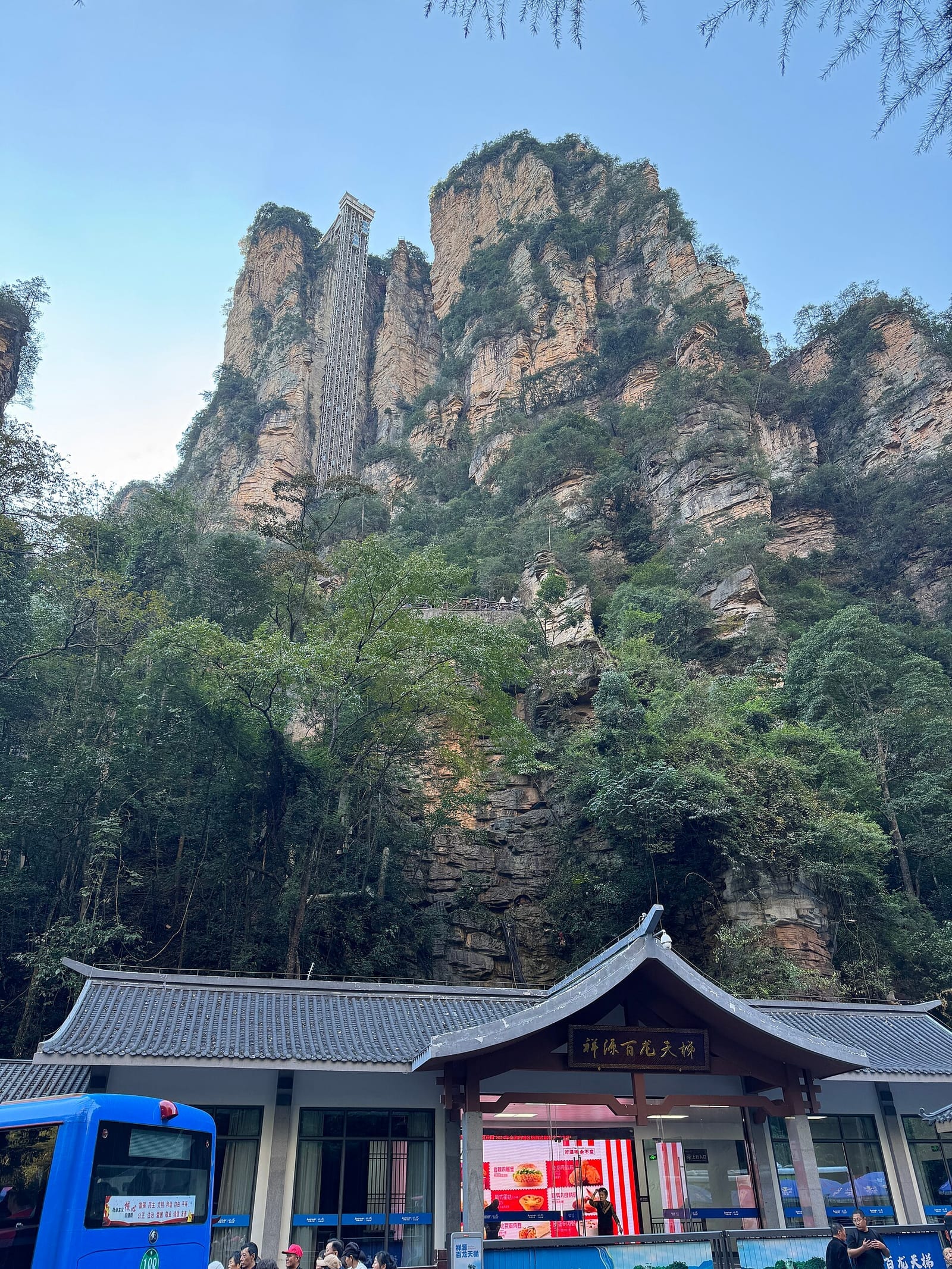
The Bailong Elevator (百龙天梯, the "Hundred Dragons Sky Ladder") is a glass outdoor elevator mounted flush against a sheer sandstone cliff inside Zhangjiajie National Forest Park, in the Wulingyuan area. It stands about 326 metres tall — the lower half running inside a shaft cut into the rock, the upper half projecting out beyond the cliff, glazed all round for the full view. It opened to the public in 2002 and holds three Guinness World Records — the tallest outdoor elevator, the tallest double-deck sightseeing elevator, and the fastest, highest-capacity passenger lift.
What makes this more than just a "lift up the mountain" is where it takes you — the upper station opens onto the Yuanjiajie (袁家界) clifftop, home of the Avatar Hallelujah Mountain and the First Bridge Under Heaven. The lower station sits beside the end of the Golden Whip Stream (金鞭溪) on the valley floor. The elevator effectively stitches the park's two levels together — down below you walk shaded paths along the water, up top you stand on the cliffs looking out over the pillar forest.
The ride splits clearly into two halves — the first inside a rock shaft, the second with the glass open to the view. Knowing the order means you won't miss the photo moment.
The lower station sits on the valley floor, near the end of the Golden Whip Stream. Most people walk the stream through the morning, then catch an in-park shuttle to this spot. As you queue up to the lift, you see the cliff wall rising vertically until you have to crane your neck — and it becomes obvious why people would rather ride than climb.
For the first stretch the elevator climbs inside a shaft cut into the rock of the cliff. This part is dark and short — you see only rock walls sliding past, and many people are still settling in. But don't put your phone away yet, because in a few seconds the scene changes completely.
As the lift clears the top of the shaft and projects out beyond the cliff, the surrounding glass opens the view all at once — thousands of sandstone pillars standing in front of you. On a day with mist drifting between the peaks it looks straight out of a film. This is the moment everyone in the car raises a phone together — stand on the outer glass side, facing the cliff, for the best view.
The doors open on top of the Yuanjiajie cliffs. A short walk brings you to the Avatar Hallelujah Mountain viewpoint (the pillar that inspired the floating scenery in the film) and to the First Bridge Under Heaven spanning a ravine. From here you can stroll on to the other clifftop viewpoints easily — no more climbing required.
The elevator ticket is charged per ride, with up and down paid separately, so many people choose to ride up in the morning (saving their legs) and walk down in the afternoon, or the reverse — climbing up to Yuanjiajie early while it's cool, then taking the lift down later. That way you pay for just one ride and still get a scenic walk through the forest path. If you want to climb the whole way on foot, allow about three hours, and expect continuous steep stairs — fine if you're a strong walker. If you're travelling with older relatives or small children, the lift is by far the easier answer.
Honestly, the hardest part of the Bailong Elevator isn't the ride — it's the queue. In peak season (roughly May to October) the line for the lift can run about one to two hours, and on Chinese public holidays or especially busy mornings it can top three hours. The simplest trick is to go as early as you can — if you can be inside the park before 8 am, your odds of a short queue are far better.
The times to avoid in particular are the Chinese public holidays — Golden Week in early October, National Day on 1 October, Labour Day on 1 May, the summer school break in July and August, and Chinese New Year. If you can't avoid them, build plenty of slack into your plan, and don't leave the lift as the last thing you do in the day.
The thing first-timers often miss is that the elevator fare is not included in the park entry ticket. The Zhangjiajie park ticket (around 225 yuan, valid for several days via fingerprint scan) covers entry and the free in-park shuttle buses, but the Bailong Elevator, the cable cars and the little monorail at certain points are charged separately on top. Carry money set aside for this — you can pay by Alipay/WeChat scan or at the ticket counter.
If you want the full picture of how the big park ticket works, which gate to use, and how to plan two days inside, read on at our Wulingyuan guide — the "how to actually visit" page for the whole area.
The elevator is deep inside Zhangjiajie National Forest Park (in the Wulingyuan area, about 33 kilometres northeast of the city). Zhangjiajie has no metro, and the lift can only be reached by the park's shuttle buses — so you enter the park first, then ride the in-park bus to a stop near the lower station.
For several days in the park, staying near the Wulingyuan gate makes coming and going easiest; if you also want to do Tianmen Mountain, base yourself in the city instead.