Every stop in detail with metro and tips
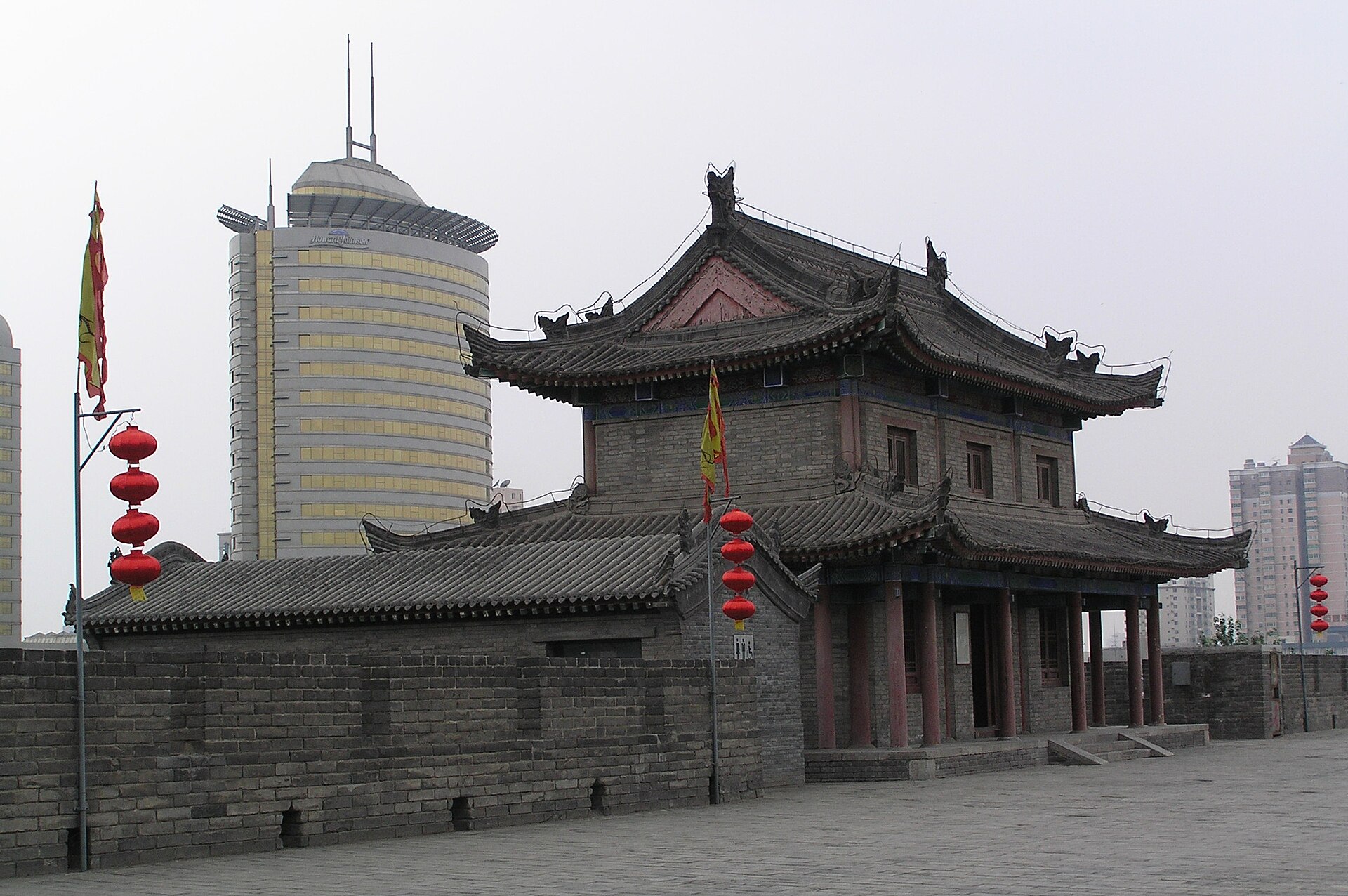
Start the day at the City Wall around 8:30 am, before the sun gets harsh and while the crowds are still thin. This is the most complete ancient city wall in China, built under the Ming dynasty in 1370 on the foundations of an earlier Tang wall — 12 metres high and wide enough on top for cars to pass each other. Go up, rent a bike, and ride the rampart: it is a closed loop, 13.74 kilometres all the way around, with the old city on one side and the modern city on the other for the entire circuit.
If you are short on time, you do not need the full loop — go up at the South Gate (Yongningmen 永宁门), the grandest and best-restored of the four, ride a half loop and turn back. The morning air on top of the wall is cool, and the red gate towers against the early sky are the first image of Xi'an that sticks.
Come down off the wall and head for the centre of the old city and the Bell Tower — a Ming-dynasty timber tower standing at the exact geographic centre of the walled city. The roundabout circling it is where the four main streets of the old town meet. Climb up for a view in every direction and a display of ancient bells. A few hundred metres away stands its twin, the Drum Tower — in imperial times the bell was struck at dawn and the drum at dusk to mark the hours for the whole city.
It is about a 430-metre walk from the Bell Tower to the Drum Tower across the central plaza, and just beyond the Drum Tower the mouth of the Muslim Quarter opens up — which is exactly the moment your stomach starts talking and the smell of grilling lamb drifts over.
Walk into the Muslim Quarter (Hui Min Jie) behind the Drum Tower — a network of food lanes where the Hui community (Chinese Muslims) has lived and cooked for over a thousand years. Both sides are lined with old halal restaurants, red signs in gold characters, clouds of lamb smoke and the rhythmic thud of dough being pulled into noodles. Lunch here means two things above all: roujiamo (肉夹馍) — spiced braised meat chopped and stuffed into a crisp baked flatbread, often called a "Chinese burger" — and yangrou paomo (羊肉泡馍), a lamb soup where you tear the flatbread into the bowl yourself.
Other things not to miss: liangpi (凉皮), cold wheat noodles in a sour-spicy dressing; grilled lamb skewers; and fried persimmon cakes (huanggui shi), the city's signature sweet. For the full menu and the shops locals actually go to, see the Xi'an food guide.
Take Metro Line 2 south from the Bell Tower (Zhonglou) to Xiaozhai (小寨), the closest station to the Shaanxi History Museum — one of the finest museums in China, holding over 1.7 million artefacts from every dynasty that made its capital in this region: Zhou bronzes, Tang tri-colour ceramics, gold dug from beneath the pagodas. Allow 1.5 to 2 hours inside.
From the museum it is about 800 metres southeast to the Big Wild Goose Pagoda (大雁塔) — a brick Tang-dynasty pagoda built in 652 AD to house the Buddhist sutras that the monk Xuanzang (the real-life Tang Monk) carried back from India. Climb to the top for a view across the south of the city, and walk the grounds of the Da Ci'en Temple that surrounds it.
Walk south down from the Big Wild Goose Pagoda and you arrive directly at Datang Everbright City — and this is the version of Xi'an that earns the trip. It is a long pedestrian street built in the architectural style of the Tang dynasty from end to end. As the sun drops (around 18:30 in winter, 19:30 in summer) the whole street lights up at once, the Tang-style buildings glow gold, and free live performances appear along the way: actors in period costume, poets reciting verse, lanterns in every shape. Walk it slowly the full length and end the trip there.
Dinner is right here — Tang-themed restaurants, cafés and street food along the strip. Or, if you would rather eat back in the old city, take Metro Line 3 or 4 from Dayanta straight back to the centre.
- The Terracotta Army — needs a separate half to full day, about 40 km outside the city. It cannot share a one-day in-city plan — you have to choose (see the decision box above).
- Mount Huashan — a sacred mountain outside the city that takes a full day, about 30 minutes away by high-speed rail.
- Huaqing Palace + the Qin tomb — these sit in the same direction as the Warriors, so save them to combine on the Terracotta day.
- The Great Mosque — it is inside the Muslim Quarter, so you can drop in over lunch if you have spare time, but skip it if the schedule is tight.