The plan, stop by stop with Metro, fares and tips
Start the day at Zhanqiao Pier (栈桥), a long stone pier reaching into Jiaozhou Bay with the eight-sided, red-roofed Huilan Pavilion (回澜阁) at its tip — the very image you have seen on cans of Tsingtao beer. Walk out to the end and you get the old town lined up behind you, with Little Qingdao islet (小青岛) and its white lighthouse not far off. Come early and you get thinner crowds and softer light, which photographs far better.
The pier sits right beside Qingdao Railway Station (青岛站), so if you arrive by high-speed train you walk out and you are basically there — a tidy place to begin the old-town line. Just west of the pier is No.6 Bathing Beach, which you can save for an afternoon stroll if you skip the ride out to No.1.
Walk a few blocks north to St Michael's Cathedral (圣弥厄尔大教堂), a twin-spire stone church in a Romanesque-meets-Gothic style that the Germans finished in the 1930s — the city's most photographed building, often with wedding couples posing out front. Inside is about ¥15. From there, climb Signal Hill (信号山), a low hill in the middle of the old town topped by a red mushroom-shaped tower with a rotating 360-degree viewpoint over a whole sea of red roofs set against the blue water. This is the view that makes Qingdao's old tag — 'red roofs, green trees, blue sea' — click into place.
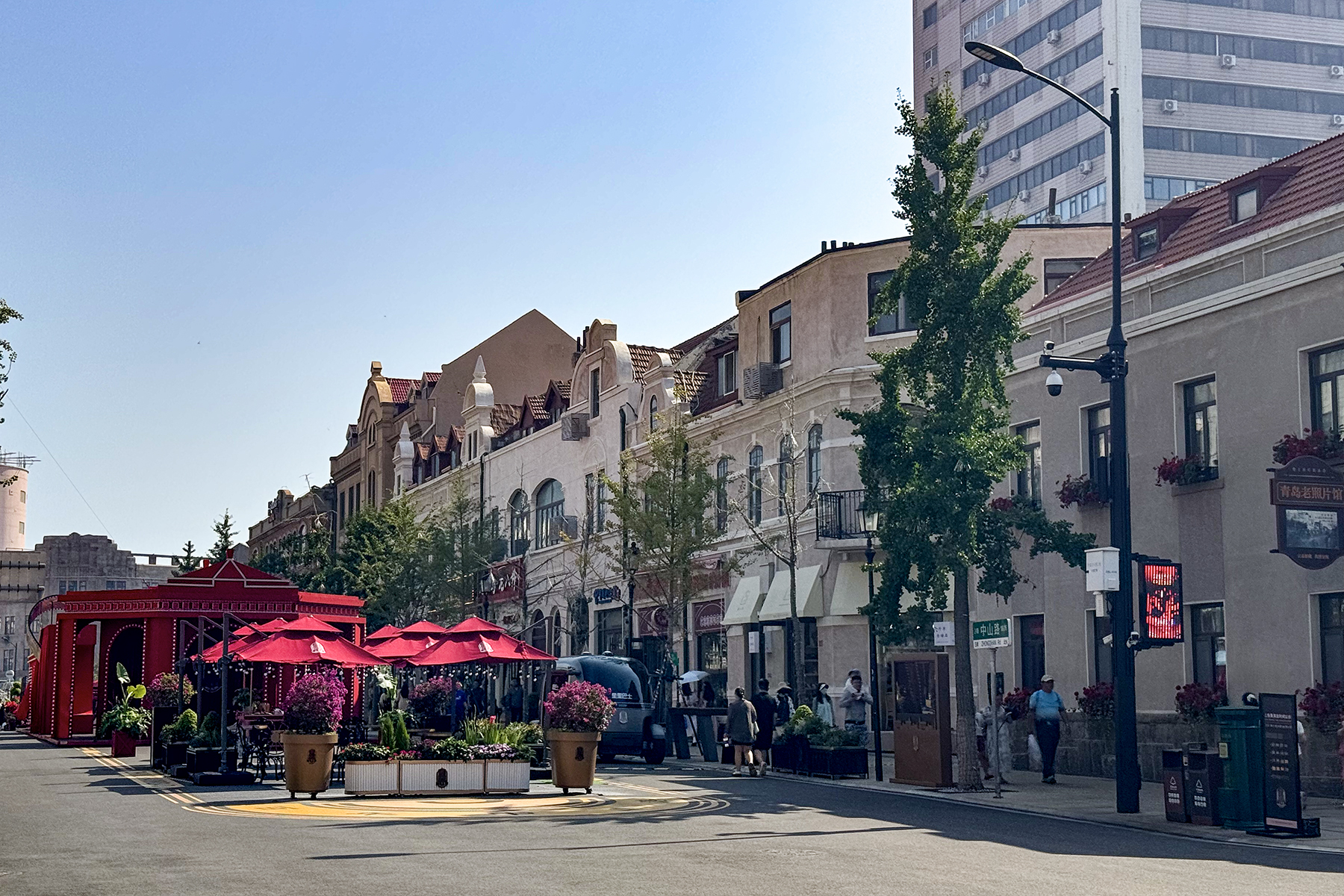
Come down and walk Zhongshan Road (中山路), the main colonial-era shopping street, recently restored, with handsome old facades, shops and cafés, and duck into Pichaiyuan (劈柴院), a historic food lane that was the city's original kitchen — graze on a few Shandong snacks to tide you over before lunch. To dig into every corner of the quarter, read the full Qingdao old town guide.
Grab lunch in the old town first. Qingdao is Shandong (鲁菜) and seafood country — try stir-fried clams, fried fish, or the local mackerel dumplings — then head for the sand. Two choices, depending on your mood. If you came to actually swim, take Metro Line 3 to No.1 Bathing Beach (第一海水浴场) and get off at Huiquan Square (汇泉广场); it is a roughly 580-metre stretch of fine sand with clearer water, the city's main swimming beach.
But if you would rather keep walking the old town and are not set on a real swim, No.6 Bathing Beach (第六海水浴场) sits right beside Zhanqiao Pier, an easy walk from the quarter. The sand is coarser and the water murkier, so it is better for photos and a relaxed stroll than for getting in. Pick this and you save the travel time and keep more of the old town.
In the late afternoon, shift east to the newer city. Take Metro Line 2 out to May Fourth Square (五四广场), a seafront plaza built around 'May Wind' (五月的风), a towering red steel spiral that is the symbol of the modern city. Behind it is Fushan Bay and a wall of skyscrapers. Stroll the waterfront, shoot the red spiral, and let the light soften before sunset.
This is the new-city centre, with malls, restaurants and a long seafront promenade that runs east to the Olympic Sailing Center (奥帆中心) just beyond. If you still have legs, walk that way for another angle on the bay — but for a one-day plan, settling in around May Fourth Square is plenty while you wait for the evening light show.
Close the day with the Fushan Bay skyline light show (浮山湾灯光秀), when the whole wall of towers along the bay shifts colour in unison — a giant choreographed display. It usually runs in the evening around 19:30–21:00 in summer and on holidays, in short bursts about every half hour (the schedule shifts with the season; in winter or on some weekdays it may not run, so check before you go). Watch from the south-side seafront promenade at May Fourth Square for the fullest view.
After the show it is time for what Qingdao does best — fresh Tsingtao beer with spicy stir-fried clams (辣炒蛤蜊). Find a seafood spot around Fushan Bay or head back to the old town, order draught beer in a plastic bag the way locals do, and pair it with a hot plate of clams. This is the supper Qingdao folk eat in every season. For more of what to try, see the full Qingdao food guide.
- Mount Lao (崂山) — the sacred seaside Taoist mountain on the eastern outskirts. Getting there and back plus the climb eats most of a day; save it for a 2- or 3-day plan.
- Tsingtao Beer Museum (青岛啤酒博物馆) — the historic 1903 brewery on Dengzhou Road, with a tour and draught tastings. Fun, but it runs 1.5–2 hours; for one day, draught beer at a restaurant is enough.
- Badaguan (八大关) — a district of old European-style villas under big shade trees, lovely for a long photo walk, but it is past No.2 Beach and needs extra walking time. Keep it for a day with more room.
- Olympic Sailing Center (奥帆中心) — the yacht marina used for the 2008 Olympics, just east of Fushan Bay. You can walk on from May Fourth Square if you have the energy, but it is not essential in a day.