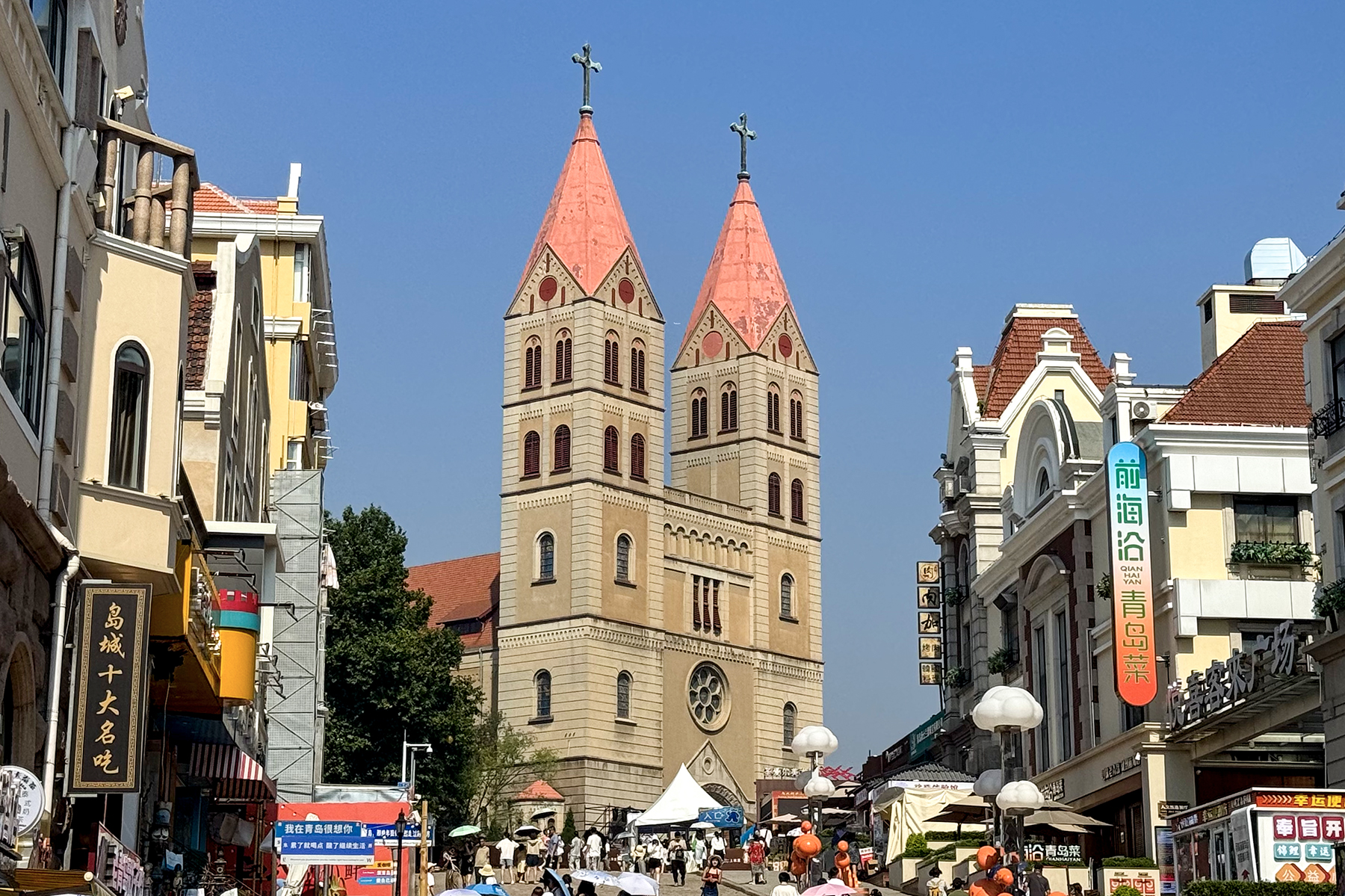
A living German colonial quarter by the bay — the old commercial spine of Zhongshan Road, red-roofed liyuan courtyard houses, the Pichaiyuan food alley going since 1902, and a twin-spire cathedral within walking distance. All in one area, all free to walk.
Picture this: you step out of a metro station, turn down a street, and suddenly you're surrounded by European stone buildings with red-tiled roofs, cafes with red parasols on the pavement, and people taking photos all day — and yet this is a city in Shandong province, China. A local will tell you that to really understand Qingdao you have to walk the old town, because this is Qingdao with the lights still on — not a museum, but a quarter where people still live, shop, and eat every single day.
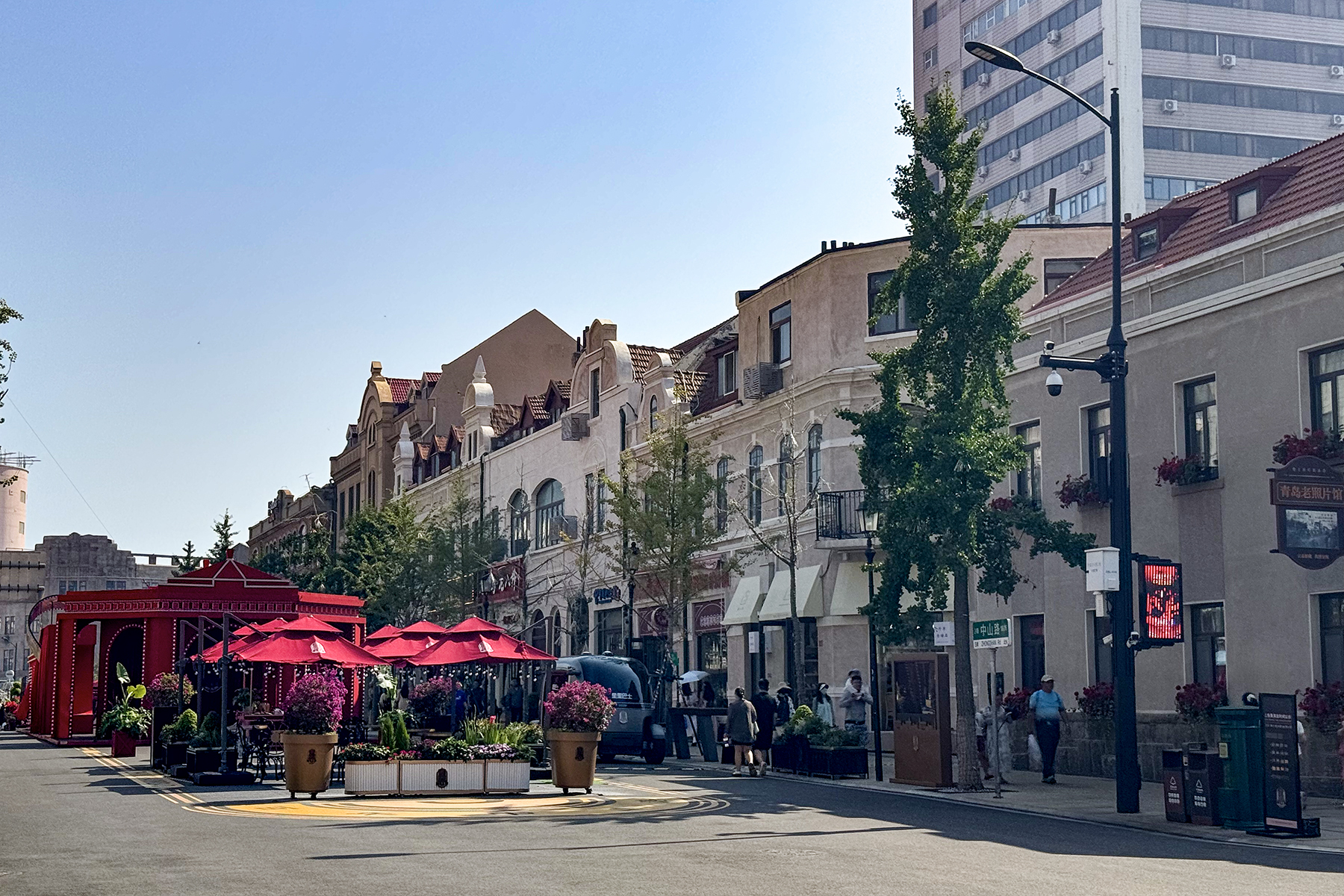
Qingdao old town (青岛老城区) took shape from around 1897, when Germany leased this port city and laid it out on a European plan. Its heart is Zhongshan Road (中山路 Zhōngshān Lù), the oldest commercial street in the city — older residents compare it to Nanjing Road in Shanghai and Wangfujing in Beijing. It runs from Zhanqiao Pier on the waterfront in the south up toward the north: the southern stretch is lined with European stone buildings, while the northern part is the liyuan (里院) courtyard quarter that is unique to Qingdao.
What makes this area worth more than an ordinary shopping street is simple: it's free to walk, and within a few square kilometres you get a hundred years of German architecture, local food in an old eating alley, a twin-spire cathedral, and bay views. Since 2022 the city has carried out a major restoration here under the principle of "restoring the old as it was" — documenting more than 372 old courtyards and repairing them with minimal intervention, so the quarter never froze into a museum. Instead it came back to life with cafes, design shops, and festivals through the year.
Know the four key parts before you set off, so you pace it right and don't miss the good stuff.
This is the street everything in the old town branches off. Near the waterfront you'll see grand European stone buildings — many were once early banks, which is why people half-jokingly call this Qingdao's "Wall Street". Walk north and the buildings gradually shift into old courtyard houses. The ground floors today hold brand shops, cafes, and Qingdao souvenir stores, and it's comfortable to stroll all day. It's the best place to start the walk.
If Zhongshan Road is the shopfront, Pichaiyuan is the kitchen behind it. The alley began as a firewood market ("pichai" means firewood), and the entrance arch marked "1902" tells you plainly this is the city's oldest eating alley. It's a narrow T-shaped lane packed with food stalls. Try the spicy stir-fried clams, Spanish mackerel dumplings, and seafood soup buns, plus oven buns, tofu pudding, pan-fried dumplings, and charcoal-grilled seafood. From about 18:00–23:30 it's at its liveliest, with the smell of charcoal grills drifting through the lane; daytime is quieter and good for a slow browse of the old shops.
This is architecture you won't find anywhere else. The liyuan (里院) blends the Chinese courtyard house (siheyuan) with European row houses — two- to three-storey timber buildings with red-tiled roofs, shops on the ground floor and homes above. The Dabaodao quarter has more than 160 of these courtyards, many freshly restored into cafes, design shops, and stylish restaurants. Stepping in off an old lane and into an inner courtyard that's become a cafe is the particular charm of this part of town.
A short walk uphill from Zhongshan Road, a twin-spire granite Catholic church rises at the top of the street — this is St Michael's Cathedral, the largest Gothic-style building in the Qingdao area, completed in 1934. The plaza in front is a hugely popular photo spot, especially for couples shooting pre-wedding portraits. Going inside costs around ¥10 (~฿50). For opening hours and mass times, see our St Michael's Cathedral guide.
The route that flows best is to start at the water and walk uphill into the old quarter. Try pacing it like this:
1. Zhanqiao Pier → begin at Zhanqiao Pier (栈桥) on the seafront, the city emblem that appears on the Tsingtao beer label. Photograph the bay and the Huilan Pavilion, then walk up into Zhongshan Road.
2. Zhongshan Road → head north past the early bank buildings, stopping for a cafe or a souvenir shop.
3. Pichaiyuan alley → turn into the food alley near Beijing Road for local snacks (busiest if you come in the evening).
4. St Michael's Cathedral → walk uphill to Zhejiang Road and photograph the plaza in front of the church.
5. Dabaodao quarter → finish by wandering the liyuan courtyards and settling into a cafe in an old courtyard.
If you have time and want the bird's-eye shot, walk on a little further to Signal Hill (信号山), a small hill with a rotating viewing platform. Looking down, you see the red-tiled roofs of the whole old town set against the blue bay — the view that makes it instantly clear why Qingdao is called the "city of red roofs". Right nearby is the former German Governor's Residence (迎宾馆), worth a look too.
The real local food is concentrated in the Pichaiyuan alley and the side lanes — try the spicy stir-fried clams that locals eat with beer, the city's signature Spanish mackerel dumplings, and fresh charcoal-grilled seafood. For more ideas on what to eat and where, see our Qingdao street food guide and the full Qingdao food guide.
One tip: the stalls in Pichaiyuan sit in prime spots, and some charge more and cater to tourists. For better value and fresher food, step into the side lanes or ask a local which stall is the good one — you'll usually find something great at a friendlier price.
Qingdao has a metro, which makes the old town very easy to reach. The quarter itself is a maze of narrow, hilly streets, so the best approach is to take the metro or a bus and walk in from there.
The restored old town has become a hugely popular photo spot — there are queues to shoot the red-roofed European corners all day. If you want a cleaner frame, come in the morning before the crowds. The best light is mid-to-late afternoon, when the sun hits the building facades head-on.
Long holidays mean big crowds: during National Day Golden Week (1–7 October), Labour Day (1 May), and the summer Qingdao Beer Festival, the quarter gets shoulder-to-shoulder. If you have a choice, come on a weekday.
Wear comfortable shoes: Qingdao's old town is hilly, and climbing from the waterfront up to the cathedral and Signal Hill is more tiring than it looks. Trainers help a lot.
Be ready to pay by QR: most stalls take Alipay/WeChat Pay first; link a foreign card in the app before your trip and it's seamless. Cash still works, but some small stalls can't make change.
Check prices before ordering in the food alley: some stalls in Pichaiyuan price for tourists, especially grilled seafood sold by weight. Confirm the price clearly before you order so there's no surprise at the till.
Stay in the old-town waterfront area — walk to Zhongshan Road, the Pichaiyuan alley, Zhanqiao Pier, and the cathedral with ease.