About 2 hours north of Guilin, the Zhuang and Yao peoples have been carving rice terraces into these hillsides for more than 600 years — ridge upon ridge of curving steps that people came to call the "Dragon's Backbone." This guide helps you choose between Ping'an and Dazhai, time the terraces to the right season, and plan the trip from Guilin without missing the famous gold.
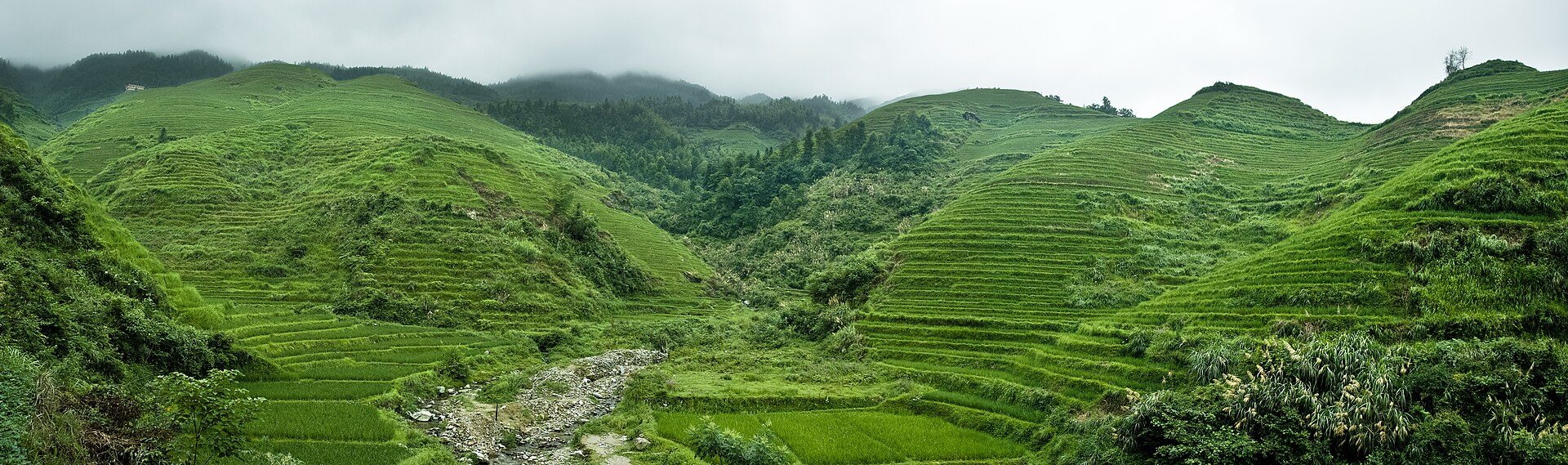
Most people come to Guilin for the Li River cruise, but if you ask which image of Guilin the whole world recognises, the answer is the Longji rice terraces (龙脊) — paddies that the Zhuang and Yao peoples carved into the hillsides one step at a time over more than 600 years, from the Yuan to the Qing dynasty. The curves of the fields follow the ridgelines and stack into ribbons that look like scales on a dragon's back, which is how they got the name "Longji," meaning the Dragon's Backbone.
Longji sits in Longsheng (龙胜) county, about 2 hours by road north of Guilin — not a place you can reach by direct train. You have to go by tour or bus (more on that below). The main sightseeing area splits into two zones, and the question everyone asks is which one to visit: Ping'an (平安), the classic, easier-to-reach Zhuang village, and Dazhai/Jinkeng (大寨/金坑), the Yao village with wider terraces and a cable car.
Here's the thing about Longji: it isn't equally beautiful every month. The fields change colour with the farming cycle — the mirror water that reflects the sky after planting, the deep green of summer, and the most famous of all, the gold of the harvest around mid-September. So making the most of Longji isn't a matter of "any day will do" — it's about matching the season to the picture you want. This guide helps you plan the zone, the season and how to get there all at once.
The first question everyone faces is "which area?" The two zones differ clearly — in how much you walk, the views and the culture. Pick by the time and the legs you have.
If you only have one day and don't want a heavy hike, start with Ping'an. If you have time and want wider, more dramatic terraces — or you want to stay over for sunrise — go for Dazhai. And if you have two full days, you can do both, because the views really are from completely different angles.
Ping'an is the Zhuang village tourists have visited the longest — easier to reach, with viewpoints that aren't a huge climb. It has two famous lookouts: Seven Stars Around the Moon (七星伴月), a round, moon-like terrace ringed by seven small piles of rocks villagers left while working the fields, and Nine Dragons and Five Tigers (九龙五虎), where the ridges split into nine ribbons like dragons bending to drink. It suits people short on time or visiting for the first time.
Dazhai is a Yao village set in the Jinkeng valley, where the terraces are wider and more dramatic. It has three main viewpoints, and the special part is the cable car up to Golden Buddha Peak (金佛顶) — the only Longji viewpoint you can reach by gondola. It is ideal if your legs aren't up for endless steps, and it's the zone many people recommend for an overnight stay to see the fields at first light.
The Longji ticket is paid once and covers both zones, so with two days it's worth doing both — walk Ping'an and shoot Seven Stars Around the Moon in the afternoon, stay the night, then move to Dazhai in the morning and ride the cable car to Golden Buddha Peak. The two zones have completely different moods. For the full rundown of every viewpoint, see our Longji rice terraces sights guide.
Honestly, Longji involves a lot of walking. The viewpoints are up on the ridges, reached mainly by climbing stone steps (the cable car in Dazhai helps for some of it). Wear comfortable shoes, save your energy and allow at least a full day. And the views depend on the weather — overcast, lightly misty days often give better photos than bright sun, while heavy rain can leave you seeing almost nothing. Check the forecast before you go.
Ping'an's two viewpoints are the heart of the zone. Seven Stars Around the Moon is a round, moon-shaped terrace in the centre, ringed by seven small piles of rocks the villagers left while digging the fields — from a distance it looks like seven stars accompanying the moon. Nine Dragons and Five Tigers is the lookout where the ridges split into nine ribbons that resemble dragons bowing to drink, with five small hills said to crouch like tigers. You reach both by climbing steps up from Ping'an village, around 20–40 minutes each depending on your pace; start with the nearer one, then walk to the far one.
The Dazhai/Jinkeng zone has something Ping'an doesn't: a cable car up to the highest, widest viewpoint in Longji — Golden Buddha Peak (金佛顶). The gondola leaves from the Dazhai car park and takes about 20 minutes to the top, costing around ¥60 one way or ¥100–110 (about ฿500–550) for a round trip. If your legs aren't up to it, or time is tight, ride up to Golden Buddha Peak and walk down through the other viewpoints — you'll see the whole Jinkeng valley of terraces from above, a view many people find more dramatic than Ping'an. (Ticket prices change with the season, so check on site.)
On the way in to Ping'an you pass Huangluo long-hair village, a Red Yao village where the women grow their hair long by a tradition handed down through generations — many of them over a metre, which earned the village a Guinness World Record as "the world's first long-hair village." There is a Yao cultural performance here, with hair-combing and traditional song and dance. It's a chance to see indigenous life up close — just visit with respect, ask before photographing people, and remember this is a real community where people live, not a stage set.
What makes Longji special isn't only the terraces but the Zhuang and Yao villages still living up here. Traditional three-storey wooden houses line the slopes, many of them now guesthouses and local restaurants. Walk through a village and you'll see people growing rice, weaving and selling local goods. Local dishes worth trying include rice cooked inside bamboo tubes and Longji black-feathered chicken. To see what Guilin eats, read our Guilin local cuisine guide and try oil tea (youcha), the local drink of the Longsheng area.
Most visitors come and go in a single day, which works and is still beautiful — but if you can, we recommend a night in a guesthouse on the terraces, whether in Ping'an or Dazhai. The most beautiful time is the early morning and sunrise, when mist drifts over the fields and the first light catches the steps — something day-trippers never get to see. The other bonus is the late afternoon, once the tour groups have all left, when the village goes quiet and feels like yours alone. Terrace guesthouses start from a few hundred yuan a night; a room facing the fields is the one worth booking.
The terraces change colour with the farming cycle and look quite different month to month. Knowing this before you go lets you pick the window that matches the image in your head.
After the farmers plough the fields and flood them ready for planting, the terraces fill with water that mirrors the sky and clouds like a thousand panes of glass. Photographers love this window, especially in the soft morning and evening light, from roughly mid-April to June (the exact start depends on each year's rains). The mirror-water shot is at its best when the sky is clear with handsome clouds to reflect.
Once the rice grows tall, the whole valley turns a vivid green — the lushest, most alive the mountains ever look. The trade-off is the hot, humid weather and the heaviest rain of the year. Downpours can shroud the views in mist or make walking hard, but the upside is fewer crowds than the gold season and that classic Chinese-painting mist drifting up after the rain.
This is the window that puts Longji on magazine covers and postcards worldwide — the ripe rice turns the entire valley shimmering gold before the villagers bring it in, around mid-September to early October (the exact dates shift with the weather each year). It is the most beautiful and the most crowded time at once. One caution: it overlaps with China's National Day Golden Week (1–7 October), when the whole country travels — book accommodation well ahead, and if you can, go a week before or after Golden Week for far smaller crowds.
In winter the fields lie bare after the harvest, but some years bring a light dusting of snow over the terraces — a rare and beautiful sight of a different kind. It's cold and often misty, with the fewest visitors of the year, ideal if you want quiet and don't mind fields without rice. Just be aware that snow doesn't come every year and the mountain road can get slippery, so check the weather and road conditions before you go.
You have two options: stay over in a village on the terraces for sunrise, or day-trip and sleep comfortably in Guilin city — it depends on the rhythm of your trip.
If you want the early-morning mist and sunrise, you have to stay in a village on the terraces — Ping'an and Dazhai both have plenty of family-run guesthouses, some of them traditional wooden houses facing the fields, from a few hundred yuan a night; a room with a terrace view is the one worth choosing. The upside is you wake up to the fields; the catch is simpler facilities and dragging your bags up steps to get there (some guesthouses can arrange a porter — check before booking).
If you'd rather not stay up in the mountains, the easier option is to visit Longji on a day trip and come back to a hotel in Guilin city — especially if your trip also includes the Li River cruise and the city sights, where a city base is more flexible. Not sure which district to pick in the city? Read where to stay in Guilin for first-timers first, then compare real hotels below.
To say it again — no train runs directly to the Longji terraces. Everyone goes by tour or bus, then a local bus or a walk up to the village. Choose the method that fits your budget and how much convenience you want.
~07:30 — Leave Guilin by tour or an early bus; allow around 2 hours up the mountain (add time for the winding road).
~09:30 — Arrive at the terraces and pick a zone: for Ping'an, climb to Seven Stars Around the Moon and stop at Huangluo long-hair village on the way; for Dazhai, ride the cable car to Golden Buddha Peak.
~12:30 — Lunch in the village; try rice cooked in bamboo tubes and Longji black-feathered chicken.
~14:00 — Walk the remaining viewpoints, take photos and watch village life.
~16:00 — Set off back, reaching Guilin in the evening; finish the day with dinner in the city.
Day one — Arrive at Longji in the afternoon, check into a terrace guesthouse (choose a room with a field view), and walk the viewpoints in the late afternoon as the tour groups start to leave — the village is quiet and the evening light is lovely. Have dinner in the village.
Day two — Wake before dawn and climb to a viewpoint for sunrise and the mist drifting over the fields (the highlight day-trippers miss). Mid-morning, move to the other zone or ride the cable car at Dazhai, then head back to Guilin in the afternoon.
To fit Longji into a longer Guilin trip, see the 4-day Guilin itinerary or the 5-day itinerary, which usually give Longji a full day. To continue on to the karst-scenery base at Yangshuo, see the Yangshuo area guide.