West Lake at golden hour, an ancient pagoda on a wooded hill, a 1,700-year-old Zen temple in a green valley, and tea terraces that run to the horizon — forty-eight hours is exactly enough to feel the best of this city.
Two days is tight, but it is not too tight. Hangzhou's icons cluster in two distinct zones — the lake and the western hills — and the city rewards a slow, focused pace far more than it rewards rushing. This plan covers everything a first-time visitor genuinely needs to see: West Lake, which Chinese poets have written about for a thousand years; an ancient Zen temple set deep in a green valley; and the Longjing tea hills that produce China's most famous green tea.
It is built for travellers with limited time — a short weekend, an add-on from Shanghai (the high-speed train is only about 45–60 minutes), or anyone testing the waters before a longer stay. Day 1 circles West Lake, all on foot and easy on the legs. Day 2 heads out to the western hills for temples and tea. What this plan deliberately excludes: the Grand Canal, the Xixi Wetland and a day trip to Suzhou (each needs a half-day or more to be worth it). If you want those, see the full Hangzhou attractions guide and add a day.
The single most useful thing to do before you arrive: book a hotel on the east shore of West Lake (Hubin) or in the downtown Wulin district — both put the lake and the metro within easy reach. See the top 10 Hangzhou hotels for options at every budget.
The Bai Causeway at dawn, a cruise to the island on the ¥1 banknote, the Su Causeway in the afternoon, Leifeng Pagoda at sunset, and street food on a Qing-dynasty lane after dark.
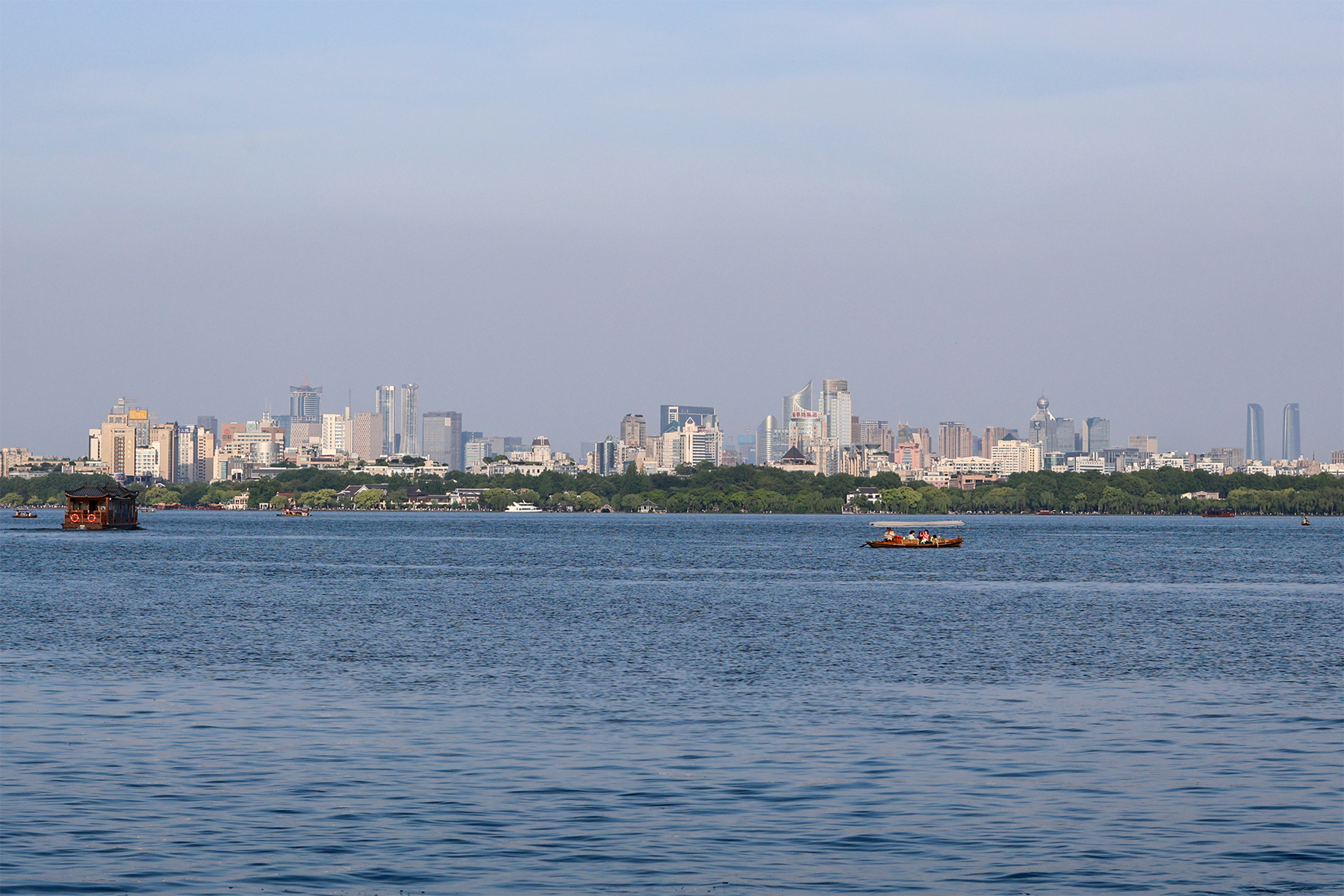
Leave the hotel early — aim to be at the lake by 8 am, when a thin mist still hangs over the water and the crowds are thin. Start on the north-east shore and walk the Bai Causeway (白堤), a long path that crosses the lake lined with alternating willow and peach trees. At the far end is Broken Bridge (断桥), the setting for the Legend of the White Snake, with a small island just beyond it.
West Lake is a UNESCO World Heritage site, the subject of Chinese poetry for over a thousand years, and free to enter all the way around. The best way to take in the views is a lake cruise out to the islet called Three Pools Mirroring the Moon (三潭印月) — the three small stone pagodas that appear on the ¥1 banknote. The loop takes about an hour.
After lunch by the lake, walk the Su Causeway (苏堤) — a 2.8-kilometre dyke that the poet Su Dongpo had built a thousand years ago, running north to south straight through the middle of the lake, with six arched bridges and shade trees the whole way. If your legs start to flag, rent a bike and ride the lakeshore instead (public bikes are everywhere, unlocked by scanning Alipay).
The afternoon's destination is Leifeng Pagoda (雷峰塔) on a hill at the south side of the lake. The original was built in AD 975 and collapsed in 1924; the current tower is built over the excavated ruins and has a lift to the upper levels. Time your climb for around 4:30–5:30 pm to watch the sun set over the whole of West Lake — the last light catches Baochu Pagoda across the water and the wooded hills around the shore. Locals call this view "Leifeng Pagoda in Evening Glow", one of the Ten Scenes of West Lake.
Come down from the pagoda and take a short bus or DiDi ride to Hefang Street (河坊街) at the foot of Wushan Hill — a Qing-dynasty pedestrian street, free to enter and at its liveliest after dark. Red lanterns line both sides, and you will find the historic Chinese medicine hall Huqingyutang (胡庆余堂), open since 1874, alongside fan shops, silk shops, Longjing tea sellers and rows of street-food stalls. Try the black-sesame sweets and the fishball soup, and watch the sugar artists shape animals from molten sugar on the spot.
For dinner, try one genuinely local Hangzhou dish — Dongpo pork (东坡肉), pork belly braised in soy and Shaoxing wine until the fat is almost translucent, named after the poet Su Dongpo, or West Lake vinegar fish (西湖醋鱼), freshwater fish in a sweet-and-sour sauce. Popular, well-priced chains like Grandma's (外婆家) and Green Tea (绿茶) serve both for ¥60–120 per person. See the Hangzhou food guide for more.
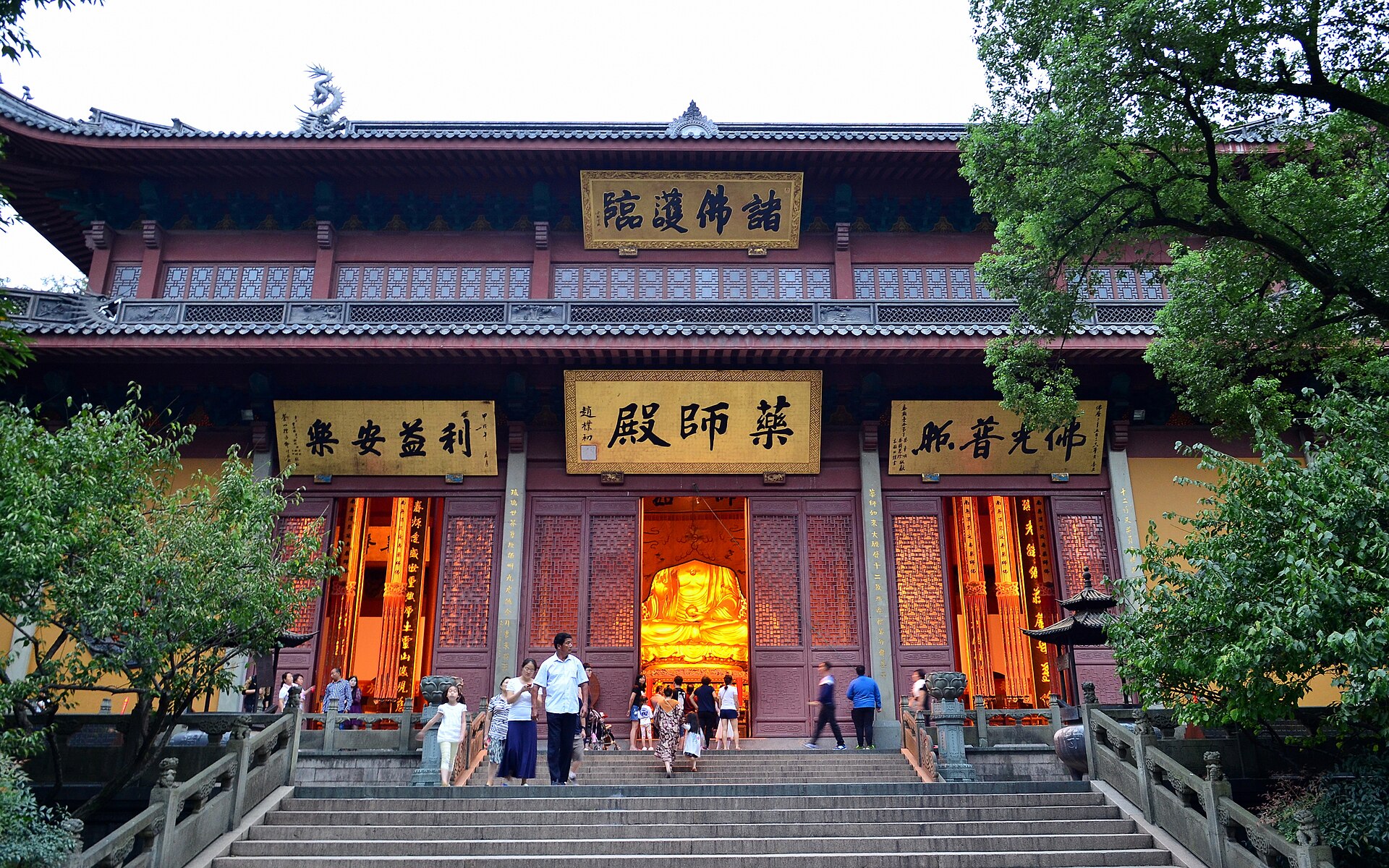
A 1,700-year-old Zen temple in a green valley at dawn light, the thousand-year rock carvings of Feilai Feng, terraced green-tea hills to the horizon, and a cup of Longjing tea before you head home.
Start early again — take bus 7 or 1314 from the lakeshore to the Lingyin stop (there is no metro to the temple itself). Lingyin Temple was founded in AD 328 and is one of the most important Zen (Chan) temples in China. The Mahavira Hall houses a gilded camphor-wood statue of Sakyamuni Buddha about 24 metres tall, and the incense, the chanting and the centuries-old trees around the grounds make for an unexpectedly peaceful morning. Allow about 1.5 hours.
Before you reach the temple itself comes Feilai Feng (飞来峰) — a limestone outcrop carved with more than 300 Buddhist and Taoist figures dating from the 10th century onward, set along the cave walls and the stream. The most famous is the broad-bellied, grinning Maitreya Buddha. Good news for 2026 — since December 2025, Feilai Feng is free to enter, leaving only the ¥30 admission ticket for Lingyin Temple itself.
From Lingyin, take a short bus or DiDi ride over the hill to the Longjing tea village and the nearby Meijiawu tea plantation (梅家坞) — terraced hillsides planted with green tea as far as you can see. Longjing (Dragon Well) is China's most famous green tea: flat, smooth leaves, pan-roasted by hand. Walk through the rows, watch the farmers roasting the leaves, then find a garden teahouse to sit with a cup of freshly brewed Longjing and the view of the terraces.
For lunch, try a garden-house meal in the village — chicken stewed with tea leaves, spring bamboo shoots, and river shrimp stir-fried with Longjing tea leaves (Longjing shrimp 龙井虾仁), a Hangzhou signature. Prices are gentler than in the city and the setting is quiet. Before you leave, pick up some Longjing tea to take home — taste first, and compare prices across a few shops.
In the late afternoon, head back into the city — if you still have energy and the light is good, return to the west shore of West Lake for one more look at the evening light from a different angle, or go back to your hotel to rest, pack and get ready to move on.
For a farewell dinner, choose a Hangzhou restaurant by the lake or in the Wulin district and order something you have not tried yet — West Lake vinegar fish if you had Dongpo pork at the first dinner, or beggar's chicken (叫化鸡), chicken wrapped in lotus leaves and baked in clay, ¥80–200 per person. If you have an evening train back to Shanghai, leave about 40 minutes to reach Hangzhou East railway station by metro Line 1 or 4.
For this plan, the east shore of West Lake (Hubin) is the most practical base — you can walk straight to the lake and the shopping streets. The downtown Wulin district is a good alternative if you would rather be near the metro and the malls. Mid-range hotels run ¥350–650 per night. See the top 10 hotels or the 6 best lakeside luxury hotels.
Metro plus bus covers every stop in this plan. Metro Line 1 runs past the lakeshore (Longxiangqiao) and out to Hangzhou East railway station, while Lingyin Temple and the Longjing hills need bus 7/27/87 (no metro reaches them). Metro fares ¥2–9, bus fares ¥2, paid by scanning Alipay or WeChat Pay QR.
Set up Alipay (international version, linked to a foreign Visa or Mastercard) before you leave home. Most shops, buses and the temple booking system accept Alipay or WeChat Pay only — some do not take cash at all. See the Alipay & WeChat Pay setup guide for step-by-step instructions.
| Category | Budget | Mid-range | Comfortable |
|---|---|---|---|
| Hotel (1 night) | ¥120–250 (hostel / guesthouse) |
¥350–550 (3–4 star) |
¥700–2,000+ (4–5 star) |
| Food (3 meals/day) | ¥70–110 (local restaurants) |
¥120–220 (mix of local & casual) |
¥280–550 (restaurants + teahouses) |
| Bus/metro (both days) | ¥15–25 | ¥20–40 | ¥50–120 (+ occasional DiDi) |
| Admission (full 2-day trip) | ¥30 (Lingyin Temple ¥30 · rest free) |
¥140 (+ pagoda ¥40 + cruise ¥70) |
¥140–220 (+ premium boat / show) |
| Total for 2 days (est.) | ¥445–760 (~฿2,225–3,800) |
¥1,010–1,640 (~฿5,050–8,200) |
¥2,080–4,910+ (~฿10,400–24,550+) |
Exchange rate used: ¥1 ≈ ฿5 · Hotel cost counted as 1 night · Prices are estimates and vary by season · Lingyin–Feilai Feng ticketing changed in late 2025 — check before you go.