The limestone hill facing Lingyin Temple, into which someone spent several centuries carving more than 300 Buddhas — follow the shaded stream, duck through the caves, and look up at the grinning Laughing Buddha that all of Hangzhou recognises.
First, the name. Feilai Feng (飞来峰) means "the peak that flew here." Legend says an Indian monk named Huili looked at this limestone hill and was startled by how closely it resembled a sacred peak he knew back in India — so he decided it must have flown across the sea to settle in Hangzhou. The temple opposite, founded by that same monk, was named Lingyin, "the soul's retreat." The two have faced each other ever since.
But what sets Feilai Feng apart from any other hill in China is not the legend — it is the 300-plus Buddhist carvings cut into its cliffs and caves along the walking path. These sculptures were created over several centuries, from the Five Dynasties through the Song and Yuan dynasties. In total there are 153 niches and more than 470 carvings, of which around 338 survive in good condition. Crucially, this is the largest and most concentrated collection of Yuan-dynasty Buddhist statuary anywhere in China.
The hill rises about 168 metres, blanketed in camphor trees, oaks and bamboo, with a clear stream running along its base. You walk a stone path beside the water, looking up at figures that emerge from clefts in the rock — some deep in dark caves, others catching the sunlight that filters through the leaves. It shares its grounds with Lingyin Temple, and both are part of the UNESCO World Heritage Site "West Lake Cultural Landscape of Hangzhou" (inscribed in 2011).
Follow the stream from the entrance — each stop has a story carved into the rock.
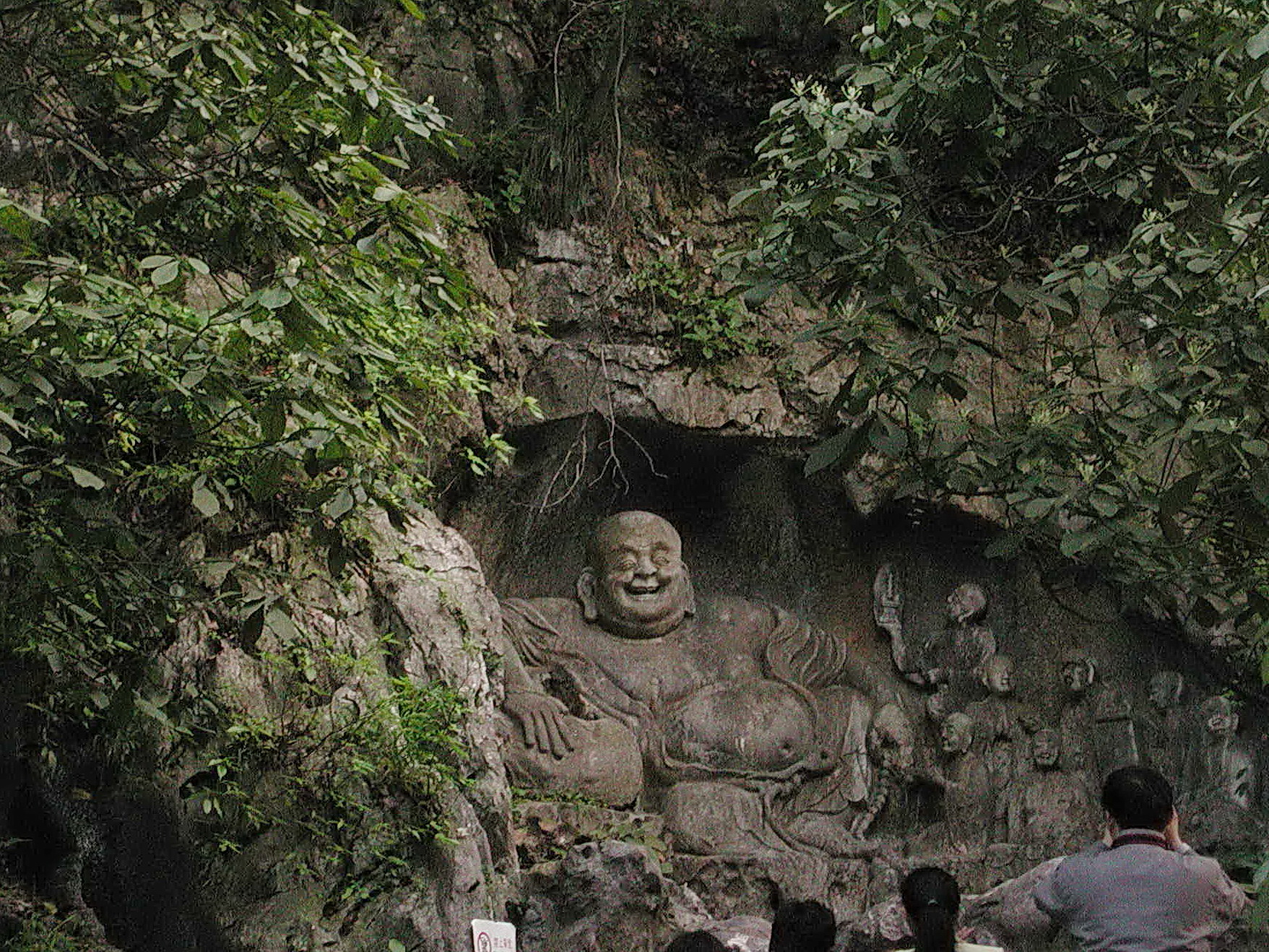
The real star of Feilai Feng. The rotund, broad-grinning form of the Maitreya Buddha, carved into the cliff above the stream and flanked by 18 arhats. At roughly 3.6 metres high and almost 10 metres long, it is the largest single carving on the whole hill — and that beaming face has become the most recognisable image in Hangzhou. You will not miss it: there is nearly always a cluster of people photographing it.
A limestone cave you can walk into, its walls set with carved Buddhas and ancient inscriptions. At certain points, light drops through a gap in the ceiling and lands directly on the figures. The air inside is noticeably cooler than outside — and it makes plain how the ancient carvers used the natural caves of the limestone to create sacred space.
One of the deepest caves at Feilai Feng — dark inside, with the sound of dripping water echoing off the walls. Look up and you will see a thin slit of light coming down from above, which locals call "a thread of sky." The atmosphere here is a complete contrast to the open path outside.
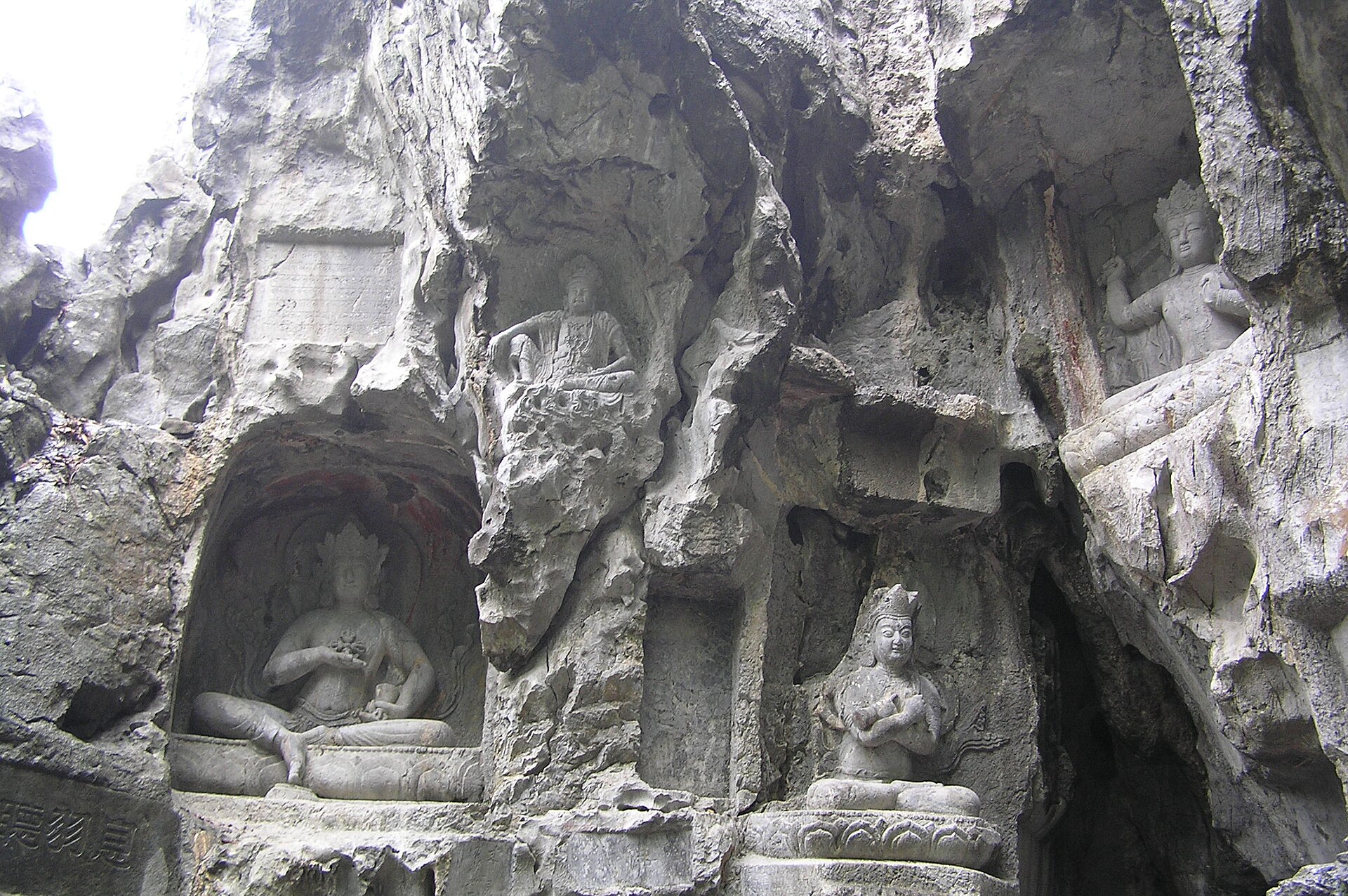
Beyond the caves, most of the carvings are out in the open on the cliff faces beside the streamside path. The Yuan dynasty left more work here than anywhere else in China. Many are sets of the "Three Saints of the West" — the Amitabha Buddha with the bodhisattvas Avalokiteshvara and Mahasthamaprapta. Walk slowly and scan both sides of the path, and you will keep finding figures emerging from the rock faster than you can count them.
The walk itself is a highlight. A clear stream runs alongside the stone path, and tall camphor trees and bamboo keep almost the whole route in shade. The water and birdsong drown out the city completely, and the path ends right at the gate of Lingyin Temple. Come in summer and you will feel exactly why it stays several degrees cooler here than in the city.
From the entrance, follow the stone path beside the stream. The main route is neither long nor steep — you simply walk slowly, looking at the figures on the cliffs and ducking through the caves. Allow around 1 to 1.5 hours if you stop to photograph and enter every cave. Most of the surface is stone and steps, so wear comfortable shoes; some sections inside the caves are dark and slippery, so take your time.
The trick is to look up often. Many of the figures are carved well above eye level and tucked into clefts that you will walk straight past if you keep your head down. Drop a little behind the tour groups and you will spot small carvings that most people miss entirely.
Something many people do not realise: the entrance to Lingyin Temple is inside the Feilai Feng area. That means you always walk past the carved hill and the stream before you reach the temple gate — there is no shortcut. The best plan is to take your time over Feilai Feng first, then buy a separate ticket (around ¥30) to enter Lingyin Temple itself and see the great hall and the colossal camphor-wood Buddha.
Together the two take about half a day, 3 to 4 hours. Read the full temple guide at our Lingyin Temple guide.
The best time is the early morning, 7.30 to 9.30 am, when light filters through the trees onto the cliff and the figures look their best — and the crowds are still thin before the tour buses arrive. For the Laughing Buddha, the best position is from across the stream, shooting slightly upward so you catch both the Buddha and the arhats around it.
Inside the caves the light is very low, so brace your camera or phone against the rock wall to avoid blur — and do not fire a flash straight at the old carvings. It flattens the image and disturbs other people who may be praying.
It shares its entrance with Lingyin Temple; the bus stop is called Lingyin (灵隐). Hangzhou's metro does not yet run all the way to the gate, so the last leg is by bus or taxi.
Most visitors base themselves around West Lake, with easy access to Feilai Feng and the other sights.