Home Pai Thailand Pai Hotels About
Home  ›  Asia  ›  Thailand  ›  Pai  ›  Attractions
Pai Attractions · 2026

What to see in Pai
Mountain valleys, a sea of mist & a town that makes you stay

Pai is the small mountain-valley town in Mae Hong Son that travellers have talked about for years — green hills on every side, rice fields, cafés over the paddies, and a pace so slow you end up cancelling half your plans. You arrive on a winding 762-curve minivan ride from Chiang Mai, and once you step off, you no longer feel like rushing anywhere.

Why come here

A small town whose charm is in not rushing

If you are tired of big cities and want somewhere you wake up to mountains and mist, Pai is the answer. This little town sits in Mae Hong Son province in Thailand's far north, a bowl of flat land ringed by green hills with the Pai River running through it, surrounded by rice fields and small coffee farms. People do not come to Pai to tick a list of sights; they come to ride a scooter with the wind in their face, sit in a rice-field café, watch sunset at the canyon and get up early for the sea of mist.

The whole point of a Pai trip is letting it slow down — climb up to Wat Phra That Mae Yen for a high view over the valley, wait for the sun to set over the red-earth ridges of Pai Canyon, rent a scooter out to Mo Paeng Waterfall, pass through the Yunnanese village of Santichon, then climb the Yun Lai viewpoint for white mist at dawn. With more time you can add a day trip out to Pang Ung, Ban Rak Thai or Lod Cave. We have picked the 10 places that tell the story of this mountain-valley town best, each linked to its own in-depth page.

Top sights

10 places worth your time

Ordered from in and around Pai town out to the longer day trips.
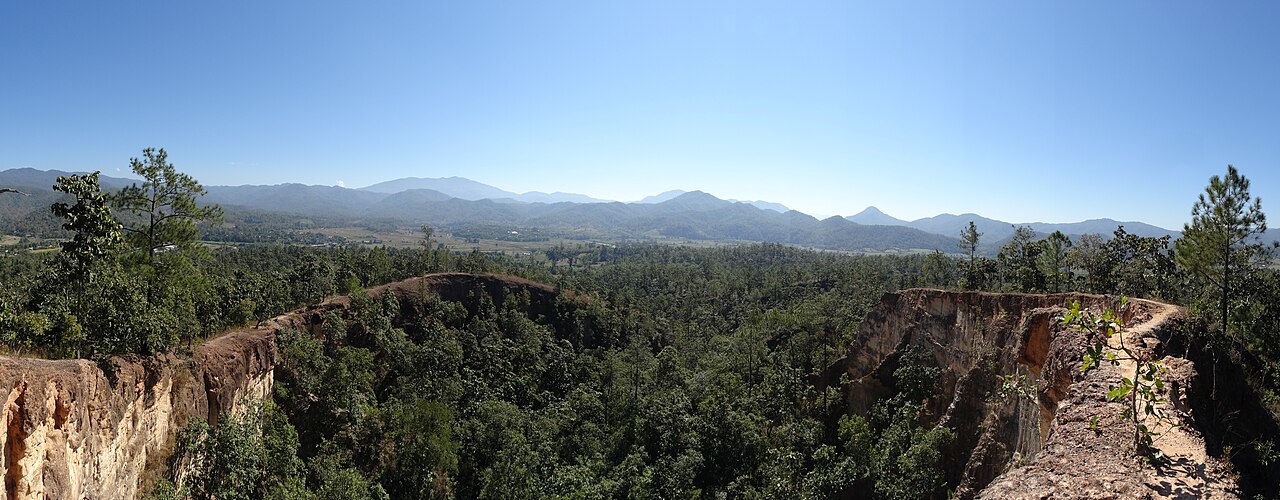
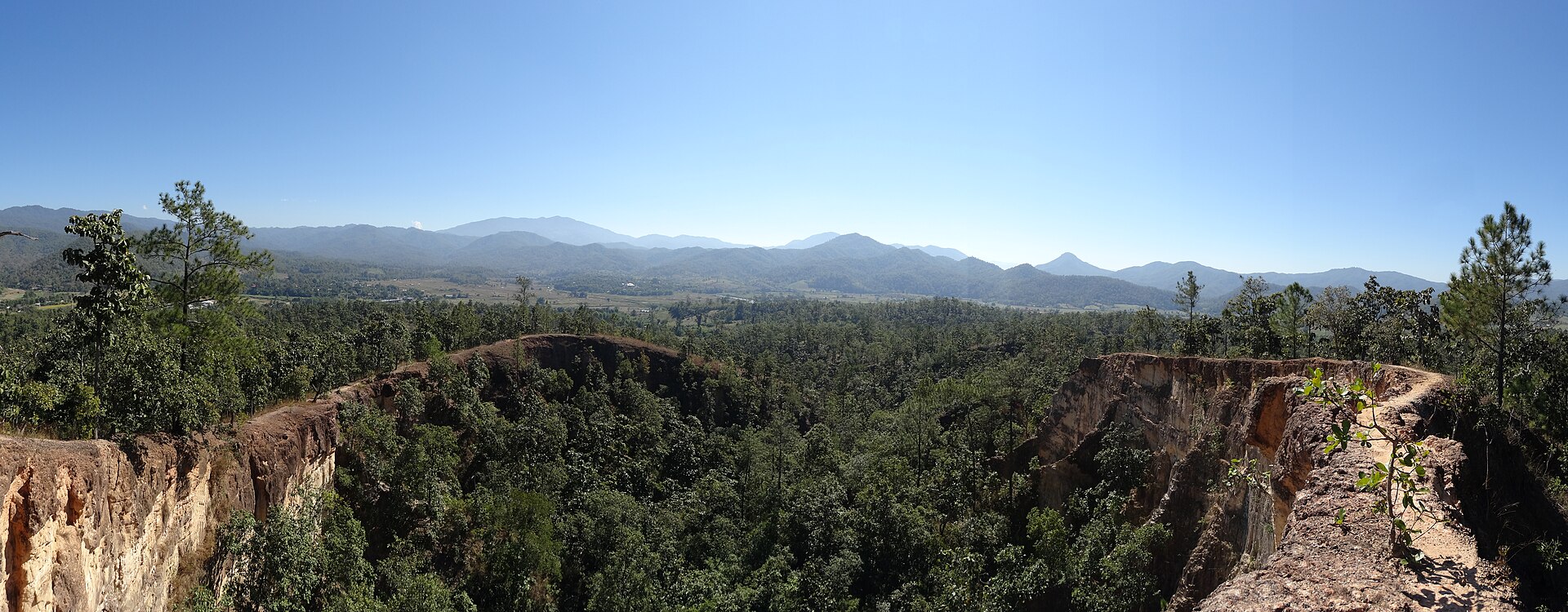
Pai Canyon, Pai — narrow red-earth ridges eroded into deep gullies, with the valley and Pai mountains stretching into the distance 1
Pai Canyon (Kong Lan)
Pai's sunset spot · ~8 km south of town

Picture this: you are standing on a narrow ridge of red earth with deep gullies dropping away on either side, a cool breeze blowing, and the sun sliding behind the hills until the whole sky turns orange. This is Pai Canyon, or Kong Lan — ridges and fins eroded by wind and water into a maze of narrow spines, about 8 km south of Pai town. Entry is free, and people come for the sunset. Be honest with yourself about the terrain: some ridges are narrow with sheer drops and crumbly soil. You get a fine view at the first viewpoint, so there is no need to push out to the far ridges. Bring water and a torch for the walk back in the dark.
Entry: free · arrive about an hour before sunset
Watch out: narrow ridges, sheer drops, slippery after rain — not for small kids
Getting there: scooter/songthaew from town · parking at the entrance
The Pai valley and rice fields in Mae Hong Son — green hills wrapping the small town in the basin, near the Pai River and the memorial bridge 2
Pai Memorial Bridge
A steel bridge over the Pai River · a WWII history

On the way into Pai you pass a steel bridge over the Pai River with a wartime story — the Pai Memorial Bridge, built around 1942 during World War II by the Japanese as a supply route toward Burma. The original was burned as the Japanese retreated, and locals later rebuilt it. Today it is a roadside photo stop with stalls and costumed-photo props for hire. It is fair to say this is a quick stop, not a half-day outing — most people pause here for a few minutes on the way to the canyon, which is right nearby.
Entry: free · about 15–20 minutes
Highlights: the old steel bridge · costumed-photo props · souvenir stalls
Getting there: on the highway south of town · often combined with Pai Canyon
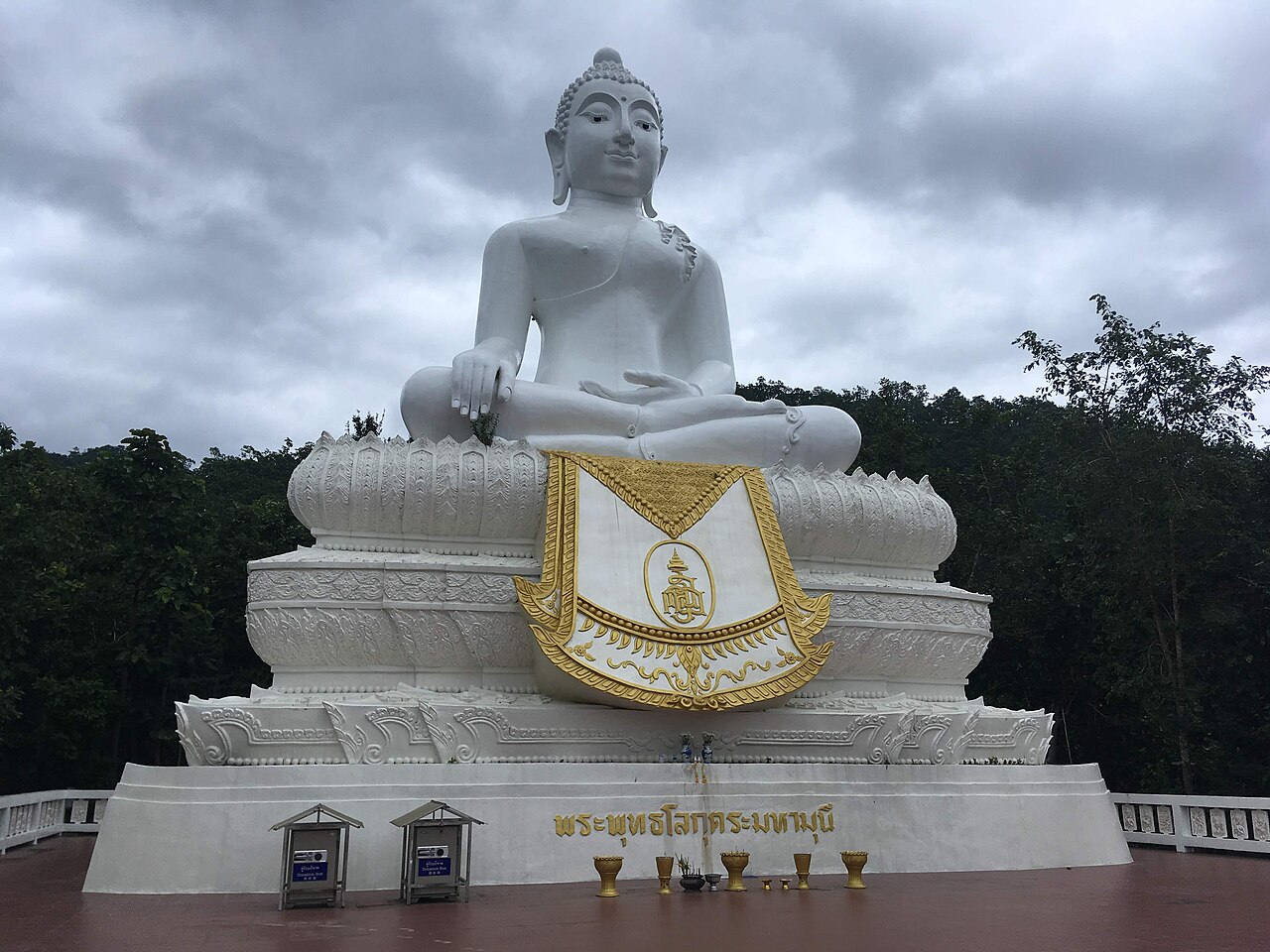
Wat Phra That Mae Yen, Pai — a large white seated Buddha on a lotus base on the hill east of Pai town 3
Wat Phra That Mae Yen (Big White Buddha)
A white Buddha on the hill · a panorama over the Pai valley

From almost anywhere in Pai you can see a large white Buddha sitting calmly on the hill to the east — Wat Phra That Mae Yen, known to most people simply as the Big Buddha. Climb the roughly 353 white steps (or drive up) and at the top you get a panorama over the whole Pai valley, lovely at both sunrise and sunset. This is a working temple, so dress respectfully with shoulders and knees covered; it is free to visit, with a donation box if you would like to give. It is a good first stop on day one, so you get the lay of the town before heading out to everything else.
Entry: free (donation welcome) · about 353 steps, or drive up
Etiquette: a working temple — dress modestly, cover shoulders and knees
Best time: sunrise, or the late afternoon before sunset
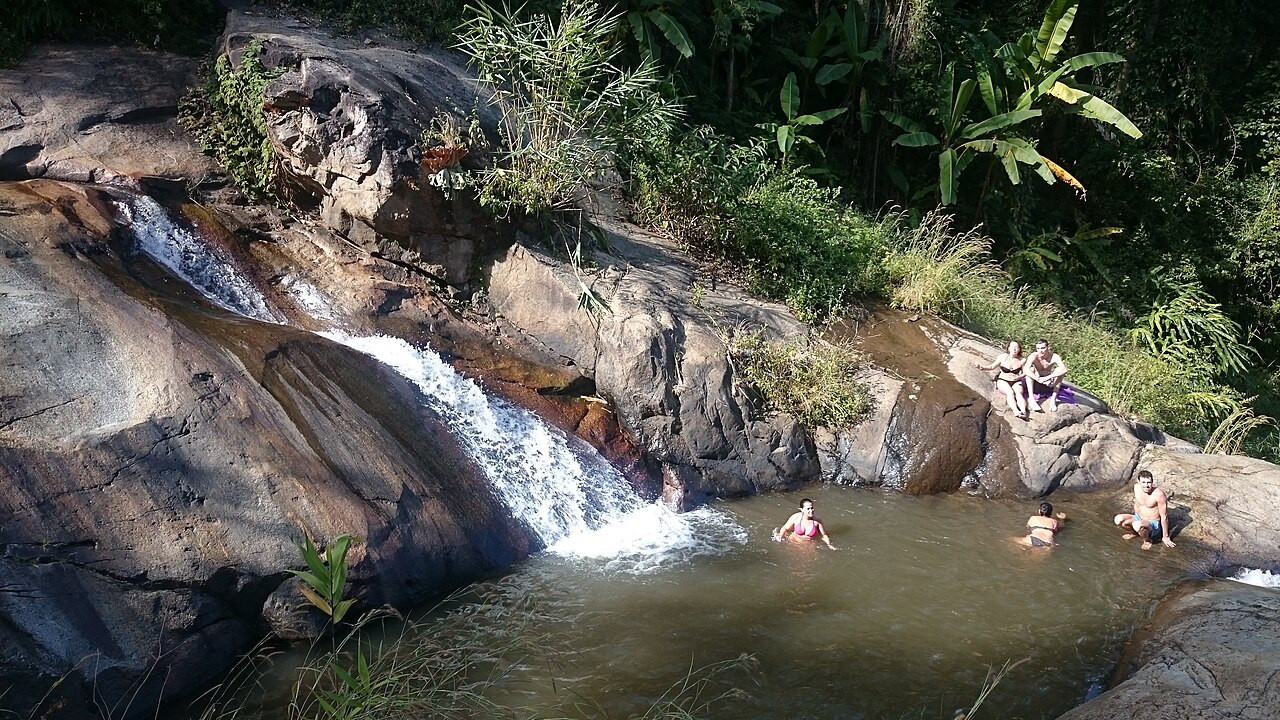
Mo Paeng Waterfall, Pai — a multi-tier waterfall running over smooth rock as a natural slide into a clear pool, with people bathing on the rocks 4
Mo Paeng Waterfall
A multi-tier waterfall · natural rock slides and pools · ~8 km NW

About 8 km northwest of Pai town is Mo Paeng Waterfall, a multi-tier waterfall whose draw is the smooth, sloping rock that acts as a natural slide down into a pool below, which is why people come to cool off here. It is fair to say it is at its prettiest and fullest in and after the rainy season, June to October; in the dry months it can thin to a trickle. Take care on the slick rock, as the slide can graze you. It sits in the same zone as Santichon and the Yun Lai viewpoint, so most people do all three together.

Entry: free · swimming in the pool
Best time: rainy and post-rainy season (Jun–Oct) when it is full · low in the dry season
Getting there: scooter from town · pair it with Santichon/Yun Lai
Santichon Village, Pai — the green of a Yunnanese-Chinese village with clay and thatch houses, a small pony and bright flower beds 5
Santichon Village + Yun Lai Viewpoint
A Yunnanese-Chinese village + dawn sea of mist · NW of town

Above Pai town is the Yunnanese-Chinese village of Santichon — a community of former KMT (93rd Division) soldiers who settled here, with clay houses in a Chinese style, a Chinese gate, a big wooden swing, ponies, and Yunnanese food such as braised pork leg with mantou and black-chicken herbal soup, alongside Chinese tea with a view. Walking around the village is free; you pay only for activities. A little higher up is the Yun Lai viewpoint, the dawn spot for the sea of mist over the valley, entry around 20 baht (check on arrival). Come at first light in the cool season and white mist fills the whole valley. We write about this Yunnanese-Chinese heritage with respect — it is a living community.

Entry: village free · Yun Lai ~฿20 (check on arrival)
Best time: first light in the cool season (Nov–Feb) for the sea of mist
Getting there: NW of town · scooter is easiest (the access road is steep)
The Pai valley at dusk in Mae Hong Son — soft evening light over the hills, rice fields and trees around Pai town 6
Pai Walking Street
The nightly pedestrian strip · street food, crafts, live music

After dark, the main street through the centre of Pai turns into a pedestrian strip — roadside food, snacks, hippie-style crafts, little bars and live music. You can graze the whole length, from grilled skewers and roti to pancakes, smoothies and vegetarian stalls (Pai is very easy for vegans and vegetarians). It has the easy-going, bohemian character that defines Pai, and it is free to walk. It is fair to say it is busiest in the cool season and at weekends, and it quiets down in the rainy low season with fewer stalls open. For what to actually eat, see the Pai food guide.

Entry: free · runs in the evenings, busiest in the cool season/weekends
What to eat: grilled skewers, sai ua sausage, roti, pancakes, smoothies, vegan stalls
Getting there: central Pai · walkable from any in-town stay
♨️7
Tha Pai / Sai Ngam Hot Springs
Soaking in natural hot springs in the forest · ~8 km from town

If your legs are tired from the canyon and the temple steps, Pai has natural hot springs for a soak. The well-known one is Tha Pai Hot Springs, about 8 km south of town, where the water is hot enough to boil eggs and a stream mixes hot and cool water for bathing. Foreigner entry is around 300 baht (cheaper for Thais; check on arrival, as it changes). A quieter, more natural option is Sai Ngam, inside a wildlife sanctuary, where the spring feeds a pool so clear you can see your toes; entry is around 20–30 baht. Morning or late afternoon is the nicest time — don't soak too long, and drink plenty of water.

Entry: Tha Pai foreigner ~฿300 · Sai Ngam ~฿20–30 (check on arrival)
Highlights: Tha Pai = egg-boiling/hot stream · Sai Ngam = a clear forest pool
Getting there: scooter from town · Tha Pai is on the Mae Yen side
💦8
Pam Bok Waterfall
A waterfall hidden in a rock crevasse · you wade in to reach it

For a quieter waterfall away from the crowds, Pam Bok sits in the same zone as the Land Split, south of town. It is a roughly 15-metre cascade tucked into a narrow rock crevasse: the walk in is short and easy, but the last stretch means wading through shallow water to reach the full falls, so wear shoes you do not mind getting wet. It is calm and shaded, good for escaping the tour groups, and most people pair it with the nearby Land Split and the other novelty stops. Like the rest of Pai's waterfalls, it is fullest in the rainy season.

Entry: free (there may be a small parking fee)
Watch out: the final stretch means wading — wear shoes you can soak
Getting there: south of town · combine it with the Land Split
📸9
Pai's novelty stops
Land Split · Coffee in Love · the bamboo rice-field bridge

Part of Pai's charm is the fun little stops that pop up along the roads — the Land Split, a crack in the ground opened by an earthquake, where the farmer lets you in free and serves fruit and butterfly-pea tea from the farm (tip as you like); Coffee in Love, a hillside café that was a Thai film location, with a valley view and photo arches; and the bamboo bridge (Boon Ko Ku So), a long bamboo walkway stretched over the green rice fields, at its best when the paddies are green (around August to October). These are mostly short stops you collect while looping around town on a scooter.

Entry: Land Split free/tip · cafés charge for drinks · the bamboo bridge has a small upkeep fee
Best time: the bamboo bridge is best over green paddies (Aug–Oct)
Getting there: spread around town · collect them while riding the loop
Pang Ung, Mae Hong Son — a pine-fringed reservoir with a bamboo raft by the bank, quiet and still in the early morning 10
Day trips around Pai
Pang Ung · Ban Rak Thai · Lod Cave · Mae Hong Son

If you have a spare day and want to go further, there are some real highlights within day-trip reach of Pai — Pang Ung, a pine-fringed reservoir often called the "Switzerland of Thailand", with mist drifting over the water at dawn (in Mae Hong Son); Ban Rak Thai, a Yunnanese-Chinese tea village by a lake near the Myanmar border; Lod Cave in Pang Mapha (Soppong), where you take a bamboo raft and a lantern through the river cave; and Mae Hong Son town with the Mae Hong Son loop. We have split out the full detail in the day-trips guide, with timing and costs.

Pang Ung/Ban Rak Thai: far, with winding roads · a tour or a car with a driver is easier
Lod Cave: in Pang Mapha · the cave raft has a boat plus guide fee
Getting there: car/tour · Pai has no train/metro — arrive by minivan from Chiang Mai
Plan your visit

How to fit it all in

Pai's sights split simply into the town, the western/southern loop and the day trips — separate them and the trip flows.

Pai town zone
Best on Day 1 · walk/scooter

Wat Phra That Mae Yen for the valley view, Pai Canyon for sunset, and the Walking Street for dinner — all doable on the day you arrive. The Memorial Bridge makes a neat photo stop on the way to the canyon. The town is walkable; out-of-town sights need a scooter.

Time needed: 1 day · Getting around: walk in town + scooter (no metro)
Western / southern loop zone
Best on Day 2 · rent a scooter

Rent a scooter and loop in Mo Paeng Waterfall, Santichon village, the Yun Lai viewpoint, a hot spring, Pam Bok and the Land Split in a single day. The riding is short but some stretches are steep — wear a helmet, take it slow, and use a songthaew or tour if you do not ride.

Time needed: 1 day · Getting around: scooter/songthaew/tour
Day-trip zone
Best on Day 3 · tour/car

Go further for a day — Pang Ung and Ban Rak Thai in Mae Hong Son, or Lod Cave in Pang Mapha. The roads are winding and far, so a tour or a car with a driver is easier than riding yourself. You could also carry on around the Mae Hong Son loop.

Time needed: 1 day · Getting there: tour/car · see Mae Hong Son
How many days?
In short — 2 days for the highlights · 3 for a relaxed trip

Two days and one night cover the town and the western loop. Add a third day for a day trip (Pang Ung / Lod Cave). Pai rewards staying longer. See the full routes on the Pai day-trips guide →

Time needed: 2–3 days · Tip: cool season Nov–Feb (pack a warm layer)
Frequently asked

FAQ · before you set out

How many days do you need in Pai?
Two to three days suits Pai's slow pace. Day 1, arrive by minivan from Chiang Mai, check in, then climb to Wat Phra That Mae Yen for the valley view and catch sunset at Pai Canyon, with the Walking Street for dinner. Day 2, rent a scooter and loop the western side for Mo Paeng Waterfall, Santichon village, the Yun Lai viewpoint and a hot spring. Day 3, if you have time, add a day trip to Pang Ung, Ban Rak Thai or Lod Cave. Pai is a place you like more the longer you stay, because the charm is in not rushing. See the full routes on the Pai day-trips guide →
How do you get to Pai — is there a train or flights?
Pai has no train and no BTS/MRT/metro, and although Pai Airport (PYY) exists, scheduled commercial flights are usually suspended. The way almost everyone arrives is the shared minivan from Chiang Mai (Arcade bus station), up Route 1095 with its roughly 762 curves — about 3 hours, around 150–200 baht per person, leaving roughly every hour. Be honest with yourself about motion sickness: the curves are relentless, so sit toward the front and take a travel-sickness tablet before you go (the vans usually hand out sick bags). If you want to fly, fly into Chiang Mai (CNX) and take the minivan from there. As for rail, the only option is the Bangkok-to-Chiang Mai overnight train, then the minivan on to Pai — no train reaches Pai itself. See the full how to get to Pai guide →
When is the best time to visit Pai?
The best window is the cool, dry season from about November to February: comfortable days, clear air, and the famous sea of mist at dawn over Yun Lai and the canyon. Be warned that nights get genuinely cold, around 5–15°C, and sometimes single digits in December and January, so pack a warm layer. March to April is hot and brings the northern crop-burning haze (PM2.5) that blankets the valley and hides the views — it is the honest worst time, so check an AQI app first. June to October is the rainy season: lush and green with full waterfalls, the fewest crowds and cheaper rooms, but with afternoon downpours and muddy, slippery mountain roads, so take care on a scooter. See the full best time to visit Pai → and the best time to visit Thailand →
How do you visit Pai Canyon, and what should you watch out for?
Pai Canyon (Kong Lan) is about 8 km south of Pai town — narrow red-earth ridges and fins eroded by wind and water into deep gullies. Entry is free, and most people come for sunset, so arrive about an hour before and bring water plus a torch or phone light for the walk back. The honest safety note: some ridges are very narrow with crumbly soil and sheer drops on both sides, so it is not for small children, and you should not push out to the far ridges after fresh rain because they get slippery. You get a fine view at the first viewpoint, so there is no need to go far. You can reach it by scooter or songthaew, and there is parking at the entrance. See the full Pai Canyon guide →
What are Santichon Village and the Yun Lai viewpoint, and are they free?
Santichon is a Yunnanese-Chinese village settled by former KMT (93rd Division) soldiers who made their home in Pai. It has clay houses in a Chinese style, a Chinese gate, Chinese tea, and Yunnanese food such as braised pork leg with mantou and black-chicken herbal soup. Walking around the village is free; you only pay for activities like a pony ride, tea tasting or costume photos. Just above it is the Yun Lai viewpoint, the dawn spot for the sea of mist over the valley, with entry around 20 baht (check on arrival). Come at first light in the cool season and you will see white mist filling the whole valley while you sip hot tea on the hill. Both sit to the northwest of town and a scooter is the easiest way to reach them. See the full Santichon + Yun Lai guide →
How do you get around Pai — is renting a scooter safe?
Pai town itself is tiny and walkable, but for the out-of-town sights — the canyon, the waterfalls, Santichon and the hot springs — most people rent a motorbike or scooter for about 100–150 baht a day, the easiest way to get around. The blunt safety truth: the hill roads are steep with loose gravel, and inexperienced riders cause a lot of accidents and road-rash (the so-called "Pai tattoo"). Wear a helmet, check the bike before you ride, never ride drunk, and take it slow in the rain. If you are not a confident rider, take a songthaew, a shared ride or a tour instead. Pai has no train, no BTS/MRT/metro, and Grab is essentially unavailable; the nearest railway is in Chiang Mai. See the full getting around Pai guide →
Klook · Pai tours

Pai tours and Chiang Mai transfers — the Mae Hong Son loop, Lod Cave, hot springs, book ahead

Chiang Mai–Pai minivan transfers, day tours taking in the canyon, Santichon and the waterfalls, the Mae Hong Son loop and Lod Cave, and Pai activities like the hot springs — book ahead on Klook. In the cool season the vans and tours fill up fast, so don't leave it to the day.

See Pai tours on Klook →
Wherebest is a Klook affiliate partner — we may earn a commission when you book through our links, at no extra cost to you.