Home Pai Thailand Pai Hotels About
Home  ›  Asia  ›  Thailand  ›  Pai  ›  Getting Around
🛵 Pai Transport Guide · 2026

Getting Around Pai
No Train, No Metro — But There's a Scooter

Pai is a small valley town with no train, no metro/BTS/MRT, and Grab is essentially unavailable — so the way to see it is renting a motorbike/scooter for about ฿100–150 a day, which reaches the canyon, waterfalls, Santichon and the hot springs. Backed up by bicycles and walking in town. But there's one thing to talk about straight first: safety on the mountain roads.

Before you go

A small valley town with no train — and that's fine

If you're used to hopping on a metro or calling a Grab to get anywhere, here's the first thing to know: Pai has no train, no metro/BTS/MRT, and Grab is essentially unavailable. Pai is a small town in the Mae Hong Son valley that moves at an easy pace. Most people arrive by shared minivan from Chiang Mai over the mountain Route 1095 with its roughly 762 curves, and once you're here you run mostly on two wheels and two feet. It sounds like a hassle, but it's easier than you'd think once you know what to use and when.

The way to see Pai is renting a motorbike/scooter for about ฿100–150 a day, with rental shops lined up around town and along the Walking Street, because it's the one thing that gets you to everything: Pai Canyon (Kong Lan), Mo Paeng Waterfall, Santichon village, the Yun Lai viewpoint and the hot springs, all scattered around the edges of town. But before you rush off to rent one, there's a safety conversation we need to have honestly first, because the mountain roads here are no joke.

There's one thing to grasp from the start: everything in Pai town is within walking distance, but the best bits are out of town. The Walking Street, restaurants and cafés are mostly a short walk apart, while the waterfalls, viewpoints and hillside villages need a ride out. This guide walks through every way to move around Pai — from renting a scooter (with an honest, no-sales-pitch safety section) to bicycles and walking, through songthaews, chartered rides and tours for those who'd rather not drive — then helps you plan your travel before you leave your accommodation.

Your main option in Pai

Renting a motorbike/scooter — the classic Pai way

Free, cheap, reaches every sight around town — but only if you can ride and ride safely. That condition isn't optional.

In a town with no train and almost no Grab, the thing that gives you the most freedom is a rental motorbike — and Pai has plenty. A small automatic scooter for about ฿100–150 a day (not including petrol) is what most visitors rent. It's easy to ride and park, and gets you to Pai Canyon for sunset, Wat Phra That Mae Yen for the valley view, Mo Paeng Waterfall, Santichon, the Yun Lai viewpoint and the hot springs in a single day. Shops take a deposit or a copy of your passport, and usually give you just enough fuel to reach a petrol station.

🛵
Scooter / motorbike rental
rent by the day · easy automatic

A small automatic scooter rents for about ฿100–150 a day, with lots of shops around town and the Walking Street — the more days you rent, the more you can haggle. A 125–150cc bike handles the climbs around Pai fine. Leave a deposit or a passport copy, and return it with as much fuel as you took.

Tip: before you ride off, photograph any existing scratches so you're not charged for damage you didn't cause. Check the lights, horn and tyres, and test the brakes in the yard before you hit the road.

Rough cost: scooter ~฿100–150/day (petrol not included)
You'll need: a deposit or passport copy · a motorcycle licence
Reaches: the canyon · waterfalls · Santichon · hot springs · viewpoints
⚠️
Safety — the blunt part
read this before you rent

Straight up: the roads around Pai have loose gravel, steep village climbs and plenty of curves. Inexperienced riders fall and graze themselves so often it has a nickname — the "Pai tattoo" (road-rash from a spill). The hard rules: wear a helmet every time, never ride drunk, and slow right down in the rain, because the mountain roads turn slippery.

Most important of all: if you've never ridden a motorbike, or you're not confident, don't force it. Pai's roads are not the place to learn. A songthaew, a chartered car or a day tour is far safer and gets you to the same sights. It might cost a bit more, but it's well worth it for the peace of mind.

Hard rules: wear a helmet · never ride drunk · slow down in the rain
Check before renting: brakes, tyres, lights, horn · photograph scratches
Not confident: don't force it — use a songthaew/tour instead
Why a motorbike fits Pai so well: Pai's best sights — the canyon, Mo Paeng Waterfall, Santichon and the hot springs — are scattered around the edges of town within a few kilometres, but there's no regular public transport to use easily. A cheap scooter lets you go anywhere, anytime. But we'll say it again: only if you can ride, and ride safely. If you're not sure, see the alternatives below, and budget for the rental and petrol in our full Pai trip budget.
In the town centre

Bicycles and walking — for a small town that's all within reach

Pai town is so small that much of it needs no engine at all. If your accommodation is in town or near the Walking Street, your own two feet are plenty. The restaurants, cafés, shops and the evening Walking Street all sit within walking distance of each other. This is part of Pai's charm that big cities just don't have.

🚶
Walking

You can cover Pai town in minutes — the Walking Street, restaurants, cafés and guesthouses sit close together. In the evening the Walking Street closes to traffic for an easy stroll.

🚲
Bicycle

Rent a bicycle for a few dozen baht a day to potter around town and the nearby rice fields — ideal if you'd rather not ride a motorbike but still want wheels.

🛺
Songthaew / charter

Flag a songthaew or charter a car with driver to the outlying sights — ask your accommodation to help arrange one; the price depends on distance and the number of people.

🚐
Day tour

A half-day or full-day tour bundles several sights into one trip with a car and driver — good if you don't ride. Book ahead on Klook.

Honestly, if you plan to stay in town or near the Walking Street, you barely need a vehicle for ordinary days and nights — you only need transport when you head out to the outlying sights such as the waterfalls or the hillside villages. Pick a base that matches your style in our where to stay in Pai guide.

Other options

Songthaews, charters, tours and the Grab question

🛺
Songthaew / shared rides
charter by the trip · no riding needed

A chartered songthaew is the main option for non-riders. Use it for the nearer sights such as Pai Canyon and the Memorial Bridge, or charter one up to Santichon and the hot springs. The price depends on distance and the number of people, so agree the fare before you get in, every time.

The easiest way is to have your accommodation arrange the ride, since local drivers know the spots and the standard fares. With a few people splitting it, it works out well, and you avoid the risk of riding the mountain roads yourself.

Good for: non-riders · the canyon / bridge / waterfalls
Price: by distance + number of people — agree before you board
Tip: let your accommodation arrange a local driver
🚐
Half-day / full-day tours
several stops in one trip

A tour is the comfortable choice for non-riders. Pai town tours usually bundle Pai Canyon, the Memorial Bridge, Santichon, the Yun Lai viewpoint, a waterfall and the hot springs into one day, with a car and driver covering it all so you don't have to think about routes — handy if you're short on time or just want an easy day.

There are also tours to spots further out such as Pang Ung, Ban Rak Thai and Tham Lod Cave in Mae Hong Son, plus the Mae Hong Son loop. Book ahead and pay with peace of mind. See the outlying sights in our day trips from Pai.

What's included: car + driver + several stops (some include a meal)
Reaches further: Pang Ung · Ban Rak Thai · Tham Lod · Mae Hong Son
Book via: Klook · your accommodation · agencies in town
📵
Grab — essentially unavailable in Pai
don't plan to rely on Grab

Up front: Pai has no reliable Grab service the way Bangkok or Chiang Mai does. A car might occasionally turn up, but you can't count on it and there's often no driver to accept the ride. Don't plan your travel around Grab in Pai.

What actually works is renting a motorbike, walking around town, or hiring a songthaew or chartered car — and having your accommodation arrange a ride when you need to reach somewhere further out. Planning your transport ahead is much less stressful.
Grab status: essentially unavailable — don't rely on it
Use instead: rental scooter · walking · songthaew/charter
Tip: let your accommodation arrange a ride for far-out spots
The Pai valley in Mae Hong Son — rice fields and mountains ringing a small town reached by minivan from Chiang Mai over Route 1095 and its roughly 762 curves Getting to Pai
Reaching Pai = minivan from Chiang Mai
Route 1095 · about 762 curves

To be clear: Pai has no train and no scheduled flights. Most people arrive by shared minivan from Chiang Mai's Arcade Bus Station over Route 1095, with its roughly 762 curves, taking about 3 hours for around ฿150–200 per person, leaving roughly hourly. If you get carsick easily, sit up front and take a travel-sickness tablet.

Coming from Bangkok, the usual route is to take a train or flight to Chiang Mai first, then transfer to the Pai minivan, since the nearest railway to Pai is in Chiang Mai. See every way to reach Pai in our getting to Pai guide.

Chiang Mai → Pai minivan: ~3 hr · ~฿150–200/person · roughly hourly
None of these: a train to Pai · scheduled flights (nearest rail = Chiang Mai)
From Bangkok: reach Chiang Mai first, then the minivan
Riding in the rainy and burning seasons — take care: in the rainy season, around June to October, some mountain roads turn slippery and muddy and the occasional landslide closes a route, so ride slower and allow extra time. In the burning season, around March to April, it gets very hot and crop-burning haze (PM2.5) blankets the valley, hurting visibility — check an AQI app before riding and carry a mask. The most comfortable riding season is the cool months, November to February, but the early mornings get genuinely cold, so put on a warm layer before you set off. See the seasons in our best time to visit Pai guide.
The most important thing about getting around Pai

A walkable town — but the best bits are out of town, so you need wheels

This is what makes planning a Pai trip different from a big city, and it's worth understanding before you decide whether to ride yourself.

If you remember one thing from this page, make it this: Pai town is all within walking distance, but the highlights people come for are out of town. In town there's the Walking Street, restaurants and cafés to explore on foot — but Pai Canyon, Mo Paeng Waterfall, Santichon village, the Yun Lai viewpoint and Wat Phra That Mae Yen all take a ride out. They're not far, but there's no regular public transport — which is exactly why people rent a scooter, or charter a car or tour if they don't ride.

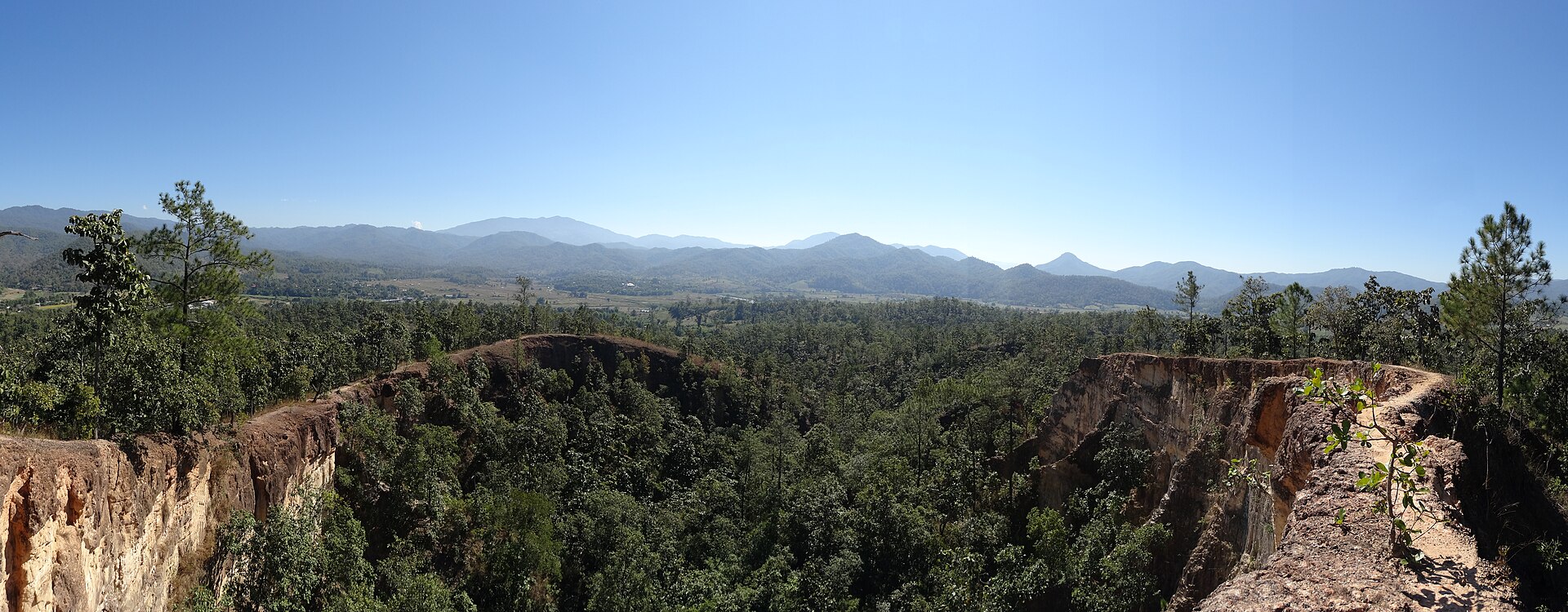
The Pai valley in Mae Hong Son — green rice fields and mountains ringing a small town whose sights are scattered on the outskirts, needing a vehicle to reach
The Pai valley, Mae Hong Son — the best bits like the canyon, waterfalls and hillside villages sit around the edges of town within a few kilometres, but you need wheels to reach them.
Distance + how to get there

From Pai town to each place

Destination Distance + how close How to get there
Pai town centre In town · walk / bicycle Walking Street · restaurants · cafés — all within walking distance
Pai Canyon (Kong Lan) ~8 km south · close Scooter · chartered songthaew · tour
Pai Memorial Bridge Near the canyon · close Scooter · songthaew (often paired with the canyon)
Mo Paeng Waterfall + Santichon + Yun Lai ~8 km northwest · the western loop Scooter (easiest) · chartered car · half-day tour
Pang Ung / Ban Rak Thai / Tham Lod Far · in Mae Hong Son · a long ride Tour / chartered car (easiest)
How to plan around your own style: if you can ride a motorbike and ride safely, one scooter covers the whole western loop in a day. If you don't ride, pair Pai Canyon and the Memorial Bridge into an evening songthaew run, and charter a car or tour for the western loop. The further-out spots — Pang Ung, Ban Rak Thai and Tham Lod — are best made into a separate day trip with a tour. See how to lay out your days in our Pai 2-day itinerary and day trips from Pai.
The real tip

Decide two things and Pai gets easy

If we had to boil it down to two points: one — ask yourself honestly whether you can ride a motorbike confidently. If you can, renting a scooter for about ฿100–150 a day is the freest, best-value way to see Pai — wear a helmet, check the bike, and ride slowly. But if you've never ridden or you're not confident, don't force it, because Pai's roads cause a lot of spills and grazes. Use a songthaew, a chartered car or a day tour instead — you'll see the same sights, far more safely.

Two — pick a base that matches how you'll get around. If you stay in town or near the Walking Street, you can wander on foot at night with no vehicle. But if you stay up in the hills or by the rice fields, you'll usually want a scooter or private transport. Sorting this before you book your accommodation saves a lot of hassle.

For first-timers in Pai: you reach Pai by shared minivan from Chiang Mai's Arcade Bus Station over Route 1095 and its roughly 762 curves, taking about 3 hours for around ฿150–200 per person (there's no train or scheduled flight to Pai) — see every way to get there in our getting to Pai guide, and start planning at our Pai first-timer guide.
Frequently asked questions

FAQ · Getting around Pai

Does Pai have a train or a metro?
No to both. Pai is a small valley town with no metro, no BTS/MRT and no train running to it. The nearest railway is in Chiang Mai. Most people reach Pai by shared minivan from Chiang Mai over the mountain Route 1095, which has about 762 curves and takes roughly 3 hours. Once you're in Pai, the most popular way to get around is renting a motorbike/scooter for about ฿100–150 a day, backed up by bicycles and walking in the compact town. People who don't ride use songthaews, chartered rides or tours instead. See how to arrive in our getting to Pai guide.
How much does renting a scooter in Pai cost, and is it dangerous?
An automatic scooter rents for about ฿100–150 a day, not including petrol, with plenty of shops around town and the Walking Street. Be honest with yourself about the risk: the roads around Pai have loose gravel and steep village climbs, and inexperienced riders crash and get road-rash so often it has a nickname, the "Pai tattoo". So wear a helmet every time, check the brakes and bike before you rent, never ride drunk, and slow right down in the rain. If you're not a confident rider, don't force it — a songthaew or tour is far safer. See the outlying sights in our Pai Canyon guide.
Can I get a Grab in Pai?
Essentially not. Pai is a small valley town with no reliable Grab service the way big cities have. A car might occasionally appear, but you can't count on it. What actually works is renting a motorbike yourself, walking around the town centre, or hiring a songthaew or chartered car with driver for the outlying sights. It's best to ask your accommodation to arrange a ride, or book a day tour if you don't want to drive yourself.
If I don't ride a motorbike, how do I see Pai's outlying sights?
Easily. The western-loop sights such as Mo Paeng Waterfall, Santichon village, the Yun Lai viewpoint and the hot springs can be reached by a chartered songthaew, a chartered car with driver, or a half-day or full-day tour that bundles several stops into one trip. The price depends on the number of people and stops. Ask your accommodation to arrange a vehicle, or book a tour ahead on Klook. For Pai Canyon and the Memorial Bridge, which sit close to town, a return songthaew is enough. See more in our day trips from Pai guide.
Can I get around Pai town on foot?
Easily. Pai town is tiny — the Walking Street, restaurants, cafés and many guesthouses are all within walking distance of each other. In the evening the Walking Street closes to traffic so you can stroll and graze on street food. If your accommodation is in town or near the Walking Street, you barely need a vehicle, and you can rent a bicycle to potter around if you like. You only need a vehicle to reach the outlying sights such as the waterfalls or the hillside villages. Compare areas in our where to stay in Pai guide.
What should I watch out for riding in Pai during the rainy and burning seasons?
In the rainy season, around June to October, some mountain roads turn slippery and muddy and the occasional landslide can close a route, so ride slower and allow extra time. In the burning season, around March to April, it gets very hot and crop-burning haze (PM2.5) blankets the valley, hurting visibility and air quality — check an AQI app before heading out, carry a mask and plan more indoor stops. The most comfortable riding season is the cool months, November to February, but the early mornings get genuinely cold, so put on a warm layer before you set off. See the seasons in our best time to visit Pai guide.