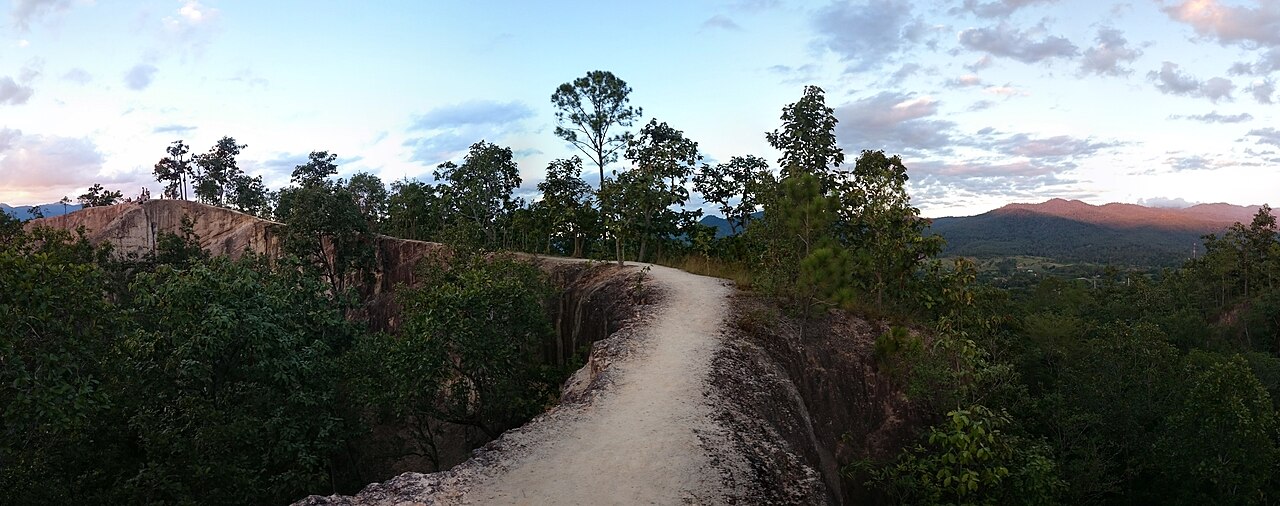
Eroded earth walls carved into deep grooves and thin spine ridges running out over the forest, just 8 km south of Pai town — when the light starts to drop, half the town rides their scooters out here to wait for it.
Picture this: you ride a scooter ten or fifteen minutes south out of Pai town, park, climb a short staircase from the car park — and the flat ground suddenly drops away into deep red-earth grooves that wind and rain have slowly carved into sharp ridges running hundreds of metres, pine trees scattered along the edges, layers of hills stacked into the distance. Pai Canyon, known locally as Kong Lan, is not a vast Grand Canyon-scale chasm. It is a strange, oddly intimate landscape at just the right size to actually walk into and explore.
Pai Canyon (Kong Lan) sits about 8 kilometres south of Pai town, beside Route 1095 — the same road the minivans use coming in from Chiang Mai. The real draw is not the scale but the narrow earth ridges you can walk out along: some sections are wide enough to stroll, others narrow to the width of a single footstep, with steep drops on both sides. How far you go is entirely a question of nerve. That is what brings people back to walk it again — and also exactly why you need to be careful, which we will get to.
But what makes Kong Lan famous is the sunset. The canyon faces the right direction to catch the sun sinking behind the ridgeline, and from around 17:00 to 18:00 the spines and edges fill up with people sitting and waiting for the sky to turn orange and red. If you visit Pai and never watch the sun go down here at least once, you have not really arrived.
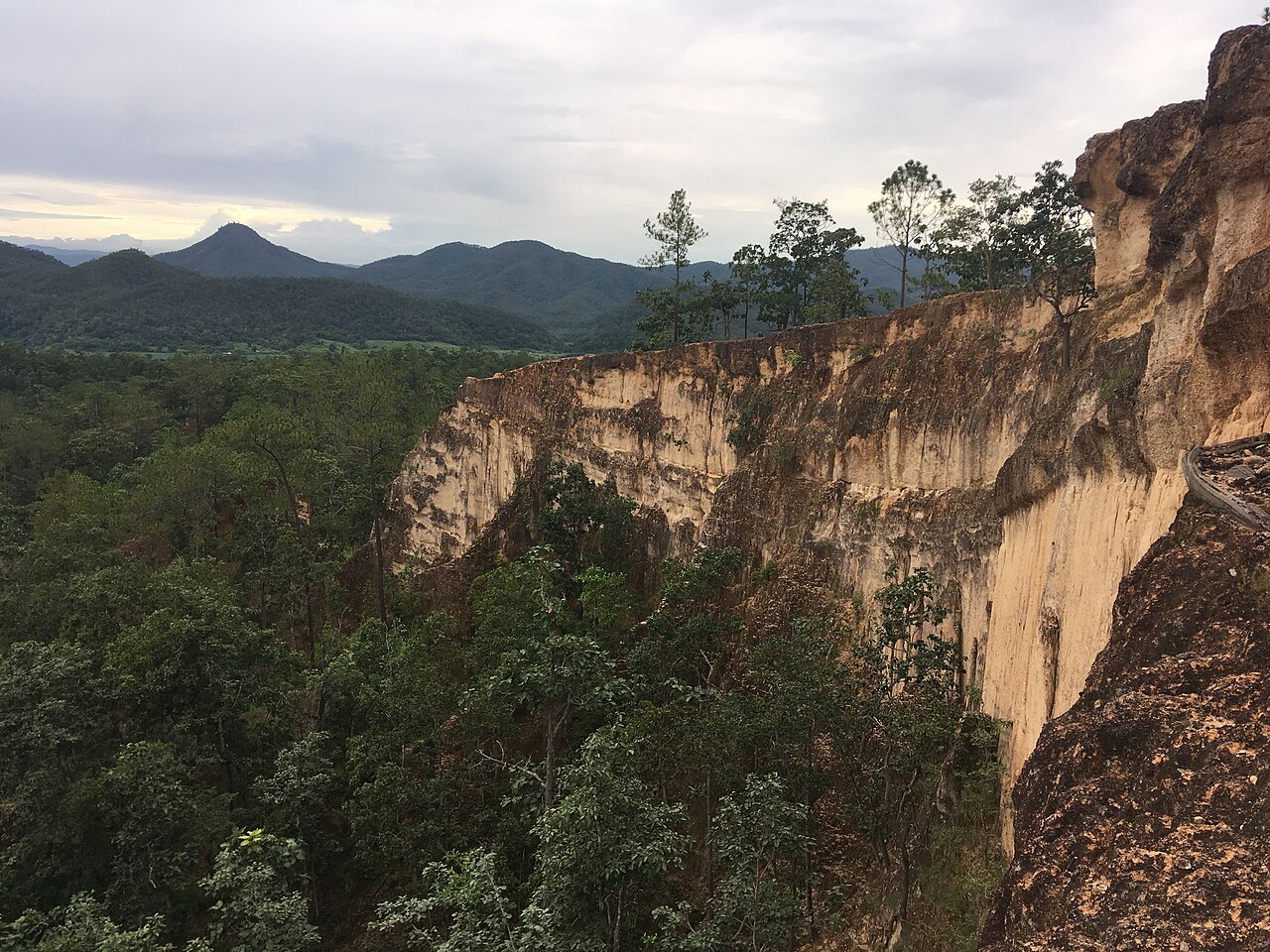
There is no fixed trail here — you roam freely. But the more freedom, the more you need to know your own limit.
From the car park a short flight of steps brings you to the first wide viewpoint, and this is the safest spot with a full view across the grooved earth and the hills beyond. If you are with small children, older travellers or anyone uneasy with heights, watching the sunset from around here is plenty — there is no need to push out onto the narrow spines at all.
From the viewpoint, earth ridges run out in several directions. Some stretches are comfortably wide; others narrow to a single foot's width, with steep drops falling away on both sides. You walk out as far as you are confident, then turn back — no one is making you reach the end. The trick is to move one step at a time, look at the ground before you put your foot down, and never turn around to take a photo on a narrow section.
The angle most people shoot is standing on a ridge facing west, letting the line of earth lead towards the sun as it drops behind the hills — you get both the silhouettes of people and the colour wash across the sky. The golden window is roughly the 10–15 minutes before the sun sets through to just after. Claim your spot early and wait, because once the light arrives the competition for angles gets fierce.
A lot of visitors get so absorbed in the sunset that they forget they still have to walk the narrow ridges back to the car park once it is dark — which is far more dangerous than the way out. Carry a torch or switch on your phone light, and if you have walked a long way out, start heading back while there is still enough light to see the path. Do not leave it until pitch dark and then try to cross a thin ridge.
Let us be honest up front: Pai Canyon is more dangerous than a lot of people assume. The ridges are loose earth that crumbles and gives way under footfall and rain. Some sections of the path are very narrow with sheer drops falling away on both sides. There are no railings and no nets. Tourists do slip and fall here from time to time, and a single misstep can mean a serious injury or worse.
For that reason this is not a place for small children or anyone afraid of heights, and it is especially dangerous when it is raining or the earth is wet and slippery (take extra care in the rainy season, June to October). To do it safely, wear shoes with good grip, walk slowly and one step at a time, do not run, and do not mess around on the narrow spines. Most important — know where to stop. You do not have to reach the end to prove anything; the view from the safe spots is already plenty.
The best window is the cool, dry season of November to February: clear skies, comfortable daytime temperatures, and sharp views across the hills. But here is the thing people forget — the nights in Pai get genuinely cold, around 5–15°C, sometimes single digits on December and January nights. If you plan to stay out for the sunset and into the evening, pack a warm layer. (December and January are peak season, so it is busier and rooms cost more.)
The season to avoid is March to April, which is both very hot (highs above 35°C) and the region's crop-burning haze season, when PM2.5 smoke settles over the whole valley, hiding the hills behind a grey veil and making the air genuinely unhealthy. If you cannot avoid those months, check an air-quality app before you head out and manage your expectations about the view. The rainy season, June to October, brings lush green and thinner crowds and cheaper rooms — but afternoon downpours leave the earth ridges slippery, so walk with extra care.
The good news is that Pai Canyon is very close to the Pai Memorial Bridge — ride a few minutes further south past the canyon and you are there. Many people plan to stop at the Memorial Bridge in the late afternoon, take a few photos, then double back up to Kong Lan to wait for the sunset. It makes a tidy half-afternoon loop south of town.
Pai Canyon is about 8 kilometres south of town on Route 1095 (the road towards Chiang Mai) — ride straight out of town heading south and you will see the sign. To be clear: Pai has no train and no metro or BTS/MRT, and Grab is essentially unavailable here — the way almost everyone does it is to rent a motorbike and ride out themselves.
Wear shoes with good grip (trainers or hiking shoes, not slippery flip-flops) because you will be walking on loose earth and rock that can give underfoot. Carry water up with you, as there are no shops out on the ridges, and pack a torch or use your phone light for the walk back once it is dark. In the cool season bring a warm layer — the temperature drops quickly once the sun is down.
Kong Lan is a fragile, easily eroded earth landscape, and repeated footfall on the spines speeds up how fast they crumble. Try to keep to the lines people already walk, do not scramble on unstable sections, and take your rubbish with you. When it is crowded at sunset, share the angles — do not stand blocking a narrow path for too long, since other people need to get past.
There are no on-site safety staff watching over you here; every decision is your own. Visiting within your limits, respecting the landscape and looking after yourself is the whole point of Kong Lan — that is how you come back with good photos and all your limbs intact.
Kong Lan is just the start — Pai also has waterfalls, a hilltop temple, villages and sea-of-mist viewpoints.