Home Pai Thailand Pai Hotels About
Home  ›  Thailand  ›  Pai  ›  Food Guide
🇹🇭 Pai Food Guide · 2026

What to Eat in Pai
11 northern Thai, Shan & Yunnanese dishes

A small town in the mountains that eats far better than its size suggests — northern Thai khao soi and sai ua meet the Shan khanom jeen nam ngiao, Yunnanese pork leg with mantou up at Santichon, and a rice-field café culture that has become the whole point of the place. Eating slowly is the local style here.

Why eat here

Northern Thai, Shan & Yunnanesemeet in one valley

Pai is a small town in Pai district, Mae Hong Son province, and the appeal of its food is that it isn't just the northern Thai cooking you'd find in Chiang Mai — it has three strands overlapping in one valley. The first is northern Thai (Lanna) as the base: khao soi, sai ua, nam prik num, nam prik ong and gaeng hang lay. The second is Shan (Tai Yai) food from the Shan communities of Mae Hong Son, best known for khanom jeen nam ngiao and ferments like thua nao. The third is Yunnanese food from Santichon, a village of Yunnanese Chinese who settled here, famous for stewed pork leg eaten with mantou buns. Together those three lines give Pai a flavour you'd be hard pressed to find elsewhere.

On top of that comes the thing Pai is especially known for — its café and slow-breakfast culture. The town is ringed by cafés with rice-field and mountain views, pouring coffee grown in northern Thailand, and it has many more vegetarian and vegan restaurants than a typical northern town. Mix that with the nightly Walking Street, where the food runs from Thai grills to falafel and smoothie bowls, and you have a lot to eat. We've pulled together 11 dishes and bites that capture the taste of Pai most clearly — from the town centre, up the hill to Santichon, and down to the Pai River.

Signature dishes

11 dishes to try before you leave Pai

Ordered by how distinctly Pai they are — the dishes that tell the story of this valley best.
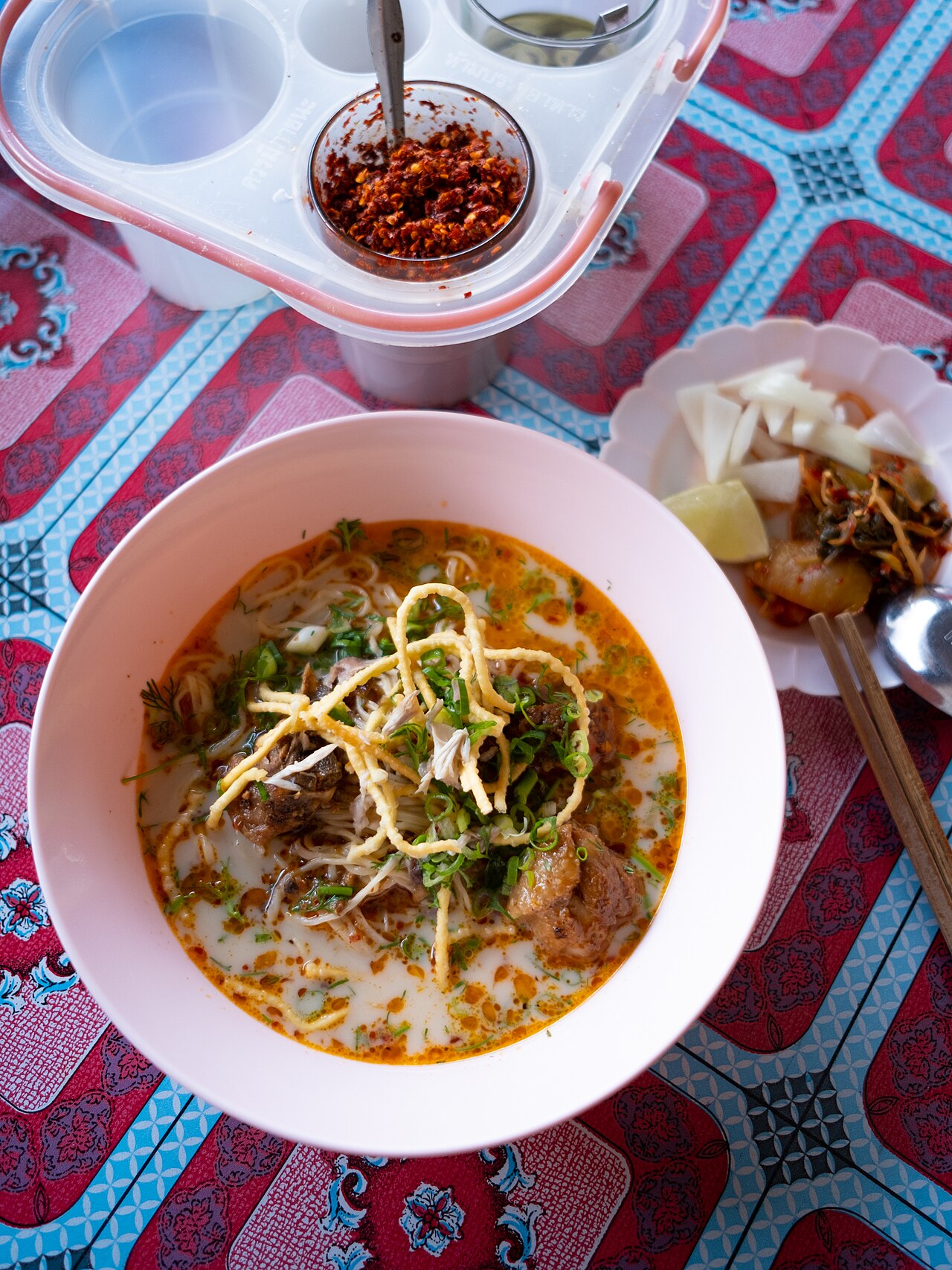
A bowl of khao soi: egg noodles in a coconut-curry broth topped with crispy fried noodles, served with a side plate of pickled greens, shallots and lime, northern Thai style 1
Khao Soi
egg noodles in coconut curry · the northern Thai starter

The opening act of northern Thai food, and Pai does it well — egg noodles in a coconut-curry broth simmered with a mild curry paste and curry powder, with tender stewed chicken (or beef), crowned with a tangle of crispy fried noodles. You eat it with pickled greens, sliced shallots and a squeeze of lime to cut the richness. The names people mention most are Khao Soi Pai (the red-table stall next to the 7-Eleven on Walking Street), Khao Soi Zister's, which has comfortable seating and lets you adjust the spice, and Charlie & Lek, a home-style place locals go to.
Where: Khao Soi Pai (by the 7-Eleven on Walking Street) · Khao Soi Zister's · Charlie & Lek
Price: about ฿40–70 / bowl
Tip: squeeze in lime, add the pickles, top with chilli paste to taste
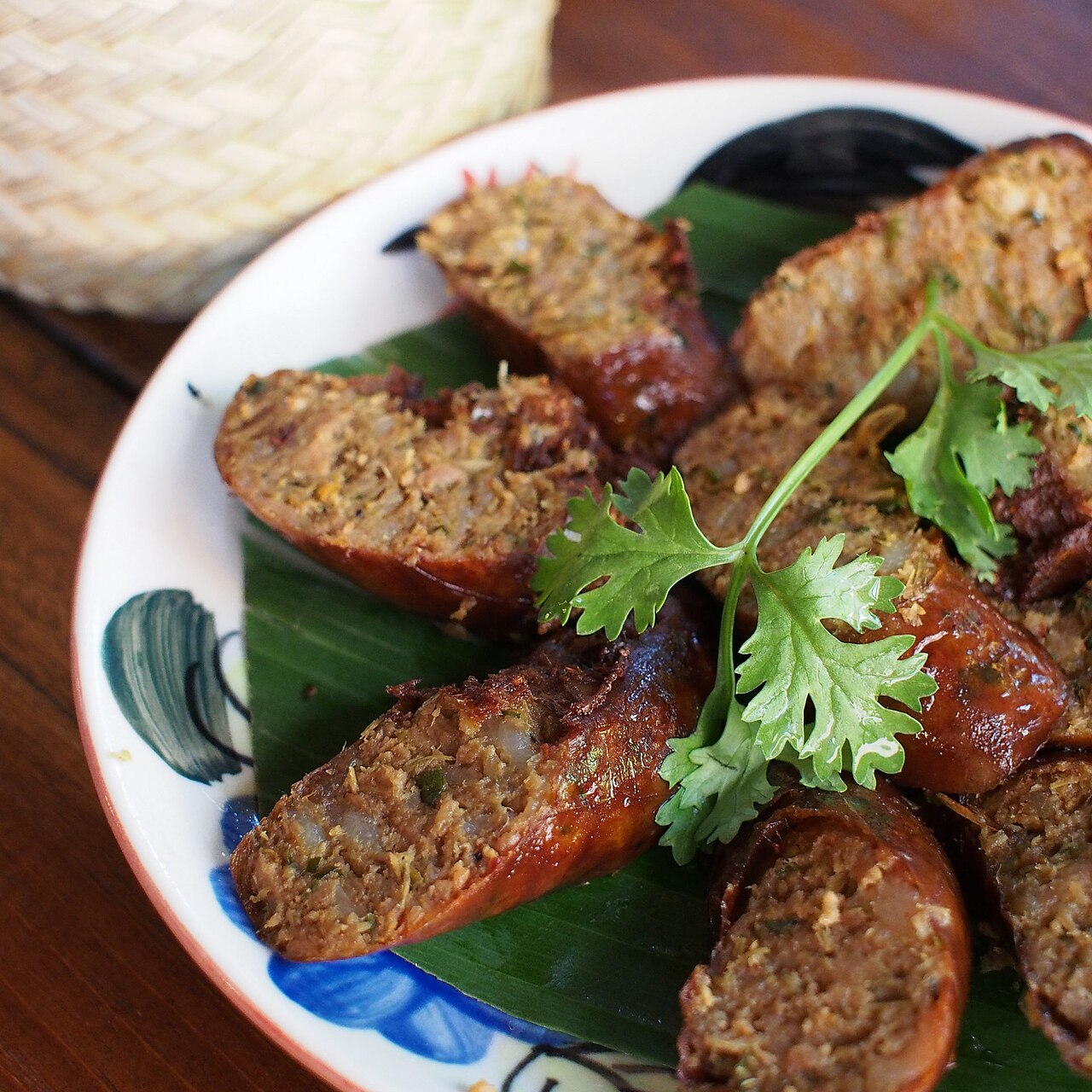
Sliced sai ua northern Thai herb sausage on a banana leaf garnished with coriander, served beside a basket of sticky rice 2
Northern Thai — Sai Ua, Nam Prik Num & Ong
a Lanna spread · eaten with sticky rice

A northern meal is really a sticky-rice spread of several things — sai ua, a pork sausage packed with curry paste and herbs and grilled fragrant; nam prik num, a roasted green-chilli dip eaten with pork crackling and steamed vegetables; nam prik ong, a sweet-sour tomato-and-minced-pork dip; and gaeng hang lay, a Burmese-Shan-style pork curry slow-cooked with ginger and spices until rich and tender. Eat it all with hot sticky rice. Try it at a home-style northern restaurant like Na's Kitchen or the local-food shops in town and on Walking Street.

Where: northern-food restaurants in town · Na's Kitchen · spread stalls on Walking Street
Price: about ฿60–120 / dish
Tip: order several to share, with sticky rice and pork crackling
🍲3
Khanom Jeen Nam Ngiao
Shan (Tai Yai) food · rice noodles in tomato broth

The dish that marks out the Shan side of this Mae Hong Son region — rice noodles in an orange-red broth simmered from cherry tomatoes, pork bones or ribs, thua nao (fermented soybean) and dried kapok flowers, with cubes of pork blood and minced pork. It's lightly sour and aromatic, eaten with fresh vegetables, bean sprouts, pork crackling and fried dried chilli. The word "ngiao" comes from the name for the Shan (Tai Yai) people; it's a breakfast or light meal you'll find at local-food shops and morning markets in Pai town.

Where: local-food shops in town · Pai morning market · Walking Street stalls
Price: about ฿40–60 / bowl
Tip: add pork crackling and fried chilli, squeeze lime to cut the sourness
🥘4
Yunnanese Pork Leg & Mantou
Santichon village · Yunnanese Chinese food

Head up the hill to Santichon village (about 5km from town), a settlement of Yunnanese Chinese who put down roots here, where the signature is Yunnanese food — pork leg stewed in Chinese herbs, slow-cooked low and slow until the meat is fall-apart tender and glazed in dark sweet soy, eaten with steamed or fried mantou buns torn and dipped in the sauce; herbal black-chicken soup with a clear, fragrant broth; and handmade dumplings. Several Yunnanese restaurants in the village, such as Mittraphap Pai, taste much alike, and you can also try Chinese tea and dress-up photos.

Where: Yunnanese restaurants in Santichon village · Mittraphap Pai
Price: about ฿150–300 / pork-leg dish (shared by 2–3)
Tip: order pork leg with fried mantou, plus black-chicken soup to break it up
5
Cafés & Rice-Field Breakfast
Pai coffee culture · slow mornings, mountain views

Pai is so well known for its rice-field and mountain-view cafés that café-hopping is one of the town's main activities. The legendary one is Coffee in Love, set on a rise looking down over paddies and hills (famous from films, so it draws crowds, but the view really is good). Chang Puak Handcrafted Coffee House sits near Wat Phra That Mae Yen (the Big Buddha) with open mountain views, and Keys's Cafe is a short walk from the centre, surrounded by rice fields, pouring northern-grown coffee. A slow breakfast over pancakes, smoothies and coffee is something Pai does well. Read on in the Pai café guide.

Where: Coffee in Love (rice-field view) · Chang Puak (mountain view, near Big Buddha) · Keys's Cafe
Price: about ฿60–110 / cup · breakfast ฿80–180
Tip: go early or late afternoon to skip the heat · settle in for the valley breeze
🍢6
Walking Street Food
the nightly market · international street bites

Dinner in Pai is most fun on the Walking Street, which runs down Rangsiyanon and Chaisongkhram roads. Every evening it fills with food stalls — grilled skewers, sai ua, roti, banana pancakes and smoothies, alongside hippie-market staples like falafel, veggie wraps, vegan burgers and smoothie bowls. Graze your way along without sitting down; each item is cheap at around ฿20–60. It's busiest in the cool season when the air makes strolling pleasant; in the rainy season and low season the stalls thin out a little. Read on in the Walking Street food guide.

Where: Rangsiyanon Rd · Chaisongkhram Rd · central Pai
Price: about ฿20–60 / item
When: from around 5:30–6pm until late · busiest in the cool season
🥗7
Vegetarian & Vegan
one of the most veg-friendly towns in the north

Pai is one of the most vegetarian- and vegan-friendly small towns in northern Thailand — there are several fully vegetarian/vegan places such as Earth Tone, a vegan café; Art in Chai, an Indian-fusion vegetarian spot; and Good Life, an international café with plenty of vegan options, plus Bom Bowls for smoothie bowls — and Walking Street stalls with clear vegan menus. At a regular restaurant, just say "gin jay" (strict vegetarian) or "mangsawirat" and most kitchens will happily do meat-free pad thai, fried rice and curries.

Where: Earth Tone · Art in Chai · Good Life · Bom Bowls · vegan stalls on Walking Street
Price: about ฿70–160 / dish
Tip: say "gin jay / mangsawirat" at regular shops to unlock the meat-free menu
🌅8
Thai Riverside Dining
a riverside dinner · sunset over the water

The Pai River runs through town, and along its banks are restaurants where you can eat over the water at dusk — everyday Thai dishes like tom yum, curries, fried fish and stir-fried vegetables, paired with the water-and-mountain setting. The known spot on the riverside is the Pai River Corner area, with a wide riverside deck (good food, but priced up a touch for the view). To be honest, a riverside table means you pay partly for the view; if you want excellent, fairly priced Thai food without the view, a place like Na's Kitchen in town cooks Thai well.

Where: Pai River bank · Pai River Corner · (in town: Na's Kitchen)
Price: about ฿120–250 / person (riverside with a view)
Tip: come at sunset · book a riverside table in high season
🌶️9
Larb Khua & Bar Snacks
dry-fried northern larb · northern drinking food

To eat the way northerners do, try larb khua (northern larb), which is different from the Isan version — northern larb is minced meat or pork tossed with "prik larb," a blend of dozens of herbs and spices, then dry-fried until fragrant, deep and savoury rather than sour. It's eaten with raw vegetables and sticky rice, and it's prime drinking food. A spot locals like, Larp Khom Huay Poo, has larb and several northern dishes in a local-shop setting — good for a proper northern dinner with a cold beer.

Where: Larp Khom Huay Poo · home-style northern restaurants in town
Price: about ฿60–120 / dish
Tip: order it with sticky rice and raw veg · northern larb isn't sour like Isan larb
🫘10
Thua Nao & Shan Tofu
Shan ferments · a flavour particular to this area

The ingredient that gives this region's food its own twist is thua nao — a fermented soybean of the Shan people, made into sun-dried discs (thua nao paen) that are grilled or fried as a snack with a cheesy aroma, or pounded into a seasoning for nam ngiao and dips. The other thing the Shan do well is Shan tofu, made from a yellow pea flour into a soft set, eaten both steamed-and-sauced and fried crisp. You'll find these at the Pai morning market and at local-food shops — a taste that marks out the Shan side of this valley.

Where: Pai morning market · local-food shops · snack stalls
Price: about ฿20–60 / item
Tip: grilled thua nao discs as a snack · fried Shan tofu with a chilli dip
🍰11
Desserts & Mountain Coffee
hippie bakeries · northern-grown coffee

Round off a meal Pai-style — the town has hippie bakeries and dessert spots turning out cakes, pancakes, brownies and cheesecake to go with coffee. A place like Witching Well, which opens early and has long done Western breakfasts and desserts, is a go-to morning coffee stop for Pai travellers. The coffee here uses beans grown in northern Thailand, with many cafés roasting their own and doing serious pour-overs, plus Thai sweets like banana roti and market treats on the Walking Street — dessert in Pai works equally well as a café sit-down or a market stroll.

Where: Witching Well (breakfast + desserts) · self-roasting cafés citywide · Walking Street sweet stalls
Price: about ฿50–150 / serving
Tip: breakfast at Witching Well · try a northern-Thailand pour-over
☀️ Season note: Pai is busiest and at its best for eating in the cool season, Nov–Feb — Walking Street and the cafés are in full swing and the cool air makes sitting out pleasant (nights get genuinely cold, ~5–15°C, so pack a warm layer). In Mar–Apr it gets hot and hazy from crop burning (PM2.5), which hides the views and harms the air — check an AQI app before you go. The rainy season, Jun–Oct, is lush and the rice-field cafés look their best, but the Walking Street stalls thin out. See the best time to visit Pai.
Go deeper on each one

Read on in full detail

Want more? We have a separate guide for each category — start with the one you most want to eat.

Where to eat

Pai's eating zones — each does something different

Know what each zone does best before you plan your meals — in town, up at Santichon, and on the river.

Walking Street — the heart of evening eating
Rangsiyanon Rd · Chaisongkhram Rd · town centre

The centre of Pai is the hub for evening eating. Every night Rangsiyanon and Chaisongkhram roads become a roughly 1km pedestrian strip packed with grill stalls, roti, pancakes, smoothies, vegan options and hippie-market sweets, plus northern restaurants, khao soi spots, cafés and live-music bars. This is your easiest base for dinner and snacking in Pai.

Best for: snacks · khao soi · northern food · vegan · When: evening to late
Santichon village — Yunnanese food country
Yunnanese Chinese village · ~5km west of town

Drive or ride about 5km up the hill to the west and you reach Santichon, a village of Yunnanese Chinese settlers. The signature food is Yunnanese — pork leg stewed in herbs and eaten with mantou, herbal black-chicken soup, and handmade dumplings. Several Yunnanese restaurants taste much alike, and there's Chinese tea, clay houses and dress-up photo spots. It pairs well with a lunch stop alongside the Yun Lai viewpoint.

Best for: Yunnanese pork leg · mantou · black-chicken soup · Chinese tea · When: lunch
The Pai River — a dinner over the water
Pai River bank · riverside decks

The Pai River runs through town, and the riverside has restaurants and resorts where you can eat over the water with mountain views at dusk. The food is mostly everyday Thai — tom yum, curries, fried fish, stir-fries — and the draw is the sunset over the river. To be honest, riverside places with a view tend to cost a little more than in town: come for the setting, but for cheaper, excellent eating, the town centre is better value.

Best for: Thai food · sunset setting · When: riverside dinner
Around town & the rice fields — cafés and views
surrounding hills · rice fields · near Wat Phra That Mae Yen

Half of Pai's appeal is out of the town centre — cafés with rice-field and mountain views scattered around the edges and up the hills, pouring coffee grown in northern Thailand. Some sit near Wat Phra That Mae Yen (the Big Buddha) looking out over the whole valley. They're made for a slow breakfast or an afternoon coffee, sitting out for ages in the valley breeze — exactly the thing people come to Pai to do. Most need a car or scooter to reach.

Best for: rice-field cafés · northern coffee · breakfast · When: morning and afternoon
Don't-miss pins

The spots Pai travellers point you to

Not a list of fancy restaurants — these are the areas and shops that actually tell the story of Pai's food. Put them on the plan.

1
Khao Soi Pai (by the 7-Eleven, Walking Street)
budget-friendly khao soi · what locals actually eat

The khao soi spot people in Pai mention most is the stall with red plastic tables and chairs next to the big 7-Eleven on Walking Street — crispy-noodle khao soi, an aromatic coconut-curry broth, tender stewed chicken, at prices locals actually pay. It isn't fancy, but it's the easiest and cheapest way to try Pai khao soi, and it's simple to reach because it sits right in the middle of Walking Street.

Where: Walking Street, Pai (next to the big 7-Eleven) · town centre
Hours: midday to evening (check on the spot) · Known for: khao soi · budget prices · cash / QR pay
2
Santichon village (Yunnanese food)
Yunnanese Chinese village · ~5km from town

A Yunnanese Chinese village up the hill to the west of town, gathering several Yunnanese restaurants in one place — pork leg stewed and eaten with mantou, herbal black-chicken soup, handmade dumplings and Chinese tea. A place like Mittraphap Pai is known for its rich-tasting pork leg, which goes well with the mantou, and the various restaurants taste much alike. It's ideal for a lunch stop paired with the Yun Lai viewpoint. Read on in Santichon Village & Yun Lai Viewpoint.

Where: Santichon village · about 5km from Pai town (west)
Hours: mainly daytime · Known for: Yunnanese pork leg · mantou · black-chicken soup
3
Larp Khom Huay Poo (local northern food)
larb khua · a place locals like

For real northern food the way locals eat it, Larp Khom Huay Poo is a name that comes up often — known for its larb khua (northern larb) and several other northern dishes, deep and complex from the prik-larb spice blend, eaten with sticky rice and raw vegetables. It's a local-shop setting with no fuss over décor, good for a proper northern dinner with a cold beer — a contrast to the tourist-zone spots that lean Western and café.

Where: Huay Poo area near Pai town (check the map before you go)
Hours: lunch–dinner (check on the spot) · Known for: larb khua · northern food · local prices
4
Coffee in Love & the rice-field cafés
mountain-view cafés · a main Pai activity

Sitting at a rice-field café is one of Pai's main activities. The legendary one is Coffee in Love, on a rise looking down over paddies and hills (famous from films, so crowded, but the view really is good). Chang Puak Handcrafted Coffee House sits near Wat Phra That Mae Yen (the Big Buddha) with open mountain views, and Keys's Cafe is ringed by rice fields a short walk from town, pouring coffee grown in northern Thailand. Go early or late afternoon to skip the heat and settle in for the valley breeze.

Where: hills and rice fields around Pai town · some near Wat Phra That Mae Yen
Hours: morning to evening (Coffee in Love roughly 7am–6:30pm) · Known for: rice-field & mountain views · northern coffee
Klook · Pai tour

Pai Tour from Chiang Mai — Santichon, viewpoints and local bites in one trip

Book a Pai tour from Chiang Mai through Klook — covering sights like Santichon village and the viewpoints, with stops to try local food, so you don't have to drive the 762-curve road yourself. Handy if you'd rather not ride a scooter.

See Pai tours on Klook →
Wherebest is a Klook affiliate partner — we may earn a commission when you book through our link, at no extra cost to you.
Frequently asked

FAQ · what people ask before heading out to eat

How much does a meal cost in Pai?
Pai is a budget town and very cheap if you eat at local shops and the Walking Street. A bowl of khao soi or khanom jeen nam ngiao runs about ฿40–70. Walking Street snacks like grilled skewers, roti, pancakes and smoothies are around ฿20–60 each. A made-to-order Thai or northern dish at a home-style shop is roughly ฿60–120. Yunnanese pork leg with mantou at Santichon, shared by 2–3 people, is about ฿150–300. Café coffee with a rice-field view is ฿60–110 a cup. A riverside restaurant with a view costs a little more, roughly ฿120–250 per person. These are approximate 2026 figures, so check on the spot.
How is Pai food different from Chiang Mai?
The base is the same northern Thai cooking — khao soi, sai ua, nam prik num, nam prik ong and gaeng hang lay are found in both cities. But Pai adds two strands. The first is Shan (Tai Yai) food from the Shan communities of Mae Hong Son, best known for khanom jeen nam ngiao and ferments like thua nao. The second is Yunnanese food from Santichon, known for stewed pork leg with mantou and herbal black-chicken soup. On top of that, Pai has a far bigger hippie café and vegetarian-restaurant scene than a typical northern town. Compare cities in the Chiang Mai food guide.
Does Pai have a lot of vegetarian and vegan food?
A great deal. Pai is one of the most vegetarian- and vegan-friendly small towns in northern Thailand. There are several fully vegetarian/vegan places such as Earth Tone, Art in Chai and Good Life, plus Walking Street stalls with clear vegan menus — smoothie bowls, falafel, veggie wraps and meat-free burgers. At regular restaurants, saying "gin jay" (strict vegetarian) or "mangsawirat" unlocks meat-free versions of pad thai, fried rice and curries. Graze on at the Pai Walking Street.
Which khao soi in Pai is good?
The one people mention most is Khao Soi Pai, the stall with red plastic tables and chairs next to the big 7-Eleven on Walking Street — cheap and exactly what locals actually eat. Khao Soi Zister's is another well-known spot with comfortable seating where you can adjust the spice and noodles, and Charlie & Lek is a home-style place serving khao soi and green curry that locals go to. Pai khao soi is egg noodles in a coconut-curry broth topped with crispy fried noodles, eaten with pickles, shallots and lime — around ฿40–70 a bowl. Go deeper in the northern Thai, Shan & Yunnanese food guide.
What should I eat at Santichon, and what is Yunnanese pork leg?
Santichon village is about 5km from Pai town, a settlement of Yunnanese Chinese (former KMT 93rd Division). The signature food is Yunnanese — pork leg stewed in Chinese herbs and soy, soft and tender, eaten with steamed or fried mantou buns; herbal black-chicken soup with a clear, fragrant broth; and handmade dumplings. Several Yunnanese restaurants in the village, such as Mittraphap Pai, taste very similar. Order one pork-leg dish with mantou to share between 2–3 people, and you can also try Chinese tea and dress-up photos. Read on at Santichon Village.
Is the Pai Walking Street food on every night, and when is it busiest?
Pai Walking Street runs every evening, with stalls setting up around 5:30–6pm and going late, stretching down Rangsiyanon and Chaisongkhram roads in the town centre. It's busiest in the cool season (November–February), when there are more travellers and the cool air makes strolling pleasant. In the rainy season and low season the stalls thin out and some nights are quiet. The food ranges from northern Thai dishes, grilled skewers, roti, pancakes and smoothies to vegan options and hippie-market sweets, cheap at around ฿20–60 each. See more things to do at Pai Walking Street.