From thousands of red-billed gulls wheeling over a lake in the middle of the city, to a UNESCO karst forest of stone that has stood for millions of years, to a dragon gate carved into a cliff with a vast lake spread out below — this plan is built to give you all of Kunming, city and nature alike, at a comfortable pace.
The Chinese call Kunming the Spring City (春城). Sitting at nearly 1,900 metres above sea level, it stays mild almost all year — never scorching, never freezing. Walk along Green Lake (Cuihu) in the soft morning light, watch thousands of red-billed gulls wheeling over the water while grandparents do their exercises and bring bread for the birds, and you'll understand at once why people here love their city so much.
This plan is built for a first visit to Kunming. Day 1 stays in the heart of town — Green Lake, Yuantong Temple, crossing-the-bridge rice noodles and evening street food. Day 2 heads out to the Stone Forest, the sight everyone comes to Kunming for, for a full day. Day 3 climbs the Western Hills to the Dragon Gate for the view over Dianchi Lake, then stops at the Yunnan Nationalities Village — or, if you're carrying on into Yunnan, Day 3 is the morning you board the high-speed train for Dali or Lijiang.
Honestly, most travellers use Kunming as a launch pad rather than a final destination — two or three days in the city, then onward by train to Dali, Lijiang and Shangri-La. If that's your plan, read our Kunming-to-Yunnan trip planner alongside this one. Short on time instead? Try the 2-day Kunming plan.
A lake in the city centre with thousands of gulls · the busiest old temple in town · the original crossing-the-bridge noodles, then a street-food night — the day that shows you how Kunming really lives.
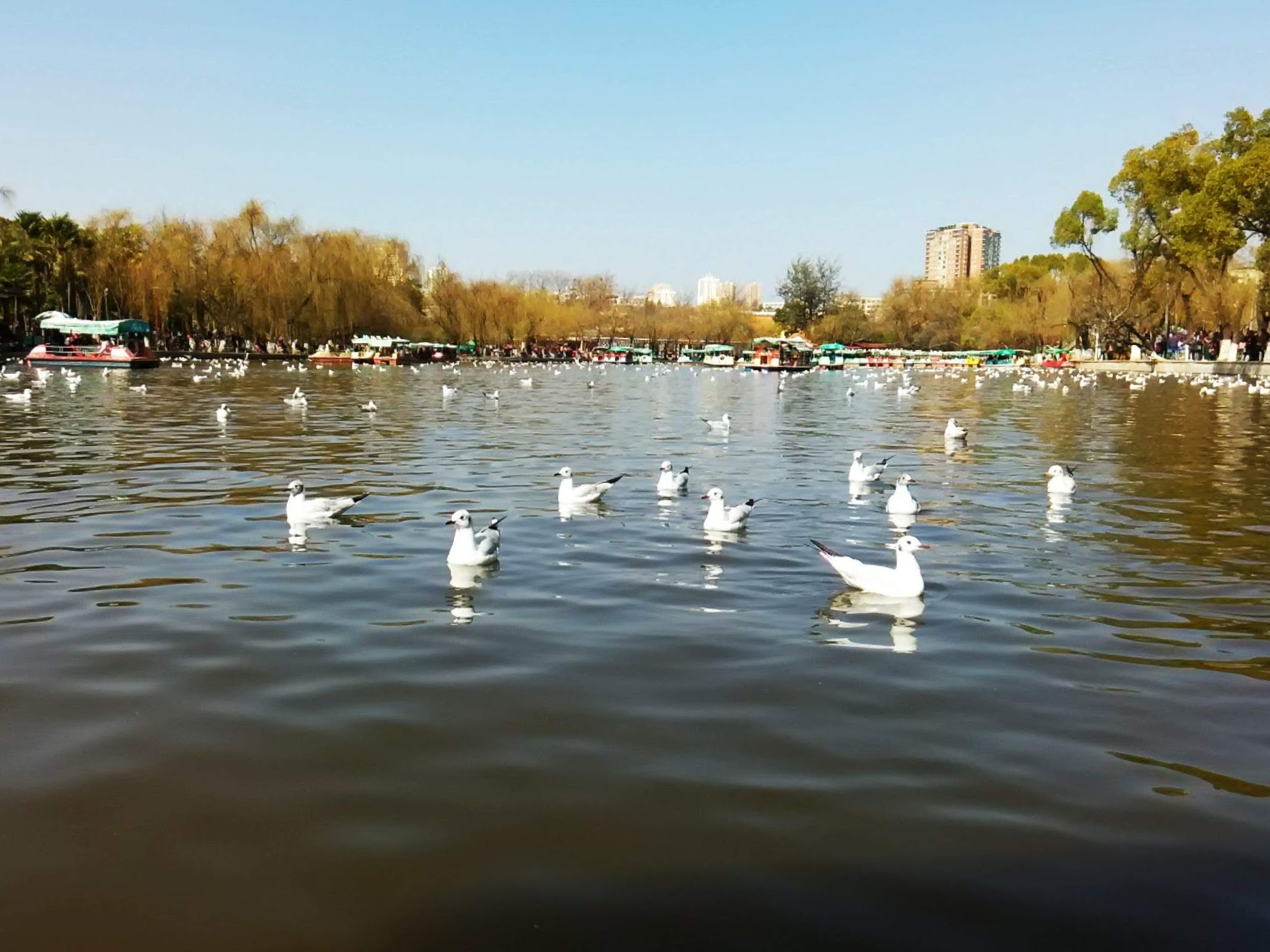
Start your first day gently at Green Lake (Cuihu Park), the city-centre park where Kunming locals come to stroll every morning, free to enter. If you visit between November and March, you'll see the image that has become the symbol of Kunming: thousands of red-billed gulls (红嘴鸥) that migrate down from Siberia to escape the cold and settle across the lake. People stand on the banks feeding them as the birds wheel around overhead — a sight worth seeing at least once. Walk the loop around the lake, cross the bridges, sip tea by the water — about 1.5 hours.
A short walk away is Yuantong Temple (圆通寺), the oldest and largest Buddhist temple in central Kunming, over 1,200 years old. What makes it unusual is that it's built downward into a hollow — instead of climbing up, you descend to it — with a pavilion over a pond, bridges across the water, and a Theravada Buddhist hall in the Thai-Burmese style that reflects Yunnan's border character. Read more in our guide to Kunming's temples.
Lunch has to be the dish Kunming is proudest of — crossing-the-bridge rice noodles (过桥米线), a Yunnan rice-noodle bowl served in a special way. A piping-hot bowl of broth, sealed under a layer of oil, comes separately, and you add the meat, egg, vegetables and noodles yourself so they cook in the bowl. Legend says a scholar's wife invented the method to carry the soup across a bridge to her husband and keep it hot — read the full story in our crossing-the-bridge noodles guide, and see the other Yunnan rice noodles in our Yunnan rice noodles guide.
In the afternoon, take a DiDi to the Golden Temple (Jindian 金殿) in the city's north-east — the largest bronze hall in China, built in the Ming–Qing era, set on a hill among pine woods and camellia gardens. A gentle climb up through a heavenly gate gets you there; it's shaded and quiet, a good break from the bustle of the centre.
End the first day at Nanping pedestrian street (Nanping Jie), the liveliest part of the centre after dark — and the lanes around it, like Nanqiang Street (南强街巷), packed with Yunnan snacks: grilled meat skewers, charcoal-grilled wild mushrooms, Shiping grilled tofu, Yunnan-style fried potatoes, flower cakes and seasonal fruit. Graze your way along for an easy, low-cost dinner, surrounded by locals out for the evening — see the best stalls in our Kunming street-food guide.
A forest of limestone pillars rising like trees made of stone · a cave world of stalactites hidden underground — the day Kunming takes you out of the city to nature like nowhere else on earth.
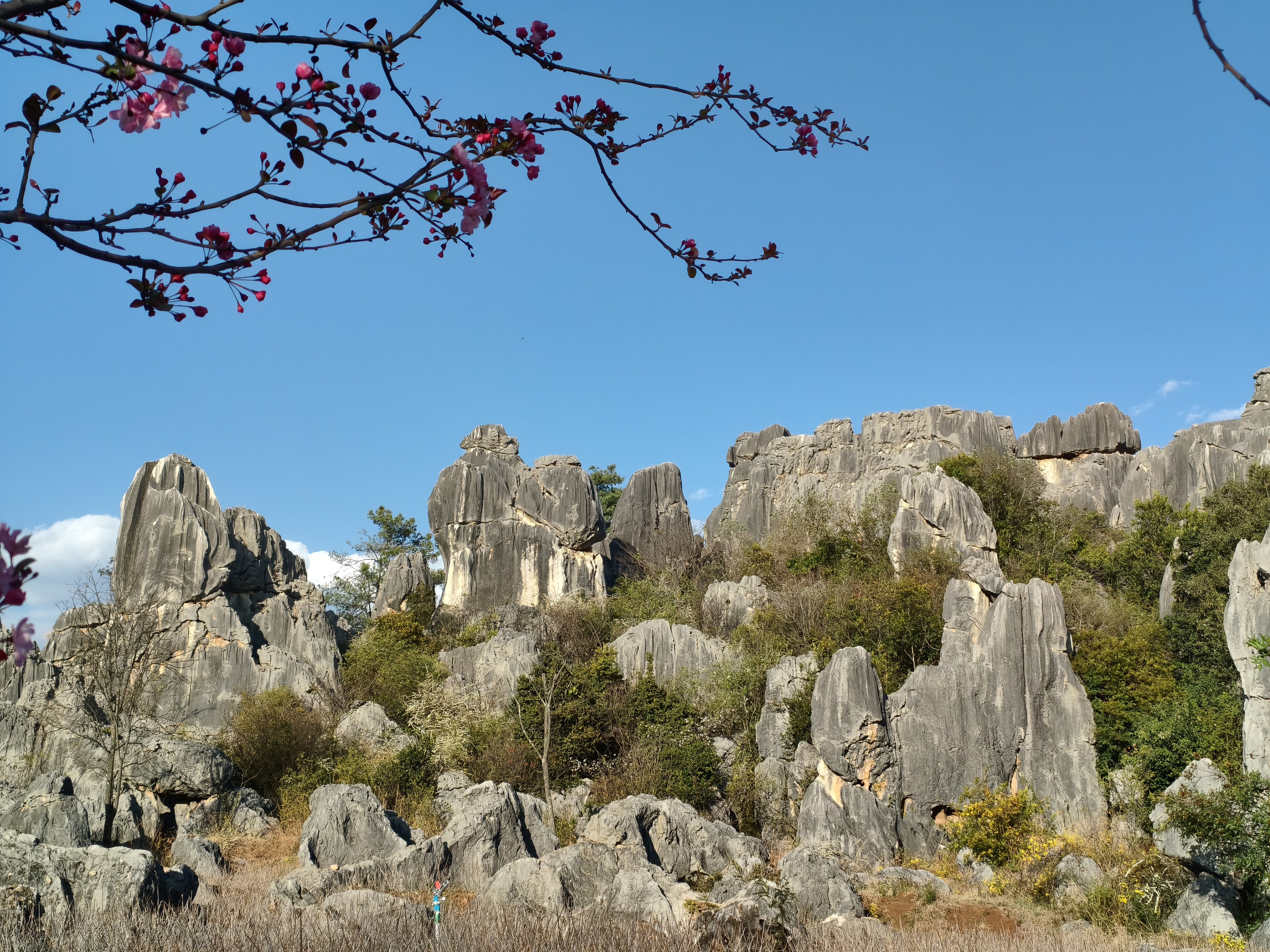
Start early today for the Stone Forest (Shilin), the sight everyone comes to Kunming for — a karst landscape over 270 million years old, where water and wind have carved the limestone into thousands of tall, sharp pillars standing packed together like a forest made of stone. It's a UNESCO Natural World Heritage site. Follow the paths through the rock, squeeze through narrow gaps, climb to the viewpoints and find the Ashima pillar that's the symbol of the local Yi people. Plan on 3–4 hours of walking — the area is huge, so wear comfortable shoes.
If you've still got energy and want to make the most of the trip out, consider stopping at the Jiuxiang caves on the way back (in the same broader area as the Stone Forest, in a different direction) — a vast karst cave system with underground rivers, waterfalls inside the caverns, and stalactites lit to dramatic effect. There's a local saying: "above ground, see the Stone Forest; below ground, see Jiuxiang." Honestly, if you're short on time or already tired, skip Jiuxiang — it's not a must-see — but if you love caves and this kind of landscape, it's a memorable, worthwhile add-on.
You'll be back in the city by evening, and a full day at the Stone Forest earns a proper meal. If you've come in the rainy season (June–September), this is the Yunnan wild-mushroom season Kunming is most famous for. Try a wild-mushroom hotpot (野生菌火锅), where dozens of kinds of fresh wild mushrooms simmer in a chicken broth, fragrant and naturally sweet (good restaurants have a server time the cooking to keep it safe). Out of mushroom season, go for Yunnan steam-pot chicken (汽锅鸡) — chicken steamed in a clay pot where the rising steam condenses into a clear, naturally sweet broth, with no water added at all. Read more in our Yunnan steam-pot chicken guide.
A dragon gate on a cliff with a vast lake below · a culture park of 26 ethnic groups · or boarding a train out to Dali and Lijiang — a final day that flexes to your bigger plan.
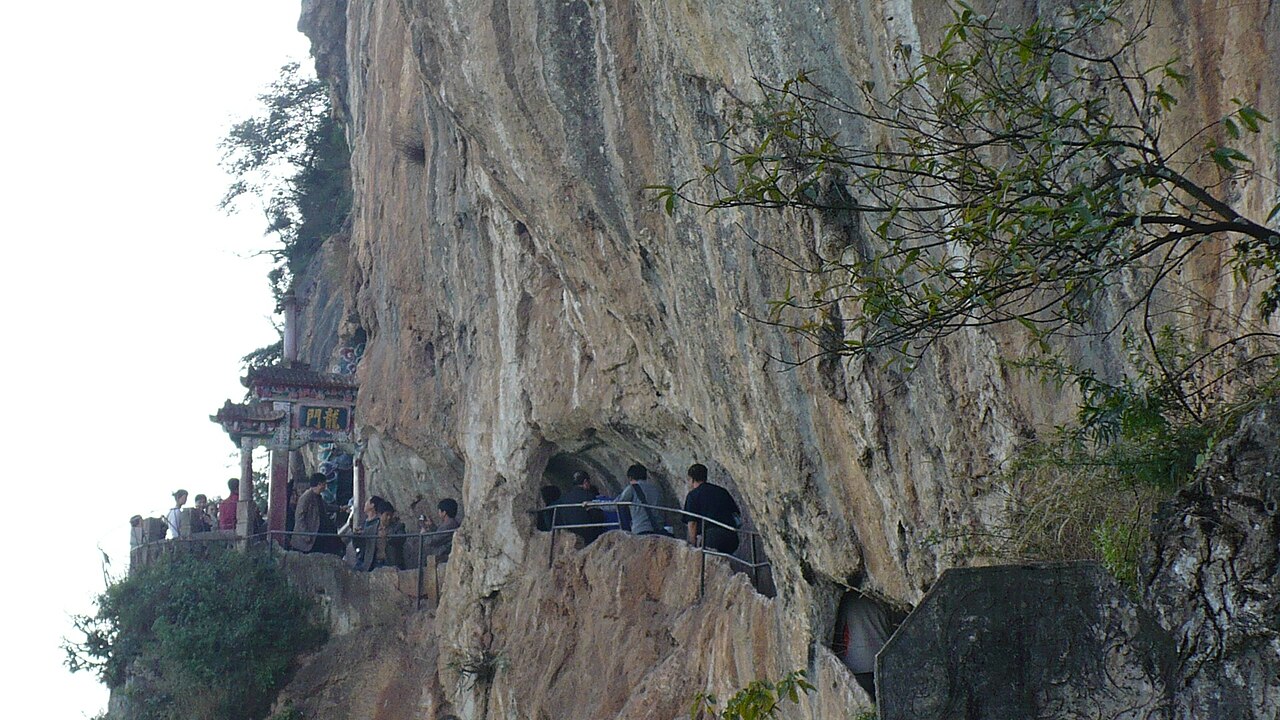
If you have another day in Kunming, this is the best one — climb the Western Hills (Xishan), the range that runs along Dianchi Lake, the largest freshwater lake in Yunnan. Locals call the Western Hills the "Sleeping Beauty" because, seen from the city, the ridgeline looks like a young woman lying on her back. The highlight is the Dragon Gate (Longmen 龙门), a path and a series of grottoes that craftsmen carved by hand into the cliff over more than 70 years. Follow the narrow walkway along the cliff face and look down on Dianchi Lake stretching out to the horizon — a view that's worth every drop of sweat. Read more in our Western Hills Dragon Gate guide and our Dianchi Lake guide.
For an afternoon or half day, if you want to grasp just how diverse Yunnan's ethnic groups are, stop at the Yunnan Nationalities Village, which sits right on the shore of Dianchi Lake at the foot of the Western Hills — a culture park that recreates the villages of 26 ethnic groups across Yunnan, from the Bai and Dai to Tibetan, Yi and Naxi, with buildings modelled on each group's real architecture, folk-dance performances and ethnic cuisine. It's good for families or anyone who wants an overview of Yunnan's cultures before travelling on. Honestly, it leans a little toward a culture theme park — but children love it and it photographs beautifully.
If your bigger plan is to see all of Yunnan, Day 3 is the day you pack up and board the high-speed train out of Kunming. The classic, most popular route is Kunming → Dali (~2 hr) → Lijiang (~3–3.5 hr) → Shangri-La. Dali has Erhai Lake and a walled old town; Lijiang has a UNESCO old town and Jade Dragon Snow Mountain; and to the south lie the Yuanyang rice terraces and the ancient town of Jianshui. Kunming is the most convenient starting point because the trains run direct to all of them — map out the route, the times and how many days you'll need in our Kunming-to-Yunnan trip planner.
For this trip, stay in the Green Lake area and the city centre — you can stroll the lakeside watching the gulls, you're close to Yuantong Temple, the old quarter and the Nanping food street, and metro Line 2 is right there. A second option is near Kunming South station, handy if you'll use Kunming as a base for onward trains to Dali / Lijiang. Compare the options in our top 10 Kunming hotels or 6 luxury hotels in Kunming.
Kunming has 6 metro lines, ¥2–8 per trip, paid via Alipay or WeChat Pay (scan the QR at the gate). Line 2 runs through the Green Lake area and Kunming Railway Station, Line 1 reaches Kunming South (HSR), Line 3 goes to Western Hills Park, and Line 6 serves Changshui Airport. The Stone Forest is outside the city and needs a train or coach. DiDi is cheap and easy in town, and Amap is the easiest map app. The city is fairly spread out, so allow time to get around.
Link a Visa/Mastercard to Alipay (through its international mode) before you travel. Most shops in Kunming only take Alipay / WeChat Pay, and some don't take cash. And book your high-speed-rail tickets to the Stone Forest, Dali or Lijiang ahead in peak season — see our Alipay & WeChat Pay guide to set everything up before you go.
| Item | Budget | Mid-range | Comfort |
|---|---|---|---|
| Hotel (per night) | ¥100–200 (~฿500–1,000) |
¥250–550 (~฿1,250–2,750) |
¥700–1,600+ (~฿3,500–8,000+) |
| Three meals | ¥50–90 (~฿250–450) |
¥80–180 (~฿400–900) |
¥250–500 (~฿1,250–2,500) |
| Metro + bus | ¥6–16 (~฿30–80) |
¥10–30 (~฿50–150) |
¥40–80 (+ some DiDi) |
| Admission + Stone Forest train | ¥30–80 (free sights + temple) |
¥130–320 (Stone Forest + Western Hills) |
¥320–550 (+ Jiuxiang + Nationalities Village) |
| Total per day (approx.) | ¥186–386 (~฿930–1,930) |
¥470–1,080 (~฿2,350–5,400) |
¥1,310–2,730+ (~฿6,550–13,650+) |
Exchange rate reference ¥1 ≈ ฿5 · prices are approximate and vary by season · the Stone Forest day is the biggest single cost, since it includes the high-speed train both ways, admission and the in-park shuttle — check before you go.