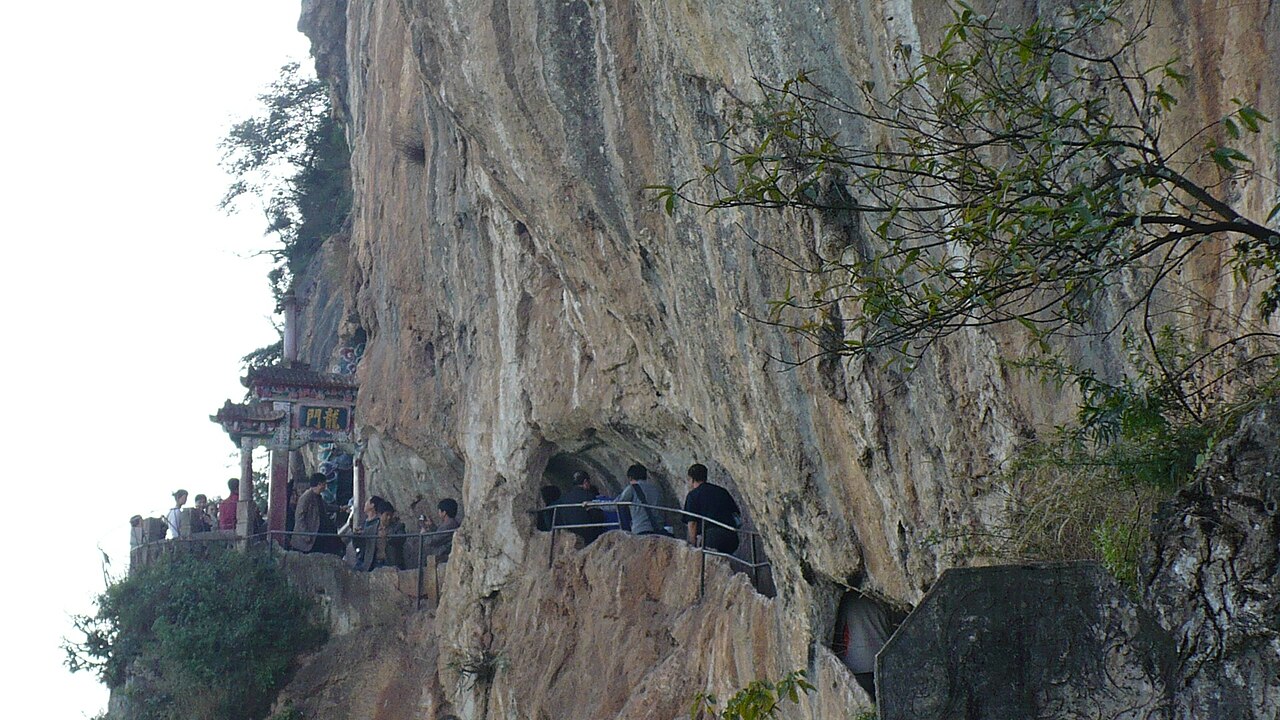
A ridge of forested hills runs above Dianchi Lake; Kunming locals see a reclining figure in it and call it the Sleeping Beauty. Up here is the Dragon Gate — grottoes, shrines and a narrow walkway cut straight into the rock, with the whole of Dianchi Lake spread out far below your feet.
Picture this: you are standing on a walkway barely wide enough for one person. On one side is raw rock face, dotted with grottoes and shrines hewn into the stone. On the other is a thin railing, and beyond it, a long way down, sits Dianchi Lake, its whole surface lying still and silver hundreds of metres below. This is the Dragon Gate (龙门) on Kunming's Western Hills, the first place locals bring visiting friends — and once you are standing here, you understand exactly why.
The Western Hills (西山, Xishan) are a wall of forested peaks running along the southwest edge of Kunming, directly above Dianchi Lake. Looked at from the city, the line of summits resembles a woman lying on her back with her hair flowing out, so people call the ridge the "Sleeping Beauty" (睡美人). The Dragon Gate is the prize at the far end of the trail — a network of grottoes, shrines and a tight walkway cut straight into the sheer cliff entirely by hand, with no machinery.
What makes it remarkable is that this path was not built in a single lifetime. A Taoist monk named Wu Laiqing began carving it around 1781, and the work was carried on for more than 70 years — hollowing out grottoes, sculpting figures of deities and cutting steps into the rock a little at a time, until it became the cliff-hanging walkway people tread today. It is at once a view that takes your breath away and a monument to a patience that is hard to match anywhere.
The way up climbs the hill in stages, taking in temples and a tomb on the way, then finishes at the Dragon Gate near the top. Walk it slowly and you will catch all of it.
1
This is the star of the whole hill: a narrow walkway cut straight into the cliff, passing grottoes carved with Taoist gods — the stars and the deity of literature among them — and ending at a white stone archway perched right at the cliff edge. Step past the railing in your mind and the entire lake opens out below. Tradition says touching the dragon's head or the orb at the archway brings good luck. Just know that this is where the crowds bunch up, because the path is so narrow you can only pass single file.
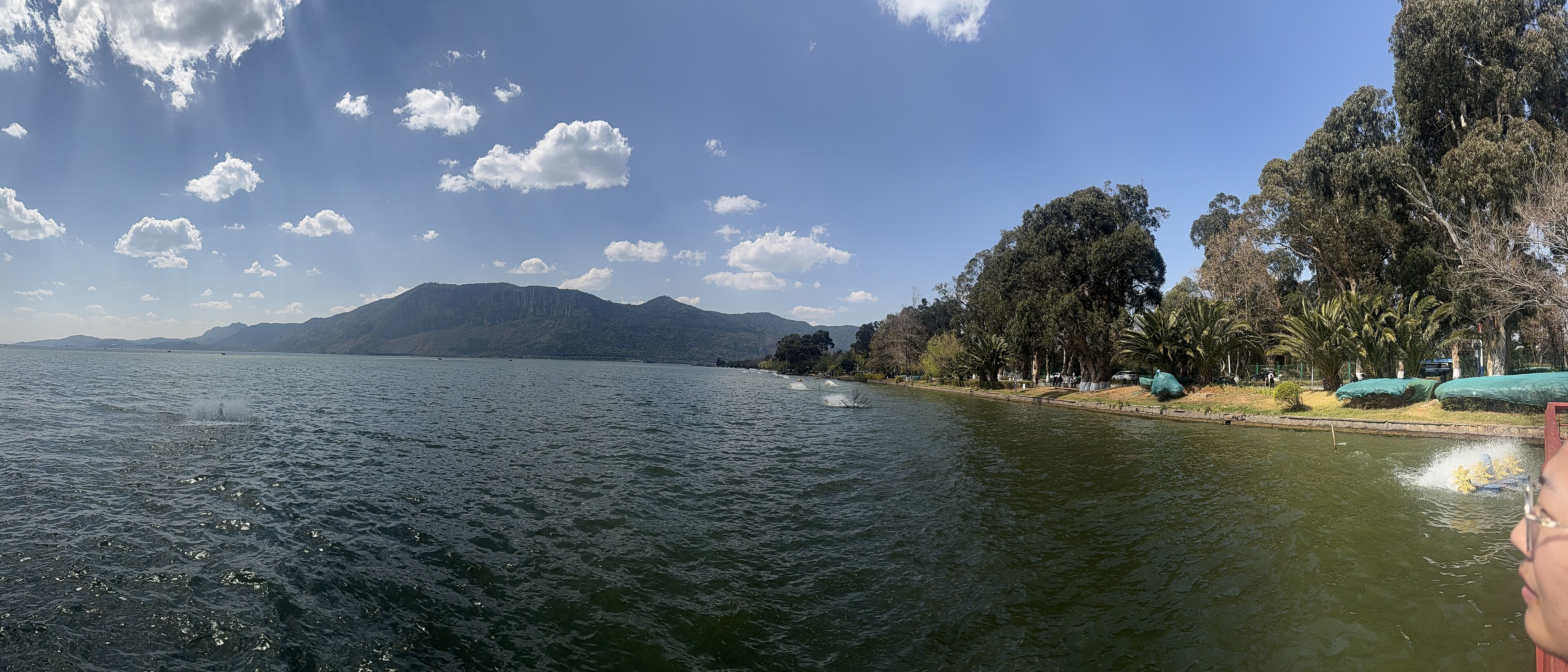
The view is the main reason people make the climb. From the Dragon Gate walkway, Dianchi Lake (滇池) stretches out below you to the horizon — the largest lake in Yunnan province. On a clear day you can pick out the Kunming skyline on the far shore. The cool wind hits your face, and you forget all about the steps you just climbed. This is everyone's favourite photo spot, so for a clean shot, wait for a gap in the foot traffic on the narrow path.
Before you reach the Dragon Gate, the route passes two old temples tucked into the forest. Huating Temple (华亭寺) is an ancient Buddhist temple with prayer halls and shaded flower gardens, while Taihua Temple (太华寺), higher up, has a viewing terrace that also looks out over the lake. The two share a separate admission from the Dragon Gate ticket, and they make a good place to rest your legs and breathe the cool forest air before the final push.
On the hillside between Taihua Temple and the Sanqing Pavilion is the tomb of Nie Er (聂耳), a son of Kunming who became one of China's most important composers. He wrote the melody of "March of the Volunteers", later adopted as China's national anthem. Nie Er died young, at just 23, and his tomb is built as a half-circle with 24 steps marking his age. Many Chinese visitors stop here to pay their respects on the way up. Entry is around ¥1 — a small spot that carries real weight.
Just before the narrow path to the Dragon Gate, you pass the Sanqing Pavilion (三清阁), a cluster of Taoist shrines built in tiers onto the cliff face. It began as a retreat for a Yuan-dynasty noble before becoming a Taoist sanctuary, and this is where the cliff carving first started. Small shrines cling into the crevices of the rock for you to climb up through, and the view from each tier's terrace gets better as you go — a warm-up before the main event.
Everything you actually need to know, in one place.
The Western Hills sit on the southwest side of Kunming, right beside Dianchi Lake. You can reach them by metro or by cableway across the lake, and they pair with the lakeshore into anything from a half-day to a full day:
Take Metro Line 3 from the city centre to Xishan Park station, leave by Exit A, and pick up the park tram up the hill. This is the most convenient, most straightforward way, and the best option if you would rather not juggle several connections.
For the full experience, head first to Haigeng Park (海埂) on the shore of Dianchi Lake, then ride the cableway across the water, landing at the lower Dragon Gate station. You see the lake from above on the way, and you tie the lake and the hill together in a single outing.
The Western Hills and Dianchi Lake belong together and visit naturally as a pair. Come down off the hill and stroll the Haigeng Dam along the lake. In winter (Nov–Mar), flocks of black-headed gulls gather here to be fed, just as they do at Green Lake — the season when Dianchi is at its liveliest.
Climb in the morning (start around 8.30 am) and see the Dragon Gate while the path is still thin, come down to walk along Dianchi Lake, then finish with a lunch of crossing-bridge rice noodles — the most famous Yunnan dish in Kunming. That makes a fine day in the Spring City.
Stay in central Kunming and you can reach the Western Hills easily on Metro Line 3, while staying close to Green Lake and the food districts. Here are the Kunming hotels we have compared: