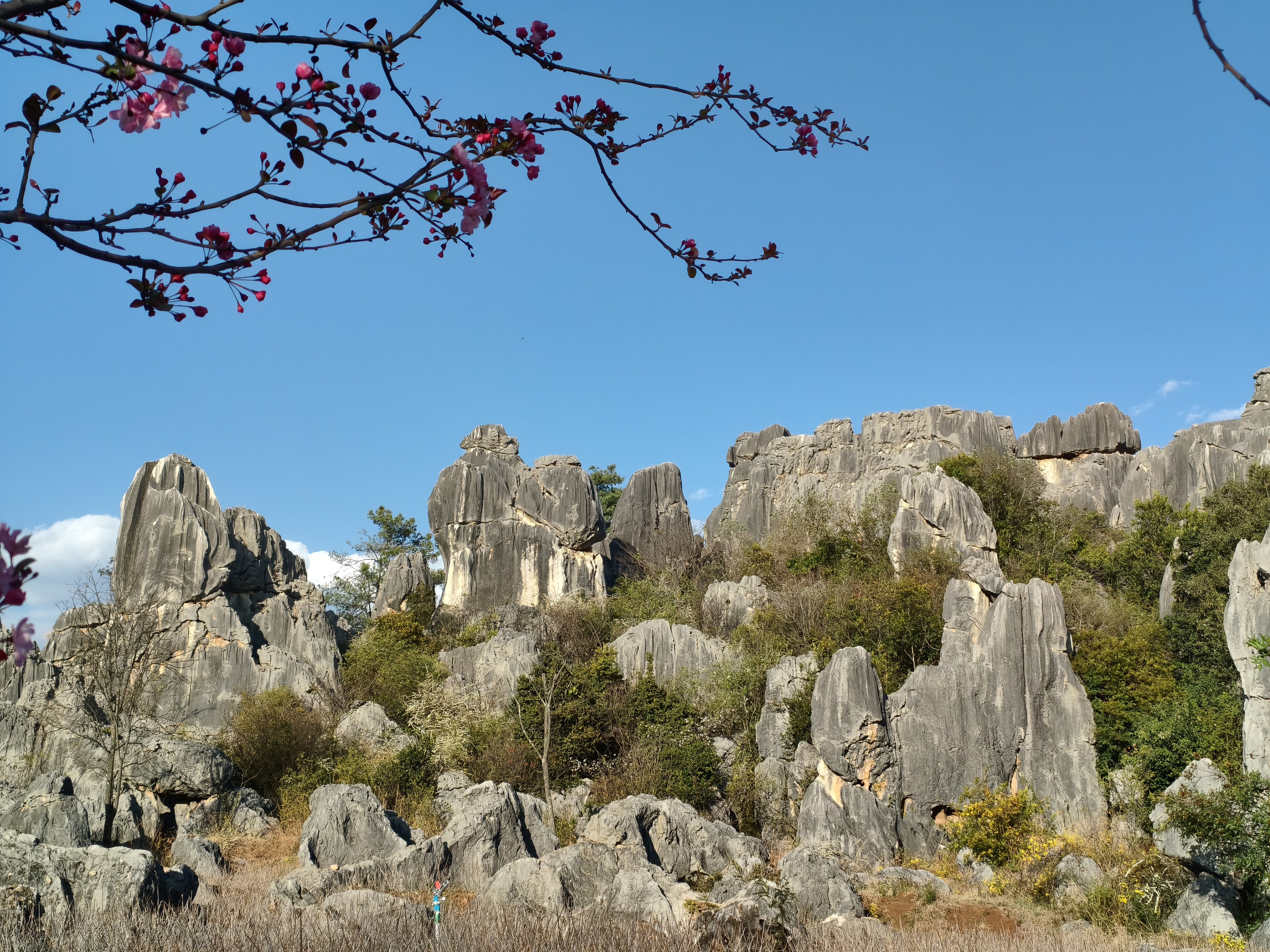
Head about 85 kilometres southeast of Kunming and the world turns into a field of grey limestone pillars — thousands of them, standing tall and close together like a real forest. This is the UNESCO wonder you came to Yunnan for, and Kunming's number-one day trip.
Picture this — you walk into a place called a "forest", but there are no tall trees around you. Instead, thousands of grey limestone pillars rise straight out of the ground, some as tall as several storeys, some thin and pointed like swords. Narrow paths lead you through the gaps between them, up flights of steps, through passages so tight in places you have to turn sideways, before you emerge onto an open terrace looking across a sea of stone peaks to the horizon. This is the Stone Forest (石林, Shilin), one of the strangest and most striking landscapes in all of China.
The Stone Forest lies in Shilin Yi Autonomous County, about 85 kilometres southeast of central Kunming. These pillars formed from limestone laid down under an ancient sea, then carved into shape by water and rain over more than 270 million years, until they became a field of stone that Ming-dynasty travellers called the "First Wonder of the World". Today it is inscribed as a UNESCO World Heritage Site as the representative example of southern China's karst topography.
It is not only about the rock — there is a story here too. This land is the home of the Sani branch of the Yi people (彝族撒尼人), whose legendary heroine, Ashima (阿诗玛), is bound up with one woman-shaped pillar in the Minor Stone Forest. Every late June the Sani hold the Torch Festival (火把节), lighting great bonfires and dancing and wrestling through the night. So the Stone Forest is not just a landscape — it is the cultural heart of the people who live around it.
The scenic area is vast and split into several zones — the Major Stone Forest is the main section to walk, while the Minor Stone Forest is gentler and holds the famous Ashima rock. Take it slowly and you will catch everything.
1
The Major Stone Forest is the heart of it all, and what everyone comes for. The path leads you in among the towering pillars — narrow enough in places to pass one at a time — then up stone staircases to terraces above, where you look out over a sea of peaks reaching to the horizon. The most photographed spot is the rock face carved with the red characters for "Shilin" (石林), where everyone stops for the obligatory photo. Follow the marked route and you will not get lost.
A short walk on from the Major Stone Forest is the Minor Stone Forest. This zone is flatter and far easier to walk, and it holds the single most famous pillar of all — the Ashima rock (阿诗玛), shaped like a young woman carrying a basket and gazing into the distance. Ashima is the heroine of a Sani-Yi legend, and the symbol of the Stone Forest you will see on the tickets, the posters and the souvenirs. Find the angle where the light catches it just right and you understand why this one rock became a legend.
Tucked among the grey pillars is a pool of clear water called Sword-Peak Pond, named for the sharp, blade-like rock that rises out of its centre. When the surface is still it mirrors the peak upside down — a moment of calm set against the jaggedness of the rock all around. It is a spot people love to pause at, take a photo and catch their breath before walking on. The water is clearest after the rains, when the level is high and the reflection sharpest.
Half the charm of the Stone Forest is not looking up at it from below, but climbing onto the peaks. The route runs up stone stairs to several viewing terraces, each opening onto rows of pillars rolling away in waves to the skyline. Between them, some passages are so narrow it feels like walking through a maze — you squeeze through dim, cool gaps in the rock and step back out into the light. Children usually love this part most. Follow the signs and photograph a map, because there are plenty of junctions.
The Stone Forest is not only rock — there are people too. The Sani-Yi are the original inhabitants, and they still keep their language, dress and traditions alive. Within the scenic area you will often find folk performances and stalls where you can try on Sani costume for a photo. The highlight of the year is the Torch Festival (火把节), held around 24 June by the lunar calendar, when the Yi light huge bonfires and spend the night wrestling, bull-fighting and dancing around the flames. Come at this time and you see the Stone Forest at its most alive.
The Stone Forest is about 85 kilometres from central Kunming, and there are several ways to get there — from the fast high-speed train to the easiest organised day tour:
Take the high-speed train from Kunming South Station (昆明南站) to Shilin West Station (石林西站), about 18–22 minutes for a fare of around ¥25 (~฿125). The train is quick, but the station sits about 22 kilometres from the scenic area, so you then take bus No. 99 for another 45–60 minutes (around ¥10). Door to door, allow roughly 1.5 hours.
Tourist coaches run from Kunming East Bus Terminal (东部客运站) straight to the scenic area, roughly 8 am to 6 pm, leaving when full and taking about 1.5 to 2 hours. The advantage is no changes — you step off at the Stone Forest entrance. A good choice if you would rather not juggle the train-and-bus connection.
If you would rather not deal with transport at all, an organised day tour comes with hotel pickup and a guide to explain the rock and the Ashima legend. Some tours combine the Stone Forest with the Jiuxiang (九乡) caves in one trip. Prices depend on the package — ideal for families or anyone short on time who wants the easy option. You can book online in advance.
Leave Kunming early and reach the Stone Forest before the tour groups, around 9 am. Walk the Major Stone Forest first while it is quiet, then move on to the Minor Stone Forest for the Ashima rock. Break for lunch inside the area, then take the viewing terraces in the afternoon before heading back to the city by evening. Budget 3–4 hours of actual walking, plus about 3 hours of travel each way combined.
Everything you actually need to know, in one place.
Most people visit the Stone Forest as a day trip from central Kunming. Before you set off in the morning, fuel up on a bowl of the city's famous crossing-the-bridge rice noodles, and pick a hotel near the station for an easy early start: