Home Kunming China Kunming Hotels About
Home  ›  Asia  ›  China  ›  Kunming  ›  Temples
🇨🇳 Kunming Temples · 2026

Which Kunming temple should you visit?
A bronze hall, a downtown sanctuary & 500 arhats

Kunming isn't only lakes and mountains — Yunnan's capital keeps several very different old temples in one place: a big downtown Buddhist temple set over a water court, a Taoist hall cast entirely in bronze on a hilltop, and a forest temple whose 500 painted clay arhats are talked about around the world.

Why come here

Three kinds of temple that tell Yunnan's whole story of faith

What makes Kunming's temples special is that none of them look alike. The city sits where Han culture from the central plains, Tibetan Buddhism from the north and Theravada Buddhism from the south (Xishuangbanna) all meet — so the temples here don't follow the usual Chinese template. Picture Yuantong Temple, the city's largest Buddhist temple, founded back in the Tang dynasty: its main hall sits in the middle of a water court, an octagonal pavilion stands on the pond linked by stone bridges, and walking in feels like entering a temple that floats. Within a single courtyard you'll find Han-style halls, a Tibetan-style stupa and gilt Buddha statues donated by Theravada worshippers.

Head northeast out of the centre and you reach the Golden Temple (金殿) on Mingfeng Hill — a Taoist hall cast entirely in bronze, one of the largest bronze buildings in China, ringed by camellia gardens that flower early in the year. In the foothills to the northwest hides the real connoisseur's stop, Qiongzhu (Bamboo) Temple, and its 500 Qing-dynasty clay arhats: every figure looks like a real person, one laughing, one scowling, one almost cartoonish. We've picked the four temples that contrast most sharply, and laid out how to combine them without losing your day to cross-town traffic.

Temples worth your time

Four temples pick the one that's you

Ordered from the big, easiest downtown temple out to the bronze hall on the hilltop and the art temple in the foothills — read the details for each below.
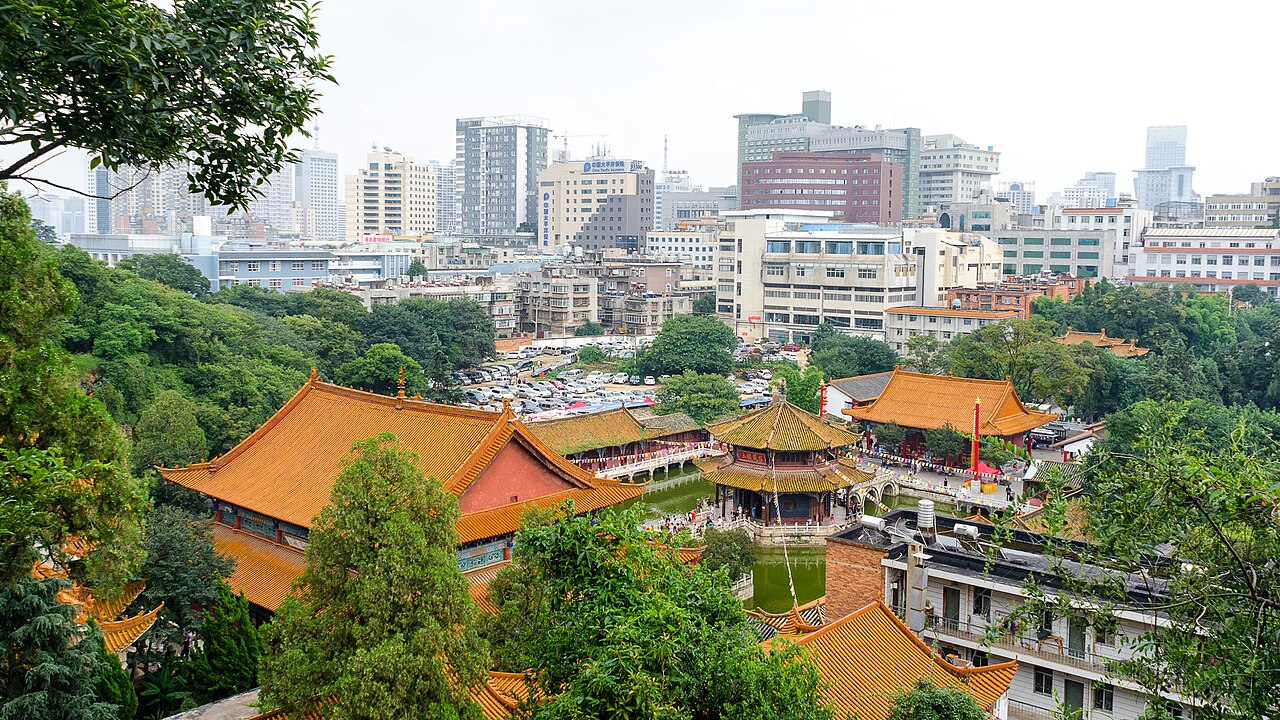
Yuantong Temple, Kunming, seen from above — orange-tiled halls arranged around a water court with an octagonal pavilion on the pond, framed by green trees and the modern Kunming skyline behind 1
Yuantong Temple (圆通寺)
The city's largest Buddhist temple · Tang-founded · easiest to reach

If you only do one temple in Kunming, Yuantong is the simplest choice — the largest and busiest Buddhist temple in the city, first built in the Tang dynasty (over 1,200 years ago) and rebuilt across the centuries since. What sets it apart is its layout, which sinks downward: you descend toward a main hall that sits in the middle of a water court, with an octagonal pavilion on the pond linked by stone bridges, like a temple on the water. Inside you'll find Han-style art, a Tibetan-style hall, and a shrine with a bronze Burmese/Dai-style Buddha donated by Theravada Buddhists. It sits right next to Green Lake (翠湖) and the zoo, so you can walk straight on from one to the next.

Getting there: City centre, Wuhua District · beside Green Lake · easy by metro/taxi
Ticket: ~¥6 (~฿30) · open roughly 08:00–17:30
Tip: Go early · walk on to Green Lake for the winter black-headed gulls
Walk on to Green Lake (翠湖) →
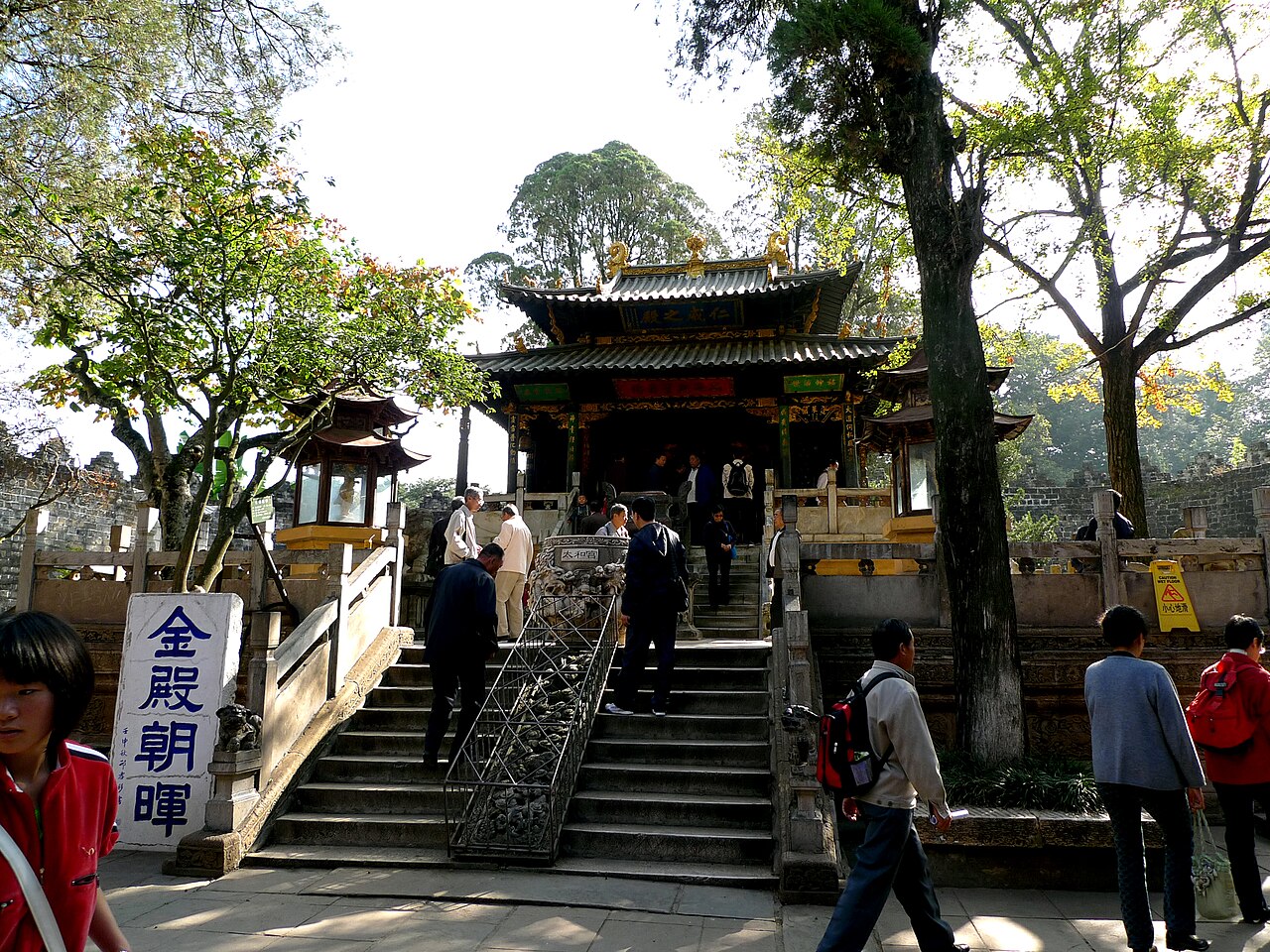
The Golden Temple, Kunming — a stone staircase rising to a dark bronze Taoist hall among trees, with a small bell pavilion to the side, a carved stone stele and visitors climbing the steps 2
Golden Temple / Taihe Palace (金殿 · 太和宫)
An all-bronze Taoist hall · on Mingfeng Hill · camellia gardens

People hear "Golden Temple" and assume gold — it's actually a hall cast entirely in bronze: columns, walls, roof and doors, all of it, which makes it one of the largest and most complete bronze buildings in China. It's a Taoist hall, built in the Ming dynasty and recast in the Qing, standing on Mingfeng Hill (鸣凤山) to the northeast of the city. The same grounds hold a large bell tower and little fortified walls to wander, and the whole hilltop is planted with camellias and azaleas that flower beautifully early in the year (around February–March). It's cool and pleasant up here thanks to the altitude. You can reach it by bus, taxi or the cable car from the adjacent World Horticultural Expo Garden.

Getting there: Mingfeng Hill, northeast · by bus/taxi/cable car
Ticket: ~¥30 (~฿150) · open roughly 07:30–18:00 · cable car extra
Tip: Best in Feb–Mar for the camellias · pair with the Expo Garden
See all Kunming attractions →
🧘3
Qiongzhu / Bamboo Temple (筇竹寺)
The world-famous 500 clay arhats · northwest foothills

This is the temple sculpture lovers happily ride out of town for — Qiongzhu, the "Bamboo Temple," is world-renowned for its 500 arhats (五百罗汉), Qing-dynasty painted clay figures made by the sculptor Li Guangxiu (李广修) and his team over several years, one by one. What stops you in your tracks is that no two are alike: one laughs, one frowns, one rides a beast through a wall, one has arms stretched so long it borders on caricature — as if the sculptor froze real people of his day in clay. It's considered a masterpiece of Chinese sculpture. The trade-off is the location: it sits in the foothills to the northwest, a fair way out, so you transfer by bus or taxi/ride-hail. It pairs nicely with the Western Hills (西山) on the same day, in a shaded grove of the bamboo it's named for.

Getting there: Northwest foothills, ~10 km out · by bus/taxi
Ticket: ~¥10 (~฿50) · open roughly 08:00–17:00
Tip: The real art highlight · pair with the Western Hills in one day
Pair with Western Hills & Dragon Gate →
🌸4
Tanhua Temple (昙华寺)
A quiet garden temple in the east · for a slow afternoon

If the three above are the highlights, Tanhua is the temple to slow down in — an old temple that's now a leafy public park in the east of the city. Locals come to sip tea, stroll, and photograph the flowers more than to sightsee. There are lotus ponds, pavilions, seasonal flower beds and old trees, and the draw is exactly that quiet, lived-in local feel, with no tour groups. It's worth a stop if you're staying on the east side or want an easy half-day away from the crowds. You don't need to go out of your way for it, but if you're passing nearby it's a pleasant pause.

Getting there: East of the city · by metro/taxi/bus
Ticket: A few yuan · daytime park hours
Tip: Quiet and local · good for a slow tea-and-garden half-day
See the full Kunming guide →
Good to know: Kunming's temples are working places of worship, especially the very busy Yuantong — dress modestly with shoulders and knees covered, keep your voice down in the prayer halls, and watch for no-photography signs inside halls with Buddha images. At Qiongzhu, photographing the 500 arhats is usually not allowed, to protect the original paintwork; admire them with your eyes and carry the memory home.
Plan your visit

How to combine them without losing your day to traffic

The three main temples lie in different directions — downtown (Yuantong), northeast (Golden Temple) and northwest (Qiongzhu). Splitting by zone is the smartest way to do it.

Downtown zone — Yuantong
Morning · next to Green Lake + zoo

Start your morning at Yuantong since it's the easiest to reach and right in the centre. After the water-court halls, step out the gate and you're at Green Lake (翠湖), which you can walk straight into. In winter (Nov–Mar) the pond fills with black-headed gulls you can feed, and the Kunming Zoo sits on the hill next door. Three stops in one easy morning.

Time needed: Half a morning · Pair with: Green Lake
Northeast zone — Golden Temple
Afternoon · Mingfeng Hill + Expo Garden

The Golden Temple (金殿) is up on Mingfeng Hill to the northeast; take a bus, taxi or the cable car up. Walk the bronze hall and the camellia gardens (best around Feb–Mar), where the air is cool thanks to the elevation, then combine it with the World Horticultural Expo Garden next door in one afternoon. Ideal if you like the unusual and a flower garden.

Time needed: Half an afternoon · Note: Cable car from the Expo Garden
Northwest zone — Qiongzhu + Western Hills
Full day · art + lake views

Qiongzhu Temple (筇竹寺) sits in the northwest foothills, a fair way from town, so it's best folded into the same day as the Western Hills & Dragon Gate nearby. See the 500 arhats at Qiongzhu in the morning, then climb the Western Hills for the Dragon Gate carvings and views over Dianchi Lake in the afternoon, transferring by bus/taxi/ride-hail between them. It's a lot of walking — wear comfortable shoes.

Time needed: Full day · Pair with: Western Hills
Slow zone — Tanhua
Optional extra · east side

Tanhua Temple (昙华寺) in the east is a low-effort add-on. If you're staying on that side or want a quiet half-day, come to sip tea, wander the flower gardens and photograph the lotus ponds — no tour groups, just the real Kunming-local atmosphere. A relaxed way to close out a temple trip.

Time needed: Half a day (optional) · Good for: Stays on the east side
Frequently asked

FAQ · before you set out

If you only have a little time, which Kunming temple should you visit?
With only half a day, Yuantong Temple (圆通寺) is enough on its own — it's right downtown, beside Green Lake (翠湖) and the zoo, and the easiest to reach on foot or by metro/taxi, with entry around ¥6 (~฿30). If you have a full day and care about art, add Qiongzhu Temple (筇竹寺), because its 500 painted clay arhats are the genuine artistic highlight of Kunming, even though it sits further out to the northwest. If you'd rather see something unusual and a garden, the Golden Temple (金殿) on Mingfeng Hill to the northeast is worth half a day.
How much are tickets for Kunming's temples, and what are the opening hours?
Approximate prices and hours: Yuantong Temple around ¥6 (~฿30), open roughly 08:00–17:30; Golden Temple / Taihe Palace around ¥30 (~฿150), open roughly 07:30–18:00; Qiongzhu / Bamboo Temple around ¥10 (~฿50), open roughly 08:00–17:00; Tanhua Temple a few yuan. Most temples stop admitting visitors around 30 minutes before closing, and the cable car up to the Golden Temple and other rides are charged separately. Prices can change — check again before you go.
Is Qiongzhu Temple and its 500 arhats worth the trip, and how do you get there?
Very much so if you love sculpture — the 500 arhats (五百罗汉) at Qiongzhu Temple are Qing-dynasty painted clay figures by the sculptor Li Guangxiu (李广修) and his team, and no two are the same. Some laugh, some scowl, some have wildly exaggerated limbs that look almost like caricatures, as if real people had been frozen in clay. They're considered a masterpiece of Chinese sculpture. The catch is that the temple sits in the foothills to the northwest, a fair way from the city, so you transfer by bus or taxi/ride-hail. It pairs well with the Western Hills (西山) on the same day. Entry is around ¥10 (~฿50).
Is the Golden Temple (金殿) really made of gold, and how do you get up there?
Not gold — it's a hall cast entirely in bronze: the columns, walls, roof and doors are all bronze, making it one of the largest and most complete bronze buildings in China. It's a Taoist hall, built in the Ming dynasty and recast in the Qing, standing on Mingfeng Hill (鸣凤山) to the northeast of the city. It's surrounded by camellia and azalea gardens that bloom beautifully early in the year (around February–March), and there's a large bell tower too. You can reach it by bus, taxi, or the cable car from the nearby World Horticultural Expo Garden.
How should you dress and behave when visiting Kunming's temples?
Kunming's temples are working places of worship with monks and local worshippers, especially the busy Yuantong Temple. Dress modestly with shoulders and knees covered, remove hats and keep your voice down in the prayer halls. Photography is often prohibited inside halls with Buddha images or icons (watch for signs). Follow the walking flow and don't point at the statues with a finger or foot. At Qiongzhu Temple, photographing the 500 arhats is usually not allowed in order to protect the original paintwork, so admire them with your eyes. You can pay for tickets and incense with Alipay/WeChat Pay or cash.
Can you see Kunming's temples in a single day?
You can, but you have to choose, because the three main temples lie in different directions. The cleanest approach is to split by zone: spend the morning at downtown Yuantong (next to Green Lake and the zoo, easy to combine), then pick one for the afternoon — the Golden Temple (金殿) to the northeast if you want the unusual bronze hall and gardens, or Qiongzhu Temple (筇竹寺) to the northwest if you want the art, which pairs with the Western Hills. Trying to hit all three temples in one day wastes too much time crossing the city by car.
Klook · Kunming tours

Kunming tickets & tours — book ahead and walk straight in

Western Hills & Dragon Gate tours, the Stone Forest, Dianchi Lake and day trips around Kunming — book on Klook ahead of time, especially over the holidays when the big sights get packed.

See Kunming tours on Klook →
Wherebest is a Klook affiliate partner — we may earn a commission when you book through our links, at no extra cost to you.