Home Kunming China Kunming Hotels About
Home  ›  China  ›  Kunming  ›  Food Guide
Kunming Food Guide · 2026

What to eat in Kunming
11 dishes before you leave

The Spring City has the freshest, most distinctive kitchen in China. Crossing-bridge rice noodles you cook tableside in scalding broth; rainy-season wild-mushroom hotpot the whole city waits for; chicken steamed in a clay pot that brews its own clear broth from steam; rose-petal flower cakes; and the sour-spicy Dai food of Xishuangbanna. This is a kitchen built on mountains, forests and 25 ethnic kitchens — bold, fresh and like nowhere else.

Photo: crossing-bridge rice noodles (过桥米线) — the broth, noodles and raw cook-it-yourself plates
Why eat here

Yunnan's kitchen — fresh, bold and unlike any other

If the picture of Chinese food in your head is a slick of red Sichuan chilli oil, Kunming will open a whole new one. Yunnan cooking — what locals call Dian cai (滇菜) — isn't a single tradition but a remarkably varied one, because Yunnan is the most ethnically diverse province in China, home to more than 25 groups. The thread that ties it together is fresh produce from the mountains and forests — wild mushrooms, edible flowers, herbs, highland vegetables and home-fermented things. It's bolder than the refined Jiangnan kitchens but never chilli-fierce like Sichuan. Some dishes run sour and spicy, like Dai food; others are pure and gentle, like steam-pot chicken. You get to choose, sometimes in the same meal.

Kunming is the "Spring City" (春城), cool and mild almost year-round, and the gateway to Xishuangbanna, Dali, Lijiang and the edge of the Tibetan plateau. Its kitchen gathers the flavours of the whole province in one place. We picked 11 dishes and bites that tell Yunnan's story best — from the legendary crossing-bridge noodle bowl and seasonal mushroom hotpot to the snacks of the wet markets and the Yunnan coffee and Pu'er tea that run deep through this land.

The essential dishes

11 things to eat before you leave Kunming

Ranked by how unmistakably Yunnan they are — dishes you won't find done quite like this anywhere else.
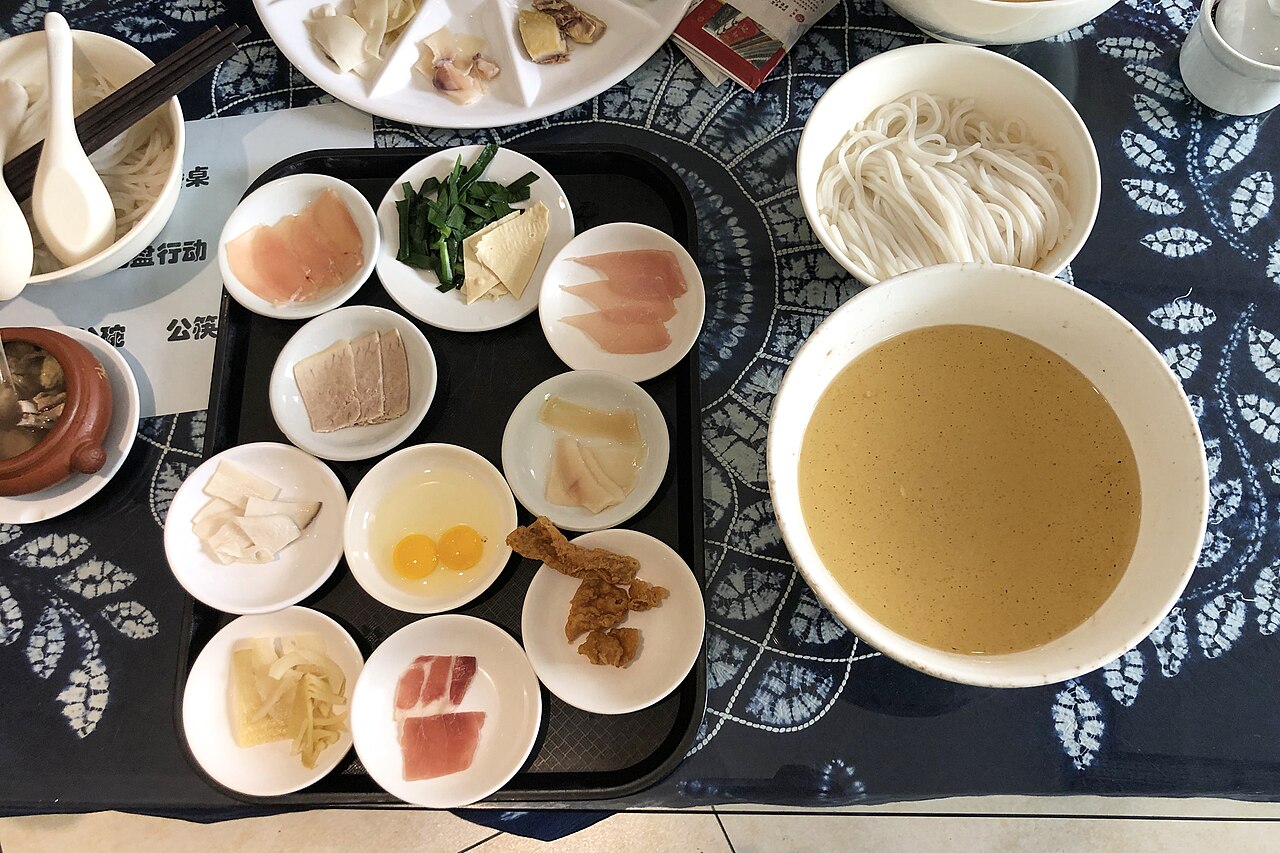
Kunming crossing-bridge rice noodles — a large bowl of golden oil-capped chicken broth, a bowl of rice noodles, and a tray of small plates with thin raw meat, a quail egg and vegetables to cook tableside 1
Crossing-Bridge Rice Noodles (过桥米线)
Scalding broth you cook raw ingredients in tableside

Yunnan's signature dish, and a small ritual in itself. A big bowl arrives holding chicken broth heated until it's fiercely hot, capped with a layer of oil that traps the heat so the surface looks calm but can scald in an instant. Alongside come small plates of thinly sliced raw meat, quail egg, vegetables, tofu and rice noodles, which you slide into the bowl to cook right at the table. The dish was born in the town of Mengzi (蒙自) from a legend of a scholar's wife who carried oil-capped soup across a bridge so it would still be hot when she reached him. It's been a listed Kunming intangible heritage since 2008.

Where: Qiaoxiang Yuan (桥香园 · the famous chain) · Jianxin Yuan (建新园) · noodle shops citywide
Price: ¥20–58 (฿100–290) / set, by ingredients
Tip: Add the slow-cooking raw items first, stir to cook, then the noodles
Read the full crossing-bridge story →
🍜2
Rice Noodles, every kind (米线)
小锅米线 / 豆花米线 · the city's daily breakfast

If crossing-bridge noodles are Kunming dressed for an occasion, the everyday bowl of rice noodles is what locals eat every morning. The star is small-pot noodles (小锅米线), boiled one serving at a time in a little brass pot with minced pork, chives and pickled greens — hot, punchy, straight off the flame. There's also tofu-pudding noodles (豆花米线) topped with soft tofu and a peanut sauce, and cold braised noodles (卤米线). The noodles themselves split into chewy dried (干浆) and softer fresh, faintly sour (酸浆) types. It's cheap, filling and eaten all day long.

Where: Duanshi Xiaoguo (端仕小锅) · corner noodle shops all over Kunming
Price: ¥8–20 (฿40–100) / bowl
When: All day, but most popular for breakfast
Read about Kunming's rice-noodle culture →
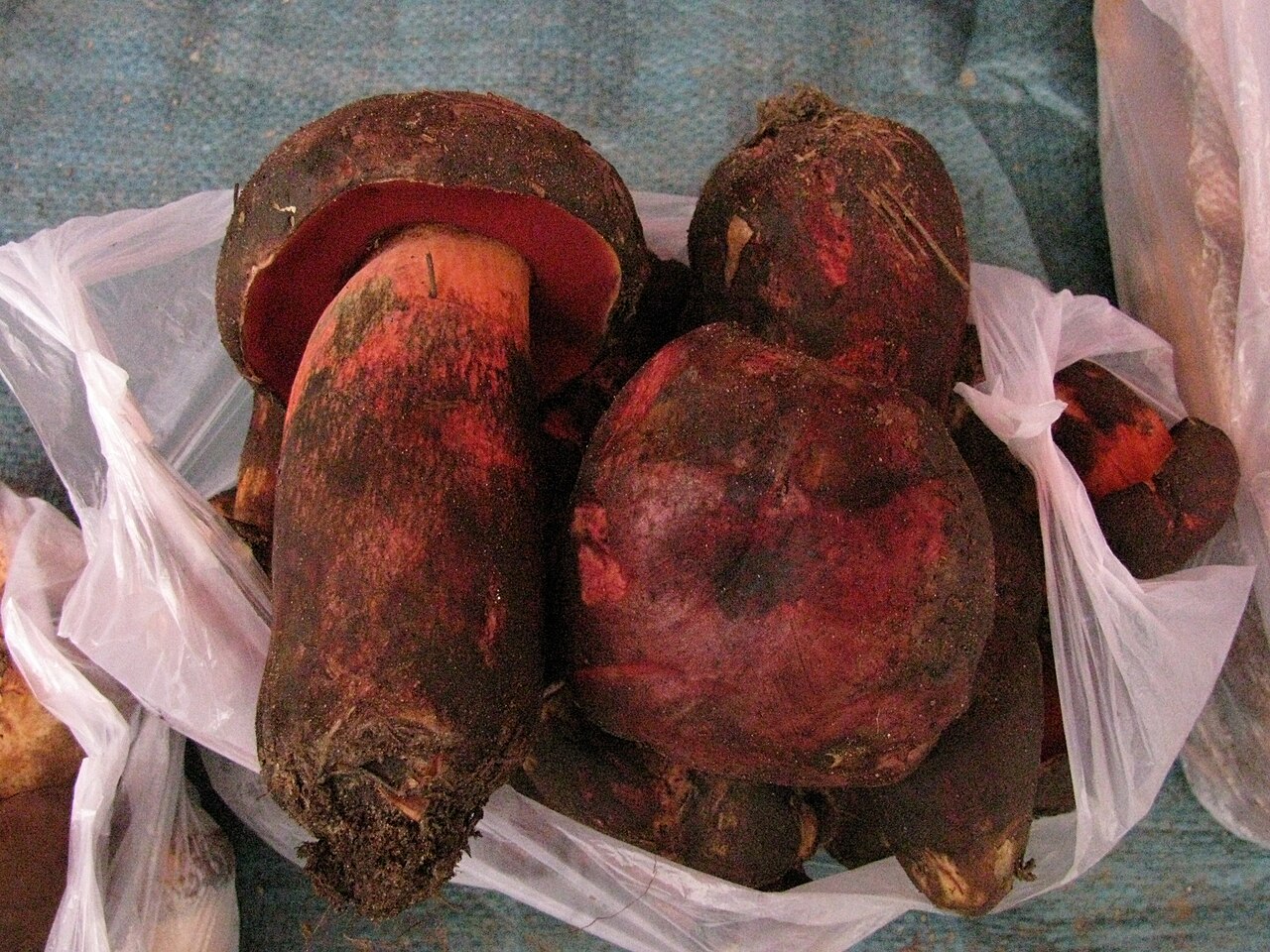
Fresh Yunnan wild mushrooms from the market — red-pored jianshouqing boletes and thick-stemmed wild fungi in a plastic bag, ready for wild-mushroom hotpot 3
Wild Mushroom Hotpot (野生菌火锅)
The rainy-season wild-mushroom obsession

Yunnan's rainy season (roughly Jun–Sep) is when the whole city goes mad for wild mushrooms — a chicken-broth pot bubbling with prized fungi like jianshouqing (见手青), jicong (鸡枞, termite mushroom), songrong (松茸, matsutake), niuganjun (牛肝菌, boletus) and ganbajun (干巴菌). The mushrooms are deep and forest-sweet, but there's one rule you cannot forget — undercooked jianshouqing causes hallucinations of "seeing little people" (见小人), and people are genuinely hospitalised for it every season. That's why restaurants set a timer and make you boil the mushrooms for at least 15–20 minutes first. Follow the staff exactly, and don't rush.

Where: wild-mushroom hotpot restaurants citywide (in season) · pick your own at Musuihua market
Price: ¥100–250 (฿500–1,250) / person, by mushroom type
Season: Jun–Sep only (peaks Jul–Aug)
Read the full wild-mushroom story →
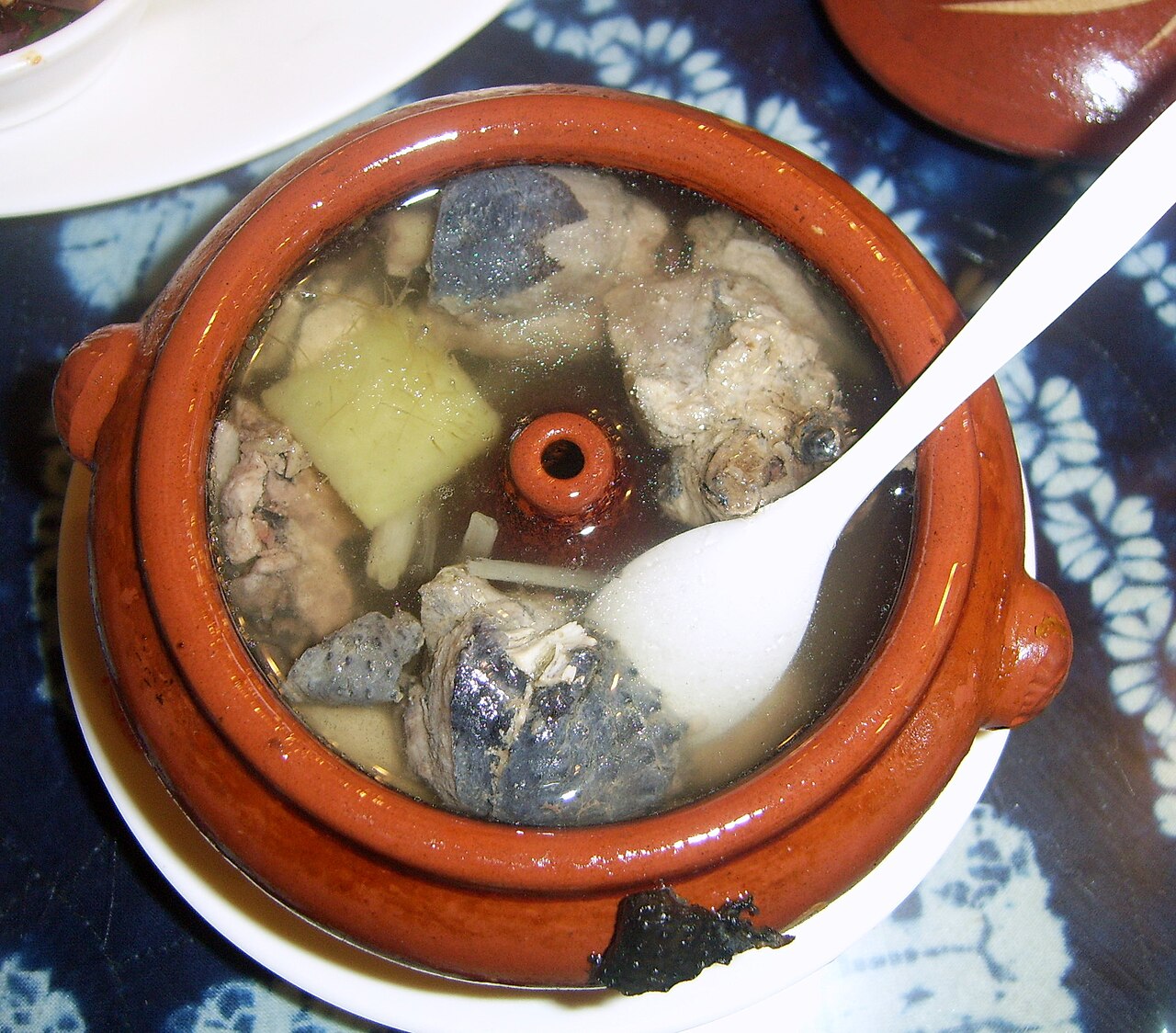
Yunnan steam-pot chicken — a reddish-brown Jianshui clay pot with a hollow central spout, holding chicken pieces in a clear broth, with a porcelain spoon 4
Steam-Pot Chicken (汽锅鸡)
Chicken steamed in a clay pot, broth made of pure steam

A restorative classic that's cleverer than it looks. Chicken pieces go into a Jianshui (建水) clay pot with a hollow spout rising in the centre — and no water is added at all. As it steams, vapour rises through the spout and condenses into clear droplets of broth inside the pot itself, mixing with the chicken's own juices. The result is a crystal-clear, purely chicken-sweet soup, never cloudy. It's often made with herbs like sanqi (三七, notoginseng) or tianma (天麻) to nourish. Legend credits a potter named Yang Li with the design in the Qianlong era. The flavour is pure, barely seasoned — one of the dishes Yunnan is proudest of.

Where: Fuzhaolou (福照楼 · famed for steam-pot chicken) · classic Yunnan restaurants
Price: ¥80–168 (฿400–840) / pot, to share
Tip: Sip the broth first to see why it needs nothing added
Read the full steam-pot story →
🌸5
Fresh-Flower Cake (鲜花饼)
Flaky rose-petal pastry, the Spring City souvenir

Yunnan's most famous edible souvenir — a thin, flaky pastry baked until fragrant, filled with edible Yunnan rose petals cooked down with sugar until they're sweet and perfumed. Bite in and the pastry flakes away while the rose scent lifts off it. The cake has more than 300 years of history, back to the Qing dynasty; April and May are rose-picking season, when locals queue to buy them warm from the oven. The brand everyone knows is Jiahua (嘉华), which bakes them fresh daily and boxes them handsomely to take home. A warm one straight from a city oven beats the boxed kind by a mile.

Where: Jiahua (嘉华鲜花饼) · flower-cake shops in the old town and at the airport
Price: ¥5–15 (฿25–75) / piece · box ¥30–60 (฿150–300)
Tip: Eat them warm in the city · take the boxed ones home as gifts
🍍6
Dai Minority Food (傣味)
Sour-spicy cooking from Xishuangbanna

Southeast-Asian travellers will recognise the flavours at once. Dai food comes from Xishuangbanna (西双版纳) in southern Yunnan, near the Laos and Myanmar borders, and it runs sour, spicy and bright — not far from Thai-Isan cooking. The highlights: pineapple rice (菠萝饭), sticky rice steamed inside a hollowed pineapple; banana-leaf grilled fish (包烧), stuffed with herbs and grilled in its leaf wrapper until aromatic; fermented-bean chilli dips with raw vegetables; and pounded pork with chilli. Kunming has plenty of Dai restaurants, so you can taste it without going all the way south. Fresh and punchy, it's a great change of pace from the city dishes.

Where: Dai / Xishuangbanna restaurants around the city · ethnic-food markets
Price: ¥40–80 (฿200–400) / person
Tip: Start with pineapple rice and banana-leaf grilled fish
🔥7
Grilled Tofu (烧豆腐)
Jianshui tofu charcoal-grilled with a dry dip

The street snack Yunnanese can't stop eating — little cubes of tofu from the town of Jianshui (建水), fermented until faintly sour, laid in rows over a charcoal grill. The vendor keeps flipping them until they puff up golden, crisp outside and soft as marshmallow within. You dip them in a dry chilli-spice mix or a sour-spicy sauce. Some stalls count how many you've eaten with corn kernels on a plate, and people work through them by the dozen. You'll find them at markets and in Guandu old town (官渡古镇), a few baht apiece — a snack woven into this city's memory.

Where: Guandu old town (官渡古镇) · Zuanxin market (篆新农贸市场) · street stalls
Price: ¥0.5–2 (฿3–10) / piece
Tip: Order a round at a time and eat them hot off the grill
Read about Kunming street food →
🍙8
Erkuai / Ersi Rice Cakes (饵块 / 饵丝)
Pounded-rice cakes grilled or stir-fried in soup

An old Yunnan staple. Erkuai (饵块) is made from cooked rice pounded and kneaded until dense and chewy, then shaped into sheets or blocks and eaten many ways. The most famous is grilled erkuai (烧饵块): a sheet toasted over charcoal until it puffs, brushed with peanut sauce and sweet bean paste, then rolled around a fried dough stick or a sausage and eaten on the go — a breakfast favourite. Ersi (饵丝) is the same rice cake cut into ribbons and stir-fried or simmered in broth, soft and springy. You'll find both at morning stalls and wet markets across the city.

Where: morning street stalls · Zuanxin market · Guandu old town
Price: ¥5–15 (฿25–75) / piece or bowl
When: Mostly breakfast · grilled erkuai is a great walking snack
Read about Kunming street food →
🧀9
Bai Dairy — Rushan (乳扇 / 乳饼)
The Bai people's rolled milk sheets from Dali

Few realise China has a dairy snack — but it does. Rushan (乳扇) is cow's milk the Bai people (白族) around Dali curdle with a sour fruit juice, then roll into thin sheets dried around a stick like a fan. The texture is cheese-like and stretchy; it's fried crisp and dusted with sugar as a snack, or grilled gently and spread with rose jam. Ruping (乳饼) is a firmer curd, like a thick cheese slab, fried, stir-fried or steamed with ham. Mild, milky and lightly salty, it's a genuine curiosity you can find in Yunnan and Dali restaurants and markets in Kunming — a taste of the highland herding cultures.

Where: Yunnan / Dali restaurants in Kunming · wet markets
Price: ¥10–35 (฿50–175) / plate
Tip: Crisp-fried rushan dusted with sugar is the easy starter
🦆10
Yiliang Roast Duck (宜良烤鸭)
Pinewood-roasted crisp-skinned duck from Yiliang

Yunnan has its own take on roast duck. Yiliang roast duck (宜良烤鸭), from Yiliang county on Kunming's edge, is roasted over pinewood in a clay oven until the skin turns glossy red-brown — thin and crisp, with the meat still juicy beneath. Unlike Peking duck, it's brushed with honey and local spices before roasting, and carries a distinct pine-smoke fragrance. With a century of history behind it, locals drive out to Yiliang to eat it on weekends, or have it at city branches. It's sliced and served with a dip, or wrapped in pancakes like Peking duck — a homely, well-balanced kind of good.

Where: Yiliang roast-duck restaurants in Kunming · Yiliang county (宜良) at source
Price: ¥45–98 (฿225–490) / whole or half duck
Tip: Order it with a stir-fried green and duck soup to balance
11
Yunnan Coffee & Pu'er Tea (云南咖啡 / 普洱茶)
China's coffee heartland and ancient tea-trading hub

Few visitors know Yunnan is China's biggest coffee-growing region — beans from Pu'er (普洱) and Baoshan (保山) make up nearly all of China's coffee. So Kunming has a steadily growing third-wave café scene, especially around Wenhua Alley (文化巷) near Yunnan University and the lanes around Green Lake, where roasters work local beans. Honestly, the coffee is newer but it's serious. The deeper heritage is Pu'er tea (普洱茶) — a fermented tea that gains value with age. Kunming is a hub of the Pu'er trade, with tea markets like Kangle and Xiongda to wander, taste and buy. Coffee in the morning, Pu'er in the afternoon — two worlds in one city.

Where: cafés around Wenhua Alley (文化巷) · Kangle / Xiongda tea markets
Price: coffee ¥25–45 (฿125–225) · tea usually tasted free before you buy
Tip: Pu'er comes raw (生) and ripe (熟) — very different, try both
Read about Yunnan coffee & Pu'er tea →
A note on seasons: Wild-mushroom hotpot is only around in the rainy months, Jun–Sep (peaking Jul–Aug) — there's almost no fresh supply out of season. Fresh flower cakes are best during rose-picking, Apr–May, though boxed ones sell year-round. Rice noodles, steam-pot chicken and Dai food are available all year.
Where to eat

Which neighbourhood for which mood

Kunming has lantern-lit evening food lanes, the wet markets where locals actually eat, and a riverside old town — know what each is good at before you set out.

Nanqiang Lane
南强街巷 · evening food lane in the city centre

An old lane turned into a lantern-lit evening food street, prettily lit, with all sorts to eat — grilled skewers, rice noodles, Yunnan sweets and places to sit and unwind. Honestly it leans touristy and runs pricier than the wet markets, but it's atmospheric and easy to graze for a first dinner in town. Good for photos and trying several things in one place.

Best for: evening grazing · atmosphere · When: evening
Wenhua Alley
文化巷 · university quarter · cafés and skewers

The alley near Yunnan University, full of new-wave Yunnan-coffee cafés, budget international restaurants and evening skewer stalls. The vibe is relaxed and young — sit with a local-bean coffee in the afternoon, come back for skewers and beer at night. Prices are far friendlier than Nanqiang Lane, and it's where you see the real life of the city.

Best for: coffee · skewers · student prices · When: afternoon–evening
Zuanxin Market
篆新农贸市场 · the market where locals really eat

If you want to see what Kunming actually eats, come here — a big wet market in the city with seasonal wild mushrooms, mountain vegetables, dry goods, fried bugs, grilled tofu, rice noodles, and cheap cooked-food stalls where workers and locals sit down to eat. It's fresher and cheaper than the tourist lanes, chaotic but honest. Bring cash and QR, since many stalls don't take cards.

Best for: fresh produce · low prices · local life · When: morning–afternoon
Guandu Old Town
官渡古镇 · riverside old town · folk snacks

A small old town on Kunming's edge with ancient pagodas and stone lanes, known for Guandu baba (官渡粑粑) — rice-flour cakes baked in a wood oven and filled with sesame, nuts or pickles, crisp outside and soft within. There's also grilled tofu, erkuai and other folk snacks to graze on. It makes a nice half-day, walking the old town with a snack in hand. Prices are fair, and it's calmer than the city lanes.

Best for: Guandu baba · folk snacks · sightseeing · When: morning–afternoon
Dish deep-dives

Want to know each dish in more depth?

We've written full articles on Kunming's standout dishes and neighbourhoods — their origins, legends, how to eat them, and where to go.

Frequently asked

FAQ · what people ask before they go eat

What does Kunming / Yunnan food taste like — is it spicy?
Yunnan cuisine (Dian cai 滇菜) isn't a single style but a wildly varied one, because Yunnan is home to more than 25 ethnic groups. The common thread is fresh, natural ingredients — wild mushrooms, edible flowers, herbs and mountain vegetables. Overall it's bolder than the refined Jiangnan kitchens but not chilli-fierce like Sichuan. Dai food from Xishuangbanna runs sour and spicy, while city dishes such as steam-pot chicken and crossing-bridge noodles are mellow and not spicy at all. You can choose either: if you don't handle chilli well, there are plenty of gentle dishes.
How do you eat crossing-bridge rice noodles (过桥米线) properly?
It arrives as a set — a big bowl of scalding chicken broth capped with a layer of oil that traps the heat, so it looks calm but can burn your tongue (be careful), plus small plates of thin raw meat, quail egg, vegetables, tofu and the rice noodles. The way to eat it: slide in the slow-cooking raw items first (thin meat, egg), stir until they cook in the broth, then add the vegetables and noodles. Stir quickly so everything cooks through, then eat. The legendary chains are Qiaoxiang Yuan (桥香园) and Jianxin Yuan (建新园) — more in the full crossing-bridge noodles article.
When is wild-mushroom hotpot season, and is the "seeing little people" story real?
Yunnan's wild-mushroom season is the rainy months, roughly June to September, peaking in July and August. The pot brims with prized wild fungi — jianshouqing 见手青, jicong 鸡枞 (termite mushroom) and songrong 松茸 (matsutake) — simmered in chicken broth. The "seeing little people" (见小人) story is real: undercooked jianshouqing causes hallucinations of tiny people, and people are hospitalised every season. That's why restaurants set a timer and make you boil it for at least 15–20 minutes before eating. Follow the staff's instructions strictly and don't rush it — more in the full wild-mushroom hotpot article.
How is steam-pot chicken (汽锅鸡) different from ordinary chicken soup?
Steam-pot chicken (汽锅鸡) adds no water at all. It uses a Jianshui (建水) clay pot with a hollow spout rising in the centre — as it steams, vapour rises through the spout and condenses into clear broth inside the pot itself, mixing with the chicken's own juices. The result is a crystal-clear, purely chicken-sweet soup. It's often made with medicinal herbs such as sanqi (三七, notoginseng) or tianma (天麻), a restorative dish Yunnanese serve at important meals. The flavour is pure, with very little added seasoning — more in the full steam-pot chicken article.
How much does a meal cost in Kunming?
Kunming is easy on the wallet. A bowl of rice noodles is about ¥8–20 (฿40–100); a crossing-bridge noodle set ¥20–58 (฿100–290) depending on the ingredients. Street snacks are ¥3–15 (฿15–75) each. A Dai or local restaurant runs about ¥40–80 per person (฿200–400). A pot of steam-pot chicken is ¥80–168 (฿400–840) to share. Seasonal wild-mushroom hotpot costs more — roughly ¥100–250 per person (฿500–1,250), depending on the mushrooms.
Do Kunming restaurants accept credit cards?
Street stalls and small shops mostly accept WeChat Pay or Alipay only — some won't take cash or foreign cards at all. Download Alipay before you arrive and link a Visa or Mastercard via its international mode. Mall restaurants and big chains such as Qiaoxiang Yuan generally accept cards, but wet markets like Zuanxin run mostly on cash and QR codes.
Klook · Food tour

Kunming Food Tour — eat at the right places, with people who know

A Kunming food tour with a local guide, tasting crossing-bridge rice noodles, seasonal wild-mushroom hotpot and the snacks of the wet markets — real food, no language worries.

See Kunming food tours on Klook →
Wherebest is a Klook affiliate partner — we may earn a commission when you book through our link, at no extra cost to you.