Home Xi'an China Xi'an Hotels About
Home  ›  China  ›  Xi'an  ›  Shaanxi Cuisine
🇨🇳 Shaanxi · Qin Cuisine (秦菜) · 2026

Shaanxi cuisine, explained
the ancient capital that eats wheat

Picture a city that was China's capital across 13 dynasties and the far end of the Silk Road — and it doesn't eat rice like the south. It eats wheat: hand-pulled noodles wide as a belt, baked breads stuffed with braised meat, and cumin-heavy lamb from a Hui-Muslim kitchen a thousand years old. This is the guide to how Xi'an's food actually thinks.

Before you eat

秦菜 — a kitchen as old as the city itself

If the picture of Chinese food in your head is fried rice and dim sum, Xi'an will rewrite it inside one meal. This city was Chang'an (长安), China's capital across 13 dynasties and the eastern terminus of the Silk Road, and its food carries a name of its own: Qin cai (秦菜), or Shaanxi cuisine — a kitchen as old as the city, with a personality that sets it firmly apart from China's other regions.

The first and most important difference is that people here eat wheat, not rice. The Guanzhong plain (关中) around the city lies in the dry, cool north, far better suited to wheat than to paddy rice over thousands of years. So Shaanxi cooks built an astonishing range of noodles and breads — belt-wide biangbiang, youpo che mian strands, the huge guokui flatbread, and the baijimo bun that goes inside roujiamo. There's a local saying that people here could eat noodles at every meal and never grow tired of them.

The second difference is flavour. Shaanxi food leans savoury and aromatic — built on salt, garlic, scallion, vinegar and a heavy hand of cumin. It isn't sweet like Cantonese, it doesn't numb your tongue like Sichuan, and sugar is barely used. It's honest, warming food, not flashy. And the third difference is two cultures living side by side: the original Han cooking, and the Hui-Muslim (回族) tradition that has been part of the city for over a thousand years. This guide walks you through the six families of dishes that, once you understand them, let you read any Xi'an menu — with a deep-dive article linked for each.

Six families

Shaanxi food, in six families

Not just a list of dishes, but how the whole city's kitchen thinks — learn the families and every menu falls into place.
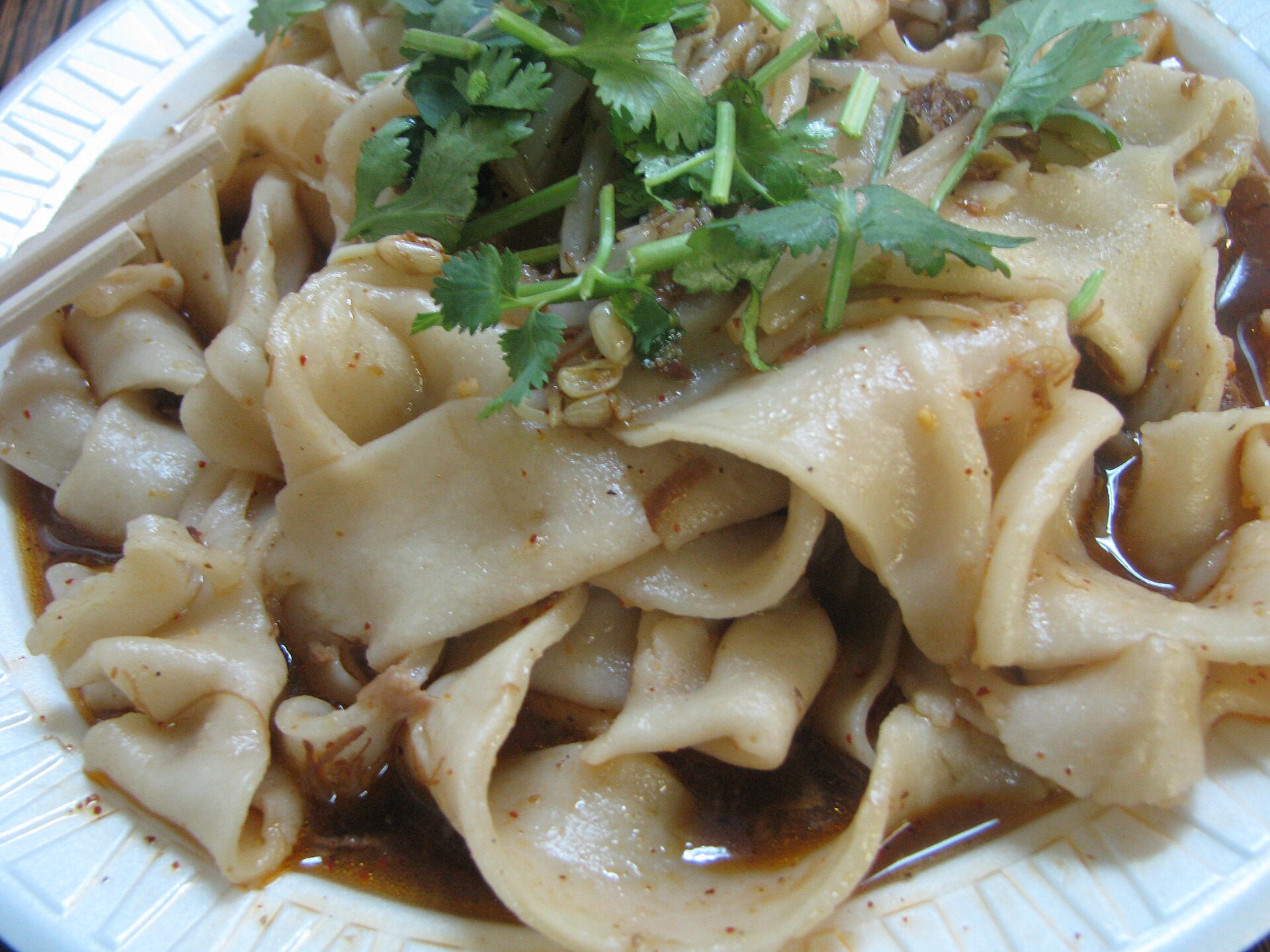
Biangbiang noodles — wide, flat wheat strands the width of a belt in a bowl, dressed with red chili oil and herbs 1
Wheat & noodles
面食 · the true backbone of Shaanxi cooking

This is the pillar the whole city's food rests on — Guanzhong wheat turned into dozens of noodles and breads. The emblem is biangbiang noodles (biángbiáng面), hand-pulled strands as wide and flat as a belt. The classic bowl is youpo che mian (油泼面): pile on ground chili and scallion, then pour sizzling-hot oil over the top until it crackles and the whole bowl smells of toasted spice. Guokui (锅盔) is a thick, oversized baked flatbread once carried as a Tang soldier's ration. Eat the noodles and you already understand half of this city.
Look for: biangbiang · youpo mian · guokui · liangpi
Price: ¥12–25 a bowl (about ฿60–125)
Read the biangbiang deep-dive →
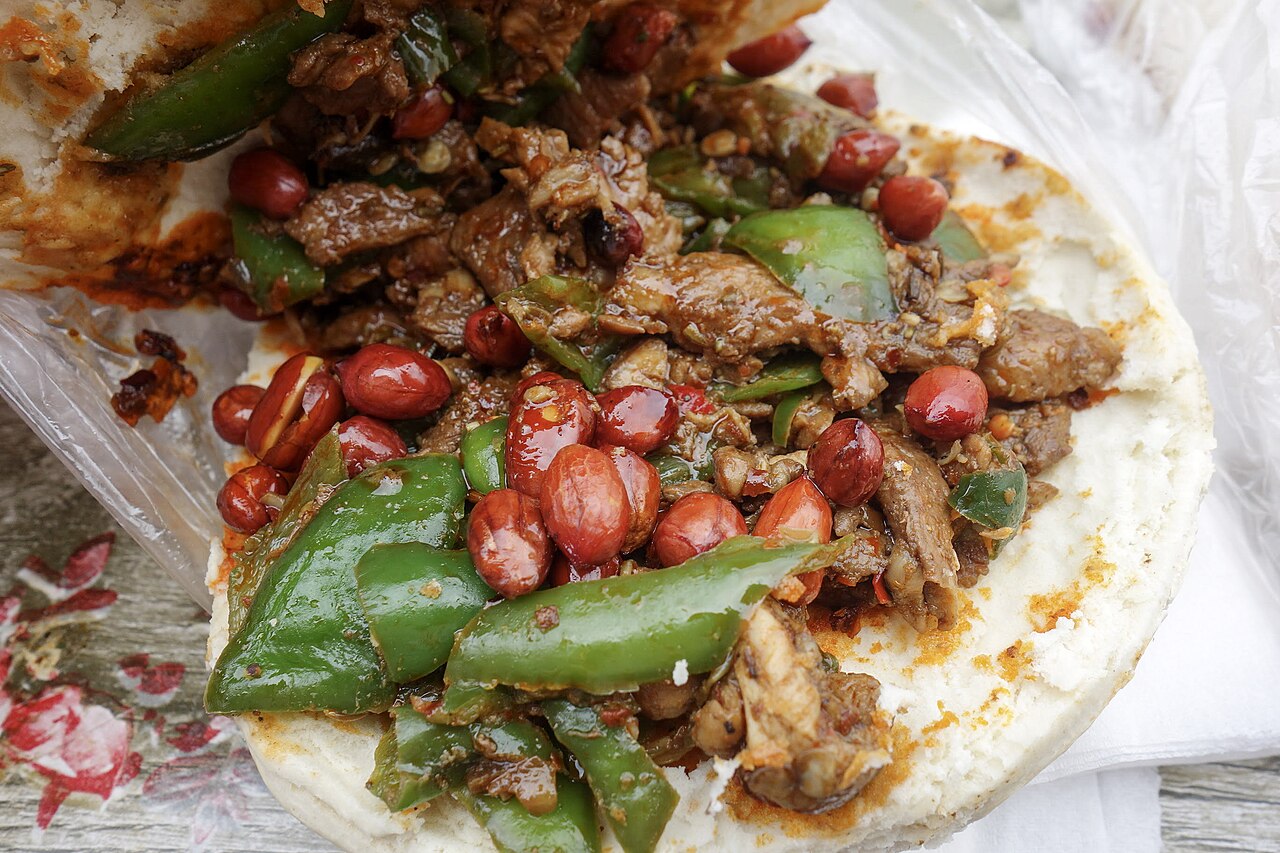
A roujiamo split open, showing cumin-spiced lamb stir-fried with green peppers and peanuts inside a baijimo bun 2
Roujiamo
肉夹馍 · the Chinese burger, in two lineages

The most famous way Shaanxi marries wheat with meat — a baijimo (白吉馍) bun baked until its edges crackle and its centre stays soft, split and packed with juicy meat. Its two styles tell both of the city's cultures: the Han version uses braised pork (la zhi rou, 腊汁肉) simmered with twenty-odd spices, while the Hui-Muslim version in the Muslim Quarter uses lamb or beef stir-fried with cumin and green chili. One bite gives you crisp bread, sweet-salty meat and a slick of braising juice all at once.
Look for: braised-pork roujiamo · halal lamb roujiamo
Price: ¥8–15 each (about ฿40–75)
Read the roujiamo deep-dive →
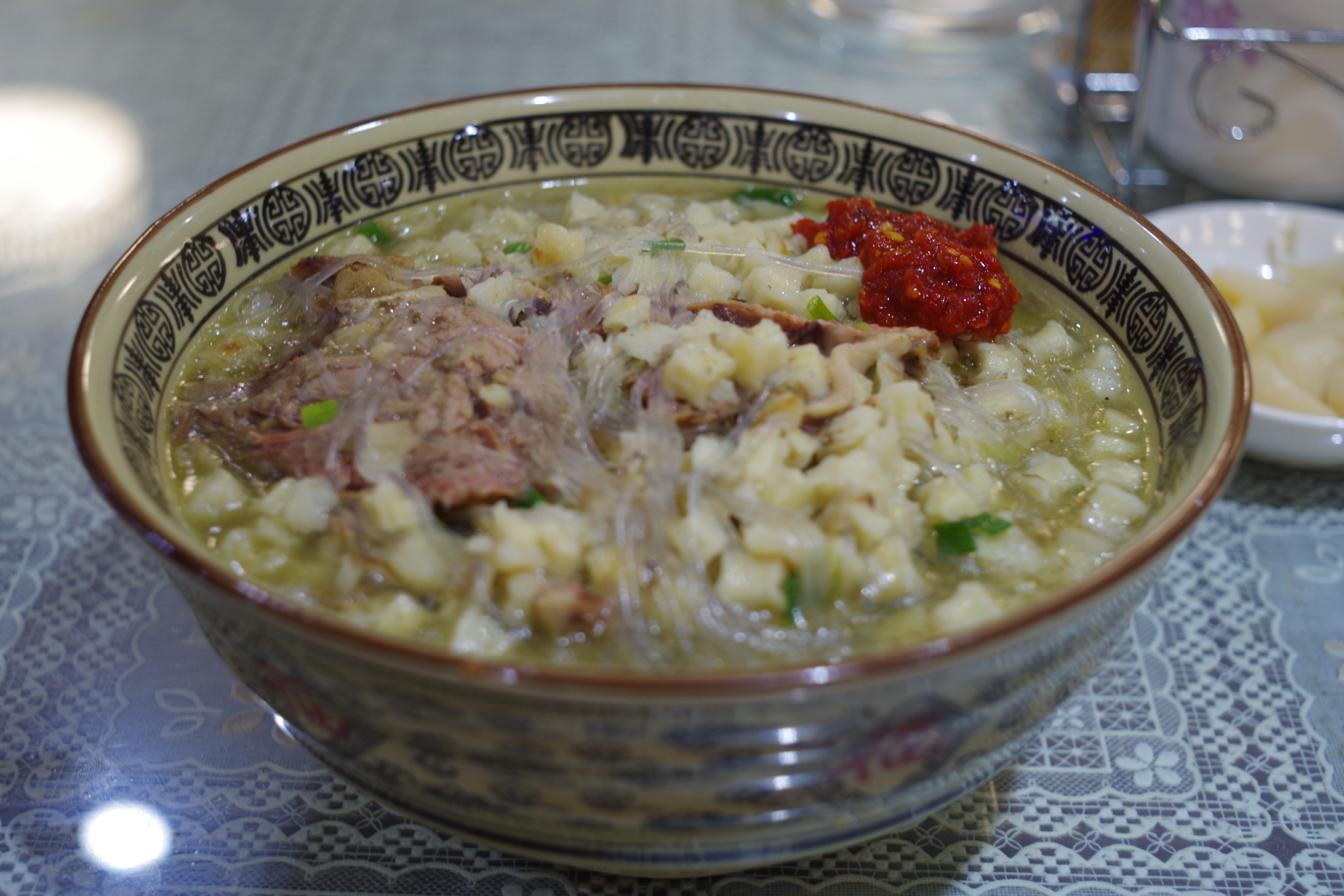
Yangrou paomo — mutton soup with hand-torn bread pieces and glass noodles in a blue-rimmed bowl, with lamb and red chili 3
Yangrou Paomo
羊肉泡馍 · the soup you build by hand

This is the face of Xi'an, and where wheat and lamb meet as a ritual. You're handed a dense round of flatbread and an empty bowl first — and you tear the bread by hand into pieces the size of soybeans (the smaller they are, the better they drink the soup; it takes 10–15 minutes). Then the bowl goes back to the kitchen, flooded with rich overnight mutton broth and glass noodles, and comes out to be eaten with pickled sweet garlic (糖蒜) and chili paste. Nothing warms a cold day more. There's a beef version too (牛肉泡馍).
The institutions: Lao Sun Jia (老孙家 · since 1898) · Tongshengxiang (同盛祥)
Price: ¥30–45 a big bowl (about ฿150–225)
Read the paomo deep-dive →
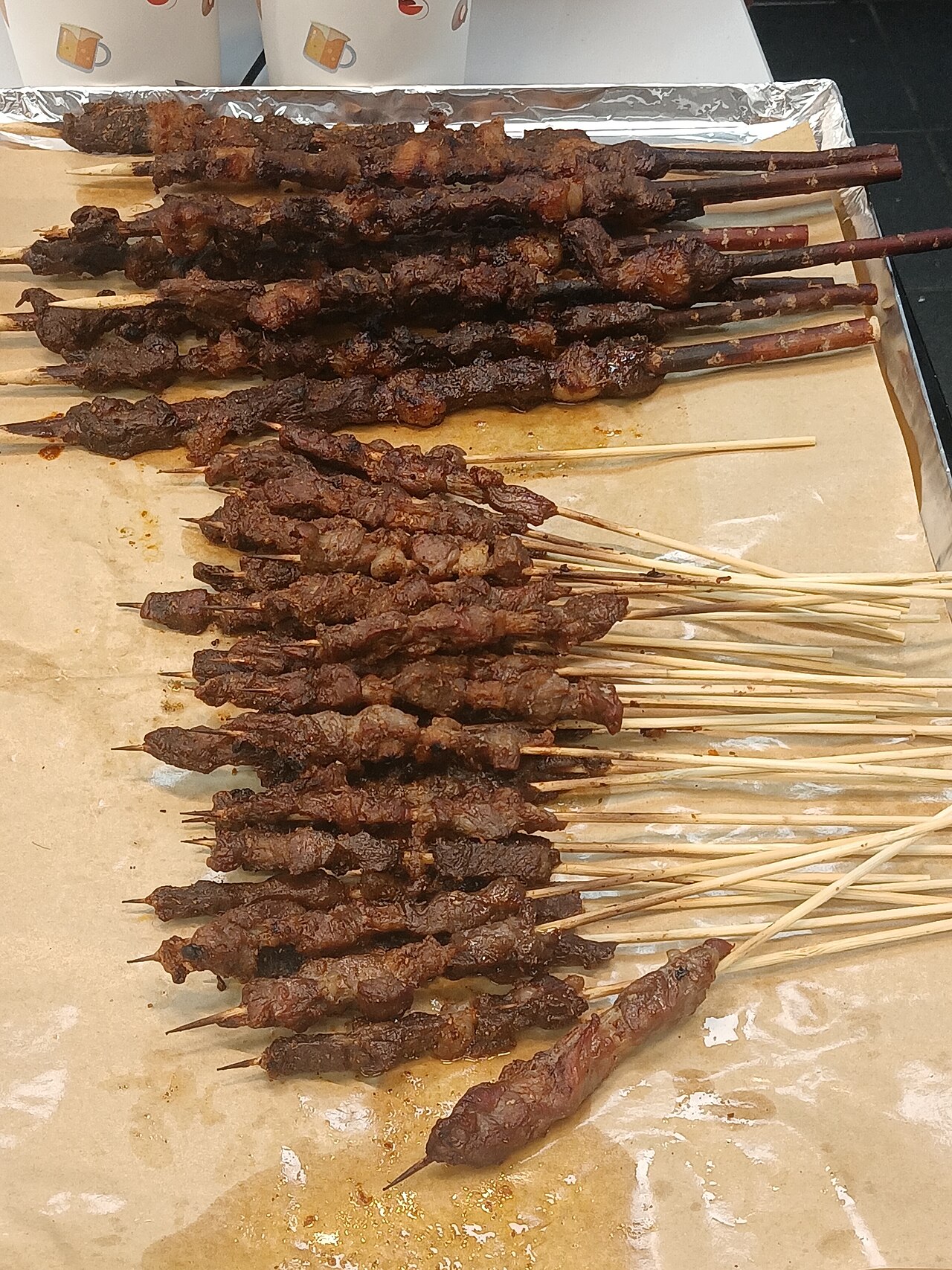
Charcoal-grilled lamb skewers heavily dusted with cumin and chili, lined up on a tray — halal Muslim Quarter food 4
Hui-Muslim cooking
清真 · a thousand years off the Silk Road

Xi'an was the Silk Road's eastern end, and Muslim traders settled here from the Tang dynasty onward, forming a Hui (回族) community around the Great Mosque in the Muslim Quarter (回民街) that has lived here for over a thousand years. All of it is halal — lamb and beef instead of pork, and a heavy hand of cumin. Walk in at dusk and you'll meet the smoke from charcoal skewers (some shops thread the meat on red-willow branches instead of bamboo), plus guantangbao lamb soup dumplings and old-fashioned sweets. This is the other half of Xi'an's kitchen.
Look for: cumin skewers · guantangbao · lamb roujiamo · liangpi
Price: skewers ¥3–6 each · grazing till full ¥50–80 a head
Read the Muslim Quarter walk →
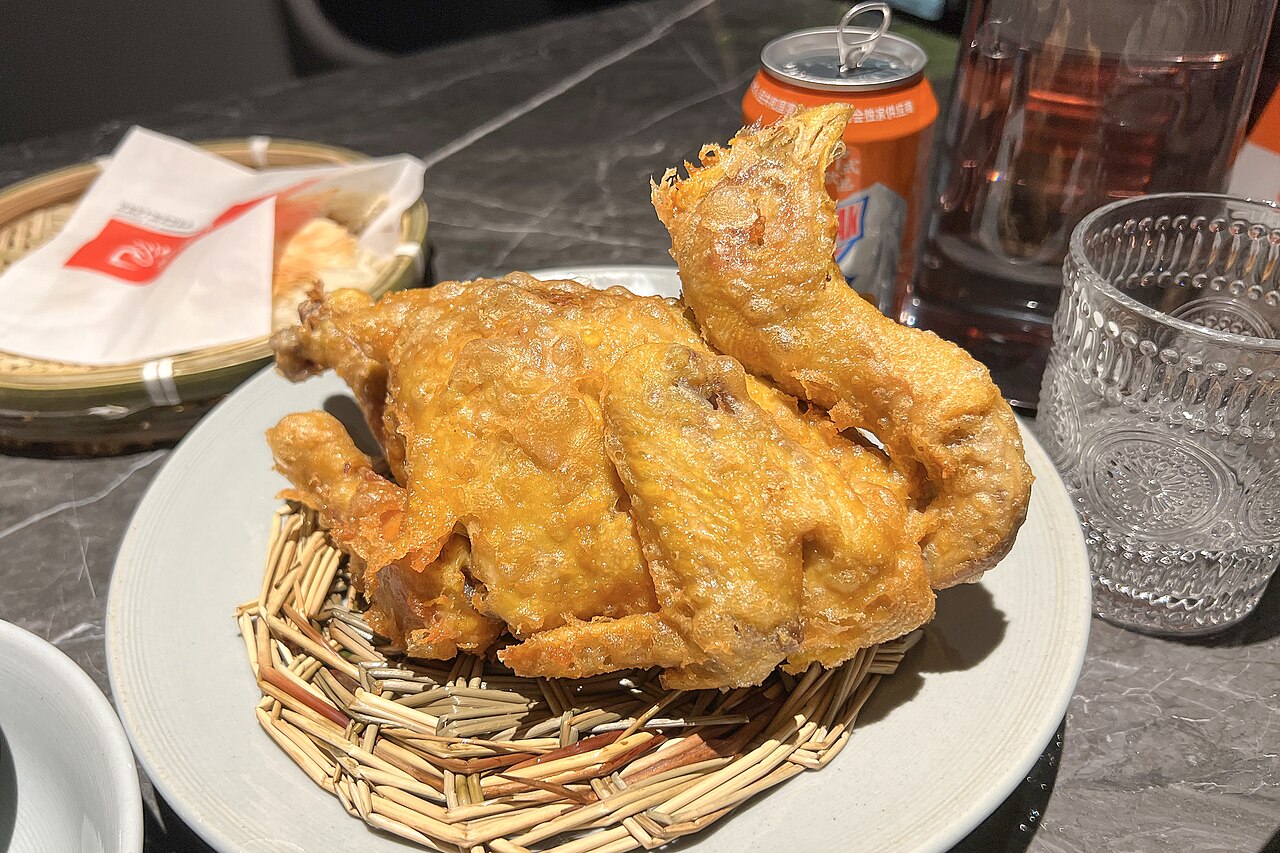
Gourd chicken (huluji) — a whole deep-fried chicken with crisp golden skin, tied into a gourd shape, served in a woven basket on a plate 5
Tang imperial dishes
唐菜 · palace cooking you can still order

Above the everyday plates sits a layer inherited from the Tang court. The most legendary is gourd chicken (葫芦鸡 huluji): a whole bird tied into a gourd shape and cooked in three stages — boiled, steamed, then deep-fried — until the skin turns golden and crackling while the meat stays juicy, earning it the nickname "the crispiest chicken under heaven." The other emblem is the dumpling banquet (饺子宴), where Xi'an turns the humble dumpling into a feast: dozens of varieties, each folded into a different shape to signal its filling — food culture from the city's most glorious age.
Look for: gourd chicken · dumpling banquet (De Fa Chang 德发长 · since 1936)
Price: gourd chicken ¥80–160 a bird · dumpling banquet ¥150–280 a head
Read the dumpling-banquet deep-dive →
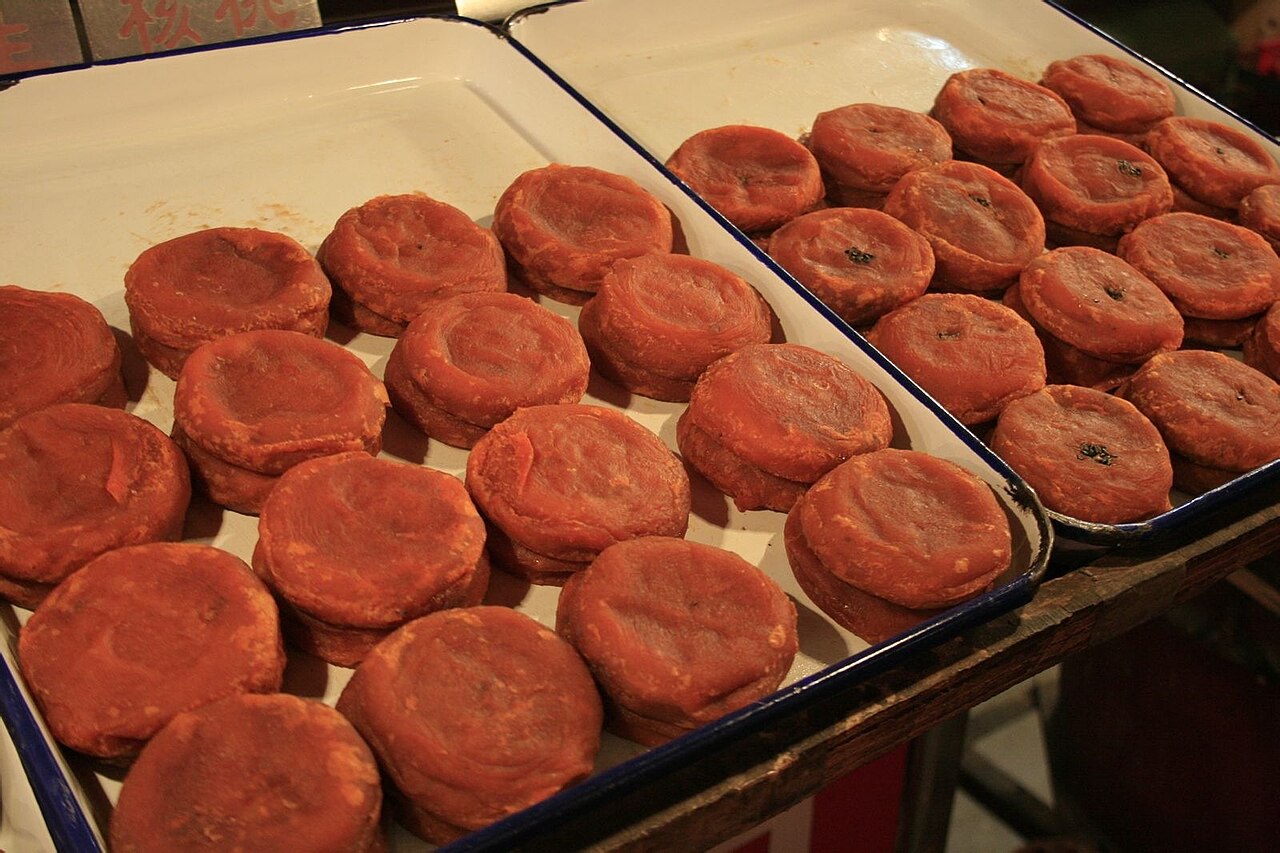
Fried persimmon cakes (huangguishi bing) — golden-orange fried dough rounds laid out on white enamel trays with blue rims 6
Cold dishes & sweets
凉菜 · 甜食 · the foils and the finishers

Shaanxi food is heavy on wheat and meat, so there's always something cold or sweet to cut through it. The emblem is liangpi (凉皮) — chewy steamed cold-skin noodles tossed with bean sprouts, cucumber and steamed gluten, dressed with vinegar, garlic and red chili oil; tangy, fresh and eaten year-round. For street sweets, there's the fried persimmon cake (柿子饼 huangguishi), dough enriched with ripe persimmon and fried crisp outside, chewy within, and zenggao (甑糕), sticky rice steamed in layers with red dates until deeply sweet — the perfect way to close a Shaanxi meal.

Look for: liangpi · fried persimmon cake · zenggao · jinggao
Price: liangpi ¥8–15 a plate · sweets ¥6–12 a piece
See all 11 must-try dishes →
A note on the grouping: we've sorted Shaanxi food into six families to make the whole kitchen easy to read — some dishes cross the lines (roujiamo and liangpi are both Han and Hui, for instance), and "Tang imperial dishes" are an inherited tradition rather than everyday eating. But all of it is what you'll genuinely find on a Shaanxi restaurant menu.
Food culture

The "Eight Oddities" of Guanzhong

Shaanxi folk have a saying about the "Eight Oddities of Guanzhong" (关中八大怪) — several of them are about food itself, and they tell the city's way of eating better than anything else.

Noodles wide as a belt
面条像腰带 · miàntiáo xiàng yāodài

A single biangbiang strand is so wide and long it looks like a cloth belt — a bowl often holds just 3–4 of them, but each is heavy enough to be a whole meal. It's the image of Shaanxi food that the rest of China knows.

Bread the size of a pot lid
锅盔像锅盖 · guōkuī xiàng guōgài

Guokui is a round baked flatbread thick and broad as a wok lid, dense and slow to spoil. It's said to have been a Tang soldier's ration because it was so portable and filling — and it's still sold cut into slabs all over the city.

Chili oil counts as a dish
油泼辣子一道菜 · hot chili oil is its own course

To a Shaanxi local, the hot-oil-poured chili (油泼辣子) isn't a condiment — it's practically a dish in its own right. Noodles need their chili oil and a clove of raw garlic on the side to taste complete.

Squatting to eat feels better
蹲着吃饭 · dūnzhe chīfàn

The old Guanzhong way is to squat outside the house or by the roadside with a big bowl of noodles, chatting with neighbours. You still see it at old noodle shops — and it speaks to the easygoing, straight-talking character of the people here.

Eat like a local

How a Shaanxi meal actually works

The order to eat in — where to start

If you're grazing, a Xi'an meal usually opens with a roujiamo on the move, followed by a noodle or soup as the main event — youpo mian at lunch, or a big bowl of yangrou paomo on a cold day. Then order a plate of cold liangpi to cut the richness, and finish with a street sweet like a fried persimmon cake or zenggao.

For a sit-down meal with a group at a Shaanxi restaurant, the order looks like any Chinese table — cold starters first (liangpi, pickles), then hot plates and a meat dish such as gourd chicken, closing with a noodle or bread course. Group sizes: two people order 2–3 plates plus one bowl of noodles · four people manage 4–5 plates. Per head: grazing on the street ¥50–80 (~฿250–400) · a sit-down meal ¥80–150 (~฿400–750).

Paying & language — sort it out first

Street stalls and small shops in the Muslim Quarter almost all take only Alipay or WeChat Pay — no foreign cards, and many prefer not to handle cash. Set up Alipay before you travel and link a Visa/Mastercard via its tourist mode. Larger sit-down restaurants like Lao Sun Jia or De Fa Chang usually take cards.

Many old shops have no English menu — just show the dish photos from this article, or point at the picture menu. Most dishes have local names that even other Chinese visitors may not know, so order one at a time and build up your taste for it. It's more fun than ordering everything at once.

Frequently asked

FAQ · what to know before you eat Shaanxi food

How is Shaanxi (Qin) cuisine different from other Chinese cooking?
Shaanxi cuisine, or Qin cai (秦菜), is the kitchen of the old capital Chang'an — today's Xi'an. What sets it apart most is that it eats wheat, not rice, because the Guanzhong plain has grown wheat for thousands of years. The staples are hand-pulled noodles and baked breads. The flavour leans savoury and aromatic — salt, garlic, scallion, vinegar and a heavy hand of cumin — not sweet like Cantonese, not numbing like Sichuan, and sugar is barely used. Signature plates include biangbiang noodles, roujiamo, yangrou paomo and the Tang-dynasty gourd chicken.
Why do people in Xi'an eat wheat and noodles instead of rice?
The Guanzhong plain (关中) around Xi'an sits in the north, where the climate is drier and cooler than southern China, so it suits wheat far better than paddy rice. Wheat became the staple in antiquity, and Shaanxi cooks developed an astonishing range of noodles and breads — wide belt-like biangbiang, youpo che mian strands, the huge guokui flatbread and the baijimo bun inside roujiamo. There's a local saying that Shaanxi people could eat noodles at every meal and never tire of them.
Where does the Hui-Muslim influence in Xi'an food come from?
Xi'an was the eastern terminus of the Silk Road, and Muslim traders and travellers settled here from the Tang dynasty onward, forming a Hui (回族) community that has lived around the Great Mosque in the Muslim Quarter (回民街) for over a thousand years. All Hui food is halal, using lamb and beef instead of pork and a generous hand of cumin. The signature plates are charcoal skewers, lamb roujiamo, soup dumplings and yangrou paomo — which is why Xi'an's kitchen today is a coexistence of Han and Hui cooking. Read the lane-by-lane route in our Muslim Quarter article.
What is gourd chicken (葫芦鸡) and where can you find it?
Gourd chicken, or huluji (葫芦鸡), is a Tang-dynasty imperial dish you can still eat in Xi'an today. The whole bird is tied into a gourd shape and cooked in three stages — boiled, steamed and then deep-fried — until the skin turns golden and crackling while the meat stays juicy inside. It's nicknamed "the crispiest chicken under heaven." You'll find it at traditional Shaanxi restaurants and Tang-banquet venues, usually around ¥80–160 per bird depending on the restaurant.
If I want to understand Xi'an food, which dishes should I try first?
If your time is short, start with the three dishes that tell Xi'an's story best: roujiamo (wheat bread plus braised meat), biangbiang youpo noodles (belt-wide strands under sizzling hot oil) and yangrou paomo (mutton soup you assemble by tearing the bread yourself). Together they cover the heart of Shaanxi food — wheat, lamb and the ritual of eating. After that, add a plate of cold liangpi to cut the richness, evening skewers in the Muslim Quarter, and a fried persimmon cake for something sweet.
Do Xi'an restaurants take foreign cards, or do you pay by app?
Street stalls and small shops in the Muslim Quarter almost all take only Alipay or WeChat Pay — no foreign cards, and many prefer not to handle cash. Download Alipay before you travel and link a Visa/Mastercard via its tourist mode. Larger sit-down restaurants like Lao Sun Jia or De Fa Chang usually accept cards.
Klook · Food Tour

Xi'an Food Tour — taste Shaanxi food with someone who knows it

A Xi'an food tour with a local guide, threading the back lanes of the Muslim Quarter to taste roujiamo, hand-pulled noodles, charcoal skewers and old-fashioned sweets — every stop is the real thing, with no language or payment worries.

See Xi'an Food Tours on Klook →
Wherebest is a Klook affiliate partner — we may earn a commission when you book through our link, at no extra cost to you.