Walk the length of the covered colonnade that has kept Guangzhou shoppers out of the sun and rain for nearly a century — old-school dim sum, century-old plasterwork, and Shamian Island an easy walk away.
Picture this: you are walking under a roofline that runs unbroken for a kilometre. Outside, the Guangzhou sun is fierce, but the walkway you are on stays shaded, because the upper floors of the shop-houses project out over your head. Above you are old plaster balconies and louvred wooden windows, their colour faded by nearly a hundred years. Below are fabric merchants, gold shops, pastry counters — and the smell of dim sum drifting out of a restaurant that has been open since your grandfather's time. This is Shangxiajiu, the heart of old western Guangzhou.
Shangxiajiu (上下九) is a pedestrian street in the Liwan District, lined with qilou (骑楼) arcade shop-houses — a southern Chinese building type where the ground floor is set back to create a continuous covered walkway. They went up in the 1920s and 1930s, when Guangzhou was a major treaty-port trading with the outside world, which is why the architecture is a distinctive Lingnan-meets-Western hybrid. That kind of intact streetscape is genuinely rare in China today.
What sets it apart from any ordinary shopping street is simple: it is free, open at any hour, and it is home to two of Guangzhou's oldest Cantonese restaurants — Tao Tao Ju (陶陶居) and Lin Heung Lou (莲香楼) — both serving traditional yum cha since the late Qing dynasty. One street gives you the old architecture, the original food, and the old-Guangzhou atmosphere that the city's older generation still recognises.
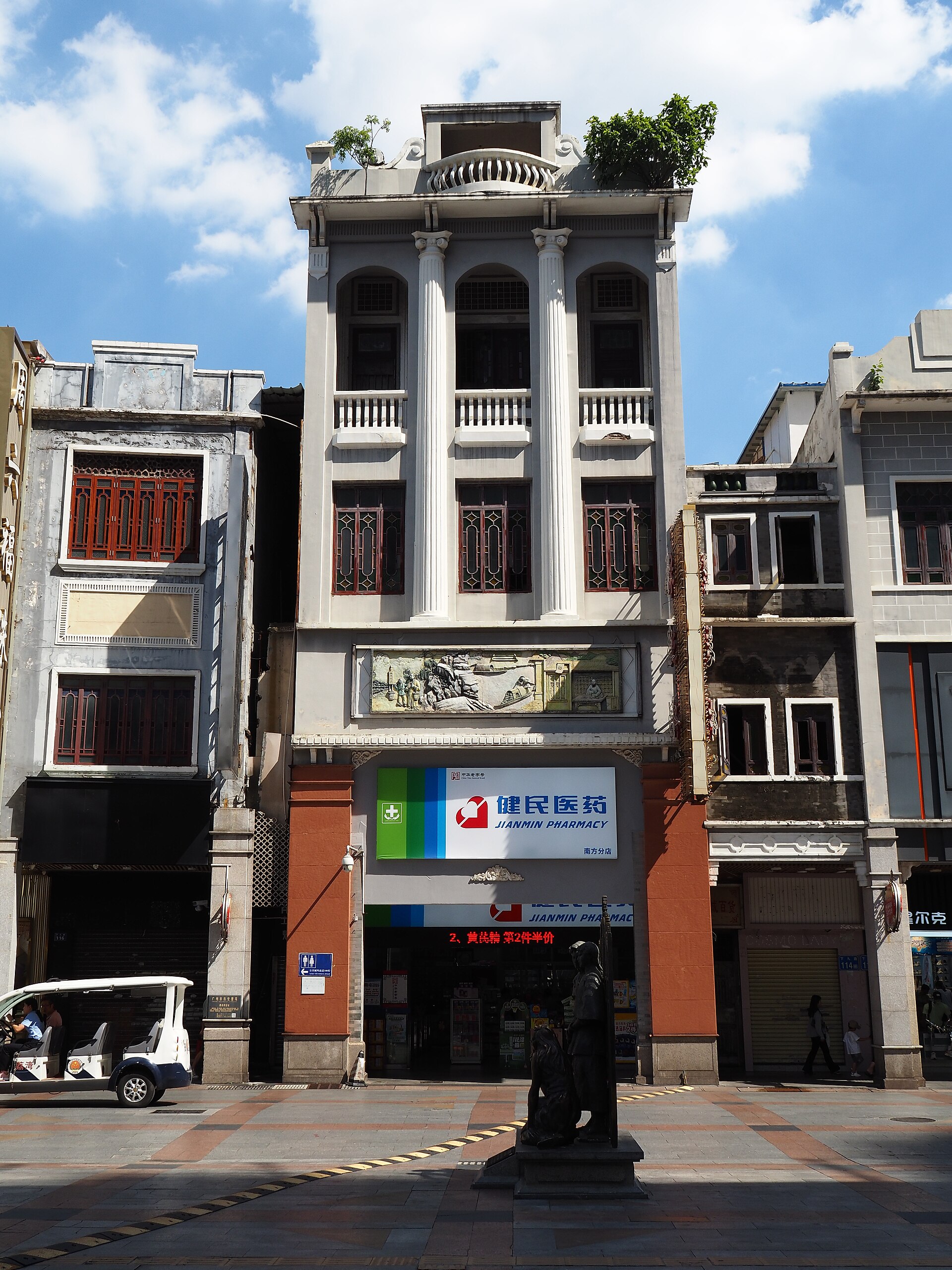
Architecture, food and shopping — each with a story of its own.
The real star of the street. These are shop-houses whose ground floors are set back to form a continuous covered walkway running for nearly a kilometre — designed so you can shop or walk the whole length without being in the sun or rain of the humid south. The upper floors overhang the walkway, decorated with plaster moulding, balconies and wooden windows in a Lingnan-colonial style. Look up: the detail above eye level is far better than you would expect.
One of the oldest teahouses in Guangzhou, famous for traditional dim sum and the culture of "yum cha" — literally "drinking tea," meaning you sit with a pot of hot tea and order steamer baskets of har gow, siu mai and bao to eat slowly over a long conversation. The dining room still feels old-school, and local families have been coming here for generations. Come mid-morning to beat the queue.
Renowned for its lotus-seed-paste mooncakes — the name "Lin Heung" means "lotus fragrance" — and traditional Cantonese pastries. The ground floor sells boxed pastries as gifts; the upper floor is a tea hall serving dim sum. During the Mid-Autumn Festival the mooncake queue gets long, because this place is a Guangzhou institution.
This district has long been a centre for fabric, silk and gold jewellery. The side lanes still hold fabric markets, and the main street is dotted with gold shops and snack counters along its length. Plenty of it is aimed at tourists now, but you will still find genuine old shops that locals actually use mixed in.
Beyond the sit-down dim sum houses, the walkway has snacks to eat on the move — brown-sugar pudding cups, steamed milk-curd desserts, fresh-baked pastries and soy milk. It pairs well with a street-food crawl: if you are hungry, you can graze your way along the whole street.
The best approach is to walk slowly along the pedestrian street and keep looking up, because the prettiest detail — plasterwork, balconies, wooden windows — sits above eye level. The walkway stays covered by the qilou roof the whole way, so it is comfortable even in strong sun or rain. A relaxed walk through takes about an hour.
The best photography window is morning to late morning, when the light is soft and the crowds are thinner, or after dark, when the shop signs light up and the street feels lively. Avoid weekend lunchtime, when it gets crowded enough that clean photographs are hard.
The heart of a Shangxiajiu visit is a dim sum meal at Tao Tao Ju or Lin Heung Lou. Cantonese culture calls it "yum cha" — sit with a pot of hot tea and order dim sum a basket at a time, to share over a long, slow meal. Start with har gow (shrimp dumplings), siu mai (pork dumplings), char siu bao (barbecue-pork buns), turnip cake and an egg tart.
Come for breakfast or mid-morning, the traditional yum cha hours, when the queue is shorter than at lunch. Expect roughly ¥50–100 per person (~฿250–500), depending on how many baskets you order. Both restaurants have picture menus you can point at.
The best thing about Shangxiajiu's location is that it is a 10 to 15 minute walk to Shamian Island (沙面) — a small riverside sandbank that was once the British and French concession, full of old European buildings under big shade trees. The atmosphere is the complete opposite of Shangxiajiu's bustle.
The classic route: dim sum at Shangxiajiu in the morning, walk the qilou, then continue through Qingping Market to reach Shamian Island in the late afternoon when the light is good — covering both the lively side and the quiet side of old Guangzhou in half a day.
The metro is the easiest option, with two stations that bring you onto the street.
Old western Guangzhou — all within an easy walk of each other.