Home Guangzhou China Guangzhou Hotels About
Home  ›  China  ›  Guangzhou  ›  Dim Sum & Yum Cha
Guangzhou Food Guide · 2026

Dim sum & yum cha (饮茶)
a morning at the source

Bamboo baskets stacked three high, a fresh pot of tea, the clatter of trolleys and conversation around every table — Guangzhou is where dim sum was born, and people here don't just eat it. They "go for yum cha", and they have done so every morning for a hundred years.

The tradition

Yum cha — not a meal so much as a rhythm

Walk into an old tea house in Guangzhou at eight in the morning and the first thing you notice isn't the food — it's the tempo. Round tables full, elderly regulars reading the newspaper over tea, three generations of a family talking unhurriedly, staff weaving through with kettles, topping up cups that never run dry. This is yum cha (饮茶, yǐn chá), which translates literally as "drink tea" but means something closer to a social breakfast that Cantonese people hold dearer than almost any other ritual.

The word dim sum (点心, diǎnxīn) means "to touch the heart" — small plates meant to be eaten a little at a time between sips of tea, never a single dish to fill you in one go. Guangzhou is the true birthplace of all this, long before it reached Hong Kong and the rest of the world. It began with roadside tea houses serving merchants and travellers in the Qing dynasty, then grew into an art form with hundreds of varieties of dim sum.

The heart of the meal fits in four characters: 一盅两件 (yī zhōng liǎng jiàn) — "one pot of tea, two baskets of dim sum". Guangzhou doesn't rush. You order the tea you like (pu'er, chrysanthemum, or tieguanyin), then keep the baskets coming a few at a time. Some people spend an entire morning at one table. This is not fast food — it is how the city begins its day.

The essential six

The dim sum no table is without

Start with the classics every tea house carries — order these six and you've tasted the heart of Guangzhou yum cha.
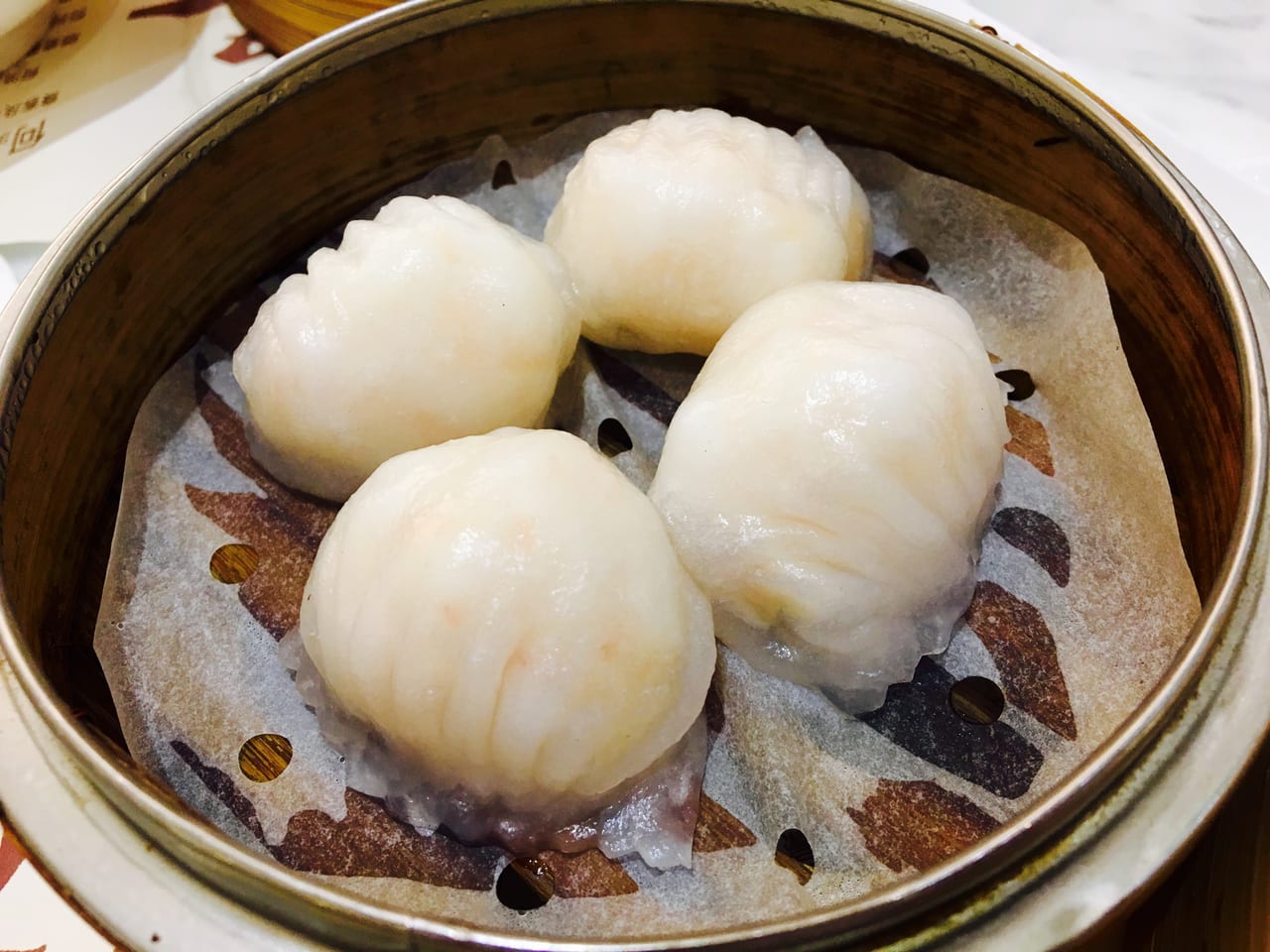
Har gow — four pleated crystal-skin shrimp dumplings in a bamboo steamer, pink shrimp visible through the translucent wrapper 1
Har gow
虾饺 · crystal-skin shrimp dumplings — the kitchen's test

This is the dish locals use to judge whether a tea house really knows what it's doing. The wrapper is made from wheat starch and tapioca, kneaded until it turns translucent enough to show the pink shrimp inside, then pleated into the classic twelve folds. The filling should be whole, snappy shrimp, never a paste. The skin has to be thin enough to lift with chopsticks without tearing, yet not collapse into mush. If a kitchen's har gow has thick skin or tired shrimp, that's your cue to eat elsewhere.

Where: Tao Tao Ju (陶陶居) · Guangzhou Restaurant (广州酒家) · Dim Dou Dak (点都德) · tea houses citywide
Price: ¥15–35 per basket of 3–4 (~฿75–175)
Tip: Order it early while the skin is still hot and soft · eat it straight away
🥟2
Siu mai
烧卖 · open-topped pork and shrimp dumplings

Cantonese siu mai looks a little different from the version you may know — wrapped in a thin pale-yellow skin, left open at the top, filled with minced pork mixed with chopped shrimp. Many places crown each one with orange flying-fish roe or a little grated carrot. The filling is dense and bouncy, naturally sweet from the pork and prawn, releasing a burst of savory juice as you bite. It's the constant companion to har gow — Cantonese diners say the two names in one breath, "har gow siu mai", as if they were a single thing.

Where: every tea house · Pan Xi (泮溪酒家) · Dim Dou Dak (点都德)
Price: ¥12–30 per basket of 3–4 (~฿60–150)
Note: In Guangzhou it's pork-and-shrimp, without the dried mushroom some other styles add
🍞3
Char siu bao
叉烧包 · steamed barbecue-pork buns that split open

The charm of a Cantonese barbecue-pork bun is in the split. A good one steams up so light and fluffy that the top bursts open into three petals like a blooming flower, flashing the red pork filling inside. That filling is char siu — honey-glazed barbecue pork — diced and tossed in a thick, glossy sauce that runs sweet then savory. The bun is soft and slightly chewy, the filling juicy, and the first bite delivers both the sweetness of the sauce and the smokiness of the roast. Children love it and adults order it every single time. Some houses also do a baked version (叉烧餐包) with a shiny golden-brown crust.

Where: Guangzhou Restaurant (广州酒家) · Tao Tao Ju (陶陶居) · tea houses everywhere
Price: ¥12–28 per basket of 2–3 (~฿60–140)
Tip: Try both the steamed (包) and the baked (餐包) and compare
🥧4
Egg tart
蛋挞 · flaky pastry, silky egg custard

The Cantonese egg tart is the most classic way to end a yum cha meal. The shell comes in two styles — some kitchens use flaky puff pastry, others a crumbly shortcrust — and inside sits a golden egg custard, smooth and only lightly sweet, served warm from the oven with the scent of egg and butter. Guangzhou Restaurant is particularly famous for its egg tarts; plenty of people order a box to take home. Bite into one while it's still warm and the custard is at its softest, wobbling at the centre.

Where: Guangzhou Restaurant (广州酒家 · the famous one) · Tao Tao Ju · Cantonese bakeries
Price: ¥10–25 per basket of 2–3 (~฿50–125)
Note: Order it near the end of the meal · best eaten warm from the oven
🐔5
Phoenix claws
凤爪 · chicken feet braised in black-bean sauce

Don't pull a face — chicken feet, poetically called "phoenix claws" in Cantonese, are one of the most loved things on a Guangzhou yum cha table. The feet are deep-fried first, then steamed and braised for a long time in fermented black-bean sauce, garlic and chilli until the skin and tendon turn meltingly soft and slip easily off the bone. The flavour is salty-sweet with a gentle warmth, and working the soft meat off the little bones is a skill Cantonese people master as children. Order one basket and you'll understand why it's an eternal favourite.

Where: every tea house · Dim Dou Dak (点都德) · Pan Xi (泮溪酒家)
Price: ¥12–28 per basket (~฿60–140)
Tip: Fingers are allowed · suck off the meat and discard the small bones onto an empty plate
🍥6
Cheung fun
肠粉 · silky steamed rice rolls in sweet soy

Cheung fun are sheets of steamed rice batter, thin and slippery, rolled around a filling and dressed with Guangzhou's special lightly sweetened soy sauce. The popular fillings are shrimp (虾肠), char siu barbecue pork (叉烧肠) or beef (牛肉肠). The rice sheet is so soft it almost dissolves on the tongue, the delicate sweet soy cutting cleanly against the filling. Guangzhou has both the tea-house version and "la cheung fun" (拉肠粉) made fresh at street stalls in the morning — the batter steamed on a tray, then scraped off piping hot. It's a breakfast locals eat almost every day.

Where: every tea house · morning la-cheung-fun stalls in the Liwan back streets
Price: ¥12–30 per plate (~฿60–150)
Tip: Shrimp is the classic filling · try the fresh street version against the tea-house one
Beyond these six, there's a whole menu: try 流沙包 (steamed buns with molten salted-egg-yolk custard) · 萝卜糕 (pan-fried turnip cake) · 糯米鸡 (glutinous rice with chicken steamed in a lotus leaf) · 马拉糕 (Malay-style steamed sponge cake) · 春卷 (fried spring rolls). A house like Tao Tao Ju lists more than 200 varieties — ordering one basket at a time and slowly exploring is exactly how it's meant to be done.
Yum cha, the local way

How a yum cha meal unfolds

Start with the tea, then order dim sum

As soon as you sit down, the staff will ask which tea you'd like first. There are several to choose from: pu'er (普洱), strong and digestive, good with rich food; chrysanthemum (菊花), fragrant and refreshing; tieguanyin (铁观音), a floral oolong; or jasmine (香片). The tea arrives as a large pot and you can have the hot water topped up endlessly.

These days you mostly order dim sum on a paper slip (点心纸) — tick the number of baskets you want and hand it back. Some older houses still push trolleys out so you can point at the hot baskets in front of you. Order three or four baskets first, finish them, then order more — that way everything arrives hot and fresh rather than landing on the table all at once.

Group size: two people order 4–5 baskets comfortably · four people order 8–10 and top up as you go · per person: a typical yum cha meal runs ¥40–90 (~฿200–450) · busy tourist-area houses can reach ¥80–120 (~฿400–600).

The finger-tap thank-you — etiquette to know

This is the custom that makes you look instantly at home: when someone pours tea for you, curl your index and middle fingers and tap their tips gently on the table two or three times to say thank you — no need to stop the conversation or speak. Legend traces it to the Qianlong emperor, who travelled in disguise as a commoner and once poured tea for his attendants. They couldn't kneel and bow without exposing his identity, so one of them bent his fingers to mimic a kneeling bow on the table. It's been the rule ever since.

One more useful signal: if you want the staff to refill the hot water in your teapot, tilt the lid open and rest it against the rim. In any Cantonese tea house that universally means "we're out of water, please top up" — no need to call out across the room.

Paying — set it up beforehand

Most Guangzhou tea houses take WeChat Pay and Alipay first. Some older establishments still accept cash in yuan, but foreign credit cards often won't work. Download Alipay or WeChat in advance and link a Visa/Mastercard through the tourist mode — it's by far the smoothest option. There's a full walkthrough in our China travel guide.

Many of the famous houses don't have full English menus, but the dim sum order-slip usually has photos or Chinese names with prices. Point at a picture or say the dish you want (虾饺 har gow · 烧卖 siu mai) — staff understand easily and are usually happy to recommend.

The institutions

Where to go — Guangzhou's great tea houses

The places locals hold up as a point of civic pride — some of them open since before the war.

1
Tao Tao Ju (陶陶居)
Legendary tea house · opened 1880 · 200+ dim sum varieties

If you had to name a single restaurant that symbolises Guangzhou yum cha, locals tend to reach for Tao Tao Ju first — a tea house open since 1880, in the Qing dynasty, its name reputedly calligraphed by a famous scholar. The original branch on Dishifu Road in the Shangxiajiu area is decorated in classical old-Canton style across several floors, with more than 200 dim sum varieties, both classic and creative. It's earned Michelin recognition. Weekends get packed — go early or be ready to queue.

Address: original branch on Dishifu Rd, Liwan (Shangxiajiu area) · Metro Line 1 to Changshou Lu / Huangsha
Hours: opens early for morning yum cha through to evening · Price: ¥60–120/person (~฿300–600) · several branches citywide
2
Guangzhou Restaurant (广州酒家)
Opened 1935 · "The No.1 Place to Eat in Guangzhou" · famous egg tarts

The nickname "食在广州第一家" (the number-one place to eat in Guangzhou) isn't thrown around lightly — Guangzhou Restaurant has been an institution of Cantonese food since 1935. The original branch sits at the corner of Wenchang Road near Shangxiajiu (it was under renovation in late 2024), but there are several branches, including Binjiang West Rd and Tianhe. It's known for Wenchang chicken (文昌鸡) and for egg tarts that many rate the best in the city. Its yum cha sets the benchmark for what good Cantonese dim sum should be.

Address: original branch on Wenchang Rd, Liwan · branches on Binjiang West Rd · Tianhe — check which is open before you go
Hours: morning yum cha / lunch / dinner · Price: ¥60–120/person (~฿300–600) · larger branches take foreign cards
3
Pan Xi (泮溪酒家)
Opened 1947 · set in a Lingnan garden beside Liwan Lake

Pan Xi isn't just a restaurant, it's an experience — built on the grounds of a former Southern Han dynasty imperial garden, beside Liwan Lake Park, open since 1947 and laid out as a genuine Lingnan garden with banyan trees, willows, waterside pavilions and arched bridges. You sip tea and eat dim sum surrounded by classical Chinese garden scenery. It's known for its steamed dishes and traditional dim sum, and it's the place to come if you want both good food and a setting worth photographing. Morning yum cha starts around 7.30am.

Address: 151 Longjin West Rd, Liwan (next to Liwan Lake Park) · Metro Line 5 to Zhongshanba, Exit B, ~8-min walk
Hours: morning yum cha ~7.30–11.30am / open until ~10pm · Price: ¥80–120/person (~฿400–600)
4
Dim Dou Dak (点都德 / Dian Dou De)
Recipes since 1933 · Michelin Bib Gourmand · lively and good value

For a livelier, better-value yum cha among Guangzhou's younger crowd, Dim Dou Dak is the answer — it carries dim sum recipes dating to 1933, relaunched as a modern chain in 2013, and turns out as many as 108 varieties. It's known for its har gow, siu mai, beancurd rolls, egg tarts and fried pork skin (炸猪皮), and holds a Michelin Bib Gourmand, the guide's stamp for good food at a fair price. There are many branches across the city, including Beijing Road and Huacheng Square. Weekend mornings draw long queues, so leave time to wait.

Address: main branch 587 Longjin Zhong Rd, Liwan · Beijing Road branch (Huifu East Rd) · and many more
Hours: ~9am–10pm · Price: ¥40–80/person (~฿200–400) · WeChat/Alipay first
Frequently asked

FAQ · what to know before yum cha

What is the difference between yum cha (饮茶) and dim sum (点心)?
Dim sum (点心, diǎnxīn) is the food itself — the small plates of dumplings, buns, steamed and fried bites. Yum cha (饮茶, yǐn chá, literally "drink tea") is the meal or the activity — going to a tea house in the morning, ordering a pot of tea and eating dim sum slowly alongside it. In short, you "go for yum cha" in order to "eat dim sum". Guangzhou locals treat this morning meal as one of the deepest parts of the city's culture.
Which are the legendary dim sum restaurants in Guangzhou?
The institutions locals point to are: 广州酒家 (Guangzhou Restaurant · opened 1935 · famous for Wenchang chicken and egg tarts) · 陶陶居 (Tao Tao Ju · opened 1880 · 200+ dim sum varieties · original branch in the Shangxiajiu area) · 泮溪酒家 (Pan Xi · opened 1947 · set in a Lingnan garden beside Liwan Lake) · 点都德 (Dim Dou Dak · recipes since 1933 · a Michelin Bib Gourmand · many branches).
What does tapping your fingers on the table mean when tea is poured?
When someone pours tea for you, tap two or three fingertips gently on the table (index and middle finger, slightly curled) to say thank you without interrupting the conversation. The custom is said to come from the Qianlong emperor, who travelled in disguise and once poured tea for his attendants — unable to kneel and bow without revealing his identity, an attendant bent his fingers to mimic a kneeling bow. Today it's standard etiquette at yum cha tables worldwide.
What is "one pot, two baskets" (一盅两件)?
一盅两件 (yī zhōng liǎng jiàn) means "one cup of tea, two baskets of dim sum". It's the Cantonese phrase for a traditional yum cha session — a pot of tea (your choice: pu'er, chrysanthemum, tieguanyin) and a couple of baskets of dim sum, eaten slowly while you read the paper or chat with friends. Some people spend the whole morning over it. It's the unhurried rhythm Guangzhou has kept for generations.
When should I go for yum cha in Guangzhou, and how much does it cost?
The best window is morning to late morning, roughly 7am to 11am, when dim sum is freshest and the atmosphere most traditional. Famous houses like Tao Tao Ju and Dim Dou Dak often have weekend queues. A typical basket runs ¥10–30 (~฿50–150) and a full yum cha meal is around ¥40–90 per person (~฿200–450). Most places take WeChat Pay and Alipay first — set up a foreign-card link in advance.
Is Guangzhou dim sum different from Hong Kong dim sum?
Dim sum was born in Guangzhou (Canton) before spreading to Hong Kong and the wider world. The core dishes are the same — har gow, siu mai, char siu bao — but Guangzhou keeps the old tea-house atmosphere, the paper order-slip system, and restaurants that have run since before the war, while Hong Kong leaned into trolleys and speed. If you want dim sum at the source of the tradition, Guangzhou is where to come.
Klook · Food Tours

Guangzhou Dim Sum Tours — go for yum cha with someone who knows

Guided dim sum walks with a local: into the old tea houses, how to order, how to pour the tea and tap your thanks, and which baskets are worth it. Taste it for real, with no language barrier.

Browse Guangzhou Food Tours on Klook →
Wherebest is an affiliate partner of Klook — we may earn a commission when you book through our links, at no extra cost to you.