Guangzhou's busiest pedestrian street, where the real story is under your feet — a glass floor reveals 11 stacked layers of ancient road dating back to the Tang dynasty. Above ground: malls, snack lanes and the Great Buddha Temple. Free, lively day and night.
Picture this: you are walking down one of the busiest pedestrian streets in Guangzhou, surrounded by malls, neon signs and a constant flow of people — then you glance down at the pavement and find a sheet of glass over an excavation pit. Beneath it lie 11 stacked layers of old road surface — Song-dynasty cobblestones, Ming-dynasty brick, Qing-dynasty foundations, going all the way down to the Tang dynasty. This is the same street people in Guangzhou have walked for more than 2,200 years; it has simply risen, layer by layer, with time.
That is what sets Beijing Road (北京路 Beijing Lu) in Yuexiu District apart from an ordinary shopping street. It is a roughly 1.4-kilometre pedestrian street that has been a centre of commerce and government in Guangzhou since the Qin dynasty. By the Song dynasty it had become the city's first "Royal Road," lined with government offices and foreign embassies. An archaeological dig in 2002 exposed the stacked road surfaces and the ruins of an ancient city gate that had accumulated here over a thousand years.
What makes the visit worthwhile is simple: free entry, open day and night, no admission, no closing time. It is a shopping street for locals, a place to eat well, and an open-air museum that happens to sit directly under your feet — history and real city atmosphere in one stop.
From the glass floor under your feet to the old temple behind the malls — point by point along the street.
The heart of the place. A glass panel covers an excavation pit in the middle of the street, letting you look down at 11 stacked layers of old road, from the Tang dynasty through to the Republican era. You can pick out Song-dynasty cobblestones, blue Ming-dynasty brick and old stone railings. Unearthed in 2002 — stand here and you feel just how old this city is. Free to view.
Not far from the ancient road, a second glass pit reveals the foundations of an old city gate and tower stacked across dynasties — proof that this spot was once the entrance to the inner city for centuries. Signage beside the pit explains the layers. It takes only a few minutes to see, but it helps you understand how important this street once was.
A historic Buddhist temple tucked behind the buildings off Beijing Road. Inside sits one of the largest bronze Buddha statues in southern China, and the calm here is the complete opposite of the shopping crowds outside. Free to enter, open roughly 8 am–9.30 pm. In the evening, around 7 to 9.30 pm, the temple is beautifully lit — well worth the detour.
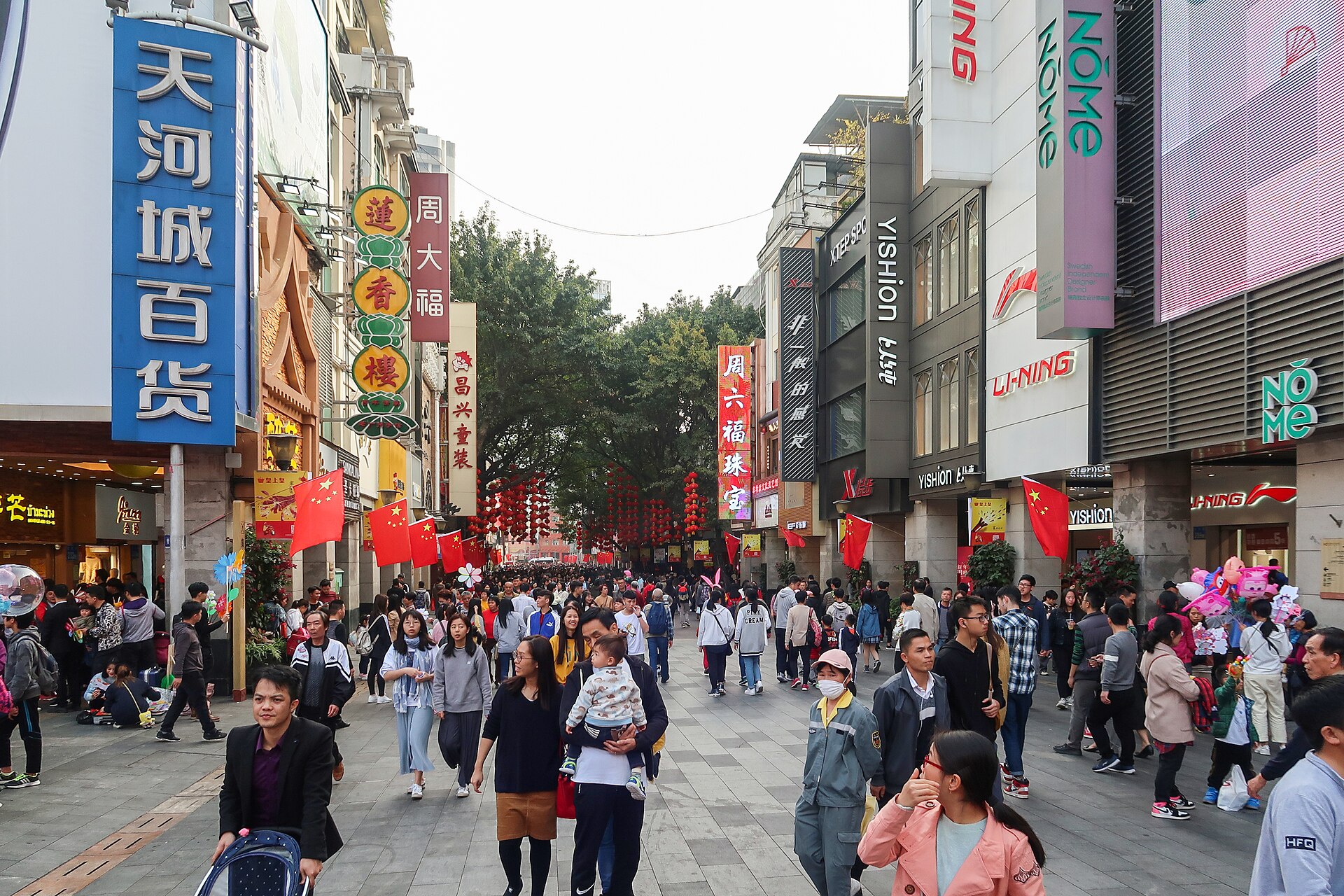
Both sides of the street are lined with malls such as Guangzhou Grand Shopping Mall and multi-brand retail towers, mixed with historic buildings like the 1920s Guangdong Provincial Bank headquarters. This is where Guangzhou locals actually shop. Frankly, prices lean towards tourists, so compare before you buy seriously — or just wander and soak up the atmosphere.
The lanes around Beijing Road are full of Cantonese snacks: steamed rice rolls (changfen) at Yinji, Cantonese sweet soups (tangshui) at Baihua, and old dim sum houses such as Tao Tao Ju. The tip, though, is that food on the main street costs more than usual — for cheaper, more authentic eating, walk a block off to Xihua Road (西华路) or Baoye Road. It is well worth the short detour.
The thing not to miss is the glass pit in the middle of the street. Walk over it, look down, and you see 11 stacked layers of old road — from the Tang dynasty through to the Republican era. The Song-dynasty cobblestones, the Ming brick and the old stone railings are all clearly visible. It was unearthed in 2002 and displayed exactly where it was found: over 2,200 years of history right under your feet.
Close by is a second pit revealing the ruins of an old city gate (Gongbei Tower). It is free to view, with signage explaining the layers — if you are travelling with kids or anyone who likes history, this is the highlight you will be talking about all trip.
A few minutes' walk into the lanes off Beijing Road brings you to the Great Buddha Temple (大佛寺), a historic Buddhist temple housing one of the largest bronze Buddhas in southern China. Free to enter, open roughly 8 am–9.30 pm. Inside it is shaded and quiet — a genuine rest for the eyes after the busy shopping street.
Come in the evening, around 7 to 9.30 pm, and the whole temple is lit; the atmosphere is completely different from the daytime. It is worth planning your route to pass by then.
The most rewarding window is around 6 pm: you still see the architecture and shopfronts clearly in daylight, then as it gets dark the shop signs and red lanterns along the whole street light up at once — two moods in one visit. The classic frame is from mid-street, camera pointed down the length of the road, with the red lanterns and signs receding into the distance.
For a shot without the crowds, come on a weekday morning — the street averages over 400,000 visitors a day, and weekend evenings get particularly packed. The glass-floored ancient road, meanwhile, shows its layers more clearly in daylight.
Metro is the easiest option, bringing you out right at the head of the pedestrian street.
Stay central or along the Pearl River, then ride the metro to Beijing Road with ease.