Home Sanya China Sanya Hotels About
Home  ›  China  ›  Sanya  ›  Local Cuisine
🌴 Hainan Local Cuisine · 2026

Hainan Cuisine, Decoded
fresh, light, island flavour

Before you eat your way through Sanya dish by dish, get to know Hainan cooking first — a tropical island that cooks lightly and lets fresh ingredients lead. There are Four Famous Dishes the whole island is proud of, seafood and coconut at the centre of every meal, and a Li and Miao rainforest cuisine most visitors never discover. This is the flavour map that ties all your meals together.

Know it before you eat

琼菜 — the food of China's southernmost tropical island

If you think Chinese food has to mean numbing málà or rich, oily braises, Hainan cooking will surprise you — because it's one of the lightest, freshest and least spicy of all the regional Chinese cuisines. Sanya sits on Hainan, China's southernmost tropical island, with a climate close to southern Thailand. The island's cooking has its own name, Qiong cai (琼菜), where 琼 is the ancient short name for Hainan. Its whole idea is to cook as little as possible and let the ingredient speak — no showy technique, no sauces that mask the flavour, just freshness, natural sweetness and produce that came out of the sea or off the tree that morning.

Hainan food stands on three legs — fresh seafood, coconut and tropical fruit. The seafood comes from the South China Sea that rings the island, the coconut from palm groves all over it (Hainan calls itself the Coconut Island, 椰岛), and the fruit because Hainan is China's tropical fruit basket, growing everything from mango and mangosteen to durian. The most distinctive way to cook here is white-cut poaching (白切), as with Wenchang chicken and Jiaji duck, and plain steaming, as with Hele crab — because when the raw material is good enough, you don't need to do much to it. Poach it or steam it, give it a good dipping sauce, and that's the dish.

This page is the hub that ties Hainan eating together — the Four Famous Dishes the whole island reveres, the fresh-light-coconut philosophy, the Li and Miao food of the rainforest, and one piece of advice worth taking: skip the resort buffet and go eat the real thing. If you'd rather go deeper dish by dish or area by area, we have separate guides to the 11 dishes to try, First Market seafood and street food to read next.

The heart of the island

Hainan's Four Famous Dishes (海南四大名菜)

The fastest way to understand Hainan food is to start with these four — chicken, duck, crab and goat that the whole island is proud to serve.
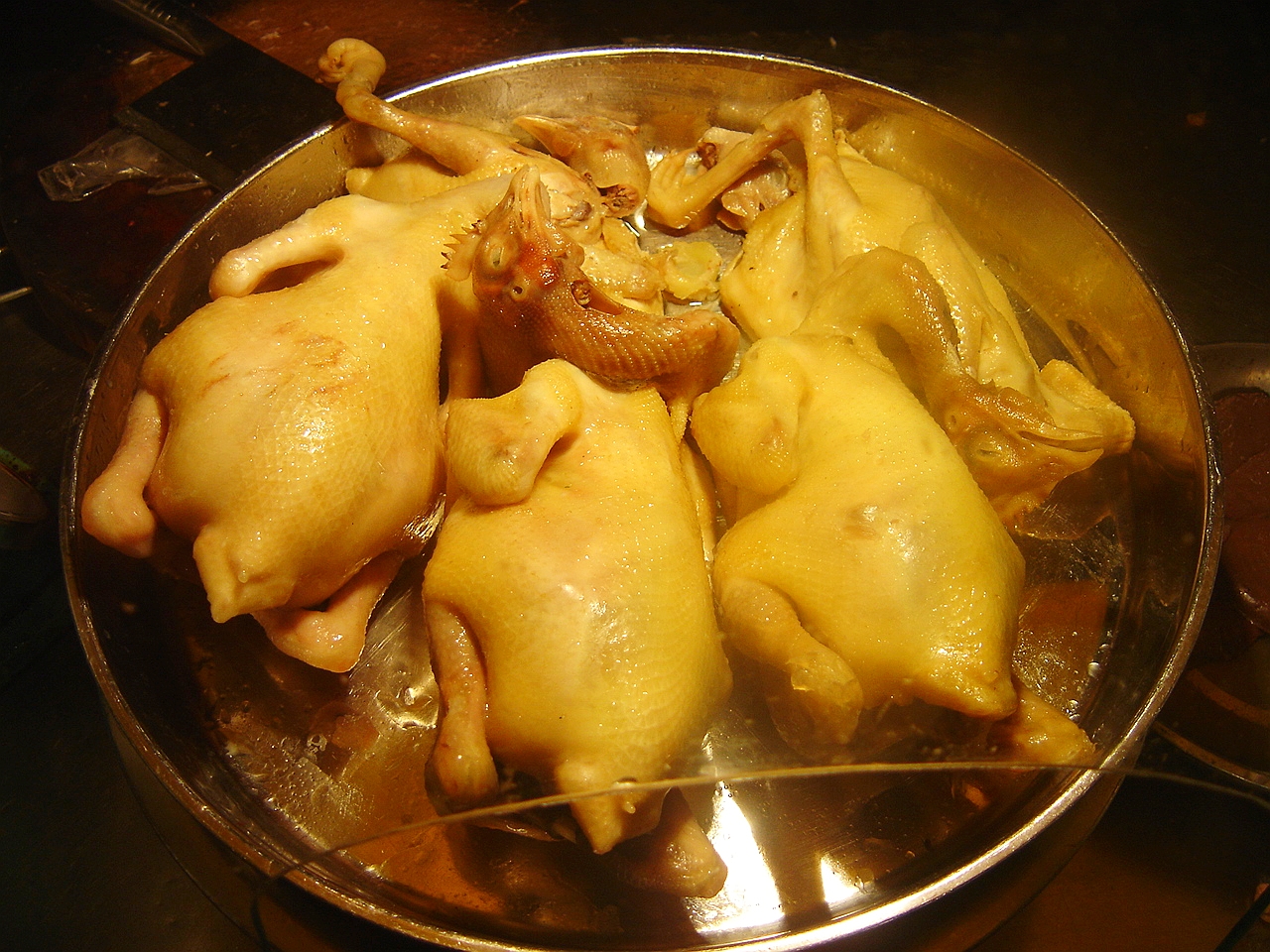
Wenchang chicken sliced and arranged on a plate, pale yellow skin and tender white meat, served beside a ginger and sand-ginger dipping sauce 1
Wenchang Chicken
文昌鸡 · the original Hainanese chicken rice

The captain of the Four Famous Dishes, and the ancestor of the Hainanese chicken rice found across Singapore, Malaysia and Thailand. It's a free-range bird from the city of Wenchang (文昌) — small, with thin yellow skin, tender white meat and soft bones. The classic preparation is white-cut (白切): poached, served cold, and dipped in a ginger, sand-ginger (沙姜) and garlic sauce, eaten with chicken-oil rice and a clear broth. The flavour isn't bold, but the meat is sweet — a dish that explains both the Hainan philosophy and the roots of the chicken rice we eat at home.

How it's cooked: white-cut (白切), served cold with a ginger and sand-ginger dip
Price: ¥60–90 (฿300–450) for half a bird (shares 2–3)
Tip: a small, thin-skinned bird is the real thing · order with chicken rice and clear broth
🦆2
Jiaji Duck
加积鸭 · specially raised, firm meat, thin skin

A duck from the town of Jiaji (加积) in Qionghai, raised along the Wanquan River and specially fed on rice, grain and sweet potato in coops until the meat is firm, the skin thin, the bones soft and the fat low — so it never tastes greasy. It's usually served white-cut (白切) like Wenchang chicken, or roasted Cantonese-style for fragrant skin. The meat is firm and sweet with no off taste. It's the dish you order alongside Wenchang chicken at a bigger meal, so the table has both the island's signature chicken and its signature duck.

How it's cooked: white-cut (白切) or Cantonese-style roast
Price: ¥60–100 (฿300–500) for half a bird (to share)
Tip: try the white-cut version against the Wenchang chicken · order them together
🦀3
Hele Crab
和乐蟹 · roe-rich steamed crab

A sea crab from the town of Hele (和乐) near Wanning on the island's southeast coast, famous for being packed with rich, oily roe. The best way to eat it is plainly steamed, so the sweetness of the meat and the fragrant fattiness of the roe come through fully, with just a little ginger vinegar to dip. The meat is firm and sweet, the roe so rich you sip it slowly. This is the clearest example of the Hainan philosophy — the ingredient is already good, so all you do is steam it. It's best in roe season.

How it's cooked: plainly steamed is best · dip in ginger vinegar
Price: ¥120–200 (฿600–1,000) per person (by size and weight)
Tip: choose a crab heavy for its size · a roe crab beats a meat crab
🐐4
Dongshan Goat
东山羊 · black mountain goat, tender, no gamey smell

The fourth dish, and the one unlike the first three. A jet-black mountain goat from Dongshan (东山) in Wanning, which grazes on grasses and herbs in the hills until the meat is tender with almost no gamey smell — unusual for goat. It's cooked several ways: braised in a hot pot, roasted in soy sauce, or simmered in a clear soup. The meat is tender, the skin springy, the broth sweetly rounded. It's a nourishing dish locals order for important meals, prized since ancient times as fine tribute fare. It closes the Four Famous Dishes with the warmest, most substantial meat course of the set.
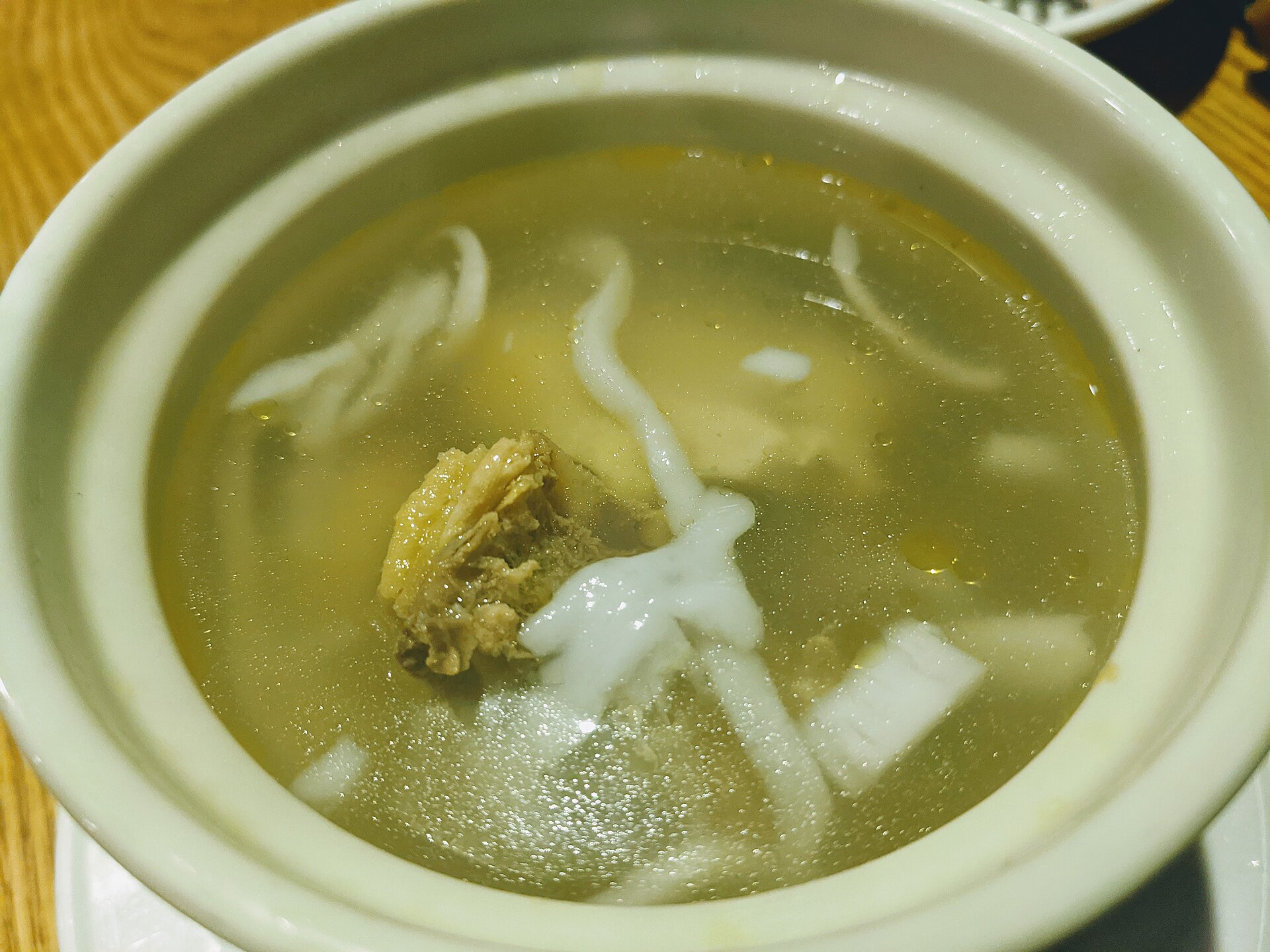
How it's cooked: hot-pot braise · soy roast · clear soup
Price: ¥80–140 (฿400–700) per dish (to share)
Tip: try the hot-pot braise on a rainy day · it really is tender and not gamey
Good to know: all Four Famous Dishes — Wenchang chicken, Jiaji duck, Hele crab, Dongshan goat — are named after the town or district they come from on Hainan. That's a Hainan custom: the cuisine takes pride in its local produce. To eat all four in one sitting, find a local Hainan restaurant in the city centre or Dadonghai and order to share with a group.
The island's philosophy

Fresh · light · tropical — three words that explain Hainan food

Remember these three and you'll order well in Sanya from your very first meal.

🌊

Fresh

Seafood straight out of the South China Sea — fish, prawns, crab and shellfish you can pick live at the market — and coconut and fruit cut from nearby trees. Freshness is the reason Hainan food is cooked so little: there's no need to mask flavour that's already good.

🍃

Light

Clean flavours, not spicy, not greasy, cooked with gentle techniques like white-cut poaching (白切) and steaming. Any heat lives in a dip you add yourself. It's one of the most spice-free-friendly Chinese cuisines, easy for those who don't eat spicy and for young children.

🥥

Tropical

Coconut runs through nearly everything — hotpot broth, desserts, drinks, the iced coconut milk in qingbuliang. The sweetness in a Hainan dish comes from nature, not from added sugar. This is genuinely the taste of a warm, humid tropical island.

Seafood + coconut

The two leads in every meal

If two ingredients define Hainan food, it's fresh seafood and coconut. Seafood in Sanya isn't always eaten in a fancy restaurant — the real experience is to walk and choose your seafood live at the First Market (第一市场), then carry it to a nearby processing restaurant (加工) to cook to order: steamed with garlic, stir-fried with chilli, or as sashimi, paying for the ingredients and the cooking separately. Be straight with yourself, though — the First Market is known for short-weighing, so always re-weigh at the official public scale (公平秤) and agree the price first.

Coconut is what sets Hainan food apart from other islands — coconut chicken hotpot (椰子鸡) uses fresh young-coconut water as the broth instead of a málà base, simmering free-range chicken in it for a clear, naturally sweet flavour; coconut rice (椰子饭) is steamed inside a coconut; and fresh chilled coconut water is sold on every corner, sweeter than anywhere because it's cut from a tree close by. These two are the thread that ties every meal in Sanya together.

Coconut chicken hotpot in a clay pot, clear young-coconut-water broth with free-range chicken, Hainan's signature coconut flavour
Coconut chicken hotpot — coconut is the lead of Hainan cooking
Ethnic-minority food

Li & Miao food in the central rainforest

Beyond the coastal seafood, deeper inland, is a layer of food most visitors miss.

🎋1
Bamboo Rice
竹筒饭 · mountain rice cooked inside a bamboo tube

A traditional dish of the Li people (黎族) — mountain rice mixed with wild boar and mushrooms, stuffed into a fresh bamboo tube and roasted over a charcoal fire until cooked and fragrant. Split the tube open and the scent of the bamboo membrane has soaked all the way into the rice. It's both the cooking pot and the serving dish in one — the food that tells the Li people's forest way of life best.

Where: Li-Miao culture villages · Baoting (保亭) · rainforest tours
Known for: bamboo fragrance · cooked and served in one tube
🌈2
Five-Color Rice
五色饭 · glutinous rice dyed with plant juices

A festive glutinous rice of the Miao people (苗族), dyed with natural plant juices into several colours — red, yellow, black, purple, white — as pretty as art on a plate, with each colour carrying a slightly different aroma from the plant used to dye it. It's made for important festivals like the Li-Miao Sanyuesan (三月三, the Third Month Third festival). It's a dish that is both beautiful and a window into the forest wisdom of using plants.

Where: Li-Miao culture villages · the Sanyuesan festival
Known for: colours from natural plants · made at festivals
Add it if you have time: the Li and Miao also have wild chicken and mountain pork, firm and full-flavoured, and shanlan rice wine (山兰酒), the Li people's traditional rice wine fermented from shanlan mountain rice — soft and sweet. You can find them in the central highlands such as Baoting (保亭) or on a rainforest culture tour — a completely different food world from Sanya's coastal seafood, and a good reason to spend a day exploring the interior of the island.
One piece of advice

Don't only eat the resort buffet — the real food is outside

Resort buffets are well done — but they aren't Hainan flavour

Sanya is a beach-resort city full of luxury hotels, and plenty of people come and eat every meal at the hotel buffet, which is well done and convenient. But honestly, those buffets are usually international food for tourists — expensive, and barely the real taste of Hainan at all. You've flown to an island with a cuisine this distinctive; to eat only inside the resort would be a shame.

The real food is all outside — white-cut Wenchang chicken in a local Hainan restaurant, seafood you pick live at the First Market and carry to a processing shop, dressed Hainan rice noodles at a morning alley stall, and a bowl of iced-coconut-milk qingbuliang from a street cart. All of it is cheaper and far better.

How to go eat the real thing — easier than you'd think

Leave the resort for at least a meal or two — take a taxi or DiDi into the old town (the First Market) or the Dadonghai (大东海) area, which has a dense cluster of local restaurants and is walkable to the beach. If you're staying in an eastern luxury bay like Yalong Bay or Haitang Bay, it's roughly a 30–50 minute drive into town, so plan one meal as a dedicated eating trip.

Sort out payment first — local restaurants, market stalls and noodle shops mostly take only WeChat Pay or Alipay, and many accept neither cash nor cards. Set up Alipay linked to a foreign card before you travel, and eating the real food in Sanya goes far more smoothly than you'd expect.

Read on in detail

Pick the guide you most want to eat

This page is the overview — we have a separate guide for each category. Start with the one you most want to eat.

Frequently asked

FAQ · what to know about Hainan food

What is Hainan cuisine (琼菜) and how is it different from other Chinese food?
Hainan cuisine, or Qiong cai (琼菜 — 琼 is the old short name for Hainan island), is the cooking of China's southernmost tropical island. Unlike numbing Sichuan, technique-heavy Cantonese or salty-savoury Shandong food, Hainan cooking is light, clean and naturally sweet, kept simple to preserve the ingredient's own taste. The headliners are fresh seafood, coconut and tropical fruit. The favourite methods are white-cut poaching (白切), as with Wenchang chicken and Jiaji duck, and plain steaming, as with Hele crab.
What are Hainan's Four Famous Dishes (海南四大名菜)?
They are Wenchang chicken (文昌鸡), a poached free-range bird from Wenchang with smooth skin and tender meat — the ancestor of Hainanese chicken rice · Jiaji duck (加积鸭), specially raised along the Wanquan River in Jiaji town, with firm meat, thin skin and little fat · Hele crab (和乐蟹), a sea crab from Hele town near Wanning, packed with rich roe and best steamed · and Dongshan goat (东山羊), a black mountain goat from Dongshan in Wanning, tender with a sweet broth and no gamey smell. Together they are the pinnacle of Hainan cooking that local restaurants are proud to serve.
Is the food in Sanya spicy, and is it okay if you don't eat spicy?
If you don't eat spicy, Sanya is very easy. Hainan cuisine is one of the least spicy regional Chinese cuisines: the core flavour is light, fresh and naturally sweet, not málà or red chilli. Any heat usually lives in a dipping sauce you add yourself, such as a ginger, sand-ginger and chilli mix. Wenchang chicken and Jiaji duck are served cold and poached, coconut chicken hotpot uses young-coconut water as its broth, and Hele crab is plainly steamed. Children and older travellers can eat all of it.
How is Wenchang chicken related to Hainanese chicken rice?
Directly. Wenchang chicken (文昌鸡) is the ancestor of the Hainanese chicken rice now found across Singapore, Malaysia and Thailand. Hainanese migrants who settled in Southeast Asia carried the recipe — poached chicken with smooth skin and tender meat, served with rice cooked in chicken fat — and it evolved into the chicken rice we know today. The original on Hainan is served cold and white-cut (白切), dipped in a ginger, sand-ginger and garlic sauce, with chicken-oil rice and a clear broth on the side. Read on in our Wenchang chicken guide.
What Li and Miao ethnic food is worth trying on Hainan?
In the island's central rainforest, the Li (黎族) and Miao (苗族) peoples have a distinct cuisine, quite different from the coastal seafood. Worth seeking out are bamboo rice (竹筒饭), mountain rice cooked inside a fresh bamboo tube roasted over fire until fragrant · five-color rice (五色饭), glutinous rice dyed with natural plant juices · wild chicken and mountain pork · and shanlan rice wine (山兰酒), the Li people's traditional rice wine. You can find them in areas like Baoting (保亭) or on rainforest culture tours — a layer of Hainan food most visitors miss.
Why shouldn't you only eat at the resort buffet in Sanya?
Sanya's resort buffets are usually well done, but they tend to be international food for tourists — expensive, and not the real taste of Hainan. The real thing is outside: white-cut Wenchang chicken in a local Hainan restaurant, seafood you pick live at the First Market and carry to a processing shop, dressed Hainan rice noodles at a morning alley stall, and a bowl of iced-coconut-milk qingbuliang from a street cart. All of it is cheaper and far better. Leave the resort for at least a meal or two — take a taxi or DiDi into the old town or Dadonghai, and you'll eat the Sanya that locals actually eat.
Klook · Food tour

Sanya Food Tour — eat at the right places, with someone who knows

A Sanya food tour with a local guide who takes you to pick fresh seafood at the First Market, try Wenchang chicken, coconut chicken hotpot and a bowl of qingbuliang — real tastes, no language barrier, and no worrying about a rigged scale.

See Sanya food tours on Klook →
Wherebest is a Klook affiliate partner — we may earn a commission when you book through our links, at no extra cost to you.