Home Guangzhou China Guangzhou Hotels About
Home  ›  Asia  ›  China  ›  Guangzhou  ›  Sacred Heart Cathedral
⛪ Guangzhou Attraction · Old City

Sacred Heart Cathedral (石室)
The all-granite Gothic church they call the "Notre-Dame of the East"

Walk the old lanes near the Pearl River, past spice shops and shophouses, and two grey stone spires suddenly rise above the rooftops — a Gothic cathedral that Chinese craftsmen cut from solid granite, block by block, over 25 years, finishing in 1888 and still holding Mass today.

Why it matters

A cathedral built entirely of stone — one of the rarest on earth

Picture it: you are walking through the old lanes of Guangzhou, past dried-goods stores, spice markets and weathered shophouses by the Pearl River, when two grey stone spires climb above the rooftops, high enough to make you stop and tilt your head back. That is Sacred Heart Cathedral, a Gothic Catholic church that looks lifted straight out of central Europe, yet sits hidden in one of the most thoroughly Chinese corners of the city.

What makes it genuinely rare is that it is built entirely of granite — the walls, the pillars, the pointed arches and the twin spires are all solid stone, with no brick and no concrete behind them. Every block was shipped by sailing boat from quarries near Kowloon in Hong Kong, then cut, dressed and laid by hand by Chinese stonemasons under the master mason Cai Xiao. That is why locals simply call it Shishi (石室), the "Stone House". Gothic cathedrals built wholly of stone like this number only a handful anywhere in the world.

The foundation stone was laid on 28 June 1861. The design came from French architect Léon Vautrin with Charles Hyacinthe Humbert, who modelled the facade on the Basilica of St Clotilde in Paris. The building runs about 77 metres long and nearly 33 metres wide, with twin spires reaching roughly 58 metres — tall enough to see from a distance across the old quarter. Construction took 25 years in all, finishing in 1888. Today it is the seat of the Archdiocese of Guangzhou and a working parish where people gather for Mass every day. It is very much alive, not a relic behind glass.

What to look for

Five things worth your attention

Don't rush past — every part of this building was made by hand to reward a closer look.
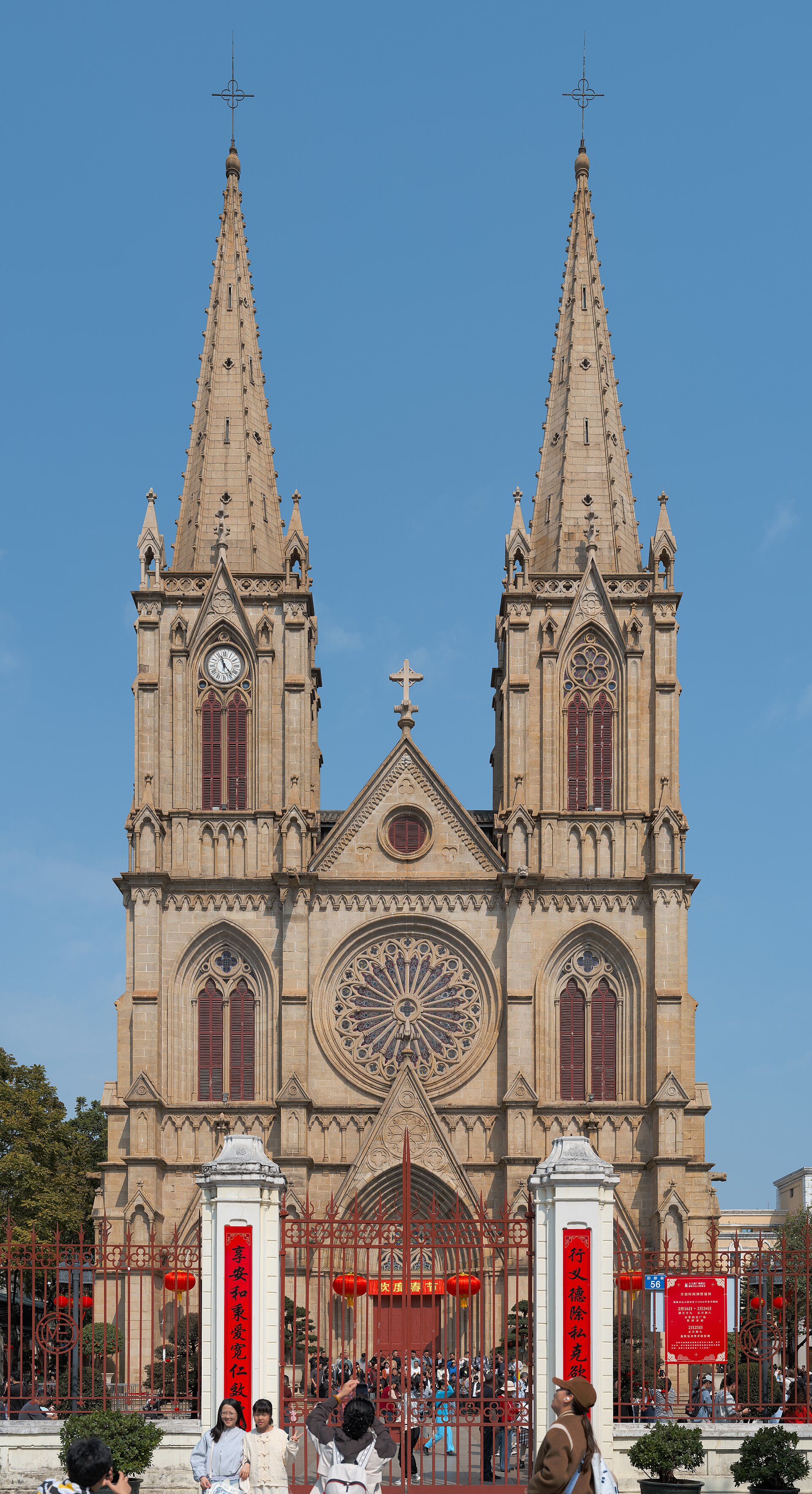
Sacred Heart Cathedral, Guangzhou — the grey granite Gothic facade and twin spires rising against the sky 1
The Twin Granite Spires (双尖塔)
Twin spires reaching about 58 metres · visible from across the old quarter

Step back into the forecourt and look straight up at the two spires — this is the best photograph you will take here. The west front was modelled on the Basilica of St Clotilde in Paris, complete with a circular rose window, pointed arches and carved stone tracery in true Gothic style. Look closely at how tightly each block of granite is cut and fitted: all of it was done by hand more than a century ago, without the heavy machinery that would make such work routine today.

Best angle: The forecourt, looking straight at the main doors
Best time: Morning or late afternoon, when raking light gives the stone depth
🪟2
The Stained Glass & the Nave
A vaulted nave 28 metres high · coloured light through the windows

Step inside and look up. The Gothic vault rises to 28 metres, and rows of granite pillars draw your eye down the nave to the altar. Tall stained-glass windows tell biblical stories, and when morning sun comes through, the floor and pillars are washed in colour. The original 19th-century French glass was lost — damaged in wartime and destroyed during the Cultural Revolution — so the windows you see today were made during the 2004–2006 restoration. They are still beautiful, and they recreate the same coloured-light atmosphere the builders intended.

Etiquette: Stay quiet inside at all times, especially during services
Best time: Morning sun lights the east-side windows most vividly
🪨3
The Story of the Stone — why "Stone House"
Granite shipped from Kowloon, Hong Kong · laid by hand over 25 years

The name Shishi, "Stone House", is not a metaphor — the cathedral really is built entirely of granite: the thick walls, the round pillars, the arches and the spires. In an age before heavy lifting gear, Chinese stonemasons cut, shaped and raised every block by hand. All of the stone travelled by sailing boat from quarries near Kowloon in Hong Kong, and the build took a full 25 years. Put your hand flat against the wall and you can feel it for yourself: this is real stone, cool and immensely solid.

Good to know: One of only a few all-granite Gothic cathedrals in the world
Architects: Léon Vautrin, with Chinese master mason Cai Xiao
4
A Living Church — Mass Every Day
Seat of the Archdiocese of Guangzhou · services in Chinese and English

This is not a museum but a working parish, where Guangzhou's Catholic community gathers for Mass every day. Weekday morning Mass usually begins around 6.30 am, with an evening service around 7 pm in Chinese; Sundays have several services, often including one in English for international visitors. Sitting in the granite nave while the chant echoes is a different experience from simply looking around — but if you arrive during a service, do not walk about. Sit quietly or come back later.

Note: No walking around during a service · sit quietly or return later
Check first: Mass times shift with the church calendar
Beijing Road pedestrian street in Guangzhou's old city near Sacred Heart Cathedral — shops, signs and crowds of shoppers 5
The Old City Around It + the Pearl River
Yide Road · Beijing Road · the north bank of the Pearl River

The cathedral stands in the middle of a lively old-city district. Yide Road out front is full of dried-goods, spice and toy wholesalers, and a short walk brings you to Beijing Road pedestrian street, where a glass floor displays layers of ancient road surface from several dynasties. It is also close to the Pearl River waterfront and Shamian Island, the leafy enclave of old European buildings. The smart move is to fold the cathedral into a half-day walk through the old city.

Beijing Road: A short walk or one or two metro stops away
Shamian Island: By the river — good to continue to in the afternoon
Before you go

Hours, dress code and how to get there

Everything you actually need to know, in one place.

Admission
Free
No ticket required · This is an active place of worship, not a museum, so treat it with respect
Opening hours
Roughly 8 am–5.30 pm daily
No walking around during Mass · Hours can vary by day and church calendar, so check before you go
Metro
Line 6 — Yide Lu station (一德路), Exit A
A 5–7 minute walk to the cathedral · Or Line 2 to Haizhu Square, Exit B2, then 8–10 minutes
Time needed
30–45 minutes
To walk the exterior, photograph the spires and step inside the nave · Add time to attend Mass or sit quietly
Dress code
Modest — shoulders and knees covered
A working church · There is usually a security check at the entrance, so carry your passport
Best time to visit
A weekday morning
Morning light through the stained glass, fewer people · Avoid Sundays, which are busy and have several Masses
Worth knowing: Photography is fine in the forecourt, but keep silent inside, especially during a service. For the best coloured light through the stained glass, come in the later part of the morning, when the sun angles in through the east-facing windows.
Getting there

Easy by metro in the old city

Sacred Heart Cathedral is at 56 Yide Road, on the north bank of the Pearl River in the heart of the old district. It is straightforward to reach by metro.

Metro Line 6 — Yide Lu station
Exit A · 5–7 minute walk

The most direct option. Take Line 6 to Yide Lu (一德路), leave by Exit A and walk northeast for 5–7 minutes; the spires come into view as you approach.

Metro fare: ¥2–5 (~฿10–25) · Total: about 10 minutes from the station
Metro Line 2 — Haizhu Square
Exit B2 · 8–10 minute walk

Take Line 2 to Haizhu Square (海珠广场), leave by Exit B2 and walk west along Yide Road for 8–10 minutes. Convenient if you are staying near the riverfront or coming from the north bank.

Metro fare: ¥2–6 (~฿10–30) · Total: about 12–15 minutes
From Beijing Road
10–15 minute walk or a short taxi

If you are already shopping on Beijing Road pedestrian street, just walk south towards the river for 10–15 minutes and you reach the cathedral — ideal for pairing the two in a single outing.

Walking: ~10–15 min · Taxi/DiDi: short hop, inexpensive
Half-day Old City plan
Cathedral + Beijing Road + Shamian + river

With a free half-day, link them all: Sacred Heart Cathedral in the morning, then Beijing Road for the glass-floor archaeology, then on to the Pearl River and Shamian Island in the afternoon, finishing at sunset by the water.

Total time: 4–5 hours · Cost: all sights free; you only pay for transport and food
Nearby

Fold it into one old-city day

The cathedral sits in the heart of a district made for walking — here is what we suggest combining into the same day:

Frequently asked

FAQ · Before you visit Sacred Heart Cathedral

Is Sacred Heart Cathedral Guangzhou free, and what are the opening hours?
Yes, admission is free. The cathedral is open to visitors roughly 8 am to 5.30 pm daily, but walking around is not allowed during Mass. Check Mass times before you go and avoid the service windows if you only want to look around. This is an active church, not a museum, so dress modestly and stay quiet inside, especially during services.
How do I get to Sacred Heart Cathedral by metro?
The easiest route is Metro Line 6 to Yide Lu station (一德路), Exit A, then a 5–7 minute walk. Alternatively take Line 2 to Haizhu Square station (海珠广场), Exit B2, and walk west along Yide Road for about 8–10 minutes. The cathedral is at 56 Yide Road on the north bank of the Pearl River.
What is the cathedral made of, and why is it called the "Stone House"?
Locals call it Shishi (石室), meaning "Stone House", because it is built entirely of granite — the walls, the pillars and the twin spires are all solid granite, with no brick or concrete. The stone was shipped by sailing boat from quarries near Kowloon, Hong Kong. It is one of only a handful of all-granite Gothic cathedrals in the world, and it took 25 years to complete, finishing in 1888.
When is the best time to visit, and what should I wear?
Morning is best — soft light comes through the stained glass and the crowds are thinner. Avoid Sundays if you want to skip the crowds and the multiple Mass services. Dress modestly with shoulders and knees covered, as this is a working church. There is usually a security check at the entrance, so carry your passport, and keep silent inside, particularly during a service.
What else can I see near Sacred Heart Cathedral?
The cathedral sits in the heart of the old city. A walk or a stop or two on the metro takes you to Beijing Road pedestrian street, where a glass floor displays layers of ancient road from several dynasties, and it is not far from Shamian Island, the leafy riverside enclave of old European architecture. Allow about 30–45 minutes inside the cathedral, then continue with a half-day old-city walk.