A whole fish grilled until it's fragrant, then dropped into a bubbling shallow pan of red, chilli-laden broth thick with dried peppers and Sichuan peppercorn — the one dish a whole table gathers around until the broth is gone.
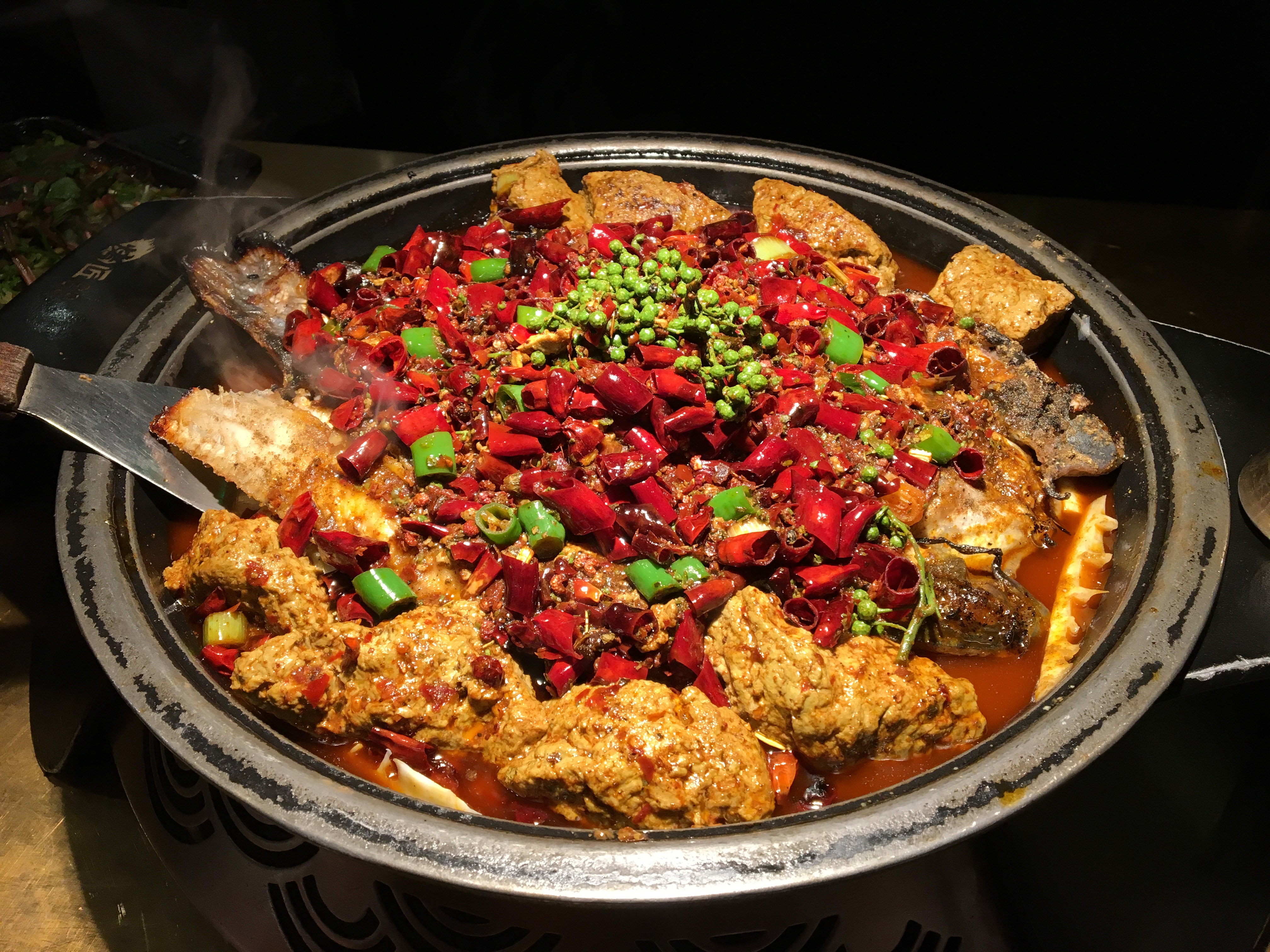
Picture a wide, shallow pan set over a small burner in the middle of the table. In it, a whole fish lies half-buried under a hill of red dried chillies, Sichuan peppercorns and spring onion, in a red oil that's gently bubbling and throwing off a fragrant, fiery smell before you've even picked up your chopsticks. This is 烤鱼 (kǎoyú) — Chongqing-Wanzhou grilled fish, and it is not the plain grilled fish you might be expecting.
The difference is right here: ordinary grilled fish finishes on the fire, but Chongqing grilled fish has two stages that turn it into a centrepiece. First the whole fish is grilled on a rack until it's about 90% cooked and the skin smells of smoke. Then it's transferred to a shallow pan and the málà (麻辣) broth goes in — simmered from Chongqing chilli-bean paste (doubanjiang), garlic, ginger, dried chilli, chicken fat and fresh stock — and the whole thing keeps cooking on a burner in front of you. The fish ends up carrying both the smoke of the grill and the soak of a spicy broth at once: three techniques in one dish — marinate, grill, simmer.
The dish comes from Wanzhou (万州), a district of Chongqing split down the middle by the Yangtze River. In the late Qing dynasty, fishermen along the Yangtze worked out this "grill-then-simmer" method to make a fresh catch taste better and keep longer, and Wanzhou became known as "the hometown of grilled fish in China." And because Chongqing is the capital of hotpot and the home of málà, throwing hotpot-style toppings into the grilled-fish pan was the most natural move in the world.
Chongqing grilled fish is a dish you design yourself — three layers of choice decide exactly how the meal turns out.
1
The most popular choice is tilapia (罗非鱼), because it's large, the flesh is thick, it comes off the bone easily and it's less muddy than most freshwater fish — the best pick for a first-timer. Next come grass carp (草鱼), softer and sweeter in a traditional way, and catfish (鲶鱼), silky and free of fiddly small bones. Most places let you pick a live fish from the tank and price it by weight.
A fair warning: Chongqing's málà runs hotter than many people expect. The heat of the chilli (辣) comes paired with a tingling, numbing buzz on the tongue from Sichuan peppercorn (麻). If you're not a big chilli eater, order 微辣 (mild) to be safe; 中辣 is a solid middle ground; and 特辣 (extra-hot) is for the genuinely heat-seeking. Staff at many places will ask your level when you order — answer in Chinese or just point.
This is the fun layer — the flavour style sets the whole personality of the dish. 麻辣 (málà) is the classic, numbing and fiery at full tilt. 泡椒 (pickled pepper) is sour and bright, cutting the richness with a little less heat. 豆豉 (fermented black bean) brings a deep, savoury funk. And 香辣 (xiāng là) is fragrant-spicy with less of the numbing tingle. Big chains like 探鱼 offer around ten styles, including a non-spicy 菌菇 (mushroom-herb) broth for anyone who can't take chilli at all.
Don't overlook what's sitting under the fish — these are the quiet stars. Sliced potato, tofu skin (豆皮), enoki mushrooms, lotus root, wood-ear, bean sprouts and konjac (魔芋) soak in the spicy broth and drink up the flavour until they're as good as the fish. Plenty of people will tell you the broth-soaked potato and tofu skin are the best bite of the whole pan. Once the fish is gone but the broth is still bubbling, you can order vegetables or noodles to cook in it, just like a hotpot.
Start at the fish tank — pick a live fish and have it weighed, then tell the staff three things: the type of fish, the spice level and the flavour style. After that you choose the toppings to go in the pan. Every fish is grilled to order, so expect to wait around 15–30 minutes — order snacks or drinks while you wait.
When the fish arrives, it sits over a gentle burner that keeps it bubbling all meal. Eat the fish first, while the flesh is firm, then move on to the broth-soaked toppings. The longer it cooks, the richer the broth gets — and once the fish is finished, order more vegetables, tofu or noodles to simmer in the same broth.
Group size: a medium fish plus 3–4 toppings is right for 2–3 people · a bigger group orders a larger fish and more toppings · cost per meal: two or three people with rice usually lands around ¥120–200 (~฿600–1,000).
Almost every grilled-fish place in Chongqing runs on WeChat Pay and Alipay. Some chain branches in malls take cash in yuan, but foreign credit cards usually don't work. The easiest move is to link a Visa/Mastercard to Alipay or WeChat through the foreign-traveller mode before you go.
Many local spots have no English menu, but most have a picture menu or flavour-style boards you can point at. For the most traditional version, look for a shopfront with the characters 万州烤鱼 (Wanzhou grilled fish) — a sign it's cooking the original recipe.
Chongqing has grilled-fish restaurants in nearly every neighbourhood — reliable big chains are easy to find in malls, while local spots hide down lanes and along the riverside.
If it's your first time in Chongqing and you want grilled fish without any guesswork, Tanyu is a safe place to start — a chain known for playful interiors and around ten flavour styles, from classic málà to pickled pepper and a non-spicy mushroom broth. The picture menu is clear and easy to order from, which suits anyone not yet used to ordering the local way. You'll find branches in big malls across the city.
The fastest-growing grilled-fish chain in China, built on value — fresh fish and a full set of toppings at prices friendlier than a sit-down restaurant. It's a good call for a meal with friends or family where you want to eat well without spending much. The core flavour styles are all there: málà, pickled pepper and fermented black bean. The rooms are simple, keeping the focus on the food.
Started by two friends who came across the grill-then-málà method while travelling through Wushan in Chongqing, then opened a restaurant on it in 2005 — the name translates roughly as "outside the city, by the river," a nod to the dish's riverside roots. It leans toward larger fish and a rich, concentrated broth, and it's another chain that Chinese diners know well, with branches in several cities.
Beyond the chains, Chongqing is full of small local grilled-fish places where the people nearby actually eat. Look for a sign reading 万州烤鱼 (Wanzhou grilled fish) down residential lanes or along the river. These places usually have no English menu and a homely feel, but they deliver the original flavour at local prices. Point at a fish in the tank, name your spice level, and let the kitchen handle the rest — it often turns into the meal you remember.