In 1894, seventy-two Chen clans pooled their money to build this hall. Every roof ridge carries rows of ceramic figures telling old legends; the beams are carved through, the brick walls cut into pictures. Admission is ¥10 — and the detail here could keep you all day.
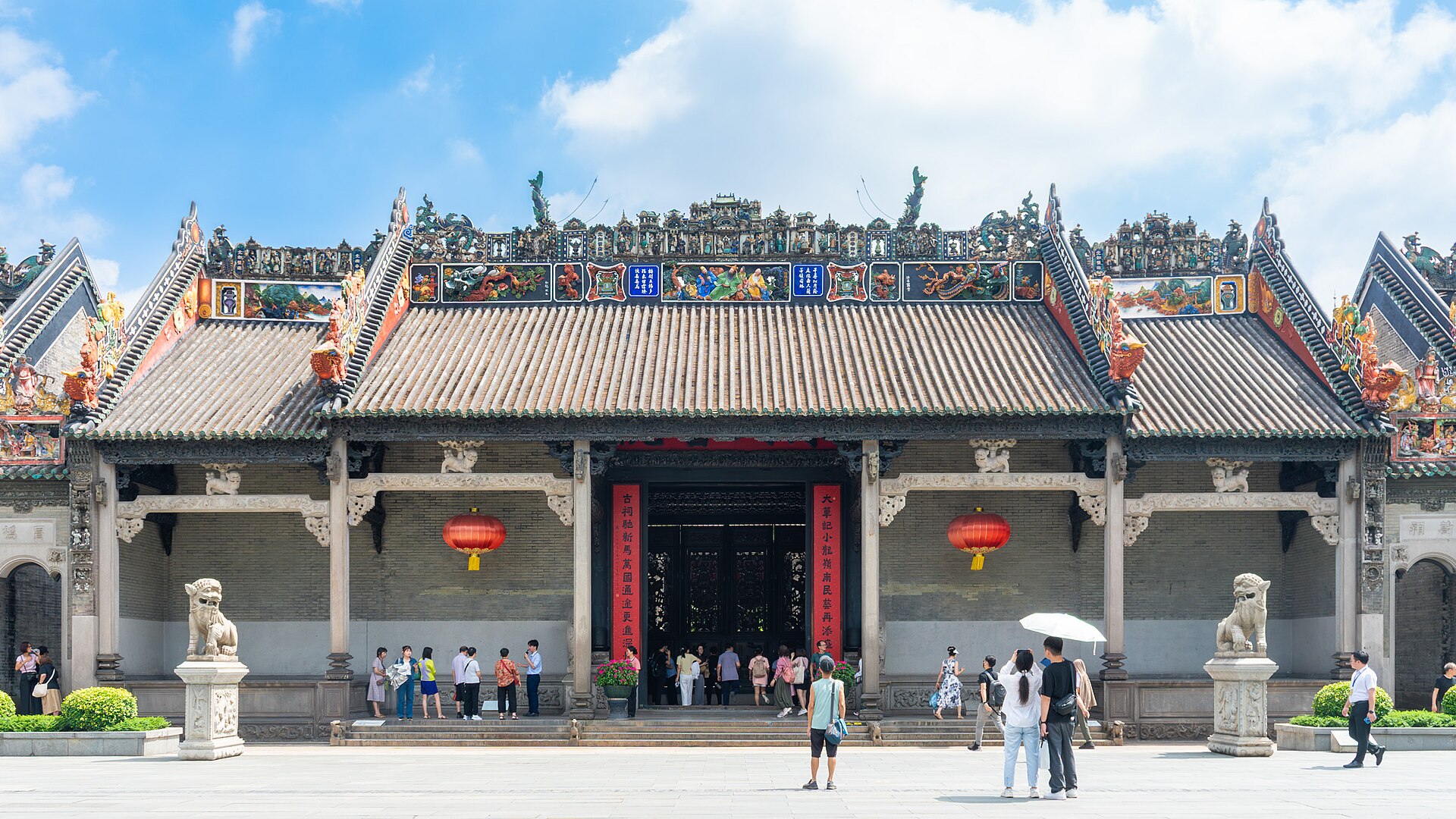
You come up the metro stairs and the hall is simply there in front of you — a pair of stone lions at the gate, red lanterns under the eaves, and then your eye is pulled upward to the roof ridge. It is not plain tile up there but a parade of brightly glazed ceramic figures: opera characters, gods, dragons, fish and flowers, arranged into scenes running the full length of the roof. That first look is what stops people at Chen Clan Academy, and it is why many call it the "pearl of Lingnan architectural art".
Chen Clan Ancestral Hall (陈家祠) was completed in 1894, late in the Qing dynasty, funded jointly by 72 Chen clans from across Guangdong province. It served two purposes: an ancestral temple for the Chen family, and a hostel and study hall for Chen clansmen who came to the city to sit the imperial examinations — hence its other name, the Chen Clan Academy. The complex is laid out with strict symmetry: 19 buildings forming 9 halls and 6 courtyards, linked by covered walkways.
What makes it remarkable is the decoration, which Cantonese craftsmen group under the phrase "three carvings, three sculptures, one casting" — wood carving (木雕), stone carving (石雕), brick carving (砖雕), clay-relief sculpture (灰塑), Shiwan ceramic sculpture (陶塑) and iron casting (铸铁). The best of Guangdong's master artisans is gathered in one place, an encyclopaedia of traditional craft you can walk through. Since 1959 the hall has housed the Guangdong Folk Art Museum, and a single ticket covers both the building and its exhibitions.
Each is a different craft tradition — walk slowly and keep looking up.
1
This is the signature of Chen Clan Academy and its most photographed feature. The eleven ridge crests on the various hall roofs are crowned with ceramic figures fired at the Shiwan kilns in nearby Foshan, arranged into narrative scenes — opera characters, deities, dragons, phoenixes, fish and floral motifs, their colours still vivid after more than a century of sun and rain. Look closely and you will see that no two figures share the same expression or pose; the craftsmen meant them to reward viewing from a distance and up close alike.
Step into any hall and look up at the beams and lintels overhead — almost every piece is carved into a picture: scenes from the Three Kingdoms, folk tales, auspicious birds and flowers. Some of the timber screens are cut so deeply, through several layers, that you can see front and back at once. Most of the woodwork here is hardwood, lacquered and gilded, a measure of both the skill on hand and the wealth of the Chen clans at the time. Move slowly and notice the small details — it is the kind of thing you can get genuinely absorbed in.
Cantonese brick carving (砖雕) is renowned for its fineness — craftsmen cut each fired grey brick into landscapes, flowers and narrative scenes, some of the panels as large as a whole wall. When light strikes them at an angle the relief reads almost three-dimensional. The stone carving (石雕) is concentrated on the columns, column bases and balustrades, cut from granite into auspicious animals and flowers. Both forms are decorative and load-bearing at the same time — a reminder that Lingnan craftsmen always thought about beauty and function together.
Walk from the front gate straight back and you pass through halls in sequence, separated by open courtyards that let in light and air. This layout is classic for an old Chinese clan hall that doubled as a study academy and a temple: symmetrical left to right, with a clear central axis. The open courts also keep the timber buildings comfortable in Guangzhou's hot, humid climate. Find a moment to stand in the middle of a courtyard and look straight through several gates at once — it is the view that shows the whole intention of the plan.
The halls around the courtyards are given over to the Guangdong Folk Art Museum, which gathers master craftwork from across the province. The piece everyone talks about is the multi-layered ivory puzzle ball — concentric spheres that rotate freely inside one another, all carved from a single block of ivory. Alongside it you will find Cantonese embroidery, Shiwan ceramics, silverwork and ivory fans. The ¥10 ticket covers both the building and the exhibitions, which makes it exceptional value for what you see.
Everything you actually need to know, in one place.
Chen Clan Academy is in the Liwan district, west of the city centre. The great advantage is a metro station of the same name right beside the gate, which makes it very easy to reach:
If you are staying near Huacheng Square or the Tianhe district, take Line 1 straight through to Chen Clan Academy station — no changes needed. Leave by Exit D and you are at the gate.
Just off a high-speed train at Guangzhou Station? Take Line 5 and change to Line 1 at Guangzhou Railway Station, then ride to Chen Clan Academy. Quick and close — a good first stop when you arrive in the city.
From the old riverside quarter, take Line 1 from Huangsha station a few stops north. A natural pairing if you spend the morning on Shamian Island and come here afterwards.
With a free half-day: Chen Clan Academy 9–10.30 am, then Line 1 into Liwan for the Shangxiajiu pedestrian street — old qilou arcade shophouses and traditional dim sum houses. Wind up in the early afternoon, or carry on to other Guangzhou attractions as you like.
The Liwan district and the central neighbourhoods are a short metro ride from Chen Clan Academy. Here are the hotels we have reviewed and the Cantonese food worth seeking out: