Guangzhou's largest central park — where the city's founding legend stands carved as five rams, a 640-year-old Ming tower watches the skyline, and the last stretch of the old city wall hides under the trees. Free to enter.
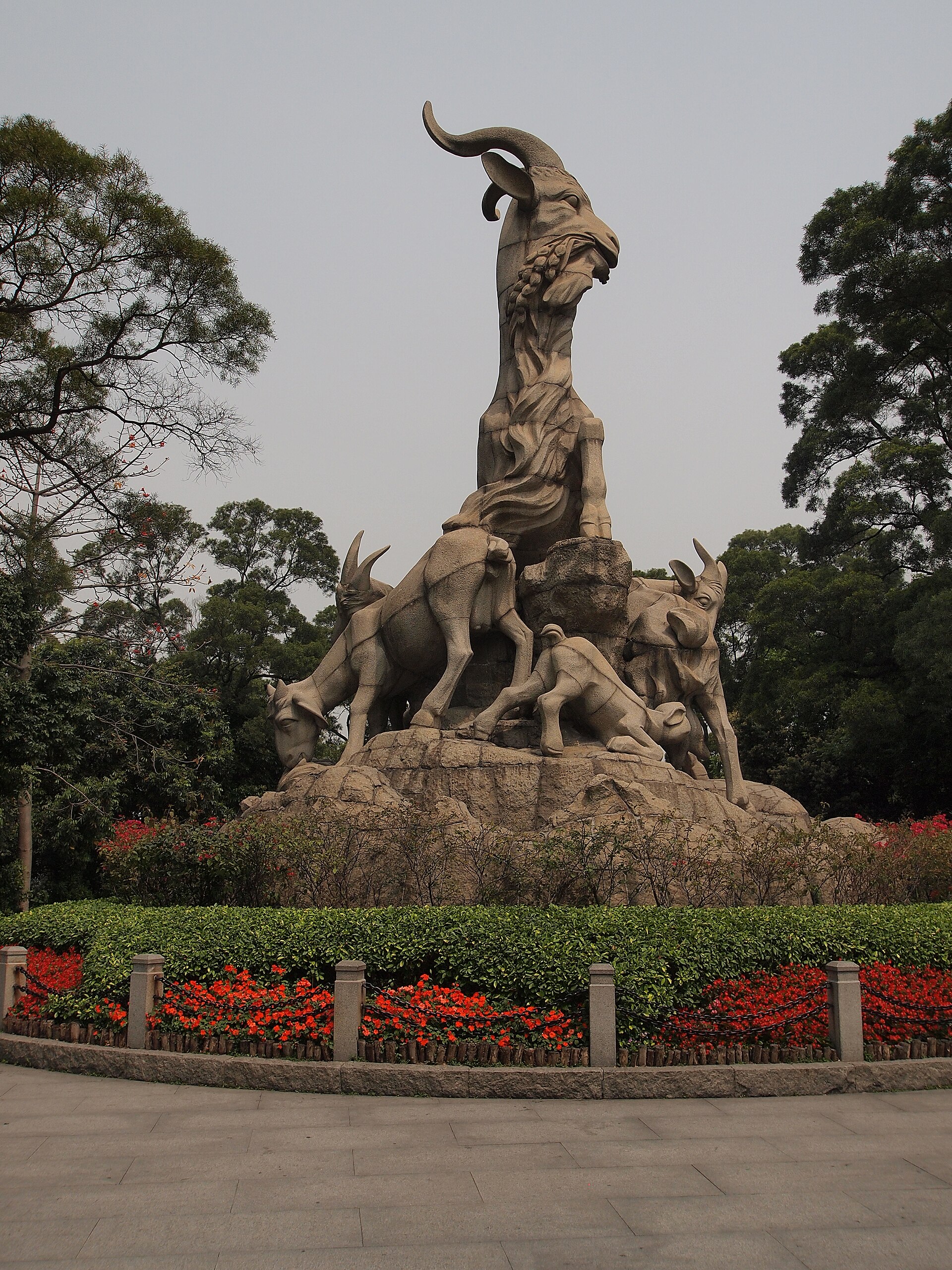
You climb a shaded path under old banyan trees, turn left at the foot of the hill, and there it is, full-on: the Five Rams Statue, eleven metres tall, the central ram with ears of rice held in its mouth and four more crouched around it on the rock, a bed of bright red flowers ringing the base. This is not just a pretty sculpture. It is the official emblem of the entire city — the reason Guangzhou has been called the "City of Rams" for more than two thousand years.
That is the way into Yuexiu Park — the largest central park in Guangzhou, roughly 860,000 square metres of three man-made lakes and seven hills stacked together. But what sets this park apart from an ordinary green space is the way history layers up inside it: the city's founding myth, a Ming-dynasty watchtower from 1380, and the only surviving stretch of Guangzhou's old city wall, all behind the same fence.
What makes Yuexiu worth your time is that it works as a local backyard and an open-air history lesson at once. In the morning you will find older residents doing tai chi, dancing and rehearsing Cantonese opera by the lakes; visitors photograph the five rams and climb Zhenhai Tower for a view over the city. And — this matters — the park is free. Only the museum inside the tower charges a small entry fee.
Walk up from the south gate — each stop is a different era, layered on the same hill.
The heart of the park and Guangzhou's defining image. It illustrates the legend in which five immortals rode down from the sky on rams, gave the people ears of rice and blessed the city against famine, then the rams turned to stone. The statue stands 11 metres tall and is carved from more than 130 granite blocks — the central ram with rice in its mouth is where everyone queues for a photo. Come early for a clearer shot.
A military watchtower from the early Ming dynasty that locals simply call the "Five-Storey Tower". It stands 28 metres tall, with the lower two floors in red sandstone and the upper floors in blue brick, and a pair of two-metre Ming-era red-sandstone lions guarding the entrance. Inside is the Guangzhou Museum, telling the city's 2,000-year history. Climb to the top floor for a wide view over the skyline.
The only stretch of Guangzhou's old city wall still standing, running more than 1,137 metres along the ridge. The base is built from blocks of red sandstone, the upper section of blue brick — the same materials as Zhenhai Tower. The detail people love: in places, the roots of old trees have wrapped right around the wall and grown into it, which tells its age better than any plaque. You can walk the wall straight on from the tower.
Yuexiu has three man-made lakes — Dongxiu, Nanxiu and Beixiu — linked by tree-shaded paths and small bridges, with pedal boats for hire on fine days. In the morning the waterside is where residents practise tai chi, dance and rehearse Cantonese opera; the mood is a world away from the rush outside the park gates. A good place to rest your legs before walking on.
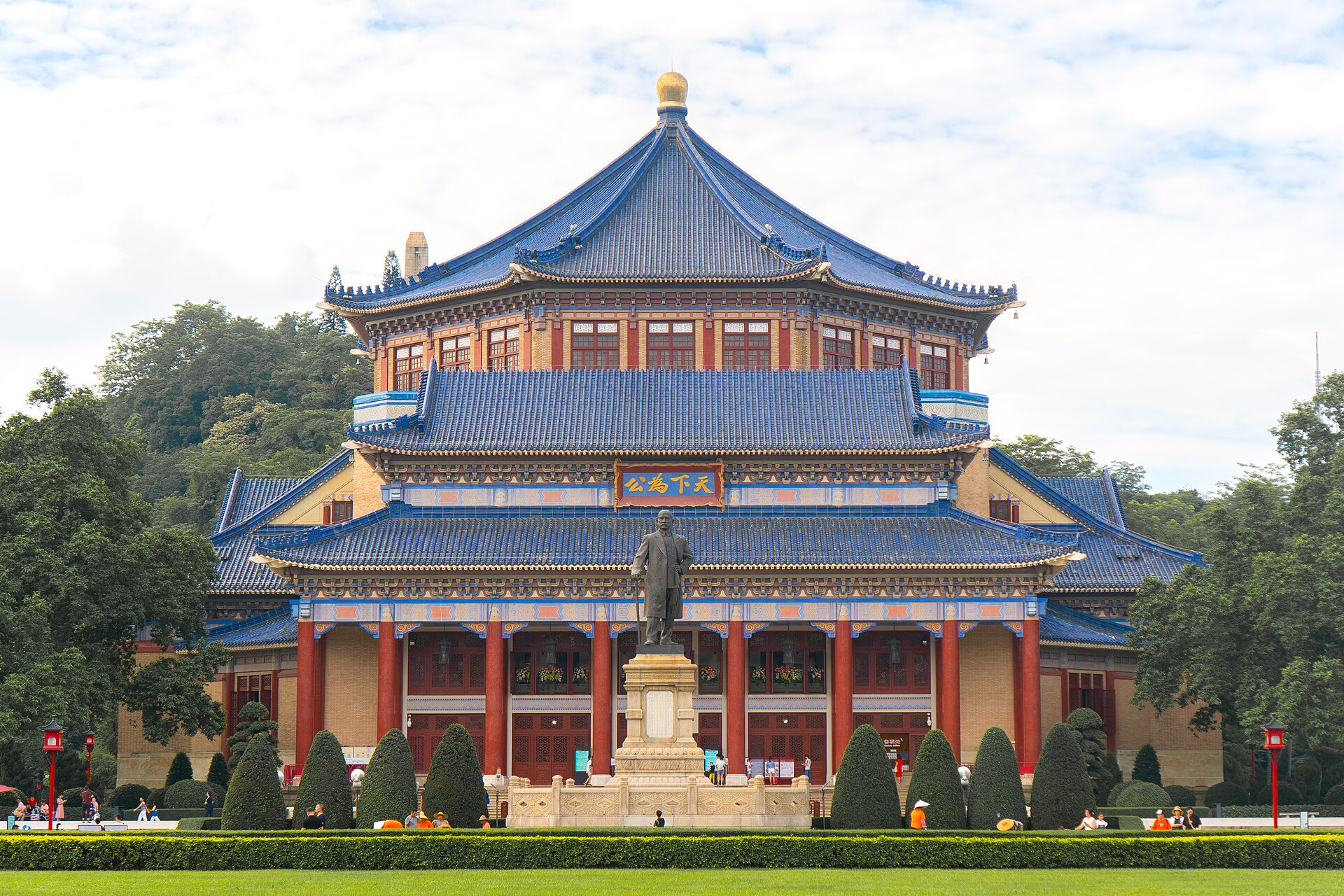
A granite memorial obelisk honouring Dr Sun Yat-sen, leader of China's revolution, set on the same axis as the Sun Yat-sen Memorial Hall just outside the park to the south. Walk down the hill this way and you can carry on to see the Memorial Hall, with its striking blue-tiled Chinese roof, in the same outing.
The story goes that long ago, when Guangzhou was a small settlement called Chuting and its people were poor and hungry, five immortals in robes of five colours rode down from the sky on five rams. Each ram carried golden ears of rice in its mouth. The immortals handed the rice to the townspeople and blessed the place so that it would never go hungry again — then they flew away, leaving the five rams behind, turned to stone, as the city's lasting blessing.
Ever since, Guangzhou has carried the nickname "City of Rams" (Yangcheng 羊城) and "City of Rice Ears" — names the people of Guangzhou still use for their home with pride today. The Five Rams Statue you see is not simply public art; it is the story that shaped the city's whole sense of itself.
Zhenhai Tower was built in 1380, in the early Ming dynasty, as a military watchtower on the highest point of Yuexiu Hill. The name "Zhenhai" means "to calm the sea", reflecting its role in guarding against incursions from the coast. The tower survived wars and several restorations; the structure you see today still keeps the elegant five-storey form.
Today the inside is the Guangzhou Museum, tracing the city from ancient times through its maritime Silk Road trading days to the modern port. Entry is just ¥10 per person — well worth it for the city view from the top floor and the displays within. Open Tuesday to Sunday, 9 am to 5.30 pm (last tickets 5 pm), and closed every Monday — plan your day around that.
Yuexiu is large and built on hills, so a route that flows well is this: enter through the main gate by the metro (Exit B1), see the Five Rams Statue first (Exit A is the nearest), then walk up the hill to Zhenhai Tower, continue along the Ming city wall, and loop back down to rest by a lake. The whole thing takes about two unhurried hours.
Wear comfortable shoes — there are stairs and slopes to climb. Drink and snack stalls are dotted along the way, but on a hot day it is better to carry your own water. A spot most people miss is the rise near Zhenhai Tower, which gives a wide city view without even paying to enter the tower.
The easiest and cheapest way is the metro — there is a station of the same name right by the main gate.
Yuexiu is the heart of old Guangzhou — easy onward connections on Metro Lines 1 and 2.