Home Beijing China Beijing Hotels About
Home  ›  Asia  ›  China  ›  Beijing  ›  Gulou & the Hutongs
🇨🇳 Beijing · Gulou & the Hutongs 鼓楼 · 胡同

Gulou & the Hutongs, Beijing
Courtyard stays, grey-brick lanes and the old city you can still live in

Narrow lanes cars can't reach, the gates of old siheyuan courtyard homes, cafés and bars hidden behind grey-brick walls, and the Drum and Bell Towers anchoring it all. This is the part of old Beijing where people still actually live — and the most atmospheric place to stay in the city.

The neighbourhood

What Gulou and the hutongs are — and why this is the most atmospheric place to stay in Beijing

Picture stepping out of your front gate into a narrow grey-brick lane: an older resident cycling past, a birdcage hanging by a doorway, the smell of fresh steamed buns drifting from a breakfast stall on the corner. That is a hutong (胡同) — one of Beijing's old residential lanes — and the part of the city that has preserved them best is the Gulou (鼓楼) area, around the Drum and Bell Towers and the Shichahai/Houhai lakes (什刹海/后海), just north of the Forbidden City.

The heart of the district is the Drum and Bell Towers (钟鼓楼), two old towers that once kept time for the entire city. Around them stretches a grid of grey-brick lanes laid out as far back as the Yuan and Ming dynasties. Most of the homes inside the lanes are siheyuan (四合院) — courtyard houses with rooms enclosing a central yard on four sides. Some have been turned into boutique hotels and cafés; many are still lived in by Beijing families who have been here for generations.

What makes Gulou worth a base, and not just a quick photo stop, is how it rewards getting lost. One lane will be packed with shops; turn into the next and it falls almost silent — just the sound of a bicycle and neighbours talking by their doorways. We'll be honest: the appeal here isn't a single must-see checkpoint, it's letting yourself wander and following whichever lane looks interesting. Plan to spend more time than the map suggests.
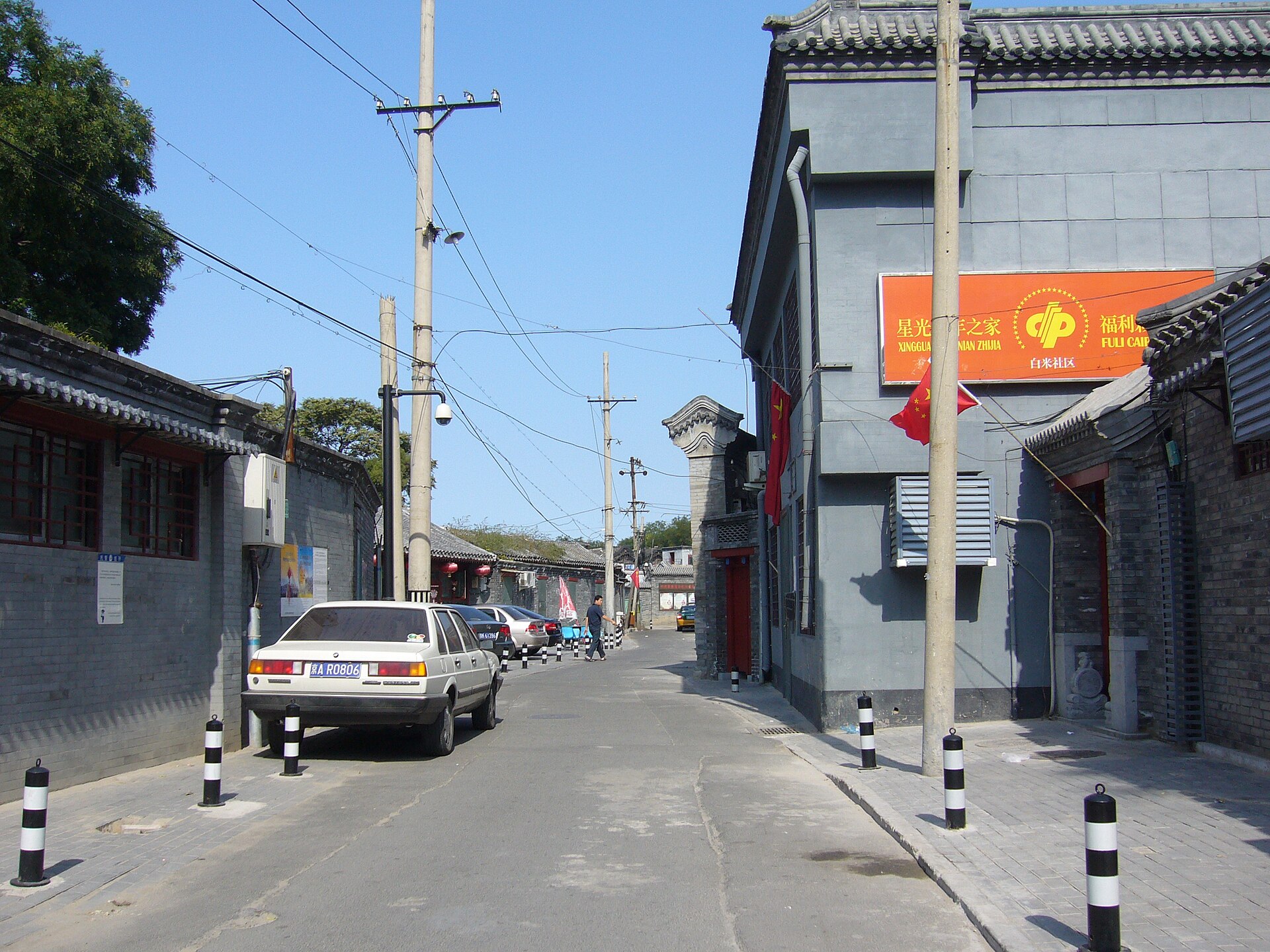
A hutong (胡同) lane in the Gulou area of Beijing — a narrow grey-brick alley with old siheyuan courtyard gates
The grey-brick hutong lanes around Gulou — old Beijing where people still genuinely live, not a stage set for photographs
🥁
Area landmark
Drum & Bell Towers (钟鼓楼)
Two old towers that once kept the city's time
🗺️
Location
North of the Forbidden City
Around the Shichahai / Houhai lakes
🏮
The famous lane
Nanluoguxiang (南锣鼓巷)
Busy and commercial — good to see once
The quieter lanes
Wudaoying · Beiluoguxiang
The more genuine indie cafés and shops
🏡
Where you sleep
Siheyuan courtyard homes (四合院)
Boutique hotels & guesthouses in old courtyards
🚇
Metro
Shichahai L8 · Gulou Dajie L2/8
Nanluoguxiang L6/8 · the rest on foot or by bike
What the area feels like

The atmosphere — busy and calm, one lane apart

Gulou is not a museum district arranged for viewing. It is a place where people still live — hang out their washing, keep songbirds, play chess under the trees. That is the appeal you can't get from a newly built shopping street.

What makes the area so good to walk is how different adjacent lanes can be. Nanluoguxiang will be dense with shops and visitors, but turn into one of the side lanes branching left and right (the "child" hutongs) and everything goes quiet at once — just red doors, a pair of stone lions guarding a gate, and potted plants lined up along the walls. You can feel that you are walking through a place where life actually happens, rather than a constructed scene.

Know the lanes

The hutong lanes to know — which is famous, which is the real thing

The lanes in Gulou are not all the same. Pick the one that matches what you're after and you'll have a far better time than following the map alone.

🏮 Nanluoguxiang (南锣鼓巷)

Beijing's most famous and most crowded hutong — a long pedestrian lane packed with souvenir shops, snack stalls and tourist-facing restaurants. If it's your first time in Beijing and you want to see one lively hutong, this is it. But honestly, on a weekend afternoon it gets so crowded it's hard to walk. The trick is to come early before the shops fully open, or just use it as a thoroughfare and immediately turn off into the quieter side lanes branching left and right. Metro: Nanluoguxiang, Lines 6 / 8.

☕ Beiluoguxiang (北锣鼓巷)

Just north of Nanluoguxiang, and a completely different mood. This lane is far quieter, with independent cafés, bookshops and small designer-clothing stores that younger Beijingers favour. It's ideal if you want to sit over a coffee and watch lane life without competing for space with the tourist crowds. More genuine in feel, and usually easier on the wallet than the Nanluoguxiang side.

🍵 Wudaoying Hutong (五道营胡同)

Our favourite café lane in the area, close to the Lama Temple. It's lined with specialty coffee shops, small bars, international restaurants and homeware stores where the owners curate their own stock. The feel is more bohemian than Nanluoguxiang and it hasn't yet been turned into a full-blown tourist attraction. If you're already visiting the Lama Temple, Wudaoying is a natural next stop — they're very close together.

🚬 Yandai Xiejie (烟袋斜街)

An old diagonal lane near the Drum Tower — the name translates roughly as "Tobacco Pipe Lane," after the pipe shops that once traded here. Today it's a short lane of souvenir shops, tea sellers and snack stalls, and it connects the Drum Tower directly down to Houhai lake. It makes for a pretty and convenient walking route if you're heading from the towers down to the waterside.

🥁 The Drum & Bell Towers (钟鼓楼)

The two old towers that anchor the district. The Drum Tower (鼓楼) and Bell Tower (钟楼) stand together on Beijing's central axis and once sounded the hours for the whole city. You can climb the Drum Tower, and there are scheduled drumming performances. The square between the two towers is a gathering spot for locals and a good place to start exploring the surrounding hutongs. Admission and performance times — check before you go, as they change seasonally.

🏯 Prince Gong's Mansion (恭王府)

The largest and most complete Qing-dynasty princely residence open to the public in Beijing, on the western side of the lakes. Inside are gardens, pavilions and ponds laid out with great care; it was once home to Heshen, one of the wealthiest officials in Chinese history. If you like classical Chinese gardens and grand official architecture, it pairs well with a hutong walk and Houhai. Admission and opening hours — check before you go.

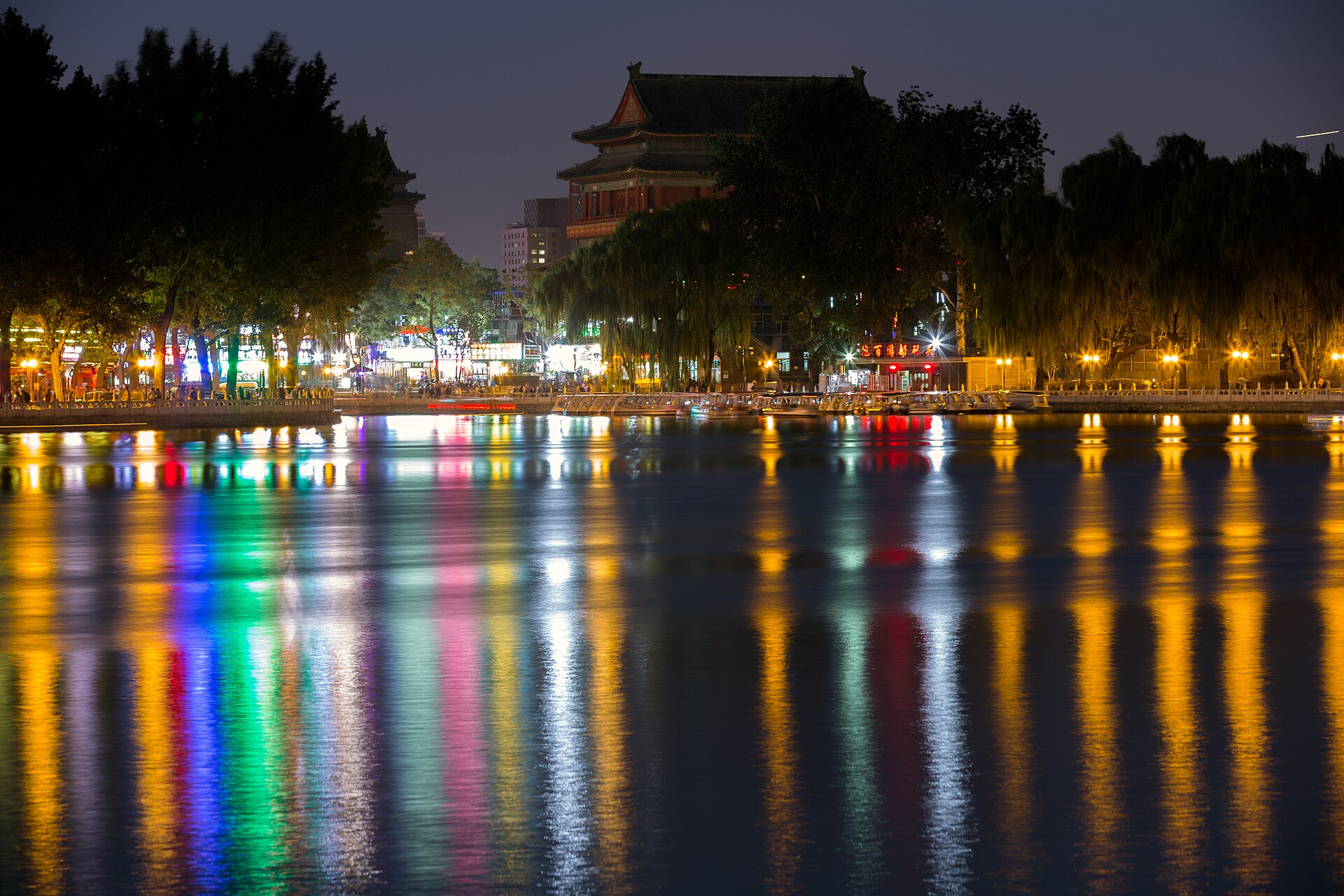
Houhai lake (后海) Beijing — the lake beside the Gulou district, with bars and old houses along the waterside
Houhai lake borders the Gulou district — a few minutes' walk from the Drum Tower, and at its best at sunset
Food and drink

Eating and drinking in Gulou — from lane snacks to lakeside bars

The area runs from a few-yuan breakfast stall in a lane, to a design café in a courtyard, to a bar hidden behind a small door down an alley.

🥟 Lane snacks and breakfast in the hutongs

The charm of eating in Gulou is the small lane shops. In the morning, look for stalls selling youtiao (fried dough sticks) with doujiang (warm soy milk), or jianbing (a savoury egg crêpe) — what Beijingers actually eat for breakfast, usually just a few yuan a piece. Nanluoguxiang has plenty of walk-and-eat snacks but at tourist prices; for the real thing at real prices, turn into the side lanes where locals are queueing. For the standout snacks worth seeking out, see our Beijing street food guide.

☕ Cafés and bars in the lanes

Gulou is the best area in Beijing for independent cafés and bars. Many specialty cafés occupy converted old courtyards; coffee typically runs ¥30–55 (~฿150–275). After dark the area becomes a hutong bar scene, from tiny cocktail bars tucked behind wooden doors to the lakeside bars along Houhai with live music. For a quieter night, try the Beiluoguxiang and Wudaoying side; for a livelier waterfront, head down to Houhai.

Beijing — the city around the Gulou and hutong district
Gulou sits in the centre of old Beijing — within easy reach of the Forbidden City, the Lama Temple and the lakes
Where to stay

Staying in a Gulou hutong — and the trade-offs to know before you book

This is the most atmospheric place to stay in Beijing — but old courtyard homes come with limitations we want to be honest about before you hit book.

The case for staying in Gulou is atmosphere and a central old-Beijing location. A boutique hotel inside a siheyuan lets you wake in a room facing the central courtyard and step straight out the gate into an old lane. You can walk to Houhai and the bar scene, the Lama Temple is close by, and Metro Lines 8 and 6 connect you to the rest of the city easily.

But here are the honest trade-offs: courtyard rooms are often small, old or basic compared with a modern chain hotel. Soundproofing and heating in old buildings may not match a new build. And importantly, cars cannot reach some lanes — you may be dropped at the lane entrance and have to drag your luggage in on foot. If you're travelling as a group or with large suitcases, ask the property how close a car can get, and read the reviews carefully on room size. If you can accept those limitations, the atmosphere you get in return is well worth it.

Or read about a courtyard property in the area directly:

Getting around

Reaching and getting around the Gulou area

Metro stations ring the Gulou area on every side — choose where to get off based on where you want to start. But within the area itself, walking or a shared bike is the most fun, because the lanes are narrow and traffic is light.

🚇
Shichahai (什刹海)
Line 8
Closest to the Drum Tower and Houhai lake
🚇
Gulou Dajie (鼓楼大街)
Lines 2 / 8
Northern edge · connects to the Line 2 loop
🚇
Nanluoguxiang (南锣鼓巷)
Lines 6 / 8
Exit right at the mouth of Nanluoguxiang lane
🚲
Shared bike
Scan a QR and ride anywhere
The most fun way to do the hutongs · via Alipay/WeChat
🚶
On foot in the lanes
Best for exploring
Narrow lanes, little traffic · get happily lost
🚕
Taxi / DiDi
Give the lane entrance, not the house number
Cars can't enter the lanes · use Amap to set the drop-off
Tip: The way locals do the hutongs is on a shared bike — scan a QR to unlock, ride straight into the lanes, leave it almost anywhere. It's very cheap. For maps in China, use Amap or Apple Maps rather than Google Maps, which does not work reliably. For the citywide transport picture, see the complete Beijing city guide.
How to spend your time

A half-day walk and a full-day route — through the lanes

⏱️ Half day (~3–4 hours)

09:00 — Start at the Drum and Bell Towers (Metro Shichahai, Line 8). Take in the old square before the crowds; climb the Drum Tower if you want the view over the lanes from above.
09:45 — Walk down Yandai Xiejie (烟袋斜街), the old diagonal lane that leads toward the lake.
10:15 — Reach the Houhai shoreline. Stroll the waterside and watch the morning rhythm of local life.
11:00 — Dip briefly into Nanluoguxiang, then turn off into the quieter side lanes and find a courtyard café for a break.
11:45 — Lane snacks or a light lunch before you head off.

🌇 Full day (adding the Lama Temple and Houhai at dusk)

Follow the half-day route through the morning, then continue:
13:00 — Lunch in the area — a traditional Beijing restaurant or one of the places in the Beiluoguxiang lanes.
14:00 — Walk or cycle to the Lama Temple (Yonghegong), the most beautiful Tibetan Buddhist temple in Beijing.
15:30 — Stop at Wudaoying hutong nearby for coffee and a browse of the independent shops.
16:30 — Walk to Prince Gong's Mansion (恭王府) on the west side of the lakes for the classical garden (check the closing time first).
18:00 — Return to Houhai for sunset, when the water reflects the lights at its best, then dinner or a lakeside bar.

For the lake detail, viewpoints and how to dodge the tourist traps, read the Houhai & hutong deep-dive. Plan the whole trip at the complete Beijing city guide.

Frequently asked

FAQ · Gulou & the hutongs, Beijing

Where is Gulou and the hutong area in Beijing?
Gulou sits north of the Forbidden City, centred on the Drum and Bell Towers (钟鼓楼) and the Shichahai/Houhai lakes (什刹海/后海). It is the best-preserved hutong (old-lane) district in Beijing. The nearest metro stations are Shichahai (Line 8), Gulou Dajie (Lines 2/8) and Nanluoguxiang (Lines 6/8). Most of the area is best explored on foot or by shared bike.
Is staying in a Gulou hutong a good idea, and who is it for?
It's the most atmospheric base in Beijing — boutique hotels and guesthouses inside siheyuan courtyard homes, such as The Orchid, tucked into the lanes, walkable to Houhai and the bars. The honest trade-off: courtyard rooms are often small, old or basic, and cars can't reach some lanes, so you may have to drag your luggage in on foot. See all the options at 8 siheyuan courtyard hotels, or compare neighbourhoods at where to stay in Beijing.
How is Nanluoguxiang different from Wudaoying, and which should I visit?
Nanluoguxiang (南锣鼓巷) is the famous, busy, commercial lane — packed with souvenir shops, snack stalls and tourist-facing restaurants. It's worth seeing once for the energy. Beiluoguxiang (北锣鼓巷) and Wudaoying (五道营) are quieter and hold the more genuine independent cafés and boutiques. For a calmer, more authentic hutong feel, we'd point you to the latter two.
How long should I spend in Gulou, and how should I get around?
Half a day to a full day works well. For a half day, start at the Drum and Bell Towers, walk down Yandai Xiejie (烟袋斜街) to Shichahai/Houhai, and dip briefly into Nanluoguxiang. For a full day, add the Lama Temple and Prince Gong's Mansion (恭王府), and save Houhai for sunset. The whole area is best on foot or a shared bike — the lanes are narrow and traffic is light.
What is the best time of day to visit?
Before 10:00 for walking the hutongs — quiet lanes, soft light and few people, the best time for photos. Late afternoon into the evening is best for Houhai and the bar scene, when the lake reflects the lights and the waterside bars come alive. Avoid Nanluoguxiang on weekend afternoons, when it gets very crowded; the surrounding side lanes stay calmer throughout.
Klook · Beijing activities

Hutong and siheyuan walking tours with a local guide

Explore the old lanes around the Drum Tower, step inside a siheyuan courtyard home, and hear the stories of the neighbourhood that the map doesn't tell, with a guide who really knows the hutongs. Book ahead through Klook.

Browse Beijing activities on Klook →
Wherebest is an affiliate partner of Klook — we may earn a commission when you book through our links, at no extra cost to you.