Home Beijing Must-Eat Dishes China About
Home  ›  China  ›  Beijing  ›  Street Food
🇨🇳 Beijing Eating Guide · 2026

Eating Your Way Through Beijing
The Snack Streets Worth Walking — and the Tourist Traps

Beijing has a dozen food streets, but only some are where locals actually eat. This guide tells you plainly which strips are the real deal, which are scorpion-on-a-stick photo bait, plus the subway stop, prices and best time to show up for each.

Before You Go

The honest version of where to eat

Picture this: 10 pm in Beijing, you step out of the subway, and the smell of chilli oil hits you before you see anything. There's the crack of crayfish shells, the clink of beer glasses, and a wall of red lanterns glowing the length of a long, packed street. That's Ghost Street (Gui Jie) — and that's what a good Beijing food street should feel like.

The catch is that Beijing has both kinds of food street: the ones locals genuinely flock to, and the ones built purely for visitors — where vendors sell scorpions on skewers that no actual Beijinger would eat. So we've split it into seven food streets, each with a clear verdict on whether it's the real thing or a tourist trap. For the dishes themselves, read this alongside our Beijing must-eat dishes guide and the dedicated Peking duck guide.

7 Food Streets

Street by street, with the honest verdict

Ordered from where the locals genuinely eat to the ones you'll want to see through before you go
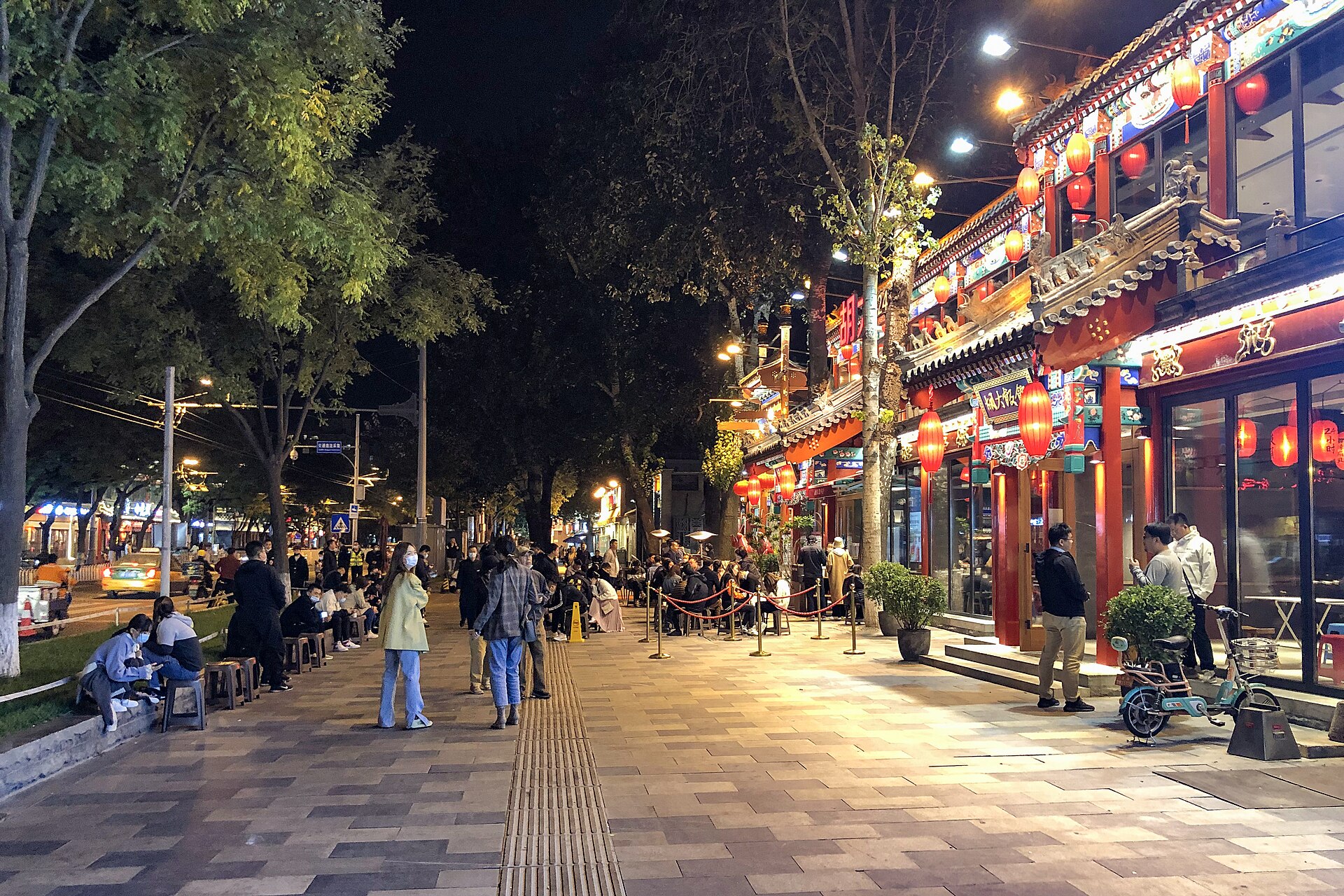
Gui Jie / Ghost Street (簋街) Beijing at night — restaurants lit with red lanterns, traditional Chinese facades, diners waiting along the pavement 1
The Real Deal · Locals Eat Here Until Dawn
Gui Jie — Ghost Street
簋街 · Dongzhimen, Dongcheng District · Metro Lines 2/5, Dongzhimen Station

This is Beijing's great late-night institution — a strip roughly 1.5 km long where many restaurants never close. The name "Ghost Street" comes from the Qing dynasty, when vendors lit oil lamps to trade in the small hours, giving the lane an eerie glow. Today it's where Beijingers and young crowds actually come to eat, from early evening until 2-4 am.

The star is málà spicy crayfish (麻辣小龙虾) — small crayfish stir-fried in numbing Sichuan chilli, eaten with plastic gloves and a cold beer, to the point that the street is half-nicknamed "Crayfish Street." The most famous name is Huda (胡大饭馆), which has several branches in a row here and a queue every night. Beyond crayfish there's bubbling hotpot, Sichuan grilled fish, and spicy snails for the brave.
Metro: Lines 2/5, Dongzhimen, 10-15 min walk
Cost: ¥150-350 (~฿750-1,750) for two, well fed
Best time: 8 pm - 2 am · many spots open 24h
Payment: WeChat Pay / Alipay / cash RMB
Heads up: Famous names like Huda get hour-long waits on weekend nights. If you don't want to queue, the neighbouring restaurants serve nearly identical crayfish a few doors down — or come on a weekday. Crayfish season peaks in summer (Jun-Sep), though you can find it most of the year.
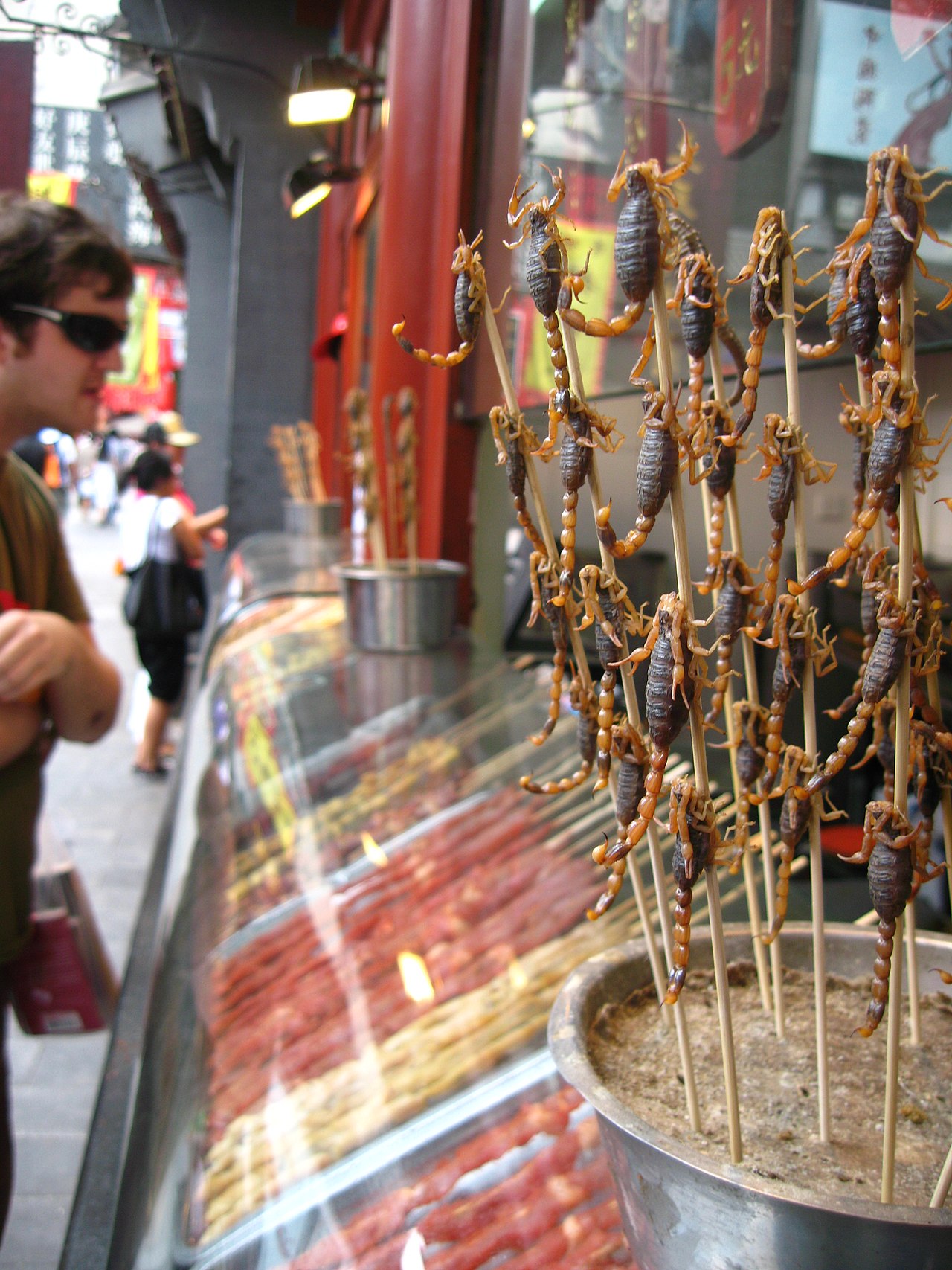
Scorpions on skewers at Wangfujing Snack Street, Beijing — a stall of novelty foods aimed at tourists, with a visitor looking on 2
Tourist Bait — Know This Before You Go
Wangfujing Snack Street
王府井小吃街 · off Wangfujing shopping street · Metro Line 1, Wangfujing Station

Let's be straight: this street has become a photo prop. What you'll see is scorpions, starfish, centipedes, seahorses and silkworm pupae on skewers, displayed so visitors can snap a picture and test their nerve. The reality is that almost no Beijinger eats any of this — it isn't genuine local food, and the prices are several times what you'd pay elsewhere.

So why mention it at all? Because it sits right beside the Wangfujing shopping street that nearly every visitor passes, and it's a "see-it-once" curiosity people want to witness for themselves. If you go, go to look, take your photo, and move on — don't expect to eat anything you'll remember fondly.
Metro: Line 1, Wangfujing Station, Exit A
Cost: ¥15-60 (~฿75-300) per skewer — overpriced
Hours: Evenings have the full display; real food is scarce
Payment: WeChat Pay / Alipay / cash
Straight talk: For genuine Beijing snacks, skip ahead to Huguosi (No. 3). For a serious late-night feed, go to Ghost Street (No. 1). Wangfujing is worth it only to confirm with your own eyes that it exists — not to actually eat.
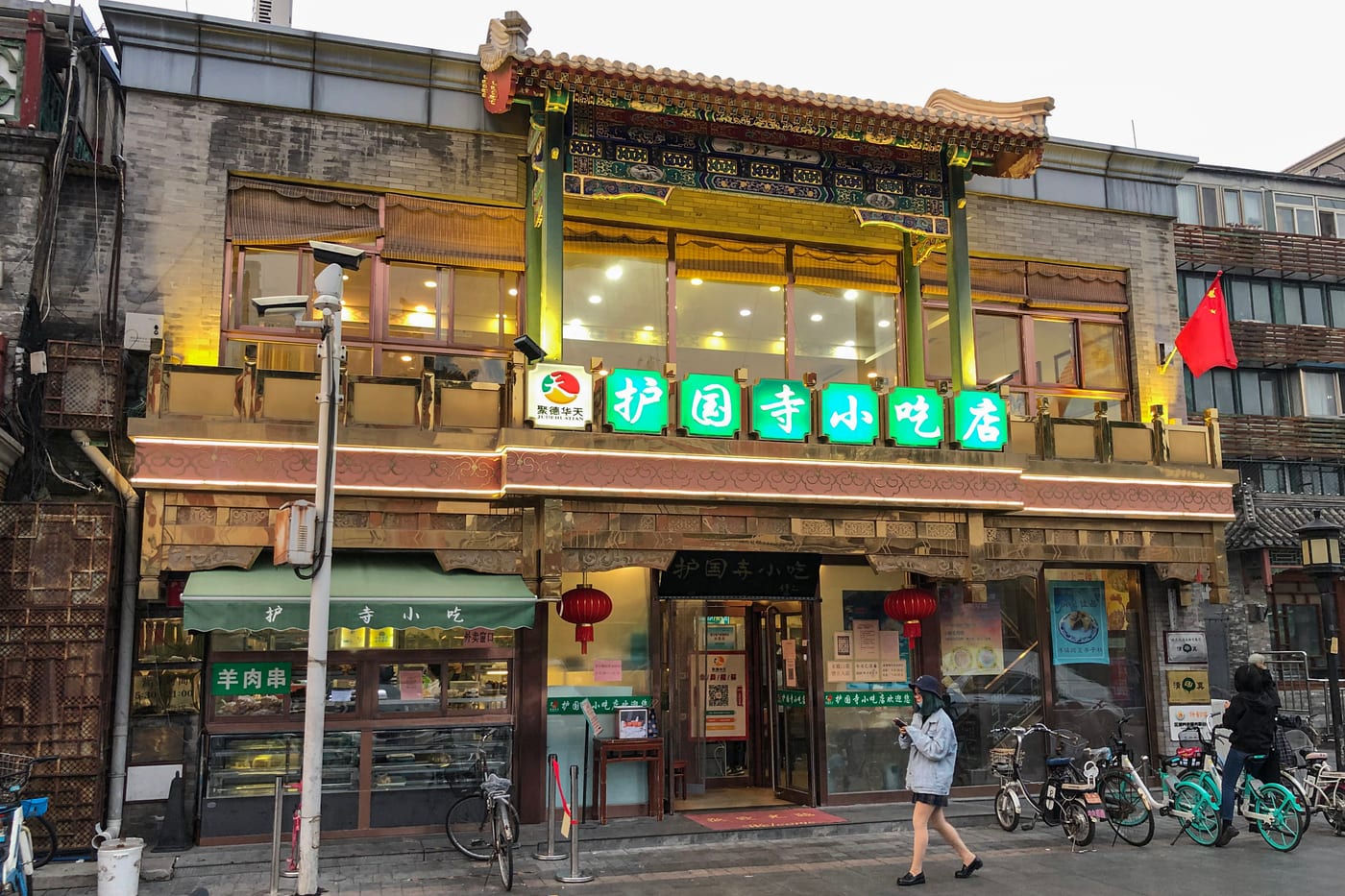
The Huguosi Snacks shopfront (护国寺小吃店) in Beijing — a traditional green-signed counter selling old-Beijing snacks 3
The Real Deal · Old-Beijing Snacks
Huguosi Snack Street
护国寺小吃街 · Xicheng District · Metro Lines 4/6, Ping'anli Station, Exit B

This is the answer to "where do I get real Beijing snacks?" Huguosi Street takes its name from an old temple whose Qing-dynasty fairs drew snack vendors from across the city. The heart of it today is Huguosi Snacks (护国寺小吃), a no-frills counter where locals actually queue.

What to order: aiwowo (艾窝窝) — round white glutinous rice balls with a sweet filling; lǘdǎgǔnr (驴打滚) — soft rolls dusted in toasted soybean flour, the name meaning "donkey rolling in the dust"; wandouhuang (豌豆黄) — a cool, gently sweet pressed pea-flour cake; and miancha (面茶) — a thick millet porridge ribboned with sesame paste, best hot in the morning. The bravest can try douzhir (豆汁), the fermented mung-bean drink that locals adore and most visitors pull a face at — give it one go.
Metro: Lines 4/6, Ping'anli, Exit B, walk northwest
Cost: ¥3-20 (~฿15-100) per snack · ¥50-100 to sample widely
Hours: Morning to evening · freshest in the morning
Payment: WeChat Pay / Alipay / cash
Why we recommend it: This is the polar opposite of Wangfujing — no spectacle, no traps, just genuine Beijing snacks that grandparents have eaten for generations, at giveaway prices. Leave time to wander the surrounding hutong lanes too.
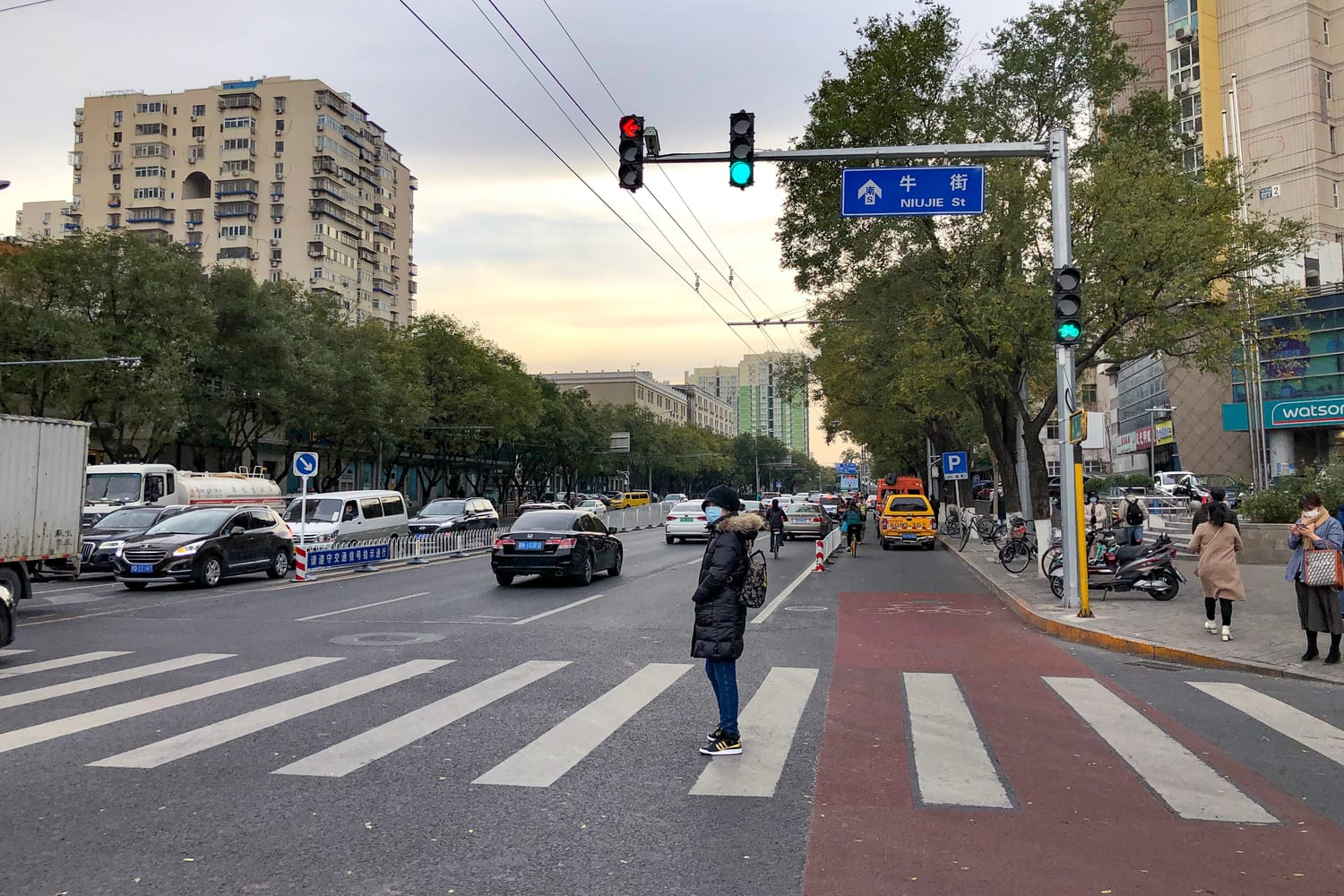
Niujie (牛街) Beijing — the NIUJIE St road sign in the Hui Muslim quarter, with buildings and shops lining the street 4
The Real Deal · Hui Muslim Halal Food
Niujie — The Halal Food Street
牛街 · Xicheng District · Metro Line 4, Niujie Station

Niujie (literally "Ox Street") is the largest and oldest Hui Muslim quarter in Beijing, anchored by the thousand-year-old Niujie Mosque. Restaurants along the whole street are clearly marked 清真 (halal), and the smell of grilling lamb reaches you from the corner.

The highlights: charcoal lamb skewers (羊肉串) — smoky, juicy, perfect to eat on the move; copper-pot lamb hotpot (涮羊肉) — thin lamb swirled in a coal-heated copper pot and dipped in sesame sauce, a classic Beijing meal. The famous spot is Ju Bao Yuan (聚宝源) at 5 Niujie Street — a real queue, but worth it, around ¥120-140 (~฿600-700) per person. And the Niujie sweets — lǘdǎgǔnr, qiegao (切糕, dense pressed sticky rice with red bean), black-sesame rolls — are sold all along the street for snacking.
Metro: Line 4, Niujie Station, a few minutes' walk
Cost: ¥5-25 (~฿25-125) per skewer · hotpot ¥120-140 pp
Best time: After 5 pm, when the grills get going
Payment: WeChat Pay / Alipay / cash
Where to stay: If you're Muslim or travelling with someone who eats halal, this is the area to base yourself — see our halal / Muslim-friendly hotels in Beijing and walk out to every meal. The famous hotpot spots fill up on weekend evenings, so arrive before 6 pm or book ahead.
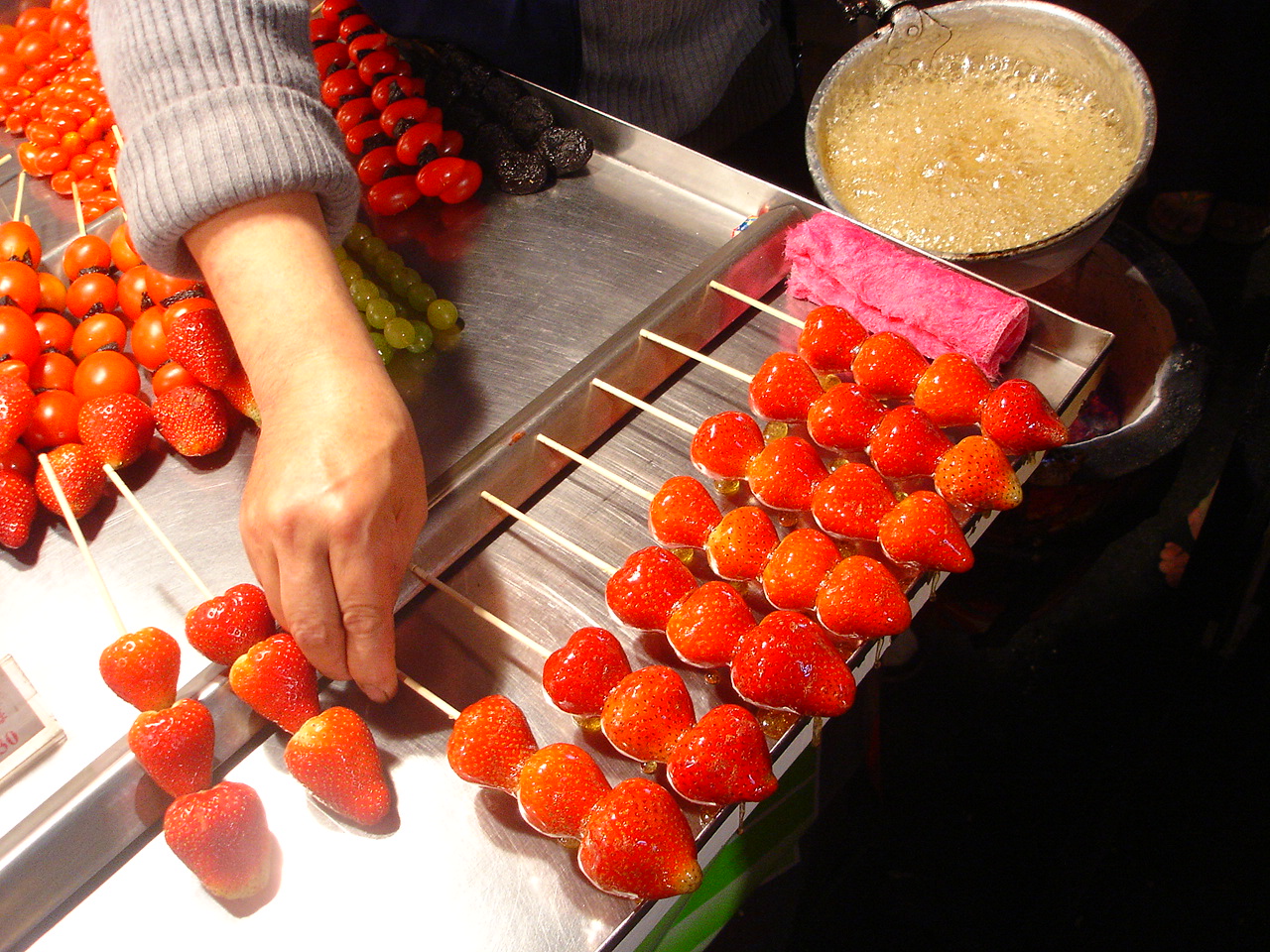
Tanghulu (糖葫芦) — strawberries and hawthorn berries glazed in hardened sugar on skewers, a classic Beijing walking snack 5
Real + Touristy · Century-Old Institutions
Qianmen / Dashilan
前门 / 大栅栏 · south of Tiananmen Square · Metro Lines 2/8, Qianmen Station

Qianmen Street sits on Beijing's central axis and was once the city's busiest commercial street in Ming times. The main boulevard today is rather polished for tourists — but the real heart is the Dashilan lanes (大栅栏), narrow alleys packed with "time-honoured brand" (老字号) shops that have traded for a century or more.

The institutions worth knowing: Quanjude (全聚德) — the hung-oven Peking duck house founded in 1864, the original; Daoxiangcun (稻香村) — a Beijing pastry name since 1895, ideal for boxing up local sweets to take home. In the lanes you'll also find tanghulu (糖葫芦), sugar-glazed hawthorn on a stick; luzhu (卤煮), simmered pork offal; and proper Beijing-style zhajiangmian (炸酱面) noodles.
Metro: Lines 2/8, Qianmen Station, Exit G
Cost: ¥10-40 (walking snacks) · duck/sit-down ¥150+ pp
Best time: Afternoon to evening · snack shops open all day
Payment: WeChat Pay / Alipay / cash
Tip: The grand main Qianmen street is dressed up for tourists and priced accordingly — duck into the Dashilan lanes and side alleys (such as Xianyukou 鲜鱼口) for the genuine old shops at better prices. Stay nearby and you can walk to Tiananmen and the Forbidden City easily — see hotels near Qianmen / Temple of Heaven.
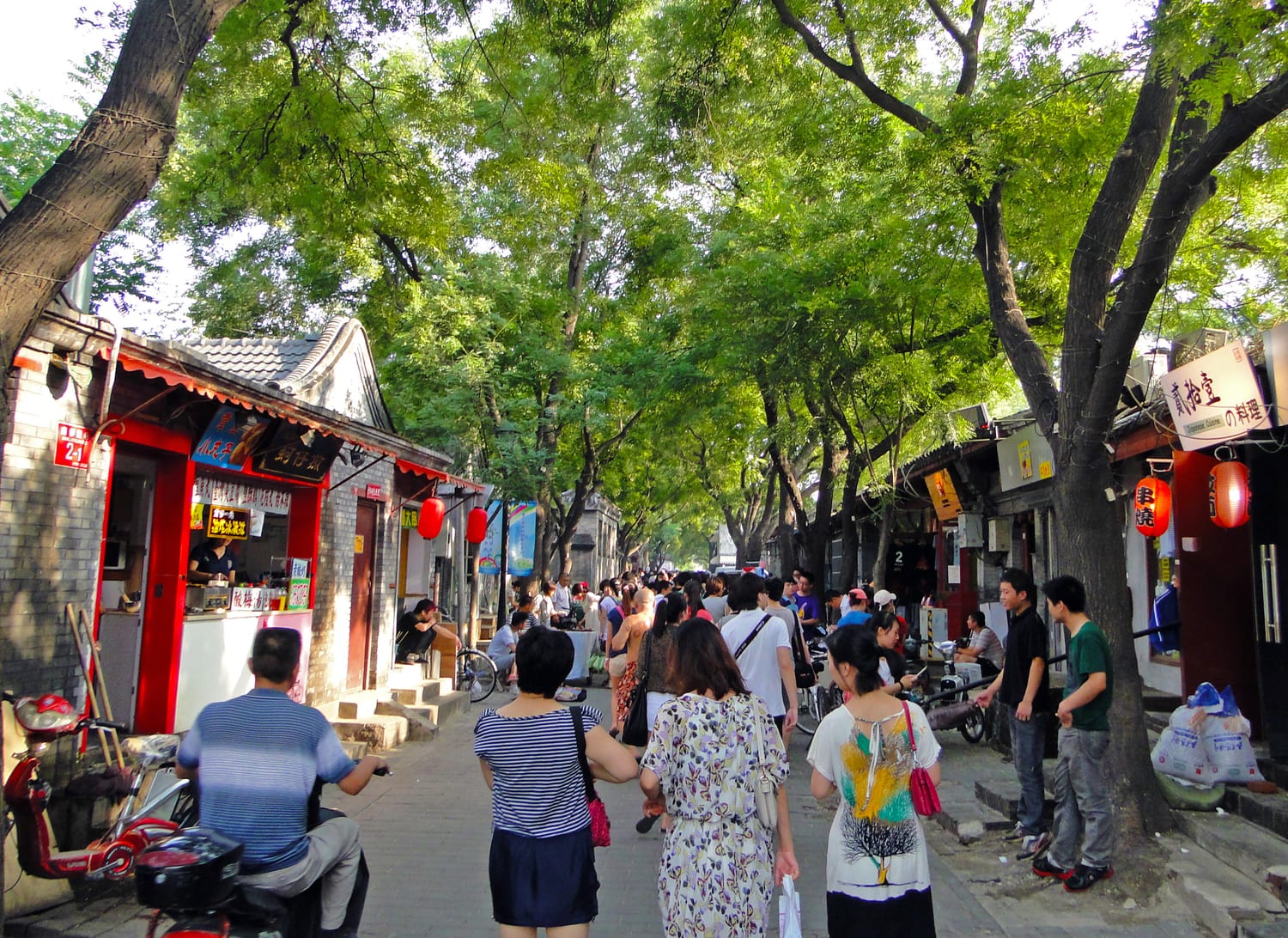
Nanluoguxiang (南锣鼓巷) Beijing — a tree-shaded hutong lane with red shopfronts and lanterns, crowds strolling through 6
Touristy — But a Fun Walk
Nanluoguxiang
南锣鼓巷 · Dongcheng District · Metro Lines 6/8, Nanluoguxiang Station, Exit E

Honestly — Nanluoguxiang is a genuinely pretty, historic hutong lane, but these days it's packed: roughly 60% tourists, 40% young Beijingers. The food leans toward "trendy street snacks," priced above Huguosi or Niujie, so it works best if you treat it as a place to graze while you stroll rather than a serious meal stop.

Worth a try: Beijing-style cheese at Wenyu (文宇奶酪店) — a thick, sweet fermented-milk dessert unique to the capital, with a permanent queue; zhajiangmian at Fangzhuanchang No. 69 (方砖厂69号), hailed online as some of the city's best; and the usual tanghulu and assorted skewers — though be wary of gimmicks like chilli-dusted bubble tea, built for likes more than flavour.
Metro: Lines 6/8, Nanluoguxiang, Exit E, 3 min walk
Cost: You can eat well for ¥60 (~฿300) per person
Best time: After 5 pm when lanterns light up (but crowded)
Payment: Mostly WeChat/Alipay · some old stalls cash-only
Straight talk: Popular spots like Wenyu and Fangzhuanchang No. 69 run 20-40 minute waits at peak — come before 11 am or after 3 pm to wait less. Think of Nanluoguxiang as "a hutong stroll that happens to have food" rather than a dedicated food street, and you won't be disappointed.
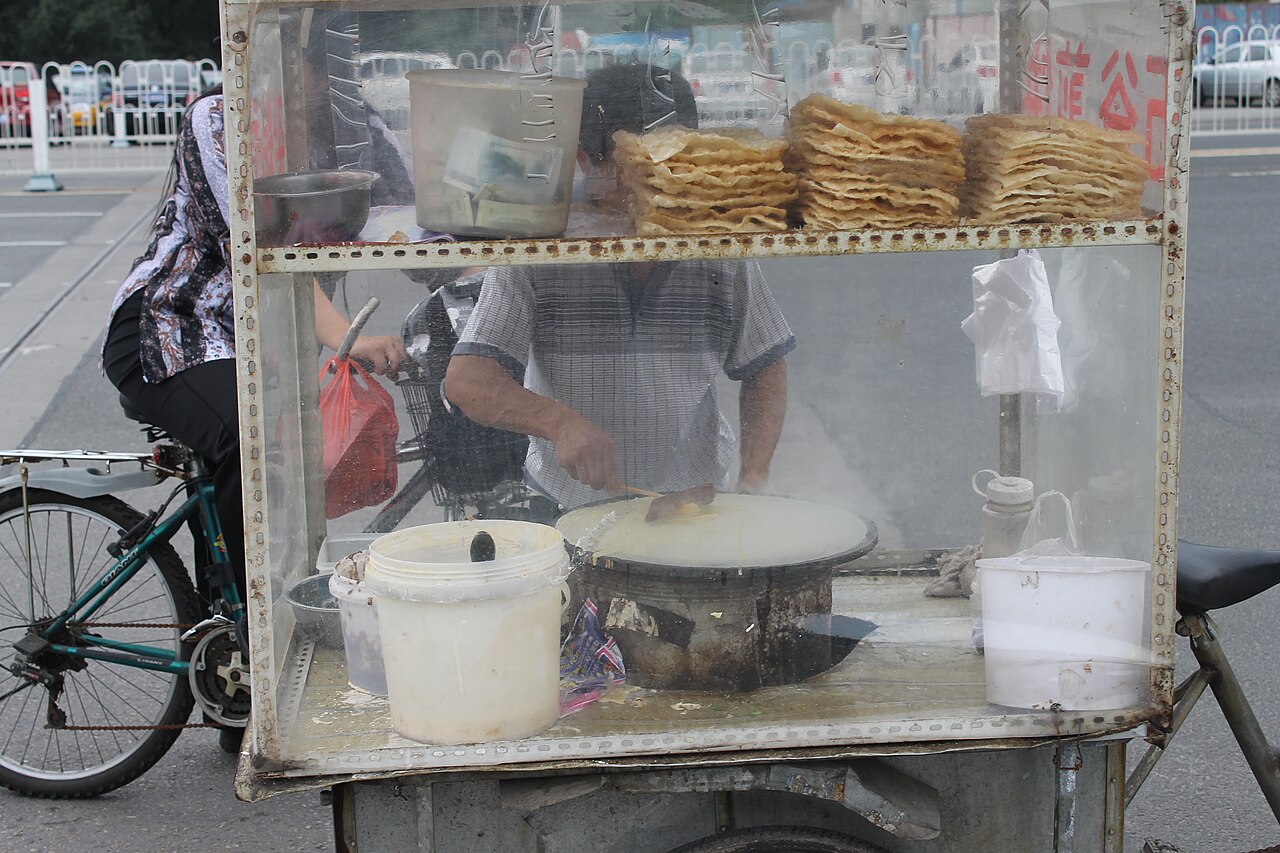
A street cart making jianbing (煎饼) for Beijing breakfast — a thin crepe spread with egg, with youtiao fried dough sticks stacked behind 7
Breakfast the Local Way
Breakfast Lanes — Eat Like an Early-Rising Beijinger
Jianbing carts · hutong lanes · near Nanluoguxiang / Gulou / Fangzhuanchang

If you want to eat the way Beijingers actually do, get up a little early and look for a jianbing cart (煎饼) at the mouth of a lane — a thin crepe spread with egg, brushed with bean sauce, scattered with herbs and spring onion, folded around a crisp cracker and handed over hot, all for ¥6-12 (~฿30-60). This is the breakfast locals grab on the way to work.

The usual morning companions: doujiang (豆浆), warm soy milk, and youtiao (油条), fried dough sticks. If you'd rather sit down, the lanes around Gulou (鼓楼) and Fangzhuanchang (方砖厂) still hide old noodle and breakfast houses, an easy walk from Nanluoguxiang.

Metro: Line 8, Shichahai / Gulou Dajie, then into the lanes
Cost: ¥6-25 (~฿30-125) per person, comfortably full
Best time: 7-9:30 am — carts are a morning thing
Payment: WeChat Pay / Alipay (small stalls sometimes cash)
Note: Street carts aren't in a fixed spot every single day — some mornings they're there, some they've moved — but the hutongs around Gulou and Nanluoguxiang usually have a few on weekday mornings. Want a sure thing? There are also sit-down jianbing shops with proper storefronts in this area.
Know Before You Go

A few things that keep you from getting lost

📱
Set up WeChat Pay before you leave the hotel
Since 2023 foreign visitors can link a Visa/Mastercard directly to WeChat Pay or Alipay. Do it before you head out — plenty of small hutong stalls don't take cards at all.
🦂
Scorpions are for photos, not eating
The novelty skewers at Wangfujing exist to draw tourists; locals don't eat them. For the genuine article, head to Huguosi or Niujie instead.
🌙
Late-night = Ghost Street
Hungry at midnight? On Ghost Street (Gui Jie) many places open 24h, with spicy crayfish and hotpot running till 2-4 am. It's the one strip that's genuinely alive in the small hours.
🗣
English menus are rare
Most hutong stalls have Chinese-only menus. Use your phone's translation camera on the menu, or just point at a photo — it works surprisingly well.
🕐
Weekdays beat weekends
Famous spots like Huda, Ju Bao Yuan and Wenyu get long queues on weekends. Go on a weekday, or dodge the lunch and early-evening peaks, and you'll wait far less.
🥢
Douzhir — try it once
The sour fermented mung-bean drink at Huguosi is a true Beijing-local taste. Visitors usually grimace, but it's one of the most authentically local flavours in the city. Give it a go.
Frequently Asked

Questions people ask before they eat

Which Beijing food streets do locals actually eat at, not just tourists?
Locals genuinely eat at Gui Jie (Ghost Street) for late-night spicy crayfish and hotpot, Huguosi for traditional old-Beijing snacks, and Niujie for Hui Muslim halal food. Wangfujing Snack Street — the one with scorpions and starfish on sticks — is almost purely a tourist photo stop that locals avoid. Nanluoguxiang is fun for a hutong stroll, but its snacks lean trendy and overpriced compared to Huguosi or Niujie.
How late is Gui Jie / Ghost Street open and what do you eat there?
Ghost Street (Gui Jie) runs about 1.5 km through Dongzhimen, and many restaurants stay open 24 hours. It peaks from roughly 8 pm until 2-4 am. The signature dish is málà spicy crayfish (麻辣小龙虾); the most famous restaurant is Huda (胡大), which has several branches along the street. You'll also find hotpot, grilled fish and spicy snails. Budget around ¥150-350 (about ฿750-1,750) for two people. Take Subway Line 2 or 5 to Dongzhimen, then walk 10-15 minutes.
Is Wangfujing Snack Street (the scorpions one) worth visiting?
Honestly, it's a one-time spectacle, not a place to eat well. Wangfujing Snack Street has become a photo stop where vendors display scorpions, starfish and centipedes on skewers for tourists, at heavily inflated prices, and Beijing locals rarely touch any of it. If you want genuine Beijing snacks, go to Huguosi instead. If you want a serious late-night feed, go to Ghost Street.
Where do you eat real old-Beijing snacks?
Head to Huguosi Snack Street and the Huguosi Snacks counter (护国寺小吃). Try aiwowo (艾窝窝, white glutinous rice balls), lǘdǎgǔnr (驴打滚, soybean-flour rolls, literally "donkey rolling"), wandouhuang (豌豆黄, sweet pea-flour cake) and miancha (面茶, millet porridge with sesame paste). Snacks cost a few yuan each; about ¥50-100 (around ฿250-500) per person lets you sample widely. Take Subway Line 4 or 6 to Ping'anli, Exit B.
Do I need cash in Beijing, or do WeChat Pay and Alipay work?
Most vendors accept WeChat Pay and Alipay first. Since 2023, foreign visitors can link a Visa or Mastercard to both apps — set this up and test it before leaving your hotel. Cash RMB still works everywhere as a fallback, but some small stall holders in the hutongs are cash-only, so keep small notes handy.
What do you eat at Niujie halal food street and how do you get there?
Niujie is Beijing's largest Hui Muslim quarter, with restaurants clearly marked 清真 (halal) the length of the street. The highlights are charcoal-grilled lamb skewers, copper-pot lamb hotpot (涮羊肉) and Niujie sweets like lǘdǎgǔnr and qiegao. The famous lamb-hotpot spot is Ju Bao Yuan (聚宝源) at 5 Niujie Street, around ¥120-140 (about ฿600-700) per person. Take Subway Line 4 to Niujie Station and walk a few minutes; the grills are busiest after 5 pm.
Klook

Beijing Food Walking Tours
with a local guide who knows the back lanes

Skip the dead ends and the tourist bait. Local food tours wind through the old hutongs — traditional Beijing snacks, Niujie's grilled lamb, Ghost Street crayfish — with someone who knows which places are the real thing and which are just for show. From around ¥200-400 per person.

Browse Beijing Food Tours on Klook →
Wherebest is a Klook affiliate partner — we may earn a commission when you book through our links, at no extra cost to you.