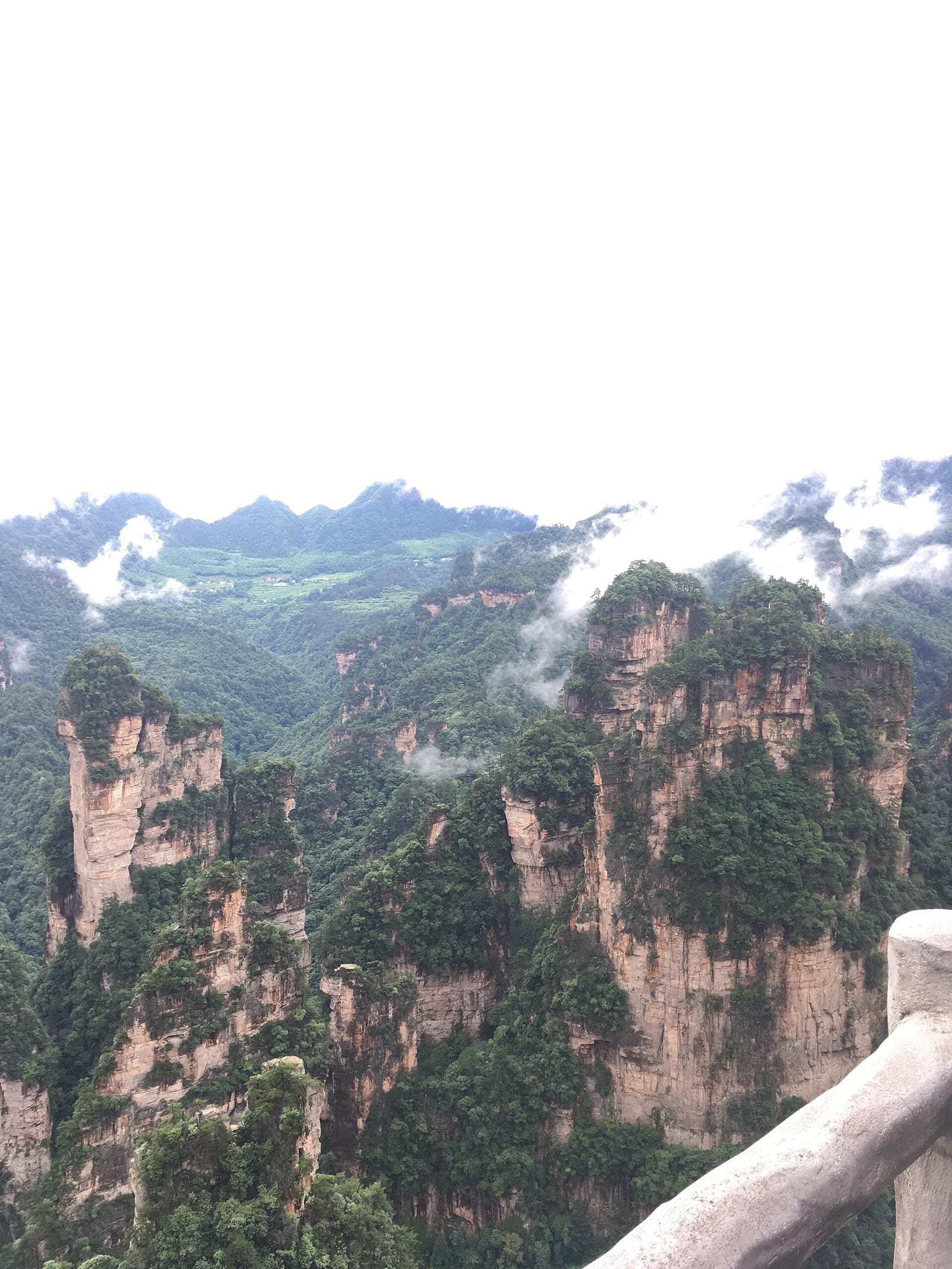
An enormous limestone cave on the eastern edge of Wulingyuan, with chambers as tall as buildings, forests of stalactites, and an underground river you actually float along by boat. The highlight is the "Dinghai Needle", a 19.2-metre stalagmite insured for 100 million yuan — and it's the best rainy-day, hot-day backup in Zhangjiajie.
Picture this: you've spent the whole day craning your neck up at the sandstone pillars of Wulingyuan, and then you duck into a cave mouth and drop down beneath the very mountain you just climbed. The air cools at once, the noise falls away, and in front of you is a chamber with a ceiling lost in the dark, a forest of stalactites and stalagmites running off as far as you can see, and — unlike any cave you've been in before — an underground river running through it that you actually float along by boat, in the dim, hidden under the range.
This is Yellow Dragon Cave (黄龙洞 Huanglong Dong), a giant limestone cave often called one of the biggest show-caves in China, on the eastern side of the Wulingyuan Scenic Area, just a 20-minute drive from Wulingyuan itself and the Grand Canyon. Inside, it spreads over four levels of wide chambers, countless stalactites and stalagmites, underground rivers, lakes and waterfalls, with several kilometres of walkway in total.
Two things get talked about most. The first is the boat ride along the underground river, about 800 metres of the route done on the water. The second is a stalagmite called the "Dinghai Needle" (定海神针), around 19.2 metres tall but so pinched in the middle that it narrows to just about 10 centimetres across — fragile enough that the cave insured it for 100 million yuan. Yellow Dragon Cave ends up being both a feat of natural scale and an indoor sight that doesn't depend on the weather at all.
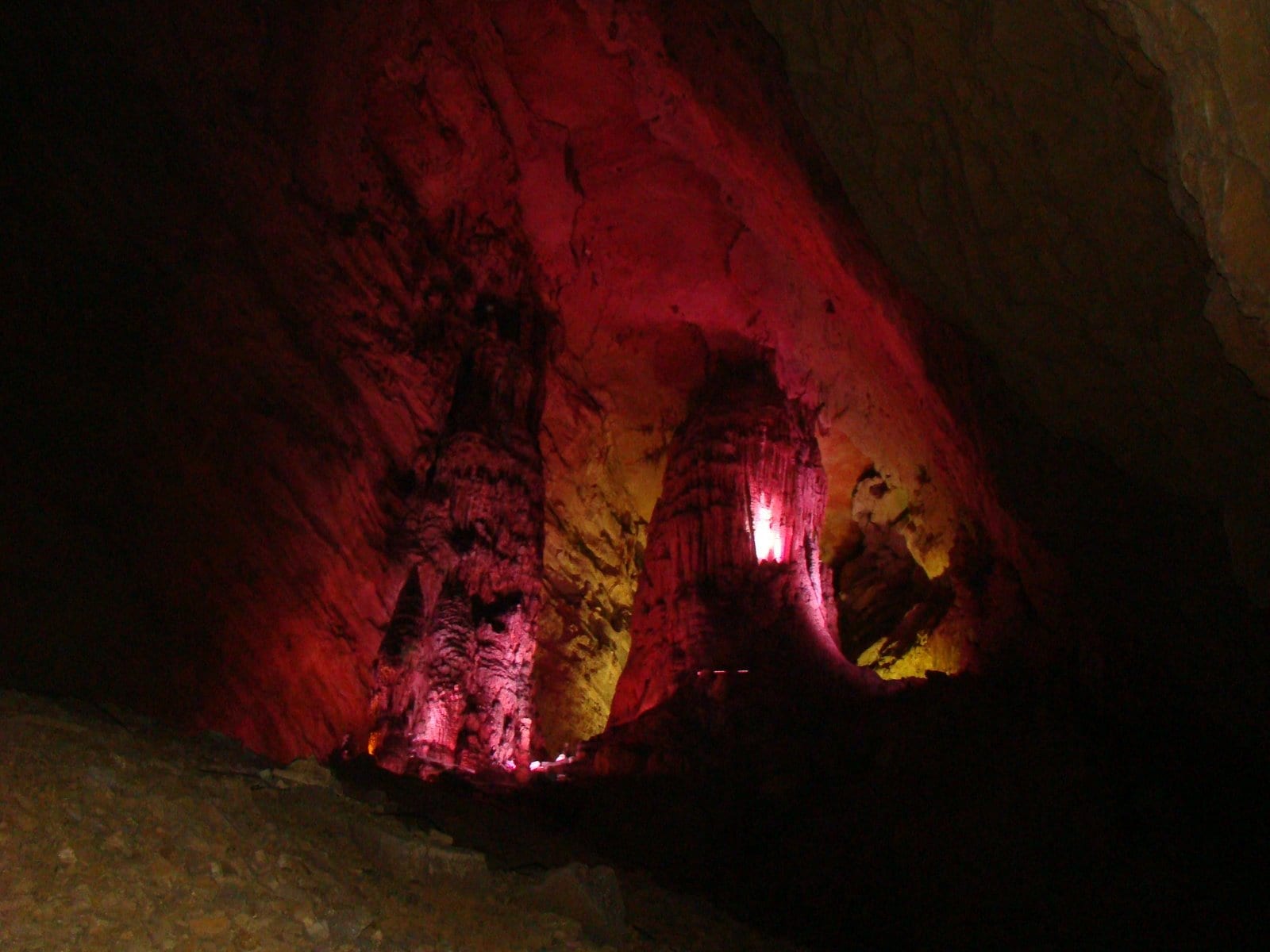
The route is a single loop along raised walkways, passing chambers, pillar forests and the boat stretch one after another — easy walking, but with steps up and down here and there.
Step inside and you meet vast chambers with ceilings lost in the dark and a forest of oddly shaped stalactites and stalagmites, many named for what they resemble — a dragon, a pagoda, a frozen waterfall. The cave runs over four levels, and you climb up and down walkways past rock built drip by drip over hundreds of thousands of years. This is a stretch to take slowly rather than rush.
The part everyone waits for is boarding a boat and floating about 800 metres along a river running under the mountain, a ride of roughly 8 minutes. The water is clear and still, mirroring the rock overhead, and the air is hushed, cool and damp. This is what sets Yellow Dragon Cave apart from an ordinary cave — you glide through it rather than only walking. The boat is included in the ticket, with nothing extra to pay.
This is where people stop to photograph the most. The tallest stalagmite in the cave stands around 19.2 metres high, with an unusual shape — thick at top and bottom but pinched in the middle, down to just about 10 centimetres across at its thinnest point. It is thought to have taken at least 200,000 years to form, and it still grows a fraction taller each year. Because it is so fragile and irreplaceable, the cave took out insurance on it for 100 million yuan in 1998. Its name comes from the Monkey King's magic staff in Journey to the West.
Beyond the chambers and the river, the cave also holds still lakes and small waterfalls spilling down the rock, lit up so you can see the layers of stone running deep below. These are scattered across the different levels, so by the end of the loop you feel like you've passed through several kinds of underground landscape rather than one single cave — which is exactly why it's worth setting aside a full two hours.
The selling point a lot of people don't think of is that Yellow Dragon Cave is indoors and the temperature inside stays cool and steady all year. On a day when rain and mist hide the Wulingyuan peaks so there's no view to be had, or one when it's too hot to face a hike, going underground is just as enjoyable — the scenery is below ground and doesn't depend on the sky. That's why many people keep this cave in their back pocket for the day the weather turns.
It is noticeably damper and cooler inside than out, so even on a hot day a light long-sleeved layer is handy, especially during the boat stretch where the air is cooler still than on the walk.
Because the cave is underground, it's comfortable to visit in any season — but the time that pairs best with a full day hiking Wulingyuan is April to October, when the air is warm and the forest is green. Winter works too; in fact it's warmer inside the cave than out.
On crowds — this is a popular tour stop, and early mornings and weekdays are quieter, with shorter waits for the boat. The times to avoid are the Chinese public holidays, especially Golden Week in early October, National Day on 1 October, Labour Day on 1 May, and the week of Chinese New Year, when the boat queue stretches out and you wait a long time.
The visit follows a set raised walkway, a single loop in and out, passing chambers, pillar forests, the boat stretch and the various viewpoints in turn. A guide usually names the rock formations along the way (mostly in Chinese). If you want to go slowly and take your time on photos, let the big tour group move ahead and follow behind — you'll get more space to yourself.
Because the cave has four levels, the walkway has steps up and down at intervals, and parts of the path are slippery from the damp, so comfortable, non-slip shoes are your best bet. If your knees are tired after a full day of hiking, take it slowly — there's no need to rush.
The cave is on the eastern side of the Wulingyuan Scenic Area. Zhangjiajie has no metro, so getting there means a public bus, a taxi, a DiDi or a tour.
Yellow Dragon Cave is in the Wulingyuan area, so staying around Wulingyuan town makes it easiest to reach the cave, Baofeng Lake and the National Forest Park gates.