Home Xi'an China Xi'an Hotels About
Home  ›  China  ›  Xi'an  ›  Day Trips  ›  Mount Hua
🇨🇳 Xi'an · Day Trip

Mount Hua (华山)
A sacred mountain, sheer granite, and the most heart-stopping walk in China

One of China's Five Great Mountains, just 30 minutes by bullet train from Xi'an — near-vertical granite peaks, cable cars floating over deep ravines, and the 长空栈道 plank walk clinging to a cliff more than 650 metres up.

What it is

Why Mount Hua is the best day trip out of Xi'an

Picture this: you board a train at Xi'an North in the morning, and barely half an hour later the window switches from city blocks to a wall of grey granite rising abruptly out of the plain. That is Mount Hua (华山) — the mountain the Chinese revere as 西岳, the "Western Sacred Mountain," one of the Five Great Mountains of China, where Taoist hermits have climbed up to meditate for the better part of two thousand years.

Hua is not a gentle, gradually rising hill. It is a cluster of near-vertical granite peaks — five main summits arranged, the story goes, like the petals of a flower (the character 华 once meant blossom). What draws people from all over the world is the 长空栈道 (Plank Walk in the Sky): a path made of nothing but wooden boards bolted onto the sheer east face of the South Peak, more than 650 metres above the ground below, regularly listed among the most frightening walks anywhere. In reality, everyone is clipped into a safety harness for the entire traverse.

The reason Mount Hua works so well as a day trip is simple: the bullet train from Xi'an takes only 30 minutes, and cable cars carry you almost to the summits. You do not need to be a mountaineer to stand among peak-level views — and if you have a spare day in Xi'an and the urge to get out of the city, this is better value than you would expect.
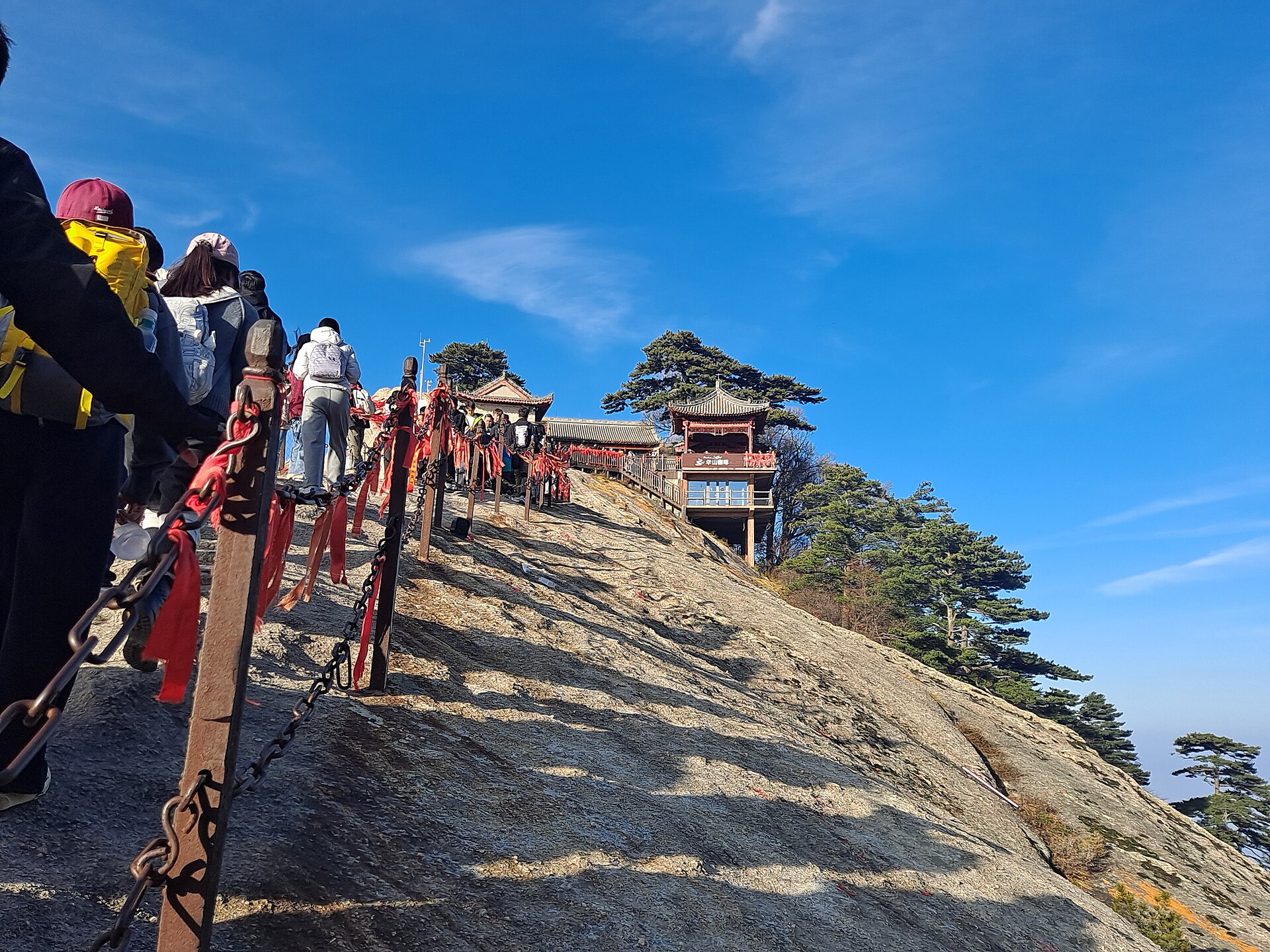
Mount Hua — a steep granite ridge with a chained, red-ribbon-lined path leading up to a Taoist summit pavilion under a clear sky
A ridge on Mount Hua — the path is lined with safety chains and red prayer ribbons, with a Taoist pavilion at the top
🚄
From Xi'an
~30-min train
Xi'an North → Huashan North · ¥54.5+
🎫
Park entry
~¥160 / ¥100
High season Mar–Nov / winter Dec–Feb
🚠
Cable cars
North ¥80 · West ¥140
One-way, high season (return is cheaper)
⛰️
Peaks
5 summits
North · East · South (highest, 2,154 m) · West · Central
🪵
Plank walk 长空栈道
~¥30 (harness)
South Peak · harness-secured · book ahead
⏱️
Time on the mountain
5–7 hours
Doable in a day if you start early, or stay for sunrise
Peak by peak

The five peaks of Mount Hua — which to climb, which to skip

Each summit has its own character; pick what fits your time and your legs.

The most popular route: ride the West Peak cable car up (the best views), loop the South Peak (step onto the plank walk if you dare), then the Central and East peaks, and take the North Peak cable car down. That covers every summit without backtracking, in about 5–7 hours on the mountain.
What to do here

The plank walk, the cable cars and the soldier's path

🪵 The Plank Walk in the Sky (长空栈道)

This is the headline act of Mount Hua — a path of wooden boards and iron foot-pegs bolted onto the vertical east face of the South Peak, more than 650 metres above the ground below. But to be clear, it does not leave you walking empty-handed: everyone wears a safety harness clipped to a steel cable for the entire traverse (a via ferrata system) that cannot be removed along the way. Miss your footing and you hang from the cable. The harness costs about ¥30, and the route is out-and-back along the same planks.

Because the path is narrow and people cannot pass each other, numbers per session are capped, and queues can run 1–3 hours in high season. Book ahead if you can (the park opens bookings through its official WeChat account at 06:30). Requirements: age 15–55, minimum height 150 cm, a minimum of two people, and not suitable for anyone with heart conditions, high blood pressure or a fear of heights. Details and booking slots can change by season, so check before you go.

No shame in skipping it: the plank walk is an optional add-on, not a path you have to cross. You can walk the South Peak and all the other summits without ever stepping onto the planks — the ridge views are spectacular on their own.

🚠 The cable cars — North Peak vs West Peak

Mount Hua has two cable cars; choose by your walking plan. The North Peak cable car is about ¥80 one-way (¥150 return) — the older, shorter line, arriving at the lowest summit, good if you want to walk the ridge up yourself. The West Peak (Xiyue) cable car is about ¥140 one-way (¥280 return) — one of the longest cable cars in Asia, floating across a deep ravine to near the high summit, with a far more dramatic ride.

Before you reach either cable-car station, you first take an in-park bus from the tourist centre — ¥20 one-way to the North Peak station, ¥40 one-way to the West Peak station, charged separately from the cable car itself. The favourite formula is to ride the West Peak cable car up and the North Peak cable car down, looping every summit without doubling back.

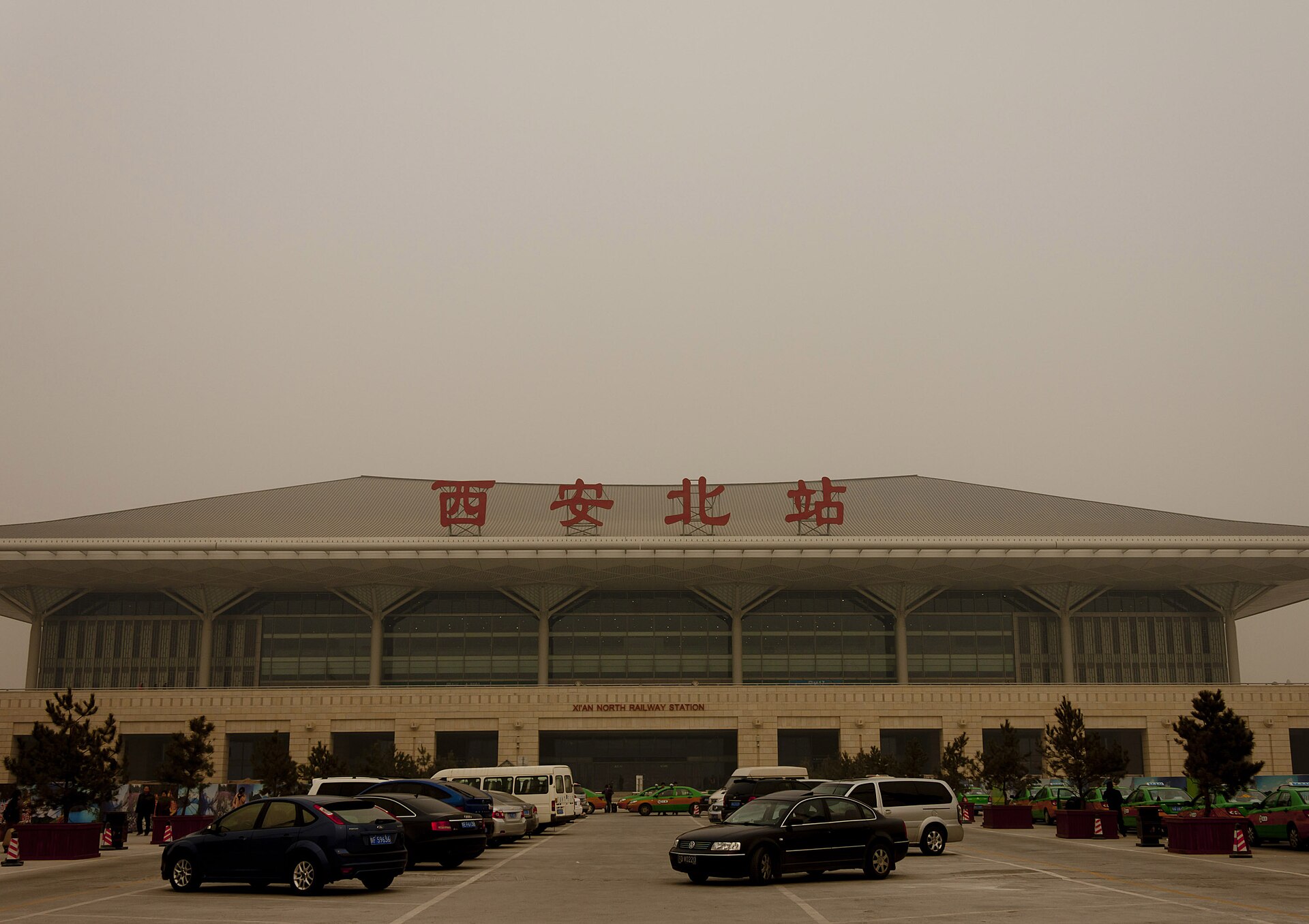
Xi'an North Railway Station (西安北站), where the high-speed train to Mount Hua departs
Xi'an North station (西安北) — where the high-speed train to Huashan North departs, about a 30-minute ride

🥾 The soldier's path, for those who want to climb

If you would rather walk up than ride, the classic route starts at Yuquan Temple at the foot of the mountain and climbs to the North Peak — about 6 km of relentless stone stairs, taking 4–6 hours depending on your fitness. Some people climb through the night to reach the East Peak for sunrise (there are drink stalls and intermittent lighting along the way). This is the famous soldier's path, notorious for its steepness — sections like the "Thousand-Foot Precipice" and the "Dragon Gorge" are almost sheer.

For most visitors doing this in a single day, taking the cable car up and down is by far the better use of your time — save your energy for looping the summits and stepping onto the plank walk.

Getting there

How to reach Mount Hua from Xi'an

Mount Hua is not on the city metro — you take an intercity train. The fastest and easiest option by far is the high-speed train.

🚄
High-speed train (recommended)
Xi'an North → Huashan North
~28–35 min · 2nd-class ~¥54.5–56 (~฿275) · ~70 departures/day from 07:16 · book on Trip.com
🚌
Free shuttle bus
Huashan North → tourist centre
Free shuttle ~30 min (every 30 min) or a free taxi for every four passengers (~10 min, show your train ticket)
🚞
Slow train (budget)
Xi'an station → Huashan
~1.5–2 hours · ticket ~¥20–40 · cheaper but much slower
The journey, step by step: train from Xi'an North to Huashan North (~30 min) → free bus or taxi to the tourist centre → buy your park ticket → in-park bus (¥20/¥40) to the cable-car station → cable car up. Allow about 2–2.5 hours from Xi'an to the summit. Leaving early gives you a full day on the mountain.
Plan before you go

Day trip, overnight and the best time to come

☀️ Day trip or overnight — both work

Mount Hua is comfortably done in a day if you leave Xi'an very early (the first train is around 07:16): cable car up, loop the summits, head back in the evening. But to catch sunrise from the East Peak — the image Mount Hua is famous for — you need to stay overnight on the mountain. There is basic accommodation near the summit (pricier than in the city, with limited facilities, so check and book ahead), or you can hike up overnight via the soldier's path to reach first light.

🍂 The best time to come

The best weather is in spring (April–June) and autumn (September–October) — clear skies, comfortable temperatures, and good autumn colour. Summer is lush green but afternoons often bring rain and mist. Winter (December–February) coats the cliffs in snow and is beautiful, with cheaper entry of around ¥100, but it is bitterly cold, slippery, and some routes or cable cars may close temporarily — always check the weather and route status before you set out.

Whatever the season, the summits are much colder than the base. Bring a windproof and warm layer, wear trainers or grippy walking shoes (no high heels), and carry water — food on the mountain is more expensive than usual.

Avoiding the crowds: steer clear of China's long holidays, especially Golden Week (National Day, 1–7 October) and Chinese New Year, when cable-car and plank-walk queues get very long. If you cannot avoid them, go on a weekday and take the first cable car of the day.
More to see / where to stay

Pair Mount Hua with Xi'an's sights and hotels

Mount Hua is a day trip — basing yourself in the city of Xi'an is the most convenient option.

Frequently asked

FAQ · Mount Hua before you go

How do you get to Mount Hua from Xi'an, and how long does it take?
The fastest way is the high-speed train from Xi'an North station (西安北) to Huashan North station (华山北), about 28–35 minutes. A second-class seat costs roughly ¥54.5–56 (~฿275), with around 70 departures a day from 07:16; you can book ahead on Trip.com. At Huashan North there is a free shuttle bus (~30 minutes) or a free taxi (every four passengers, on showing your train ticket) to the tourist centre, then an in-park bus to the cable-car stations. Allow about 1.5–2 hours from Xi'an to the foot of the cable car.
How much are Mount Hua entry tickets and cable cars?
Park entry is about ¥160 in high season (March–November) and ¥100 in low season (December–February). The in-park bus is ¥20 one-way to the North Peak cable car and ¥40 one-way to the West Peak cable car. The North Peak cable car is ¥80 one-way (¥150 return); the West Peak (Xiyue) cable car is ¥140 one-way (¥280 return). Cable-car prices are lower in winter. All prices can change by season, so check before you go.
Is the plank walk in the sky (长空栈道) dangerous, and do you need to book?
The 长空栈道 plank walk is on the east face of the South Peak, more than 650 metres above the ground below — but everyone wears a safety harness clipped to a steel cable for the whole traverse (a via ferrata system) that cannot be removed on the way. The harness costs about ¥30 and the route is out-and-back on the same planks. Numbers per session are capped, so book ahead (via the park's official WeChat account, bookings open 06:30). Requirements: age 15–55, minimum height 150 cm, a minimum of two people, and it is not suitable for anyone with heart conditions, high blood pressure or a fear of heights. Details can change — check before you go.
Should you visit Mount Hua as a day trip or stay overnight?
Mount Hua works comfortably as a day trip if you leave Xi'an very early (the first train is around 07:16): take a cable car up the North or West Peak, walk the peak circuit, and head back in the evening — about 5–7 hours on the mountain. To catch sunrise from the East Peak you need to stay overnight on the mountain (there is basic accommodation near the summit) or hike up overnight via the soldier's path. The best seasons are spring and autumn, when skies are clear; winter is beautiful but very cold and some routes may close, so check the weather first.
How many peaks does Mount Hua have, and how do they differ?
Mount Hua has five main peaks: the North Peak (北峰, the lowest, where the North Peak cable car arrives and the soldier's path begins); the West Peak (西峰, lotus-petal shaped, reached directly by the Xiyue cable car and the best for photos); the South Peak (南峰, the highest at 2,154 m, home of the plank walk in the sky); the East Peak (东峰, the sunrise viewpoint); and the Central Peak (中峰). The most popular route is to ride the West Peak cable car up, loop the South, East and Central peaks, then take the North Peak cable car down.
Klook · Mount Hua tours & tickets

Mount Hua day tours from Xi'an — transfers, entry and cable car included

Choose a guided round-trip day tour, or buy your park entry and cable-car tickets in advance and skip the on-site ticket queue — handy for travellers without WeChat Pay. Book through Klook before you go.

Browse Mount Hua tours on Klook →
Wherebest is an affiliate partner of Klook — we may earn a commission when you book through our links, at no extra cost to you.