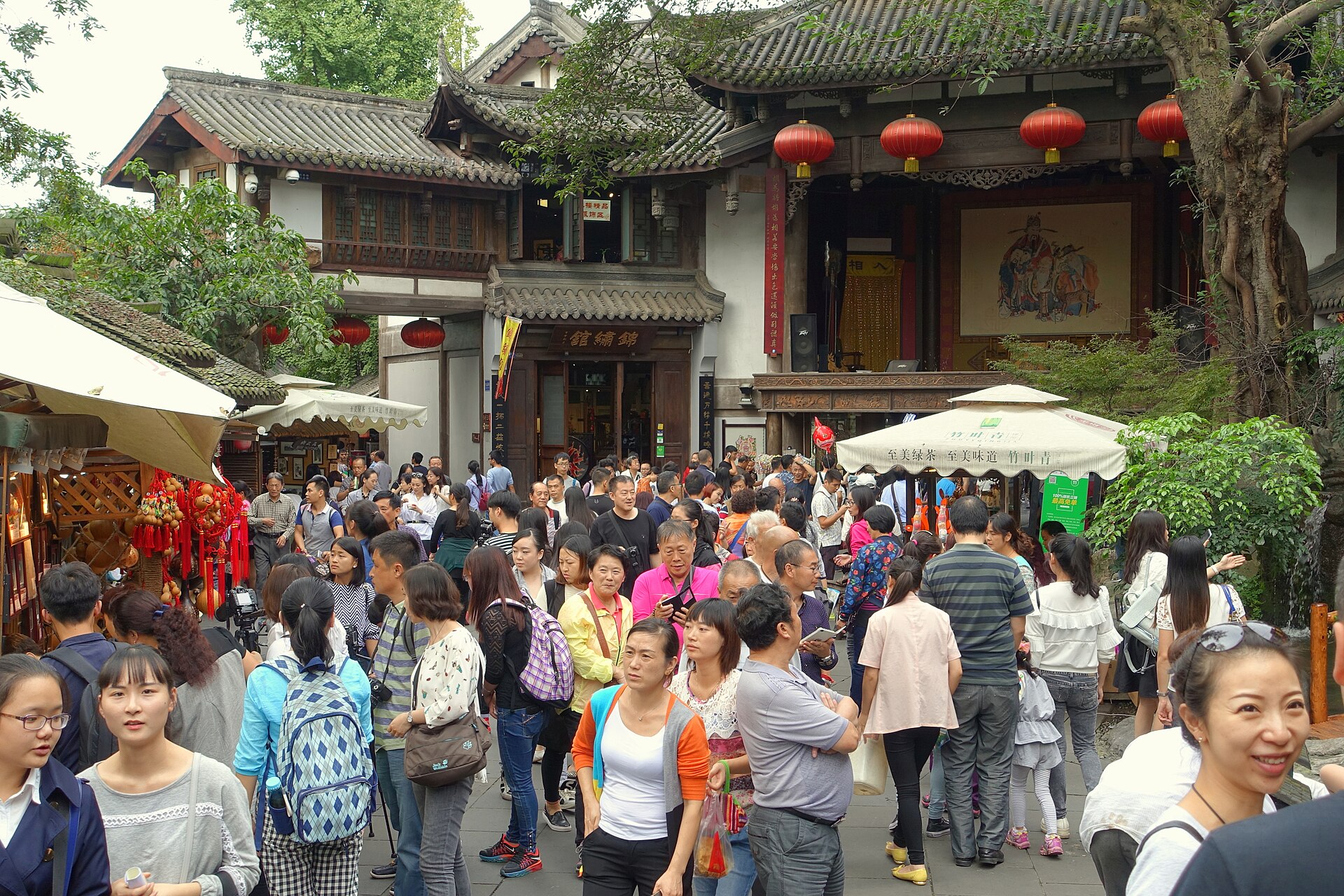
China's largest Three Kingdoms memorial temple — the shrine to the strategist Zhuge Liang, Emperor Liu Bei and his tomb, set in a green walled garden in central Chengdu, right beside Jinli Ancient Street.
If you grew up with the story of the Three Kingdoms — through the novel, the comics, or the video games — standing in front of the actual shrine to Zhuge Liang lands differently than any page ever could. You pass through a red timber gate, ancient trees close over the path, the noise of the street drops away, and then you reach the hall: a seated statue of Zhuge Liang in his minister's robes, holding the feather fan, exactly as everyone pictures him.
Wuhou Shrine (武侯祠) is the largest and most influential Three Kingdoms (三国) memorial temple in China. It was built to honour Zhuge Liang (诸葛亮) — the chancellor and master strategist of the Shu Han kingdom, revered across Chinese culture as the embodiment of intelligence and loyalty. The name "Wuhou" (武侯) comes from Zhuge Liang's noble title, Marquis Wu.
What makes the site unusual is that it is not only Zhuge Liang's shrine. The same walled complex incorporates the Han Zhaolie Temple (汉昭烈庙) dedicated to Liu Bei (刘备), founding emperor of Shu, and Liu Bei's tomb (惠陵 Huiling), more than 1,700 years old. That makes it the only place in China where a ruler and his minister are honoured within a single temple — a reflection of the bond between Liu Bei and Zhuge Liang that Chinese culture has retold for over a thousand years.
No prior reading required — knowing these three names makes the whole visit click.
After the Han dynasty collapsed, China fragmented into three rival states: Wei in the north, Shu in the southwest and Wu in the southeast, locked in war for nearly sixty years. The battles, the strategies and the loyalties of this era were later dramatised in the classic novel "Romance of the Three Kingdoms," one of the most widely known stories in East Asia. Chengdu was the capital of Shu — which is exactly why Wuhou Shrine is here.
The strategist Chinese culture holds up as the model of intelligence and faithful service. The enduring image is a man in a scholar-official's robe holding a feather fan, repeatedly turning hopeless situations around with clever schemes. He served Liu Bei to the last day of his life, and it is precisely that loyalty that led later generations to build him a memorial grander than the one for the emperor he served.
The founder of the Shu kingdom and the ruler Zhuge Liang served. The story of the "three visits to the thatched cottage," in which Liu Bei called on Zhuge Liang three times to persuade him to leave his hermit's life and help govern the realm, is a legend of mutual respect retold endlessly in China. Liu Bei's tomb (惠陵) lies within this complex, and the temple honouring him is called the Han Zhaolie Temple, after his posthumous title.
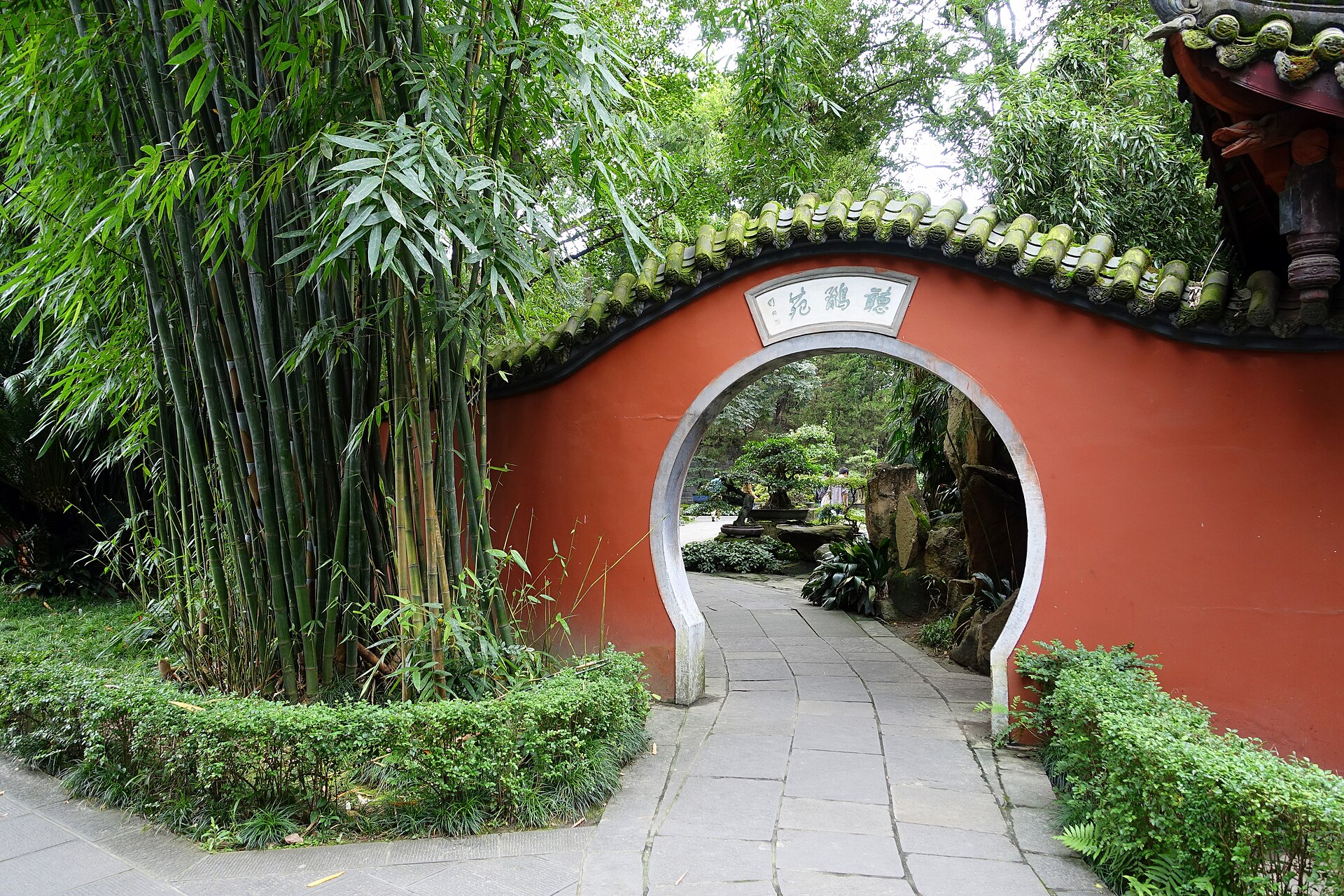
This is the shot everyone comes for — a stone walkway running between a tall vermilion-red wall and a screen of green bamboo, in the Liu Bei tomb section on the western side of the complex. Mid-morning, when sunlight filters through the bamboo and casts soft shadows on the red wall, it is at its best. The Chinese name is "Hongqiang Zhuying," and it is one of the most popular photo spots in all of Chengdu.
On weekends and afternoons people queue to take the picture. For a clear frame, come early after opening, and avoid the Chinese public holidays if you can.
Walking in along the central axis, you reach the Liu Bei Hall (the Han Zhaolie Temple) first, with a statue of Liu Bei and side galleries lined with statues of the ministers and generals of Shu — look for the name plaques of Guan Yu, Zhang Fei and Zhao Yun. Further in is the Zhuge Liang Hall, with the seated statue of the strategist holding his feather fan. Stone tablets and plaques around the halls record the history in detail, including the famous calligraphy steles.
Liu Bei's tomb is a circular earthen mound enclosed by a brick wall and shaded by old trees; you can walk a full loop around it, and it is noticeably quieter than the bustle beyond the walls. The whole of Wuhou Shrine is really a classical Chinese garden — ponds, small pavilions and winding paths — so it is as much a place where Chengdu locals come to stroll and escape the heat as it is a temple.
Wuhou Shrine is in the southwest of central Chengdu, easy to reach by metro or by taxi.
Central neighbourhoods with easy access to Wuhou Shrine, the Panda Base and the shopping streets.