Line 1 runs from Hangzhou East station to the West Lake shore in minutes, bus 7 goes straight to Lingyin Temple (the metro doesn't reach it), and a shared bike for ¥1.5 lets you ride the causeways. China's most romantic city is far easier to navigate than you'd expect.
Hangzhou gives visitors a two-layer gift. The first layer is West Lake itself, which you tour entirely on foot or by bike — no transport needed at all. The second is a 12-line metro with more than 260 stations, one of the largest systems in China, carrying you from Xiaoshan Airport and the high-speed rail stations to your lakeside hotel for ¥2–9 a ride.
Two things to know before you step on. First, every entrance has a bag X-ray security check — not just at rush hour, always — so budget a couple of extra minutes per entry. Second, and this one matters for planning: no metro line reaches Lingyin Temple or the Longjing tea fields directly. You'll need a bus or a DiDi for those, and we cover exactly how below.
This guide pulls together every way to get around Hangzhou: the fast, cheap metro; bus 7, the key to Lingyin Temple; metered taxis and DiDi for when you have luggage; and the shared bikes that let you ride the lake for a few yuan. A little preparation and the trip flows from your first step. Set up Alipay first — details in the Alipay & WeChat Pay guide.
Your first choice for longer hops across the city and to the airport. Clean trains, English signage throughout, and fares of ¥2–9 every ride.
Hours are roughly 06:00–23:00, though this varies by line and terminus — last trains on a few of the longer lines leave earlier, so check the posted timetable if you're heading back late. Fares are distance-based, starting at ¥2 for the first 0–4 km, with most central rides at ¥3–5 and a ¥9 ceiling. A single ticket is valid for 240 minutes.
| Line | Route | Key stops |
|---|---|---|
| Line 1 (the spine) | Xianghu ↔ Linping | Longxiangqiao (West Lake / Hubin) · Hangzhou East (HSR) · Hangzhou City Station · Ding'an Rd |
| Line 7 | City centre ↔ Xiaoshan Airport (HGH) | Wushan Square (near Hefang Street) · Xiaoshan Airport |
| Line 4 | North ↔ south (along the Qiantang River) | Qianjiang New City (riverside CBD) · connects Line 1 at Jiangjin Rd |
| Line 5 | West ↔ east | Western districts · interchanges with Lines 1/2/4 |
| Line 2 | SW ↔ NE | Fengtan Rd · Qianjiang Rd · connects Line 1 at Fengqi Rd |
| Line 19 (express) | Airport ↔ Hangzhou West / Future Sci-Tech City | Express link between the airport and Hangzhou West station, few stops, fast |
Easiest for visitors. Open Alipay, tap Metro or Transport, scan at the gate. No token, no card. Link a foreign card and set this up at home.
Same concept via WeChat City Service. Open WeChat, find Metro, scan at the gate. Works on every line.
Buy from machines inside every station. English menus, takes coins and notes. A good fallback if Alipay isn't set up yet.
The rechargeable Hangzhou Tong card (杭州通) works on metro and buses. Buy and top up at station service windows — handy if you'll ride buses a lot.
Honest summary: Alipay is worth setting up even if the metro were your only reason, because it also handles buses, taxis, DiDi, shared bikes, restaurants, and nearly every shop in the city. Read the step-by-step setup in the Alipay & WeChat Pay guide before you travel.
Key to Lingyin
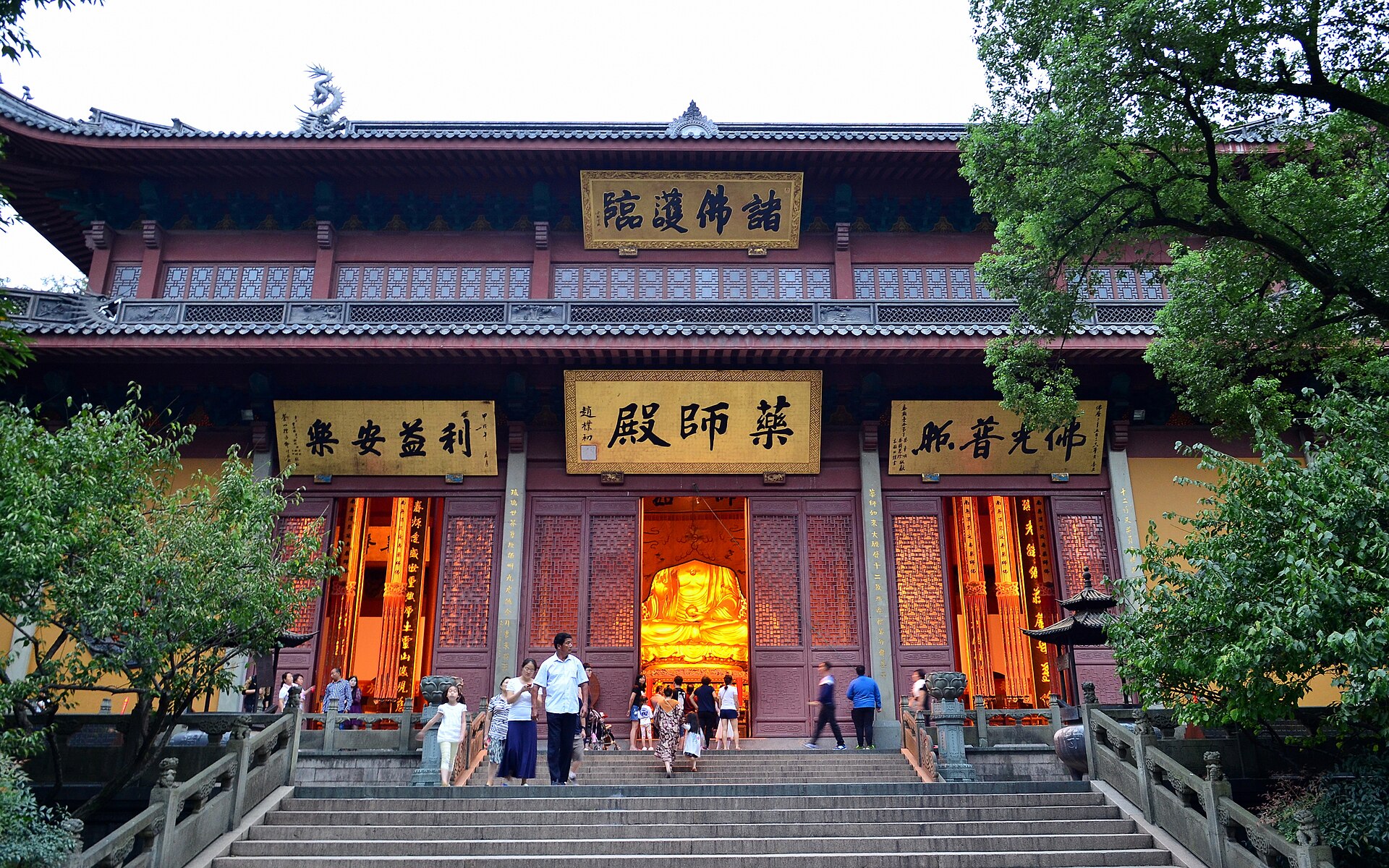
Here's the thing to know first: no metro line reaches Lingyin Temple or the Longjing tea fields. The easiest, cheapest answer is bus 7, which runs from Hangzhou City Station past the lakeshore to the Lingyin stop for just ¥2. Or take Line 1 to Longxiangqiao and transfer to bus 7 there.
Around the lake itself there are also West Lake sightseeing buses (the Y2/Y9 and tourist loop routes) that circle the shore and stop at highlights like Su Causeway and Leifeng Pagoda — useful when you've walked a lot and want to rest your legs.
Hangzhou taxis are metered, with a flag-fall of around ¥13–16 for the first 3 km, then roughly ¥2.3–2.7 per km. DiDi — China's ride-hail app — starts a touch lower at around ¥11 and shows you the fare before you confirm. Its interface is in English, you can type destinations in English, and payment links straight to Alipay.
Tip: street-hailed taxi drivers rarely speak English, so keep your destination in Chinese characters on your phone — or just use DiDi, which removes the need to speak at all. It's the right call when you have luggage, when it's raining, or for the temples and tea fields the metro doesn't reach.
Cycle the lake
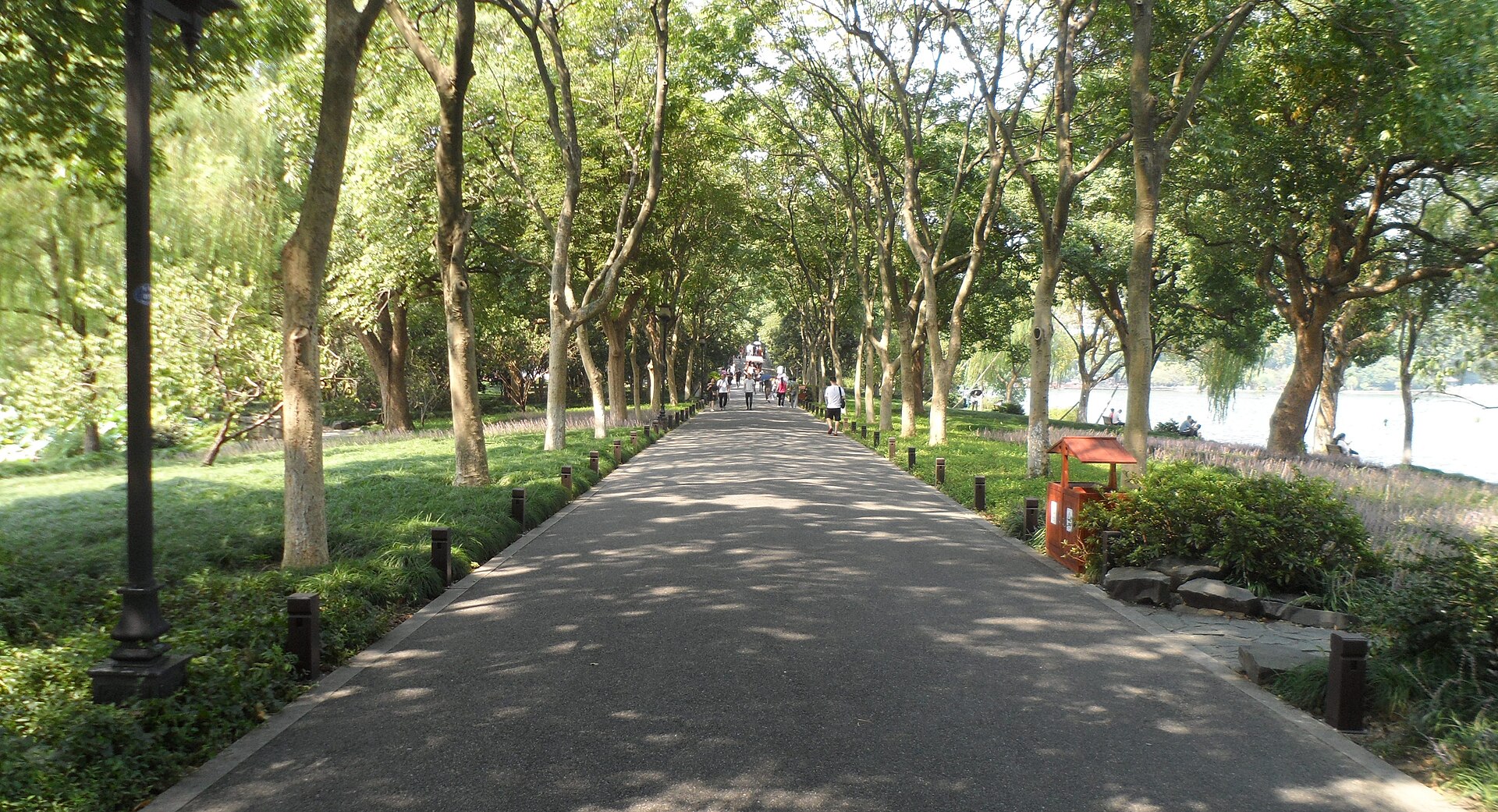
This is how locals tour West Lake. Shared bikes are everywhere in Hangzhou; the main brands are Hellobike and Meituan Bike. Just scan the QR code on the bike through your app — Hellobike is built right into the Alipay menu, so there's no separate download. It costs around ¥1.5–2 per 15–30 minutes.
The routes along Su Causeway and Bai Causeway are flat, breezy and dotted with old stone bridges and lake views — one of the best things you can do in Hangzhou, for the price of a coffee. Read the lakeside walking and cycling routes in the West Lake guide.
On foot
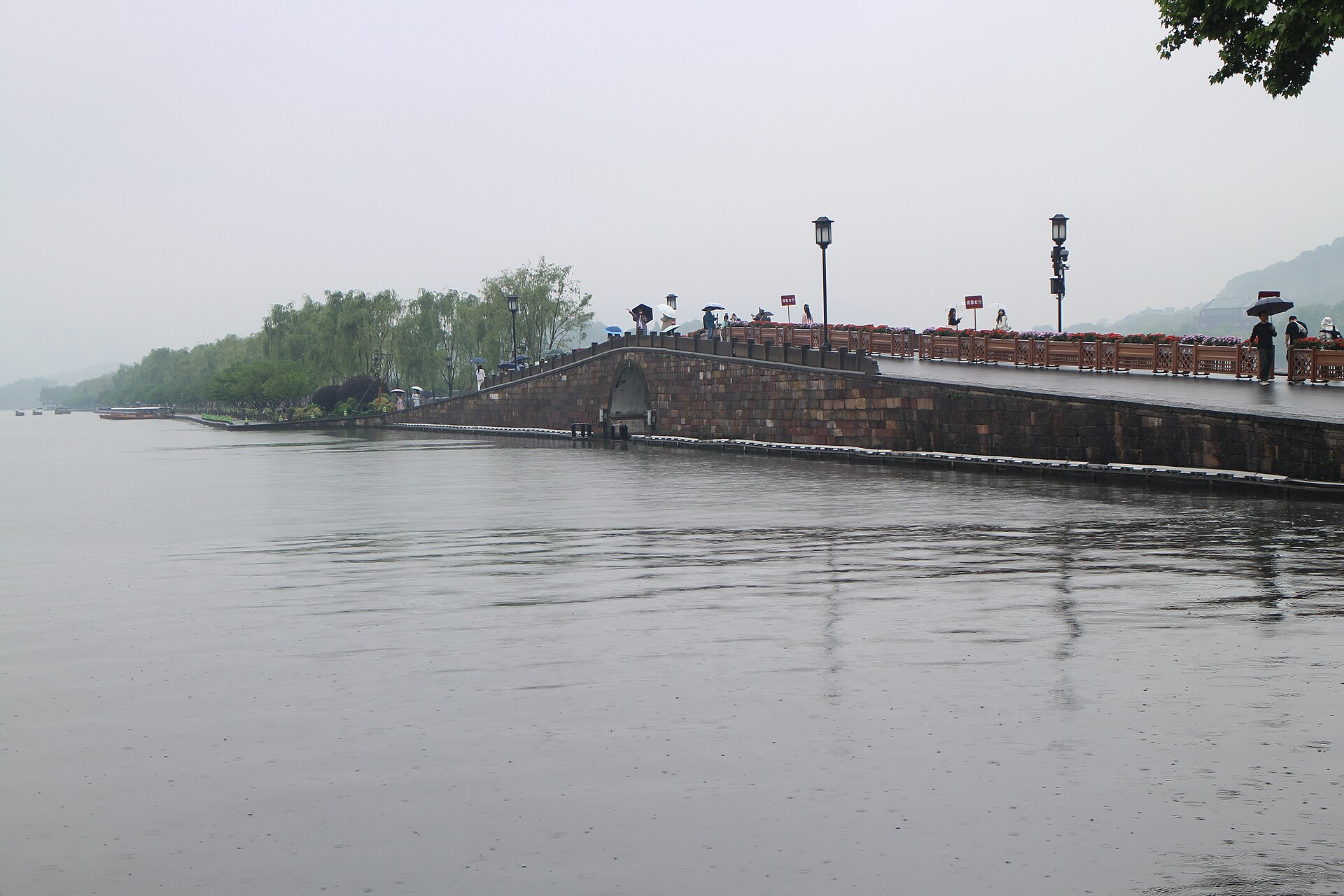
An honest truth: the heart of Hangzhou is best seen on foot. West Lake is ringed by connected promenades, old bridges and gardens. From Longxiangqiao station you can walk to the Broken Bridge, along Bai Causeway and out to the island in the lake comfortably in half a day.
Tip: start from the Hubin (east) shore in the morning, then use a shared bike or sightseeing bus for the stretches when you tire. For the old town, Hefang Street is a walkable district near the lake — ride Line 7 to Wushan Square.
Hangzhou Xiaoshan International Airport (HGH) is about 27 km east of West Lake, and there are several ways in. Metro Lines 7 and 1 now reach the airport — Line 7 takes about an hour from the airport to Wushan Square in the centre for ¥4–8, with a change to Line 1 for the West Lake / Wulin side. Airport Express buses run to the lakeshore and railway stations for ¥20–30 in roughly 60 minutes, and a taxi or DiDi is ¥120–150, around 50 minutes. There's no maglev here.
This matters more than people expect. Google Maps' public transit data for mainland China is unreliable — even with a VPN, route guidance for the metro and buses is frequently wrong or simply absent. Two apps give accurate, real-time transit directions without any workaround:
Amap has accurate, live data for every metro line, bus route, and intercity train in China. You can search destinations in English, and the transit planner gives step-by-step directions down to which exit to use. Download it from the App Store or Play Store before you arrive — no VPN required to use it.
Apple Maps in China uses Amap's data as its backend, which means its transit directions for the Hangzhou metro are accurate. On an iPhone this is the path of least resistance — no extra app, no VPN, and it fits your existing Maps workflow.
If you want LINE, Instagram, Gmail or full Google Maps while in China, you'll need a VPN installed and tested before you fly — most VPN websites are blocked once you're inside the country. See the full breakdown in the China internet, VPN and eSIM guide.
If there is one preparation that makes a difference, it's this: open Alipay, link your Visa or Mastercard through the international mode, and find the Metro and Hellobike features in the app before you leave home. Once you land in Hangzhou you won't be hunting for anything — one app scans you through the metro gate, unlocks a bike, hails a DiDi and pays for dinner.
One more practical note: plan your Lingyin Temple / Longjing tea day carefully, because the metro doesn't reach either — you'll transfer to bus 7 or take a DiDi, so allow travel time and dodge the busy weekends. The lake itself, by contrast, you can walk and cycle freely without touching any vehicle.